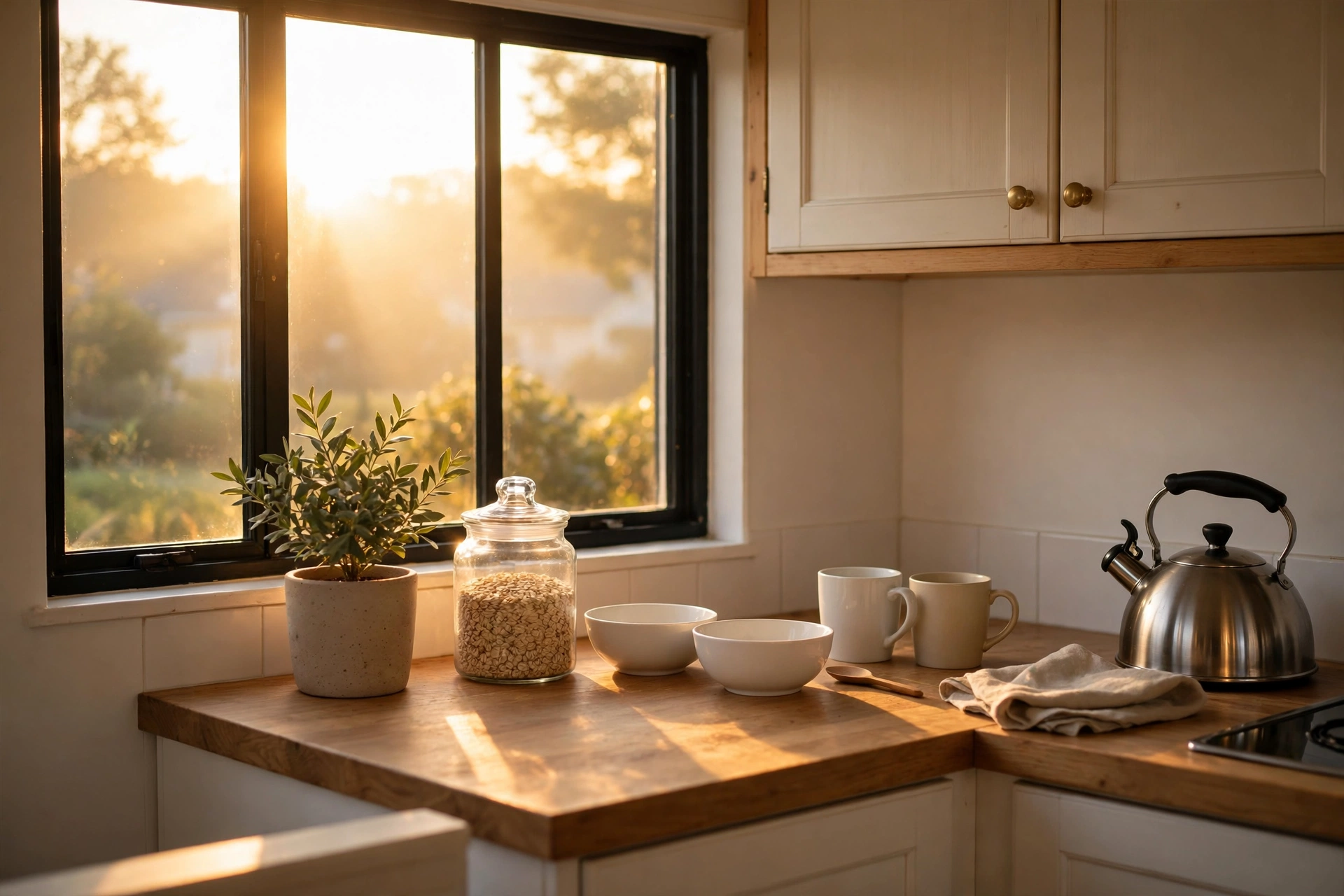
Small kitchen organization busy mornings start the night before, not at the alarm. When breakfast things, lunchboxes, and mugs each have a fixed spot, you stop hunting for them while the kettle boils.
The goal is not a perfect kitchen. It is a kitchen where the first twenty minutes of the day run the same way every time, so your brain can stay half asleep while your hands know what to do next.
This guide gives you a 15-minute evening reset, a breakfast station that runs itself, and a timed morning flow — the three parts of small kitchen organization busy mornings that actually work.
Table of Contents
- Why Mornings Feel Harder in a Small Kitchen
- The Evening Reset: 15 Minutes That Buy a Calm Morning
- A Breakfast Station That Runs Itself
- Small Kitchen Organization Busy Mornings: The 20-Minute Morning Flow
- Sharing a Small Kitchen on Busy Mornings
- The Grab-and-Go Shelf
- The Weekend Top-Up: 30 Minutes That Protect the Week
- Common Mistakes to Avoid
- Frequently Asked Questions
- Conclusion
Why Mornings Feel Harder in a Small Kitchen
A small kitchen is not just short on space — it is short on room for people doing different things at once. One person wants the kettle, another needs the toaster, and a third is packing a lunch, all in a space barely wider than an arm span.
That traffic jam is what makes small kitchen organization busy mornings different from general tidiness. A tidy kitchen can still fail at 7 a.m. if three people need the same counter at the same minute.
The fix is not more storage. It is fewer decisions at the busiest minute of the day, and a layout that lets two people work without bumping elbows — the whole-room starting point in our how to organize a small kitchen guide.
The Evening Reset: 15 Minutes That Buy a Calm Morning
The evening reset is the heart of small kitchen organization busy mornings, and it takes about fifteen minutes after dinner. You are not deep-cleaning — you are setting tomorrow up so the morning has nothing left to decide.
- Pack lunches and put them on one fridge shelf.
- Set out mugs, bowls, and spoons for breakfast.
- Run the dishwasher or wash the few dishes left, so the sink starts empty.
- Wipe the counter and leave only the kettle and the breakfast station in place.
- Put bags by the door with keys and anything else that leaves with you.
Do the reset at the same time each evening, right after dinner, before you sit down. Once it becomes the last kitchen job of the day, it stops feeling like an extra chore — and small kitchen organization busy mornings start to feel calm instead of rushed.
Packed lunches sitting in the fridge overnight are safe when they cool down first and stay chilled, so check the food storage guidance if you are unsure how long a dish keeps.
If dinner runs late, shrink the reset instead of skipping it. Mugs out, lunch in the fridge, sink empty — those three alone save most of the morning scramble.
A Breakfast Station That Runs Itself
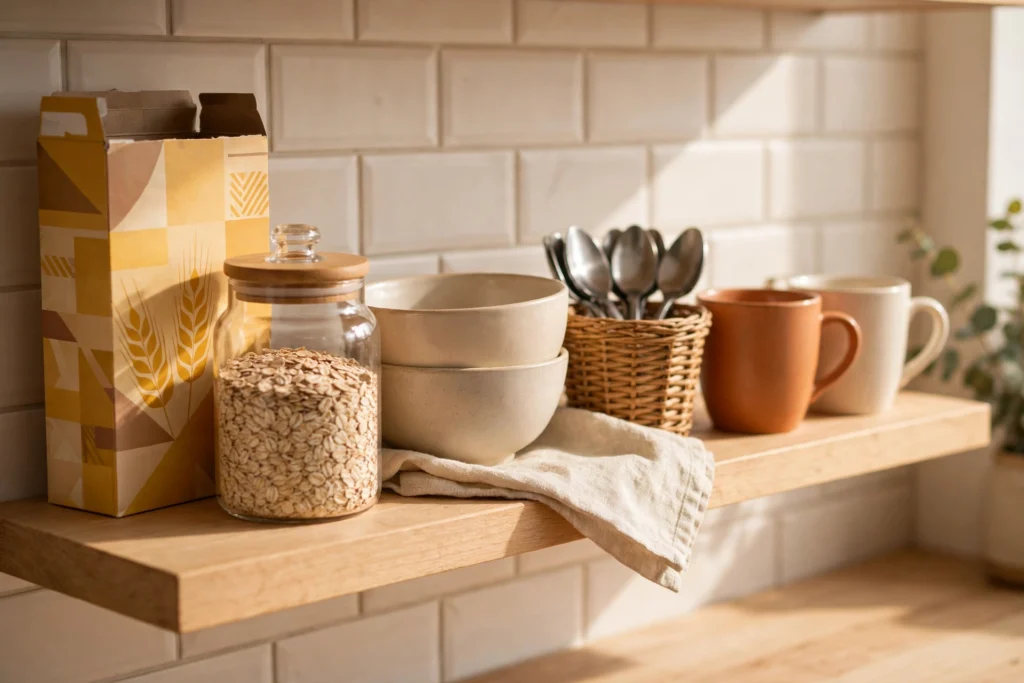
A breakfast station is one fixed spot where everything for the first meal lives together: bowls, spoons, cereal or oats, the kettle, and mugs. You walk to one place, and breakfast is already half made — which is the whole point of small kitchen organization busy mornings.
Pick the spot closest to the kettle and the fridge, so you are not crossing the kitchen with a bowl in each hand. A single shelf, one stretch of counter, or the top of a small cupboard all work — the size matters less than the fact that nothing else moves in.
Keep spoons and small tools in the drawer right below or beside the station, so the reach is short. Our how to organize kitchen drawers guide shows how dividers keep that drawer from turning into a jumble.
Keep one spare box of your usual breakfast staple in the cupboard behind the station. A low jar then never stops the morning, because the refill is already within reach.
If you prep breakfasts ahead, the station is where the finished pots and packs wait each morning. Our how to meal prep breakfasts ahead of time guide covers overnight oats, egg muffins, and other make-ahead options that suit this setup.
Small Kitchen Organization Busy Mornings: The 20-Minute Morning Flow
The morning flow is a fixed order, not a race. Each step starts the next one, so nothing waits for you to decide what comes first. That fixed order is what makes small kitchen organization busy mornings feel unhurried even when the clock is ticking.
- Minutes 0–2: Switch the kettle on and open the fridge.
- Minutes 2–8: Eat or make breakfast at the station while the kettle boils.
- Minutes 8–12: Take the lunch bag from the fridge shelf and put it by the door.
- Minutes 12–16: Load the dishwasher or wash the breakfast dishes.
- Minutes 16–20: Wipe the counter, check keys and bags, and leave.
Starting the kettle first matters because it heats while you do everything else. Small kitchen organization busy mornings work on this kind of overlap — one passive job running while you handle the active ones.
Washing the breakfast dishes before you leave is what keeps the counter clear for the next morning. Our how to meal prep with limited counter space guide uses the same wash-as-you-go habit for cooking sessions.
Time the flow once with your phone’s timer, on a normal weekday. Most people find the twenty minutes is generous — and knowing that takes the pressure out of the alarm going off.
Sharing a Small Kitchen on Busy Mornings
Two or more people in a small kitchen at 7 a.m. need a plan, not patience. Stagger the starts by fifteen minutes where you can, so one person is eating while the other is still getting ready.
Give each person one job and one patch of counter. One makes breakfast, the other packs lunches — and neither crosses into the other’s patch until their own job is done. Shared jobs are how a full house survives the morning rush.
Kids get the lowest shelf of the breakfast station, with their own bowl, cup, and spoon. When children can reach their own breakfast things, they stop asking you to fetch them mid-rush.
A shared kitchen runs on agreements, not reminders. Our small kitchen organization for family guide covers how households divide zones and chores so one person is not doing everything.
The Grab-and-Go Shelf
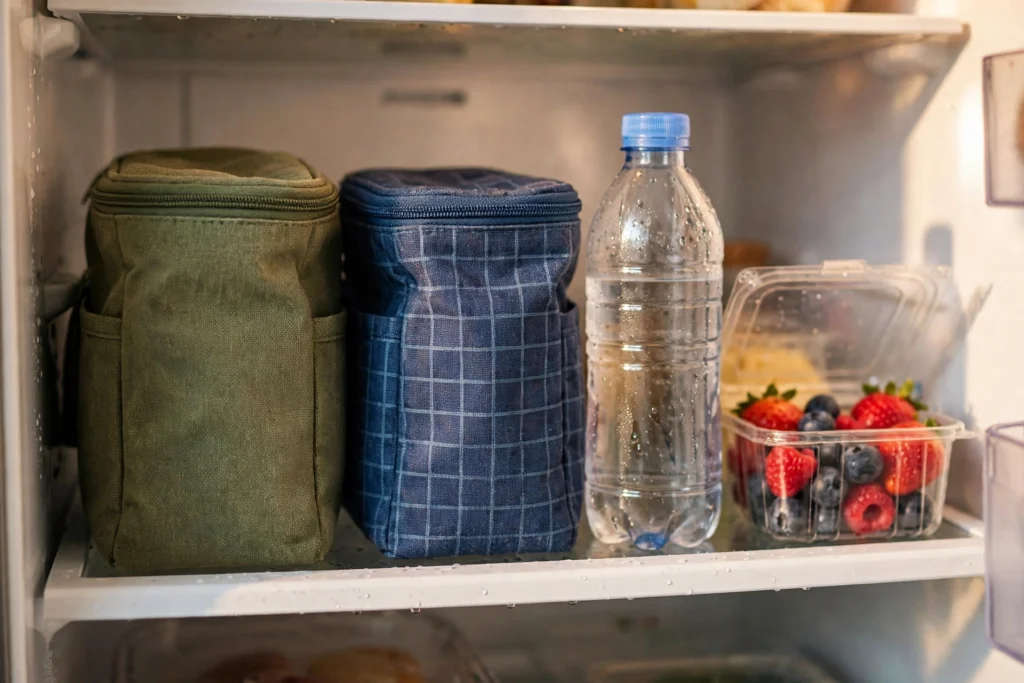
The grab-and-go shelf is one fridge shelf and one spot by the door, reserved for things that leave the house. Lunch bags, water bottles, and fruit for the day sit there, ready to lift out. One shelf, one spot by the door: that is small kitchen organization busy mornings in miniature.
One shelf is enough because it holds only what leaves today. Anything that stays home goes back to its usual place, so the shelf never fills with leftovers and forgotten jars.
Pack the bag the night before and keep it in the fridge until you leave, so nothing sits out on the counter warming up while you get ready.
Keep the fridge shelf at eye level if you can. Our small fridge organization for meal prep guide shows how a clear shelf map stops the morning hunt for the right container.
The Weekend Top-Up: 30 Minutes That Protect the Week

Once a week, spend half an hour restocking the station and the grab-and-go shelf. Check what is running low, write it on the shopping list, and put the spares where they belong. A weekly top-up is the part of small kitchen organization busy mornings most people skip — and the part that keeps the rest working.
This is also the moment to throw out anything past its best in the fridge and wipe the station shelf. A small weekly clear-out stops the slow build-up that turns a calm system into clutter by Friday.
If you batch-cook on weekends, this is when the week’s lunches and breakfasts get made. Our one-hour meal prep plan for busy weekdays shows how one focused hour covers four days of meals.
Pair the top-up with a quick reset of the whole kitchen. Our small kitchen cleaning and organization routine guide sets out a weekly focus that keeps the rest of the room matching the morning system.
Common Mistakes to Avoid
Most attempts at small kitchen organization busy mornings fail in small, predictable ways. Watch for these five, and fix the one that sounds familiar before it costs you a morning.
Storing breakfast things in three different places
When the bowls live in one cupboard, the spoons in another, and the oats on a high shelf, every breakfast becomes a treasure hunt. One station, one spot — that is the whole point.
Buying organizers before fixing the routine
A new basket or rack feels like progress, but it cannot fix a morning with no plan. Set the routine first, live with it for two weeks, and only then buy the one organizer that solves a real gap.
Keeping the system only in your head
If the evening reset lives only in one person’s head, it stops the day that person is away. Write the five reset steps on a card inside a cupboard door, so anyone can run it.
Keeping every appliance on the counter overnight
A counter crowded with appliances leaves no room to actually make breakfast. Store the ones you do not use before 9 a.m., and keep only the kettle and the station on show — the same one-in, one-out thinking behind our small kitchen counter organization guide.
Overfilling the breakfast station
A station crammed with every cereal, spread, and gadget in the house is just clutter with a new name. Keep the two or three breakfasts you actually eat on rotation, and store the rest in the pantry.
Frequently Asked Questions
How do I keep the morning system working when I work night shifts or irregular hours?
Anchor the reset to your own bedtime, not to the clock. The fifteen minutes before you sleep do the same job whenever your shift ends, and the breakfast station waits for whichever morning you wake to.
What if my kitchen has no counter space for a breakfast station?
Use a tray on top of the fridge, a shelf inside the nearest cupboard, or a slim rolling cart parked beside the counter. The station is a fixed spot, not a fixed surface — what matters is that everything for breakfast lives together.
How do I handle mornings when guests stay over?
Add one spare mug and bowl to the station for the visit, and tell guests where the kettle and the station are. A guest who can make their own tea is one less person waiting on you at the busiest minute.
Should the routine change during school holidays?
Keep the evening reset and the station, but drop the timed flow. Without school runs the morning can breathe, and the reset still means you wake to a clear counter and a stocked station.
How do I stop breakfast supplies running out midweek?
Check the station every Wednesday evening and add anything low to the shopping list that night. A midweek check catches the empty oats box two days before it would have ruined a morning.
Conclusion
Small kitchen organization busy mornings come down to one idea: the morning is won the night before. When tomorrow is already set up, the first twenty minutes run themselves — and your hands learn the pattern faster than your brain expects.
Start tonight. Set a timer for fifteen minutes after dinner, pack tomorrow’s lunch, set out the mugs, and clear the sink. Tomorrow morning will tell you whether the system fits — and you can adjust one thing at a time from there.