
Meal prep breakfast sandwiches are the fastest way to turn a rushed morning into a two-minute breakfast. You cook once, build a stack of sandwiches, wrap them, and freeze them — then each morning is just unwrap, heat, and eat.
No pan to wash, no decisions before coffee, and no skipping breakfast because the clock ran out. This guide covers which builds hold up, how to cook the eggs to fit the bread, and how to reheat one so it tastes fresh.
For the wider breakfast picture — oats, egg muffins, and burritos — see our guide to meal prepping breakfasts ahead of time. Everything here is built for a small kitchen.
Table of Contents
- What Makes a Good Breakfast Sandwich for Meal Prep
- Pick Your Sandwich Build
- How to Cook the Eggs for Sandwiches
- Meal Prep Breakfast Sandwiches: The Assembly Line
- Wrapping and Labelling for the Freezer
- Fridge vs Freezer: How Long They Keep
- How to Reheat a Breakfast Sandwich
- A One-Hour Sandwich Prep Session in a Small Kitchen
- Common Mistakes to Avoid
- Frequently Asked Questions
- Conclusion
What Makes a Good Breakfast Sandwich for Meal Prep
Meal prep breakfast sandwiches that survive the freezer hold their shape, reheat evenly, and stay dry inside. The bread carries most of that job, and the filling needs to be firm too.
Bread that holds up
English muffins are the classic choice: the same size as a cooked egg round, and they toast well from frozen. Small rolls and mini bagels work the same way.
Split the bread and toast it lightly before you build. That light toast dries the cut surface, so the bread soaks up less moisture in the freezer.
Fillings that freeze well
The best fillings are already cooked and fairly dry: eggs, cheese, cooked sausage patties, and sautéed mushrooms or peppers. They freeze solid and thaw evenly.
What to leave out until morning
Fresh tomato, lettuce, cucumber, and avocado never belong inside a sandwich going into the freezer. They go soft, watery, or brown, and they make the bread soggy before you even reheat it.
Keep them in the fridge and add them after reheating — a slice of tomato on a hot sandwich takes ten seconds.
Pick Your Sandwich Build
A build is just a combination that works — bread, egg, one protein, and cheese. Pick one build per batch, so your meal prep breakfast sandwiches are all the same and every morning is the same easy routine.
Classic egg and cheese
The simplest build is also the most reliable: a toasted English muffin, one egg round, and a slice of cheese. It freezes perfectly and reheats in two minutes.
Add a cooked sausage patty if you want something heartier. Keep the cheese on the bottom half so it melts into the muffin when you reheat it.
Egg, beans, and cheese
This build skips the meat and still keeps you full until lunch. Mash a spoonful of seasoned beans onto the bottom half, add the egg round, and top it with cheese.
The beans act like a spread, so nothing slides around when you take a bite.
How to Cook the Eggs for Sandwiches

The egg is the part most people get wrong, because a fried egg is the wrong shape for a sandwich. For meal prep breakfast sandwiches, you need eggs that are flat and the same size as the bread.
Sheet-pan eggs
Whisk eight to ten eggs with a pinch of salt, pour them into a greased baking tray, and bake at 180°C (350°F) for about 12 to 15 minutes, until just set.
Let the slab cool for five minutes, then cut it into squares the size of your muffins. One tray makes eight to ten portions at once — see batch cooking in a small kitchen for more.
Muffin-tin rounds
Crack one egg into each cup of a greased muffin tin, break the yolk with a fork, and bake for about 10 to 12 minutes. The rounds come out the perfect size for an English muffin.
Scrambled, then portioned
Scramble the eggs gently in a pan over a low heat, take them off just before they look done, and spoon equal portions onto the bread.
This suits a flatbread pocket best, because the soft egg folds into the wrap. Let the eggs cool first, or the steam will soften the bread.
Meal Prep Breakfast Sandwiches: The Assembly Line
An assembly line is what makes a batch of meal prep breakfast sandwiches fast. Instead of building one sandwich from start to finish, you do each step for all of them at once — and the whole batch is wrapped in under fifteen minutes.
Clear one stretch of counter and lay everything out in the order you will use it: bread, cheese, eggs, cooked protein, then wrapping paper.
Toast the bread first, then lay the bottom halves in a row. Put cheese on each bottom half, then the egg, then the protein, then the top half. The cheese melts when reheated and keeps moisture out of the muffin.
Let everything cool to room temperature before you wrap. A warm sandwich wrapped in paper steams itself soggy, and that sogginess does not go away in the freezer.
While the eggs cool, wash the pan and wipe the counter. If your counter is too small for a full line, build in two rows of four — our guide to meal prepping with limited counter space has more ideas.
Wrapping and Labelling for the Freezer
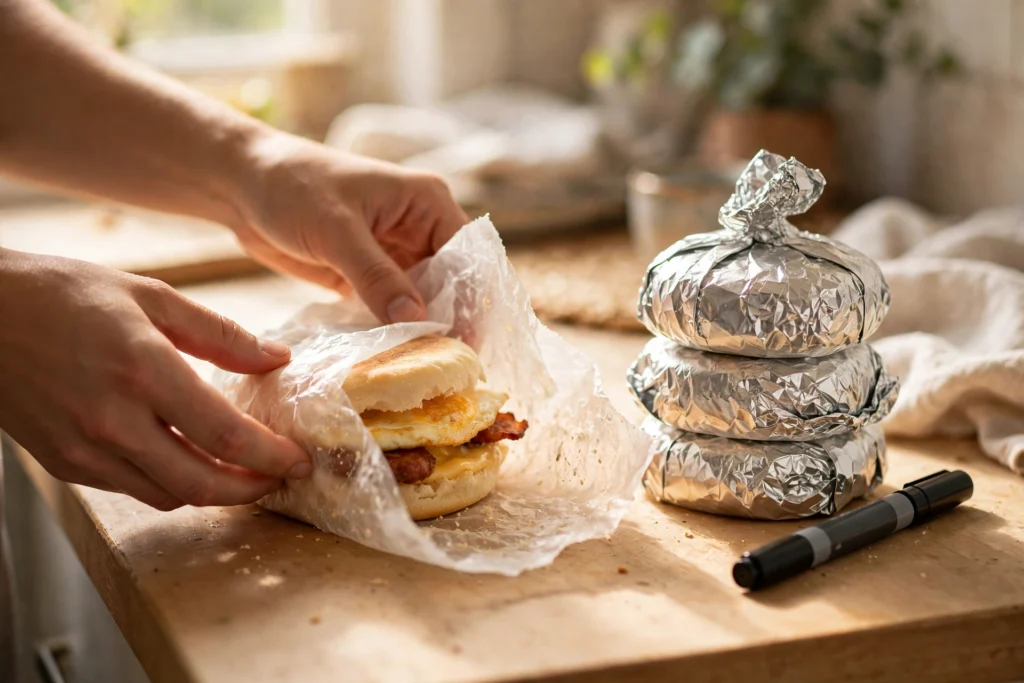
Wrapping decides whether meal prep breakfast sandwiches taste fresh on Friday or like they have been in the freezer for a month. Each sandwich gets its own wrap, so you can pull out exactly one without thawing the rest.
Wrap each sandwich snugly in greaseproof paper first, folding the ends in like a parcel, then add foil or a freezer bag. The paper stops the bread sticking to the foil, and the outer layer keeps out freezer air.
Label every sandwich with the contents and the date on the outside of the wrap: “egg + cheese, 29 Nov”. A sandwich without a label gets opened, sniffed, and put back.
For fridge sandwiches, a lidded container stacks neatly — see our guide to storing meal prep containers. Our freezer meal prep guide covers flat packing.
Fridge vs Freezer: How Long They Keep
Fridge and freezer are two different plans: fridge sandwiches are for this week, freezer sandwiches for next week and the week after.
Keep two or three meal prep breakfast sandwiches in the fridge for the next few days, and freeze the rest the same day you make them.
Eat the fridge ones first, within three or four days, and move a frozen one to the fridge the night before. Give them a fixed spot on the middle shelf — our small fridge organization for meal prep guide shows how.
Cool cooked fillings promptly, and move them to the fridge or freezer without a long wait — the FDA’s guidance on storing food safely explains how long cooked food keeps.
Eggs and cheese keep well in the freezer for a few weeks, and the bread is usually the first thing to taste tired. A well-wrapped sandwich still tastes good after a month, while a loosely wrapped one tastes stale in a week — the freshness rules cover each ingredient.
How to Reheat a Breakfast Sandwich
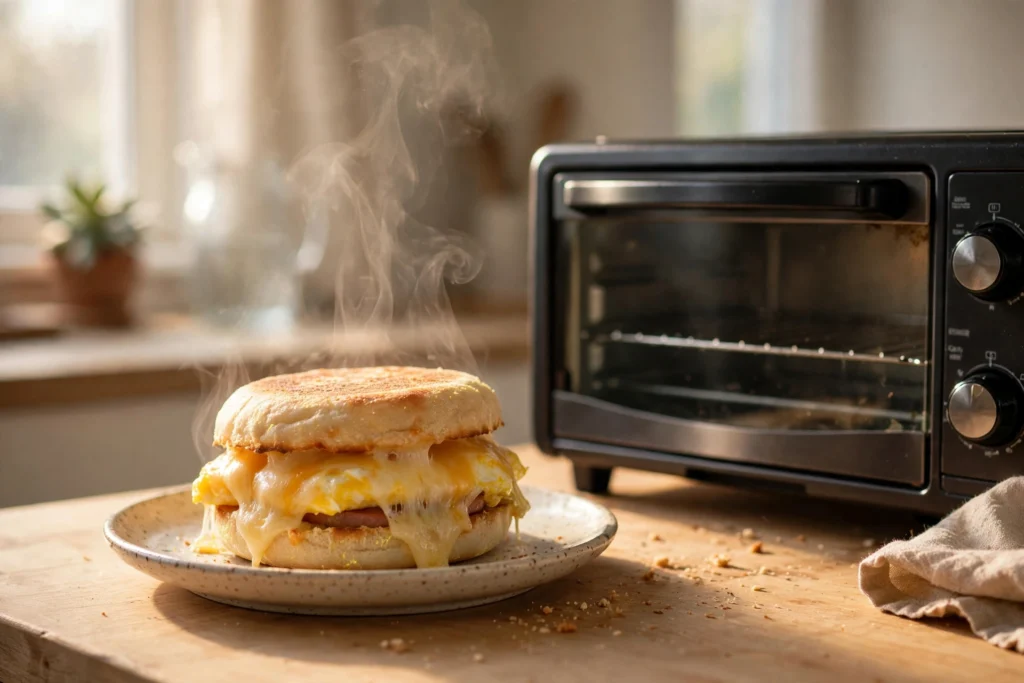
Reheating a meal prep breakfast sandwich is a two-minute job if it was wrapped well, and a soggy disappointment if it was not. The trick is the same in every method: let the steam out.
For the microwave, unwrap the foil completely — never microwave foil — and keep the greaseproof paper loosely around the sandwich. Heat in two short bursts of 45 seconds, turning it over between bursts.
For the oven or toaster oven, keep the sandwich in its foil and bake at 180°C (350°F) for 10 to 15 minutes from the fridge, or a few minutes longer from frozen. Open the foil for the last two minutes so the bread crisps up.
For a pan, unwrap the sandwich and heat it on a low heat with the lid on, flipping once. Whatever method you use, heat it until it is piping hot all the way through — the FoodSafety.gov reheating charts list safe temperatures.
A One-Hour Sandwich Prep Session in a Small Kitchen
A full batch of eight meal prep breakfast sandwiches fits into a single hour, and most of that hour is waiting for the oven. The wrapping starts the moment the eggs cool.
Start by heating the oven and whisking the eggs for the sheet-pan method. While the eggs bake, cook the sausage patties or mushrooms in the pan and set them aside to cool. Toast the muffins in the same warm pan.
When the eggs come out, cut them into squares and lay everything out. Build all eight sandwiches, wrap them, and label them.
Two go in the fridge for Monday and Tuesday, and six go in the freezer. Wash up as you go — and for a timed version of a wider session, see the one-hour meal prep plan for busy weekdays.
Common Mistakes to Avoid
These five mistakes turn a good batch of meal prep breakfast sandwiches into a disappointing one.
Freezing sandwiches in the freezer door. The door is the warmest spot in the freezer, with the biggest temperature swings. Sandwiches stored there go stale fastest — keep them on a middle shelf or in a drawer instead.
Overfilling each sandwich. A sandwich stuffed with two eggs, a double patty, and a pile of mushrooms falls apart when you pick it up. One egg, one protein portion, and one slice of cheese is the right amount.
Slicing sandwiches in half before freezing. Cut edges dry out in the freezer, and the halves fall apart when reheated. Freeze sandwiches whole, and slice them after reheating if you want halves.
Making a full week’s batch when your freezer is small. Eight frozen sandwiches need a whole shelf, and a cramped freezer crushes them into odd shapes. Prep four for the fridge and freezer combined, then repeat the session midweek.
Adding sauce before freezing. Ketchup, mustard, and mayo all soak into bread in the freezer, and they go watery when reheated. Keep sauces in the fridge and add them fresh after reheating.
For the full list of errors across all your prep, see meal prep mistakes to avoid in a small kitchen.
Frequently Asked Questions
Can I use croissants or bagels instead of English muffins?
Yes, and both work well if you handle them differently. A bagel is sturdy enough to freeze and reheat exactly like a muffin. A croissant is flakier, so wrap it gently and reheat it in the oven.
How many breakfast sandwiches should I prep for one person?
Five meal prep breakfast sandwiches is the sweet spot for one person: two in the fridge for the first two mornings, and three in the freezer for the rest of the week.
Do breakfast sandwiches taste different after freezing?
A little, and mostly in the bread. A well-wrapped sandwich reheated in the oven tastes close to fresh, because the dry heat crisps the bread again. One reheated in the microwave tastes softer.
Can children take a breakfast sandwich to school?
Yes, if it is packed the right way. Wrap a fridge sandwich in paper, keep it in a lunchbox with a cold pack, and pick a build that tastes good at room temperature — egg and cheese works.
Check your school’s rules first, since some schools do not allow food that needs reheating.
Conclusion
Meal prep breakfast sandwiches work because the hard part — cooking, building, and wrapping — happens once, on a quiet evening, and the busy mornings just take the reward. One tray of eggs and a row of labelled wraps give you breakfast for the week.
Start this weekend with a batch of eight: pick the classic egg and cheese build, bake one tray of eggs, and wrap them while the kitchen is tidy. By Monday morning, breakfast will be the easiest part of your day.