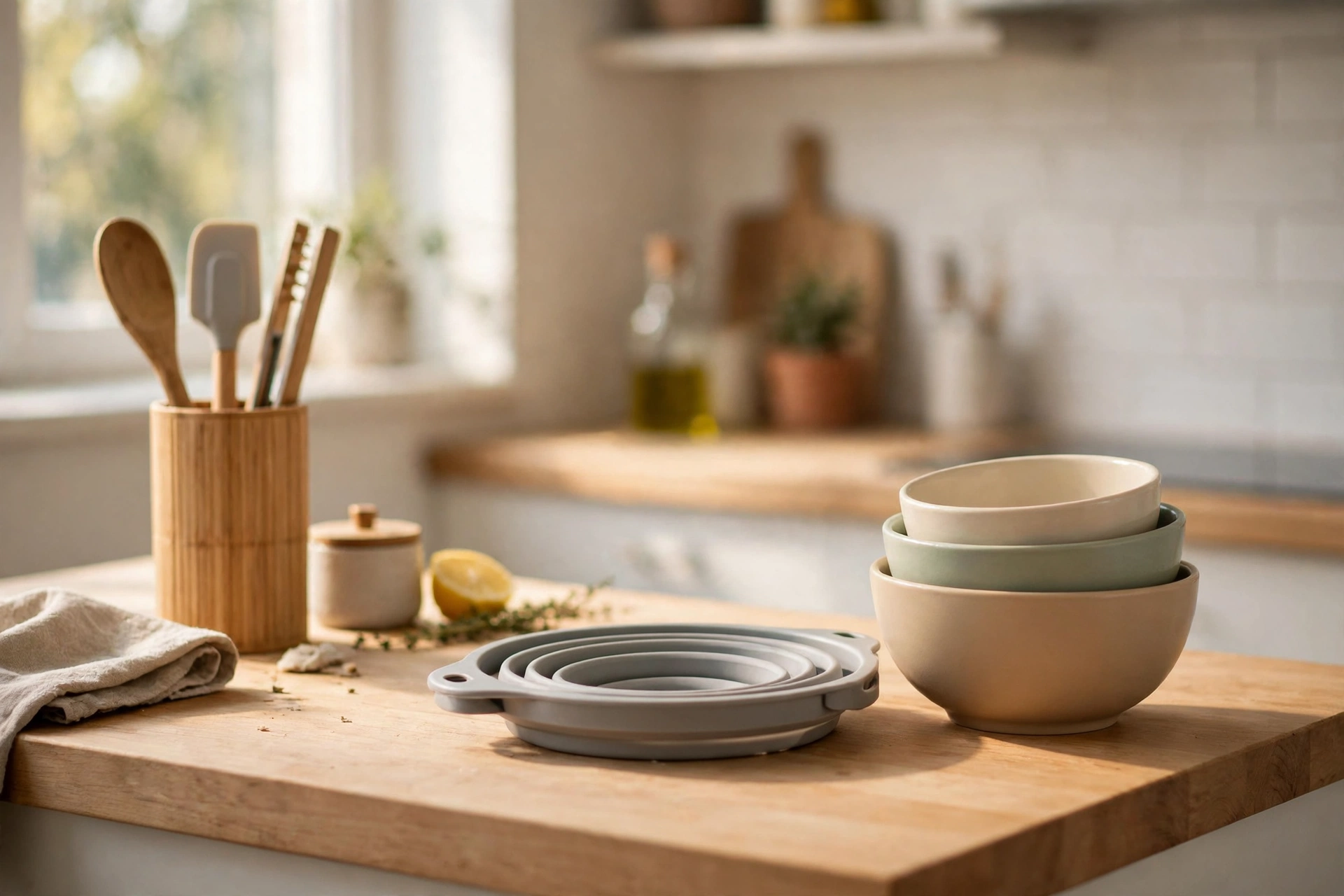
The best space-saving kitchen tools shrink when you store them, stack when you put them away, or do two or three jobs instead of one. Nesting bowls, a folding colander, stackable containers, and a good chef’s knife give you a full working kitchen.
They work because they change the maths of a small kitchen: fewer items, each taking up less room and doing more work. This guide covers the types that earn their space, a five-step plan, and how to store them so the saving sticks.
Table of Contents
- What Space-Saving Kitchen Tools Really Are
- Space-Saving Kitchen Tools: Four Ways They Save Room
- The Tool Types That Earn Their Space
- A Five-Step Plan for Choosing Space-Saving Tools
- Storing Them So the Saving Sticks
- What to Check Before You Buy
- Mistakes That Waste the Space You Saved
- Frequently Asked Questions
- Conclusion
What Space-Saving Kitchen Tools Really Are
A tool earns the label “space-saving” only if it takes up less room than the ordinary version. Many products sold as compact kitchen gadgets save space in one place and waste it in another — a folding steamer basket is genuinely space-saving, while a single-use gadget is not.
Size is only half the question — the other half is how often you use it. A stock pot used weekly earns its shelf far more than a gadget used twice a year.
The honest test is simple: does it nest, stack, fold, or replace something else? If it does none of those, it is just a small tool — and a small tool you rarely use is still clutter.
Space-Saving Kitchen Tools: Four Ways They Save Room

Every genuinely space-saving tool works in one of four ways. Knowing them helps you judge any tool in seconds, in the shop or online, without trusting the label.
They nest
Nesting tools fit inside one another, so a set takes up the space of its largest piece. Mixing bowls are the classic example, and nesting measuring cups work the same way. Look for pieces that nest snugly and separate easily — a lip or pouring spout helps.
They stack
Stacking matters most for flat, rigid items that cannot fit inside one another. Stackable food storage containers are the best-known example: matching footprints build into a stable tower instead of sliding around a shelf. Baking trays and chopping boards follow the same rule. Keep stacks short, most-used piece on top. For containers and lids in full, see How to Organize Food Storage Containers and Lids.
They fold
Folding tools collapse when not in use, which suits items that are bulky in use but needed only some of the time — a colander, or a drying rack that folds flat into a drawer. They work best when the folded version is flat and the open version is stable: a colander that wobbles when full of hot pasta is not a bargain. Silicone is the most common material, but it must be thick enough to hold its shape.
They replace two or more tools
A multi-use tool replaces two or more single-purpose tools — the most direct way to cut the number of items in a kitchen. A chef’s knife is the classic example, and a sheet pan that roasts and bakes is another. The honest test is whether you actually use it for more than one job: a garlic press that also slices is still single-use if you only ever press garlic with it. This family is covered in full in Multi-Functional Kitchen Tools That Save Space.
The Tool Types That Earn Their Space
You do not need every type below — one or two good examples from each family is enough, and the right mix depends on what you cook.
Nesting bowls and measuring sets
Nesting tools are the easiest win because they need no new habit. A set of mixing bowls, plus nesting measuring cups and spoons, takes up roughly the space of one bowl and one small bundle. Choose bowls with a lip or pouring spout — easier to separate when wet.
Stackable containers and trays
Stackable containers matter most where food is stored: matching footprints build a stable tower, and square containers waste less shelf space than round ones. Keep stacks to three or four pieces, most-used on top.
Folding colanders and racks
A folding colander is the tool most small kitchens notice first, because an ordinary colander is bulky and awkward to store. Choose one that opens and closes in one smooth movement, or you will stop folding it. Check it stands flat and steady when open, and opens fully for cleaning — food collects in the fold.
Multi-use knives and pans
One good chef’s knife replaces a drawer of specialist knives and choppers. A sheet pan roasts vegetables, bakes biscuits, and reheats leftovers — one pan doing the work of a roasting tin, a baking tray, and a serving tray. A large mixing bowl doubles as a salad bowl. These tools save space by cutting the count, not the size.
Slim and flat tools
Some tools save space simply by being thin: a slim utensil holder takes up less counter than a wide crock, and a thin cutting board slides into the gap beside the fridge. Measure first — a drawer 5 cm deep will not hold a chunky whisk.
Tools that hang on the wall
Wall-mounted tools do not shrink, but they save space by moving storage off the counter and out of the drawers: a rail with hooks for ladles and spatulas, a magnetic strip for knives, a small rack for spice jars. Moving even five or six tools to the wall makes cooking noticeably easier — see Vertical Kitchen Storage Ideas for Small Spaces. Keep everyday tools within easy reach of the prep area, and check your lease before drilling.
A Five-Step Plan for Choosing Space-Saving Tools
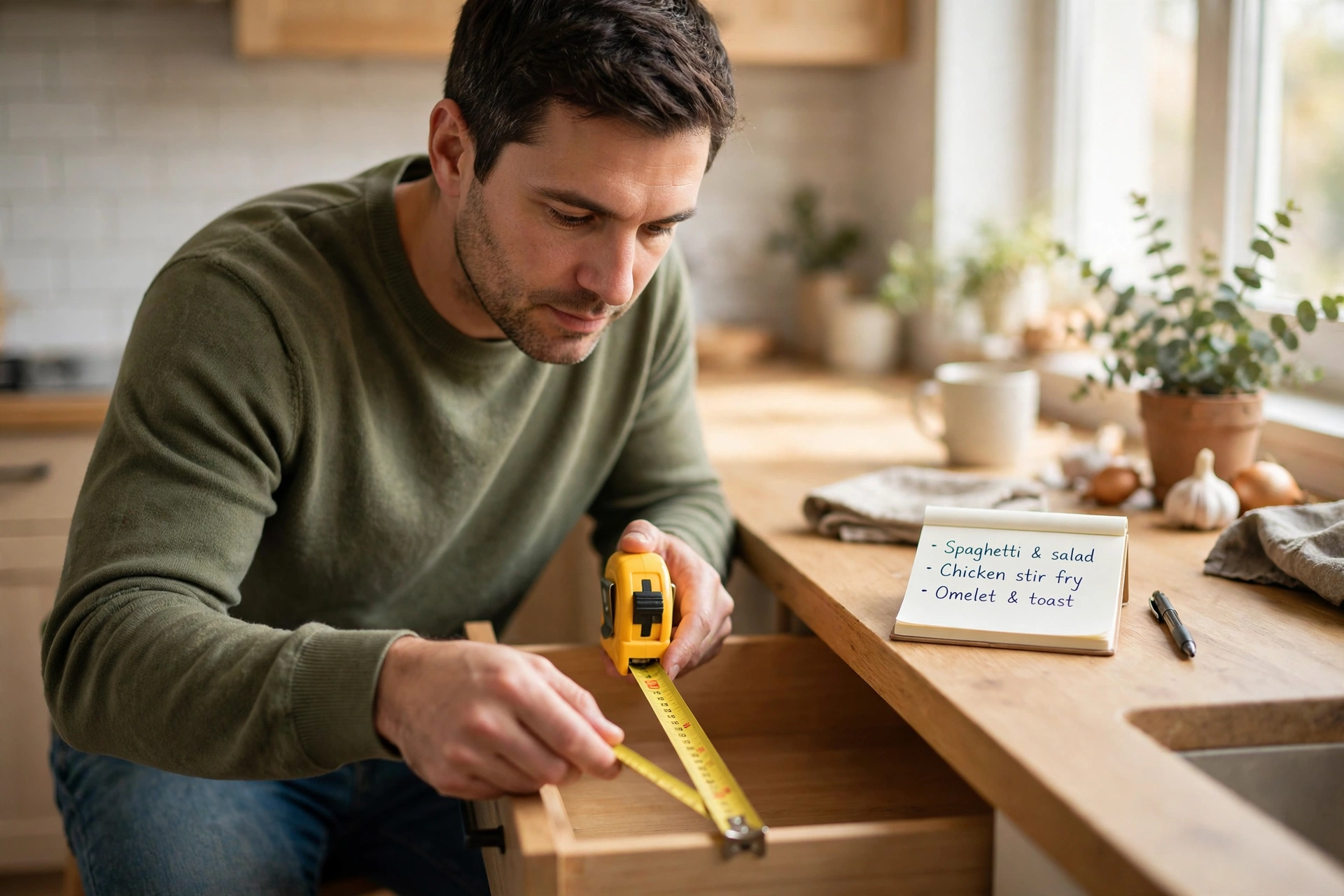
Buying tools whenever something catches your eye is how small kitchens end up full of gadgets. A short plan, done once, saves more room than any purchase.
Step 1: Measure your storage before you shop. Measure the cupboards, drawers, and shelves where tools will live: width, depth, and height. A colander 28 cm across will not fit in a 25 cm cupboard, however flat it folds.
Step 2: List what you actually cook. Write down the ten meals you cook most often, then list the tools each needs — probably just five or six: a knife, a chopping board, a saucepan, a frying pan, a spatula, and a mixing bowl. Anything not on that list is for a meal you rarely cook.
Step 3: Audit what you already own. Empty one drawer or cupboard at a time and sort tools into three groups: used weekly, used monthly, and not used in the last six months. Duplicates are common — keeping one of each frees space immediately. For a full method, see How to Declutter a Small Kitchen: A Step-by-Step Guide.
Step 4: Replace, don’t add. Let a new space-saving tool replace the ordinary version, not sit beside it — keeping both doubles your storage problem. If the new nesting bowls work, the old bowls should leave the kitchen.
Step 5: Give every tool a fixed home. Decide where each tool lives — which drawer, hook, or shelf — and put it back there every time. If a tool has no home, you have too many tools. For drawer layouts, see How to Organize Kitchen Drawers in a Small Kitchen.
Storing Them So the Saving Sticks
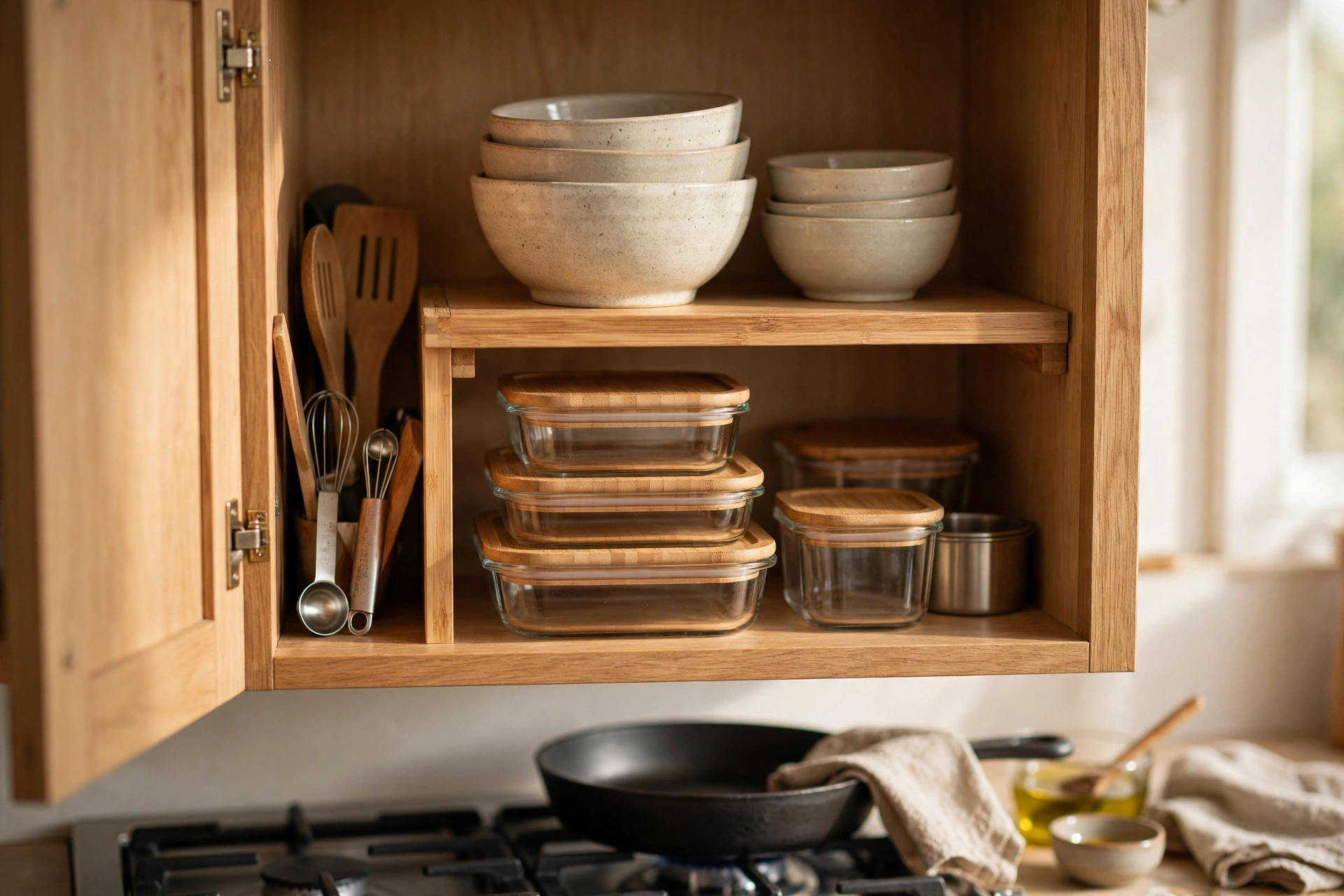
Buying the right tools is only half the job — the way you store them decides whether the saving actually happens.
Nest and stack by family: keep nesting sets together as one unit and stacks short and stable. A shelf riser lets you stack containers two levels high inside a cupboard — see 25 Smart Small Kitchen Organization Ideas That Make Every Inch Count for more ideas.
Keep everyday tools within arm’s reach of the cooker. Store lids with their containers, or all together upright in one organizer — mixing the two approaches creates the mess. How to Organize Pots, Pans, and Lids in a Small Kitchen covers lids.
Finally, keep the counter clear: a tool that lives there permanently is taking up worktop. Only tools you use every day earn a permanent spot — see Small Kitchen Counter Organization: Keep Your Counters Clear and Useful. Everything else should be put away after use, even if it folds flat.
What to Check Before You Buy
Space-saving tools come in every price range, and price alone tells you very little.
Dimensions. Compare the tool’s folded or nested size, not just its open size, with the space you have.
Materials. Stainless steel is durable but heavy. Silicone folds well but must be thick enough to hold its shape and resist heat. Wood is kind to knife edges but should not be soaked. Plastic is light and cheap but can stain and warp.
Durability. Check joints, hinges, and handles: a folding tool lives or dies by its hinge, and a nesting bowl is only useful if its rim does not chip. A multi-use tool is used more, so its weak points wear faster.
Cleaning. Washing-up space is limited too, so dishwasher-safe tools save time. Food collects in the fold of a collapsible tool, so check it opens fully for cleaning and dries quickly.
Capacity. A tool too small creates extra work — a tiny colander means draining pasta in two batches. Choose the size that fits your household’s cooking.
Storage footprint. How much room does it take up when put away? A nesting bowl set takes the footprint of one bowl; a folding colander, a flat disc. If you cannot picture where it will live, you are not ready to buy it.
Mistakes That Waste the Space You Saved
Buying gadgets before fixing storage. A new folding tool does not help if your cupboards are already full of tools you never use. Declutter first, then buy.
Choosing the smallest version of everything. The smallest colander, board, and pan look tidy in the shop and frustrate you at home.
Collecting single-use gadgets. Spiralizers, avocado slicers, and egg separators each do one small job. Five of them fill a drawer that could hold the tools you use every day.
Ignoring the folded size. A collapsible tool is only space-saving if you actually fold it. An awkward mechanism makes it just a bulky tool with a hinge.
Forgetting about weight. Stackable glass containers are sturdy, but a tall stack is heavy to lift from a high shelf. Use lightweight materials up high and heavy ones down low.
Buying matching sets you do not need. A ten-piece set looks like good value, but pieces you never use still take up room, even nested.
Keeping the old tool as well as the new one. The new nesting bowls arrive, the old bowls move to the back of the cupboard “just in case,” and nothing has been saved. If the new tool works, let the old one go.
Frequently Asked Questions
What are the best space-saving kitchen tools for a very small kitchen?
Start with tools that nest, stack, fold, or do more than one job: a nesting bowl set, nesting measuring cups, a folding colander, stackable containers, a good chef’s knife, and a sheet pan.
Are collapsible kitchen tools durable?
It depends on the material and the hinge or joint. Thick silicone with a firm joint usually holds up well for everyday jobs such as draining pasta; thin silicone can sag, and a loose hinge only gets looser. Choose one that folds flat easily and opens into a stable shape.
Do I need to buy a whole set of space-saving tools at once?
No — buying everything at once is an easy way to end up with tools you do not use. Start with the tool that solves your biggest frustration — usually a nesting bowl set, a folding colander, or stackable containers — and live with it for a few weeks.
Can space-saving tools work in a rental kitchen?
Yes — they are often the best option for renters, because they change what is inside the cupboards. Nesting, stacking, and folding tools need no drilling or permission; wall-mounted tools need care, so check your lease first and use adhesive or tension-mounted options instead.
Conclusion
Space-saving kitchen tools are not the cleverest gadgets or the most expensive sets. They are the tools that nest, stack, fold, or do more than one job — and that you use every week. A few well-chosen tools beat a drawer of single-use gadgets.
Start with the five-step plan: measure, list the meals you cook, audit what you own, replace rather than add, and give every tool a home. Then buy one tool at a time, checking dimensions, materials, durability, cleaning, capacity, and footprint. For the appliances that share your counter, see Best Compact Kitchen Appliances for Small Counters.
10 thoughts on “Best Space-Saving Kitchen Tools for Small Kitchens”