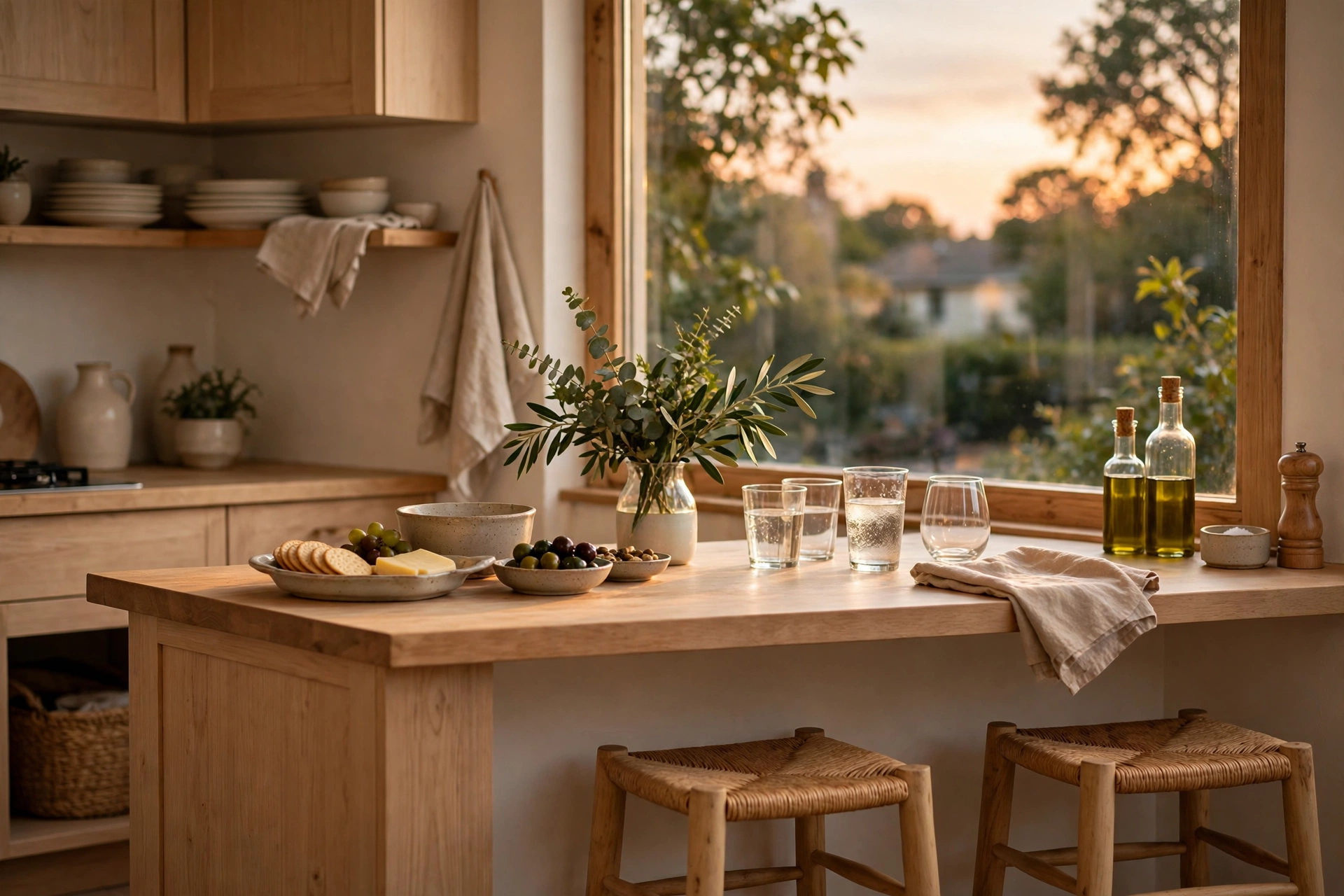
You can organize small kitchen for entertaining without a bigger room or a remodel. What you need is a clear plan: who is coming, where they will stand, and what stays out of the way.
Most small kitchens fail at parties for one reason: the cooking, serving, and chatting spaces share one stretch of counter. Once you split those jobs apart, even a galley kitchen can host a relaxed evening.
This guide covers a setup for four to eight guests: plan around your guest count, set up three zones, build a drinks station, and prep ahead.
Table of Contents
- What Entertaining in a Small Kitchen Really Looks Like
- Start With the Guest Count, Not the Menu
- A 5-Step Plan to Organize Small Kitchen for Entertaining
- Set Up Three Zones for the Night
- The Drinks Station: Keep Guests Out of Your Way
- Serving Food When There Is Nowhere to Put It
- Seating and Flow in a Tight Space
- Prep Ahead So You Are Not Cooking While Guests Stand Around
- Dishes and Cleanup During the Party
- Common Mistakes to Avoid When You Organize Small Kitchen for Entertaining
- Frequently Asked Questions
- Conclusion
What Entertaining in a Small Kitchen Really Looks Like
Forget the picture of a host gliding around a huge island while guests sip drinks at a marble bar. In a small kitchen, entertaining looks much more ordinary. Friends lean against the counter, someone reaches for a glass, and you plate food a few steps from the stove.
Start With the Guest Count, Not the Menu
Most people plan a party backwards. They pick a menu first, then realise four guests cannot fit around the counter, or the oven cannot hold two trays at once. Start with the number of people.
Count the chairs you actually have, including any you can borrow from another room. Then count the glasses, plates, and forks. The smaller number is your limit.
Once you know the number, the rest gets easier. Four guests fit a sit-down meal at a small table, while six to eight suit a casual spread. If your setup feels tight, refresh your general kitchen organization before party week.
A 5-Step Plan to Organize Small Kitchen for Entertaining
You do not need a week of preparation to organize small kitchen for entertaining. Five steps, spread over a few days, will get a small kitchen ready to host. Do them in order.
Step 1: Pick the Date and the Guest List
Choose a date at least a week ahead, then invite people right away. A short list beats a long one in a small space. Four to six guests is a comfortable first party.
Tell guests the start time and the kind of evening it is — “drinks and snacks from seven” sets very different expectations from “dinner at seven” — and ask about food allergies.
Step 2: Walk the Kitchen as a Guest Would
Walk from your front door to the kitchen the way a guest would. Notice what you bump into and where you would naturally stop. That first walk tells you more than any checklist.
Look for where people will gather — usually the gap between the counter and the fridge, or the end of the worktop nearest the door. That is your traffic lane. Keep it clear all evening.
Step 3: Clear One Full Counter for the Evening
A party needs one clear surface more than fancy decorations. Empty the longest stretch of counter you have. Move the toaster, the fruit bowl, and the everyday clutter elsewhere for the night.
This cleared counter becomes your serving surface — food, plates, and serving spoons, nothing else. If clearing a whole counter feels impossible, a focused pass through your counter organization will often free up more space.
Step 4: Set the Menu to Fit the Kitchen
A small kitchen rewards a short menu. One main dish, two sides, and one dessert is plenty. For a drinks evening, three or four snacks will do.
Choose dishes that finish at different times. If everything needs the oven at 200°C (400°F), you will run out of space. Pick one oven dish, one stovetop dish, and one cold dish.
Step 5: Do a Ten-Minute Practice Run
The day before the party, set the kitchen up as you plan it for the night. Put the serving dishes where they will go, lay out the glasses, and walk the route a guest would take. Ten minutes now saves a scramble.
This practice run catches small problems. A spoon that does not fit the bowl, a tray that blocks the kettle, or a chair that will not pull out fully are easy fixes today.
Set Up Three Zones for the Night
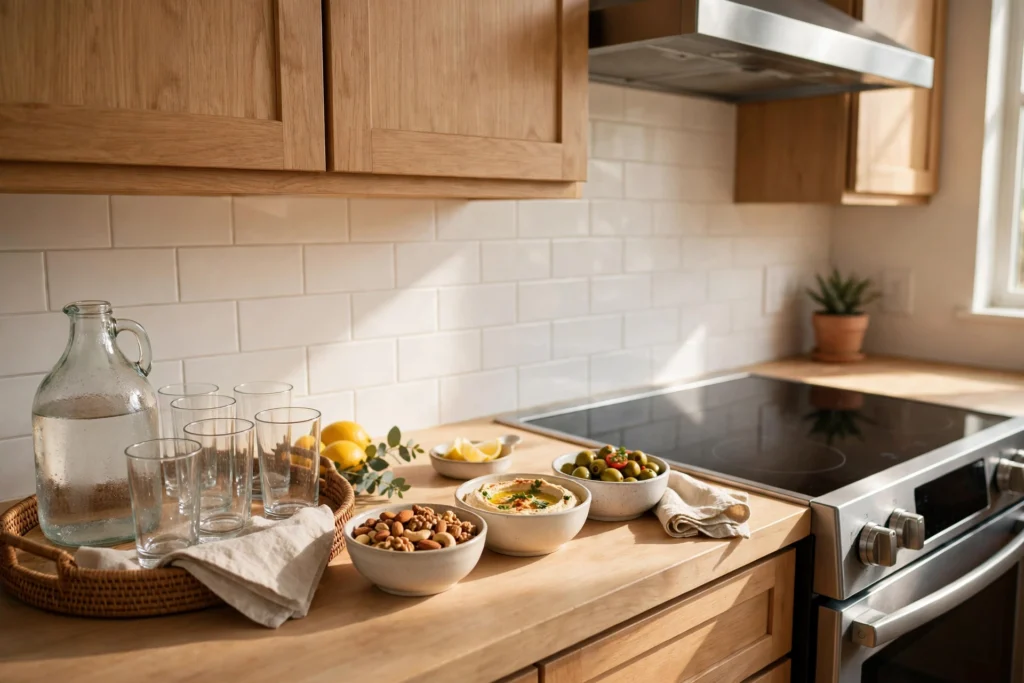
A party kitchen works best when every job has its own spot. That is the heart of how you organize small kitchen for entertaining: three zones.
The cooking zone is the stove, the oven, and the counter beside them — your workspace. The serving zone is the cleared counter from Step 3, holding food, plates, and serving spoons. Put it where guests can reach it from the side.
The drinks zone goes as far from the stove as your kitchen allows — a side table, a windowsill, or the far end of the counter. Our guide to organize kitchen cabinets by zone uses the same idea.
The Drinks Station: Keep Guests Out of Your Way
Drinks cause more kitchen traffic than food does. People refill glasses, look for a bottle opener, or ask where the water is. Every trip crosses your cooking space unless drinks have a home of their own.
Set the station up before anyone arrives: glasses, a jug of water, and whatever you are serving in one spot, with an opener nearby. Guests serve themselves and stay out of your way.
Keep the station small. Two or three drink choices are enough — a crowded station is just as bad as no station. When you organize small kitchen for entertaining, the drinks station frees up the most space.
Cold drinks need a plan, because the fridge fills up fast. Chill bottles the night before, then move them to a bowl of ice on the station. If children are coming, give them their own low tray — see our small kitchen organization for family article.
Serving Food When There Is Nowhere to Put It
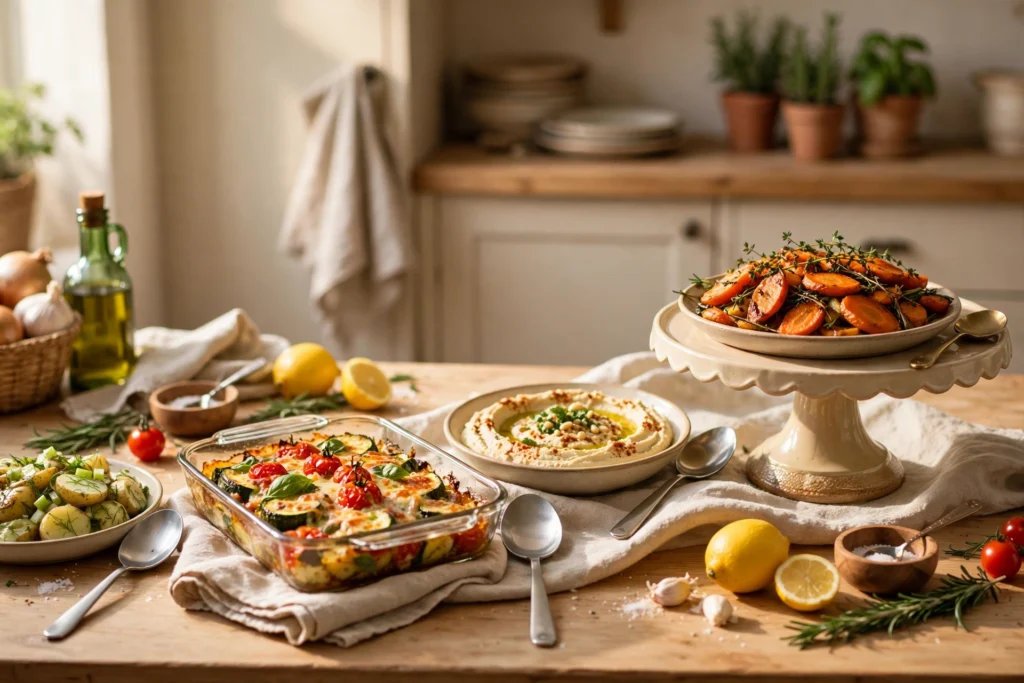
Small kitchens rarely have room for a full buffet, so when you organize small kitchen for entertaining, serve in waves. Put out the first course or the snacks, then bring the next dish out when the first is finished.
Use height to create space. A sturdy box, an upturned pot, or a cake stand lifts one dish above the others. Just make sure whatever you stack is stable and heat-safe.
Serve food in the dish it was cooked in. A baking dish on a folded tea towel looks welcoming, and it saves a serving dish and a wash-up.
If you have an island or a peninsula, treat it as your serving surface for the night. Our guide to small kitchen island organization explains how to keep an island top clear for exactly this job.
Seating and Flow in a Tight Space
Seating is where small-kitchen parties succeed or fail. People need a place to sit with a plate, a drink, and a bit of elbow room. A cramped seat makes even great food feel awkward.
Count your seats honestly. A dining chair, a sturdy stool, and a bench all count, but a wobbly chair does not. Borrow chairs from other rooms and test each one.
When you organize small kitchen for entertaining, think about the path between the seats and the food. Guests should reach the serving counter and get back for seconds without squeezing past the cook. If the only route passes the stove, move the counter or the seats.
A slim rolling cart works as a mobile side table. See our small kitchen storage without remodeling article for more temporary party setups.
Prep Ahead So You Are Not Cooking While Guests Stand Around
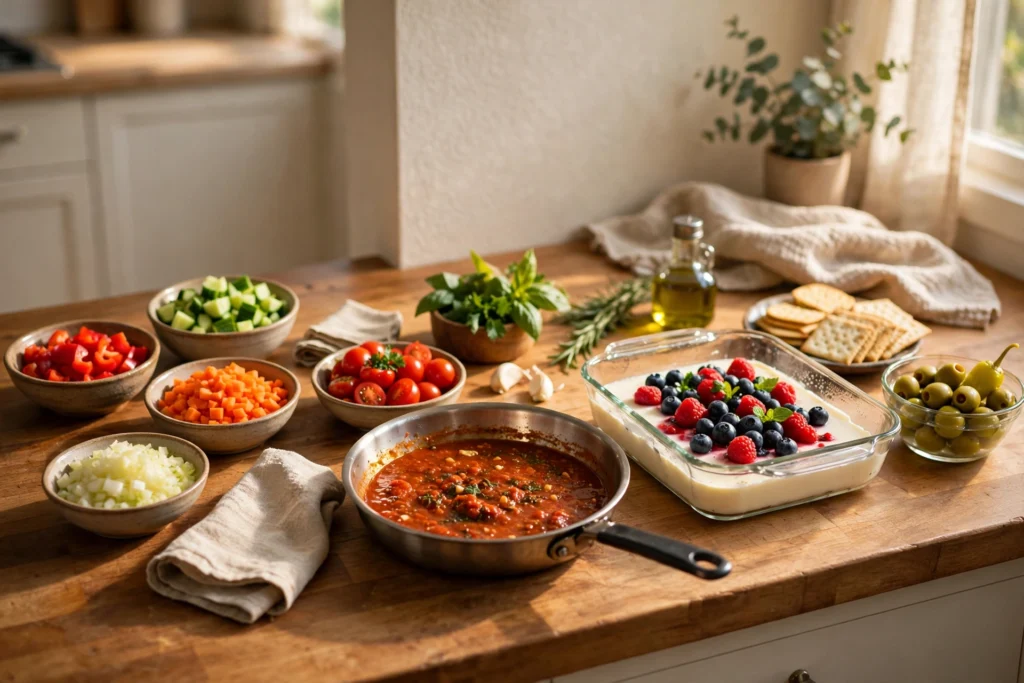
The best hosts in small kitchens do most of the work before the doorbell rings. If you are still chopping when guests arrive, they will stand in the kitchen watching you. That is why prep comes first when you organize small kitchen for entertaining.
Work backwards from the start time. Chop, mix, or assemble what you can the day before — salads washed, sauces made, desserts chilled.
Cook in batches when the menu allows it. Making a sauce or grain dish in one larger batch, then dividing it into serving bowls, uses fewer pans and less counter space. The same thinking behind batch cooking in a small kitchen works for party food.
Dishes and Cleanup During the Party
A small sink fills fast, and a full sink makes the whole kitchen feel messy. Wash as you go, in small bursts. Cleanup is part of how you organize small kitchen for entertaining, not an afterthought.
Soak a pan as soon as it is empty and wash it while something bakes. A five-minute wash between courses keeps the sink usable and the counters clear, and means far less washing after guests leave.
Leftovers need the same care as the meal itself. Cool them quickly, pack them into food storage containers with lids, and get them into the fridge within two hours of serving. The FDA’s guide on storing food safely explains how to keep them safe the next day.
Do not finish all the washing while guests are still there. Stack what is left by the sink, run the dishwasher if you have one, and save the rest for the morning. For a simple end-of-night routine, borrow the steps in our small kitchen cleaning organization routine.
Common Mistakes to Avoid When You Organize Small Kitchen for Entertaining
No plan for coats and bags. Coats, bags, and gifts land on chairs and counters. Clear a hook near the door first.
Forgetting to empty the dishwasher and bin. A full dishwasher leaves nowhere to load dirty plates. Empty both before guests arrive.
No spot for rubbish. Plates and napkins pile up fast. Put an empty bowl at the end of the serving counter for rubbish.
Harsh light and silence. Bright overhead light and silence make a small room feel flat. Switch on a lamp and start a playlist before guests arrive.
Cooking a brand-new recipe for guests. A dish you have never made takes longer and uses more pans. Party night is the wrong time to experiment.
Frequently Asked Questions
How do I host a dinner party if I have no dining table?
Use what you have. A counter with stools works for four people, and a coffee table with cushions works for a relaxed meal in the living room.
Serve food that is easy to eat from a plate on your lap, with glasses on a tray nearby. That is the simplest way to organize small kitchen for entertaining with no dining table.
What should I do when guests offer to help in the kitchen?
Give them one small job away from the stove, like topping up drinks or carrying plates. A clear task makes a guest feel useful without adding a second cook. If the kitchen is too tight for two, thank them warmly and point them to the snacks and drinks instead.
Can I host a dinner party with only one oven?
Yes, if the menu is built around it. Choose one oven dish and let the others use the stovetop, a slow cooker, or no heat at all. Stagger the times so dessert can go in as the main dish comes out.
How do I keep food warm without extra counter space?
Use the oven itself as a holding spot. Turn it to its lowest setting and keep finished dishes inside, covered loosely with foil, until serving time. A slow cooker on warm also works for soups and stews. Avoid stacking hot dishes.
What if a guest arrives much earlier than the start time?
Welcome them in, hand them a drink, and give them a seat away from the cooking zone. Early guests are easiest with something to do, so ask them to arrange the drinks station or set out napkins.
If you still need ten quiet minutes to finish cooking, say so plainly — most people are happy to wait with a glass in hand.
Conclusion
A small kitchen does not stop you from hosting a good evening. It just asks you to plan the night around the room you have. Pick a guest count that fits, clear one counter, and keep drinks away from the stove.
Start with the simplest version of this plan. Invite four people, cook a menu you already know, and set up the three zones the day before. Once the evening is over, keep the change that worked best, so next time you organize small kitchen for entertaining, the hardest part will already be done.