
One-Hour Meal Prep Plan for Busy Weekdays
A one hour meal prep session for busy weekdays means cooking once, for about sixty minutes, and eating well from Monday to Thursday — without a big kitchen or a whole afternoon. The grain and the tray go on first, the chopping happens while they cook, and the last ten minutes are for packing and cleaning up.
That is the whole plan. The rest of this guide gives you the order, the menu, and the habits that keep the hour from running over.
Table of Contents
- What One Hour Meal Prep Actually Gets You
- The Weekday Schedule: Where the Hour Fits
- Before the Hour: Ten Minutes That Save Twenty
- One Hour Meal Prep: The Minute-by-Minute Plan
- Parallel Cooking: The Skill That Makes the Hour Work
- What to Cook First — and What Goes Last
- The Weekday Menu: Four Days From One Hour
- Equipment and Containers for a One-Hour Session
- Packing, Labelling, and the Fridge Map
- Adapting the Plan to Your Kitchen and Your Week
- When the Hour Runs Over
- Common Mistakes to Avoid
- Frequently Asked Questions
- Conclusion
What One Hour Meal Prep Actually Gets You
One hour of meal prep does not cover a whole week. A small fridge cannot hold seven days of cooked food, and food kept that long is not worth eating anyway.
What it does cover is four days: three dinners and two or three lunches for one or two people, from one grain, one tray of vegetables, and one pot of something savoury. The hour happens once, usually on a Sunday evening or a Monday morning, and the rest of the week runs on what it produced, plus one fresh meal midweek.
A bigger household can use the same hour — it just covers fewer days. The hour includes the washing up.
The Weekday Schedule: Where the Hour Fits
The hour needs a fixed slot, or it will not happen. Sunday evening, after the weekend shop, suits most households: the shopping is done and the fridge is full.
Monday morning works just as well. Pick the slot that fits your week and protect it.
The schedule then runs like this. Monday: grain and tray vegetables, reheated with a sauce. Tuesday: the pot — soup, lentils, or a stew — with bread or rice.
Wednesday: the fresh meal, cooked in twenty minutes. Thursday: the second half of the pot, or the last grain bowl. Friday stays open on purpose: a takeaway, a meal out, or an assembly meal from what is left.
Before the Hour: Ten Minutes That Save Twenty
The hour only works if the ten minutes before it are done: three or four dinners your household already likes, built around one or two shared ingredients.
Check the fridge, freezer, and pantry for what needs using up. Write the short shopping list from the plan, and buy only what it needs. For the planning steps in full, see A Beginner’s Guide to Meal Planning for a Small Household.
Then set up the kitchen: clear the counter, wipe it, and put the containers, lids, labels, and a pen on the dining table.
Fill the sink with hot soapy water, so washing takes seconds instead of minutes.
One Hour Meal Prep: The Minute-by-Minute Plan

Sixty minutes, in five blocks. The times are a guide, not a stopwatch — if a block runs long, take the time from the next block.
Minutes 0–10: Start the passive cooking
Put the grain on first: rice, couscous, or quinoa in a lidded pot, on a low heat. Put the tray of vegetables in the oven at the same time — potatoes, carrots, peppers, courgettes, and onions, cut into similar-sized pieces.
They cook themselves for the next half hour while you wash the board and knife and wipe the counter.
Minutes 10–25: Chop everything, in order
Chop in one wave. Work from dry to wet: onions and peppers first, then tomatoes and herbs, and leafy vegetables last, so the board needs fewer washes.
Chop the pot vegetables into one bowl and the salad vegetables into another.
Minutes 25–40: Start the pot, wash as you go
Put the pot on the second hob ring: onions and garlic first, then lentils or beans, tinned tomatoes, and stock or water. Bring it to a simmer, lid on, heat down.
Then wash up for five minutes: board, knife, bowls, and counter.
Minutes 40–55: Pack while things finish
Take the tray out and leave it on the hob to cool. Tip the grain into a bowl. Pack one container at a time: grain into two containers, tray vegetables into two more, and the pot last, when it has finished simmering.
Label each container with what is inside and the date, lid it, and move it to the table or the fridge.
Minutes 55–60: The reset
The last five minutes are the reset. Wash the last pan, wipe the counter and the hob, put the board and knife away, and return the table to normal.
Fridge: oldest at the front, newest at the back. The kitchen looks as it did before — plus four or five labelled containers. That is the whole hour.
Parallel Cooking: The Skill That Makes the Hour Work
Parallel cooking means two or three things cooking at once while you do a third job with your hands: the grain cooks itself, the tray roasts itself, and the pot simmers itself.
Your job is to start them in the right order and chop while they work. Never stand and wait — while one thing cooks, do the next job.
The limit is two hob rings and one oven shelf: a third pot or a second tray steals counter space and attention, and something burns.
For the wider ideas behind a short session, see Easy Meal Prep Ideas for Small Kitchens.
What to Cook First — and What Goes Last
Start with the longest, most hands-off jobs: the grain, the tray, then the pot. Chop while they cook.
Do the cold work — salads, dressings, wraps — after the hot work, when the counter is free. Pack last, when everything is cooked.
Never start with the chopping: the hob sits empty while the counter fills up, and half the hour is gone before the grain goes on. Work dry to wet, vegetables before raw meat or fish, and raw meat or fish last, followed by a proper wash of the board and knife.
The Weekday Menu: Four Days From One Hour
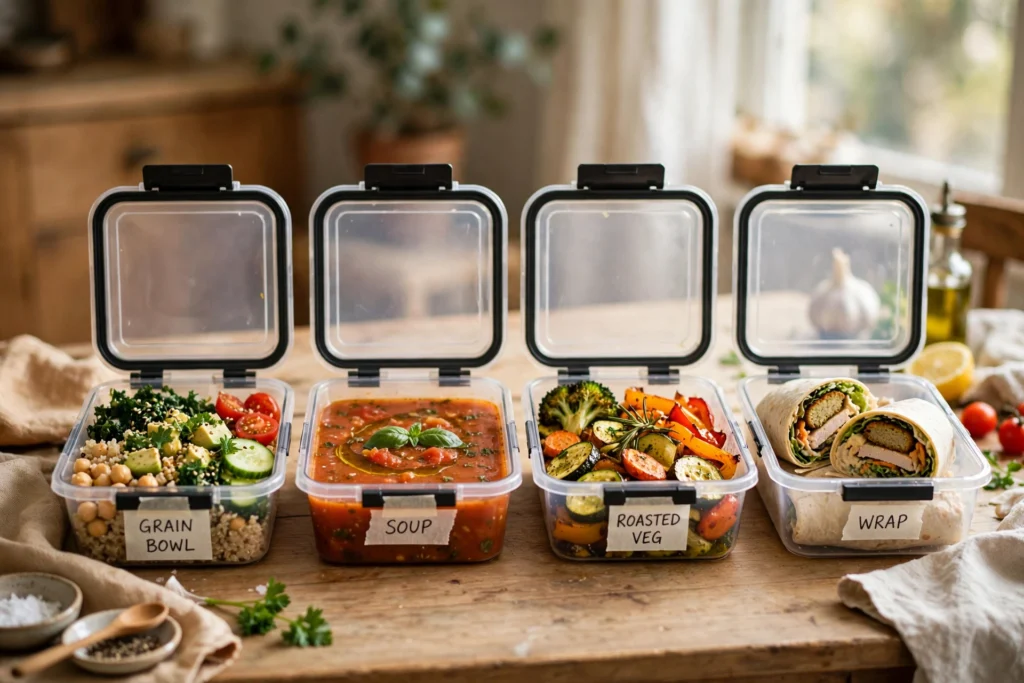
The menu combines a small set of ingredients differently, so the same food never feels like the same meal twice. Monday: a grain bowl with tray vegetables and sauce, dressing packed separately.
Tuesday: the pot — lentil soup or bean stew — with bread, or over rice. Wednesday: the fresh meal, cooked in twenty minutes — a stir-fry from the vegetables that need using up, or a one-pot pasta.
Thursday: the second half of the pot, or the last grain bowl. Lunch is a wrap of leftover tray vegetables and beans, or a portion of the pot.
Swap any meal for another your household likes, as long as the ingredients stay the same.
Equipment and Containers for a One-Hour Session
A one-hour session uses a short list of equipment: one large pot with a lid, one frying pan, one baking tray, one chopping board, one good knife, a peeler, a mixing bowl, and four to six containers.
A board about 30 by 45 cm (12 by 18 inches) is big enough to work on and small enough to store.
Use square containers that stack and seal, since round ones waste the corners of a small fridge. For matching containers to lids, see How to Organize Food Storage Containers and Lids.
Packing, Labelling, and the Fridge Map
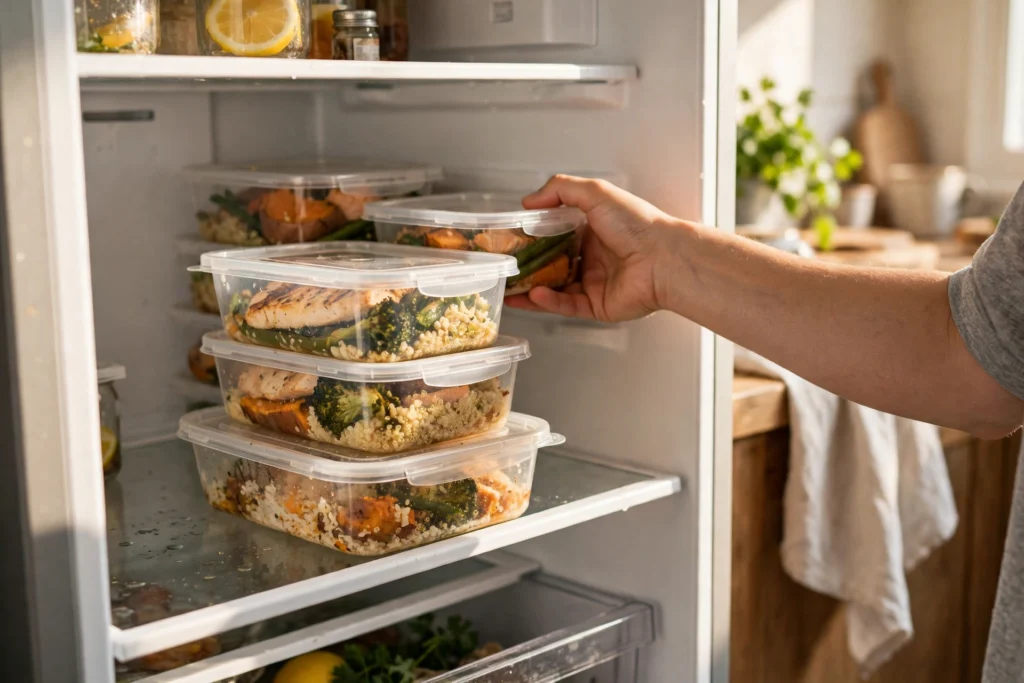
Packing is part of the hour, not an afterthought. Pack the grain first, while it is cool enough to lid.
Pack the tray vegetables next, and the pot last, when it has cooled a little — a hot pot lidded too soon steams up and cools slowly.
Label every container with what is inside and the date, on the container, not the lid, because lids get swapped. Store sauces and dressings separately.
In the fridge, Monday’s food goes at the front and Thursday’s at the back. Chill cooked food promptly and use prepped meals within a few days, following packet guidance. For the fridge layout in full, see Small Fridge Organization for Meal Prep.
To keep the prepped food fresh until its day comes, see How to Keep Meal Prep Ingredients Fresh Throughout the Week.
Adapting the Plan to Your Kitchen and Your Week
Without an oven, the tray becomes a second pot: vegetables steamed or fried in a pan, or a second grain. Without two hob rings, run the grain and the pot in sequence and take seventy-five minutes instead.
For one person, halve the grain and the tray; a pot of soup becomes three meals instead of two. In a shared kitchen, do the hour when the kitchen is quiet, label containers with your name, and wash up as you go.
If an hour is too long, split it across two evenings. If the week changes, move the meals around and use a standby from the cupboard.
If counter space is the tight part, the one-board method helps — see How to Meal Prep with Limited Counter Space.
When the Hour Runs Over
Every plan runs over sometimes, and the fix is not to cook faster — it is to cut something. If the pot is not ready, leave it simmering and pack what is done: the grain and the tray are a full meal on their own.
If the chopping is taking too long, chop less — one tray is enough.
Do not skip the reset to catch up. The last five minutes make the kitchen usable on Monday morning.
If the hour keeps running over in the same place, the plan is wrong, not you: swap a slow pot for lentils that cook in twenty-five minutes, or cook the batch on its own another day — see Batch Cooking in a Small Kitchen: Tips to Save Time and Space.
Common Mistakes to Avoid
Trying to prep a whole week in one hour. A small fridge cannot hold seven days of food. Prep for three or four days, then cook fresh midweek.
Cooking five new recipes in one session. New recipes take longer and leave more washing up. Start with two or three familiar dishes.
Starting with the chopping. Chop first and the hob sits empty while the counter fills up.
Skipping the ten minutes before the hour. A session that starts with searching for lids is an hour lost before it begins.
Packing everything into one big container. Use smaller containers, so you take out one portion and the rest stays fresh.
Forgetting to label containers. Unlabelled food gets opened, sniffed, and thrown away. Label everything with the contents and the date.
Skipping the final reset. A kitchen left messy after prep is a kitchen nobody wants to cook in on Monday.
Frequently Asked Questions
Can I really meal prep for the week in one hour?
You can prep for three or four days in one hour, which is what a small fridge holds comfortably. Plan Monday to Thursday, cook fresh midweek, and leave Friday open.
What should I cook first?
Start the grain and the tray first — they cook themselves while you chop. Then the pot, the cold work, and pack last.
How do I meal prep in one hour with a small fridge?
Prep for three or four days, not a full week. Use square containers that stack and label everything.
What if I do not have an oven?
Cook the tray vegetables in a pan, or steam them. Grains, lentils, beans, soups, and stews all cook on the hob.
How do I fit meal prep into a busy week?
Fix the hour to one slot and protect it. If an hour is too long, split it into two thirty-minute sessions. For the full journey from shopping to storage, see Small Kitchen Meal Prep Workflow: From Grocery Shopping to Storage.
Conclusion
One hour meal prep works when the order is right, not when you cook faster. Fix the hour to one slot, spend ten minutes on the plan and set-up, then work in blocks: passive cooking first, chopping while it cooks, the pot next, packing last, and five minutes for the reset.
One grain, one tray, one pot, and a few labelled containers cover Monday to Thursday, with Wednesday’s fresh meal and an open Friday to carry the week.
Try it this week: pick the hour, choose three familiar meals, and run the plan once. For your next step, read A Small Kitchen Cleaning and Organization Routine You Can Maintain, which keeps the kitchen ready for the next prep session.
8 thoughts on “One-Hour Meal Prep Plan for Busy Weekdays”