
A Small Kitchen Cleaning and Organization Routine You Can Maintain
A small kitchen cleaning routine works when it is short, regular, and realistic. The core of it is a two-minute reset after cooking, a one-hour weekly session, and a ten-minute monthly check of one cabinet, drawer, or shelf.
Small kitchens do not need a deep clean every day — they need the same few habits, done often enough that mess never builds up.
Table of Contents
- What a Kitchen Routine Really Is
- Start With a Clean Slate: The One-Time Reset
- The Daily Reset: Two Minutes After Cooking
- Daily Habits That Do the Heavy Lifting
- The Weekly Routine: One Hour, One Focus
- The Monthly Check: Cabinets, Fridge, and Pantry
- The Seasonal Reset: Four Times a Year
- Fitting the Routine to Real Life
- Tools and Supplies That Support the Routine
- When the Routine Breaks Down
- Common Mistakes to Avoid
- Frequently Asked Questions
- Conclusion
What a Kitchen Routine Really Is
A routine is not a cleaning schedule printed on the fridge and ignored by Thursday. It is a small set of habits tied to things you already do: wash up while food cooks, wipe the counter before you sit down to eat, and put everything back before you leave the kitchen.
It matters more in a small kitchen because there is nowhere for mess to hide. A pile of washing up takes the only preparation space, so the next meal starts with clearing up instead of cooking.
A routine keeps the kitchen usable, not perfect. If the counter is clear, the sink is empty, and you can find what you need, the routine is working. For the wider picture, see 25 Smart Small Kitchen Organization Ideas That Make Every Inch Count.
Start With a Clean Slate: The One-Time Reset
A routine cannot fix a kitchen that is already full. Before you start, do one full reset — the same groundwork as a declutter — so the routine starts from order rather than chaos.
Pick a weekend and work one area at a time: clear the counter, empty one cabinet, sort everything into keep, donate, relocate, and throw away, and put back only what you use. Check food dates and match lids to containers as you go.
For the full steps, see How to Declutter a Small Kitchen: A Step-by-Step Guide. Then clean the empty spaces before anything goes back: wipe shelves, clean the sink, wipe the hob, and mop the floor.
This is the only deep clean the routine needs at the start. After that, the daily and weekly habits keep the kitchen at that standard.
The Daily Reset: Two Minutes After Cooking
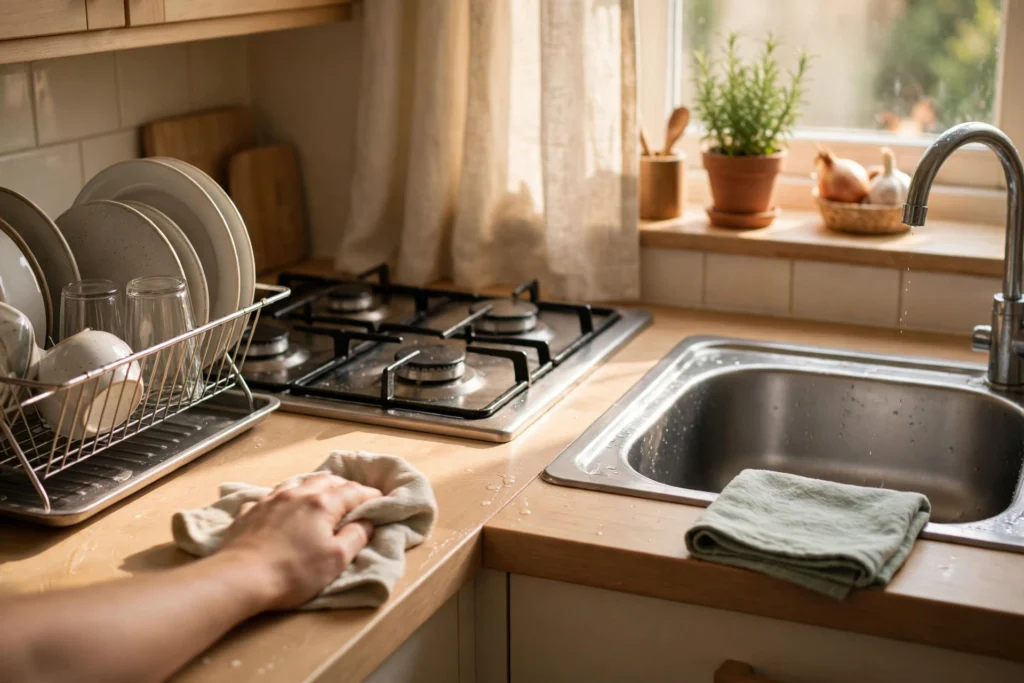
The daily reset is the single most important part of the routine, and it takes about two minutes. Do it after cooking, before you sit down to eat.
Wash up or load the dishwasher, wipe the counter and the hob, and put everything back where it belongs. That is the whole reset: clean dishes, clear surfaces, things in their homes.
Do not start a new job — no sorting a drawer, no cleaning the oven. The reset is small precisely so you will do it every day, including on tired evenings.
If you cook more than once a day, do a shorter version after each meal: plates away, crumbs wiped, board and knife put away.
Daily Habits That Do the Heavy Lifting
The reset works because a few small habits support it. The first is to clean as you cook: fill the sink with hot soapy water before you start, and wash a pan or board the moment you finish with it.
While food simmers, wipe a surface or put away an ingredient you have finished with. The second habit is to put things back immediately after use: a spice jar left on the counter becomes three by the end of the week.
Returning each item to its home takes seconds and stops the slow drift that fills a small kitchen. The third habit is the one-in, one-out rule.
When a new mug, gadget, or container comes into the kitchen, an old one leaves. Small kitchens have no spare capacity, so every new item needs a place — and the place comes from something going, not from a new shelf.
The Weekly Routine: One Hour, One Focus
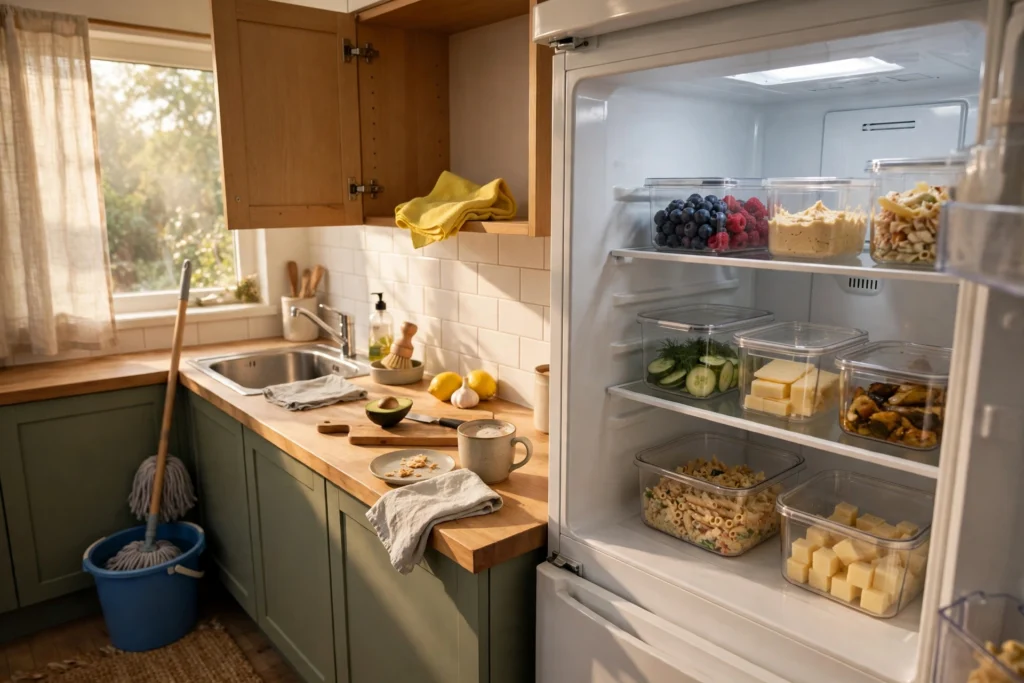
Once a week, set aside about an hour at a fixed time — for example Saturday morning. The hour has four parts.
First, the surfaces: wipe the worktops, the hob, the sink, and the cabinet fronts, clean the microwave inside, and wipe the kettle and toaster. Second, the floor: sweep, then mop.
In a small kitchen this takes ten minutes, and it makes the whole room feel clean. Third, the fridge: take out anything past its date, wipe one shelf, and move the oldest food to the front.
Fourth, one focus area: rotate through one cabinet, drawer, or shelf each week — open it, remove anything that does not belong, wipe the base, and put everything back by job. Over a month, every area gets checked once.
For drawer layouts, see How to Organize Kitchen Drawers in a Small Kitchen. For cabinet layouts, see Small Kitchen Cabinet Organization: Practical Ideas for a Clutter-Free Space.
The Monthly Check: Cabinets, Fridge, and Pantry
Once a month, spend half an hour on the three places where clutter builds quietly: cabinets, fridge, and pantry.
In the cabinets, check for the slow return of clutter: the extra mug, the gadget bought for one recipe, the lid with no container. Ask the same four questions as a declutter — used monthly, unique job, good condition, easy to reach — and let go of anything that fails two or more.
In the fridge, check every date and wipe the shelves. In the pantry, throw away stale open packets and note what is running low before the next shop. For pantry layout, see Small Pantry Organization Ideas for Tight Spaces.
The monthly check also covers the supplies themselves: is the cloth clean, is the sponge due for replacement, are you out of washing-up liquid? Supplies kept in one place — a caddy or a small box under the sink — show at a glance what needs replacing.
For the layout, see Under-Sink Organization Ideas for Small Kitchens.
The Seasonal Reset: Four Times a Year
Four times a year, do a longer session of about two hours — the same reset as the start, but smaller, because the routine has been holding. Work through the kitchen area by area: empty one cabinet, sort, clean the shelf, and put back only what earns its place.
Check the oven and the extractor filter, and wash any curtains or blinds. Seasonal resets are also the time to check what the kitchen no longer needs: the slow cooker unused since winter, the baking tins from last Christmas, the duplicate utensils that crept back in.
A seasonal clear-out of one bag is enough, and it is a good moment to check expiry dates on medicines and cleaning products kept in the kitchen.
Fitting the Routine to Real Life
A routine only works if it fits the household keeping it. A household of one or two can keep the daily reset to two minutes and the weekly hour to forty-five.
In a shared kitchen, agree the routine together first. Divide the weekly hour fairly, write down who does what and on which day, and keep each turn short — a rota that says “wash up, wipe the counters, and take out the recycling on your day” beats one that just says “clean the kitchen”. Review it when someone moves in or out.
For renters, the routine has one extra rule: use cleaning products and methods that will not damage surfaces you do not own. Test a new cleaner on a hidden spot first, avoid abrasive pads, and clean up spills straight away so they do not stain.
A kitchen handed back in the condition it was found in protects your deposit. For renter-specific ideas, see Small Kitchen Organization for Renters: No-Drill Storage Ideas.
Tools and Supplies That Support the Routine
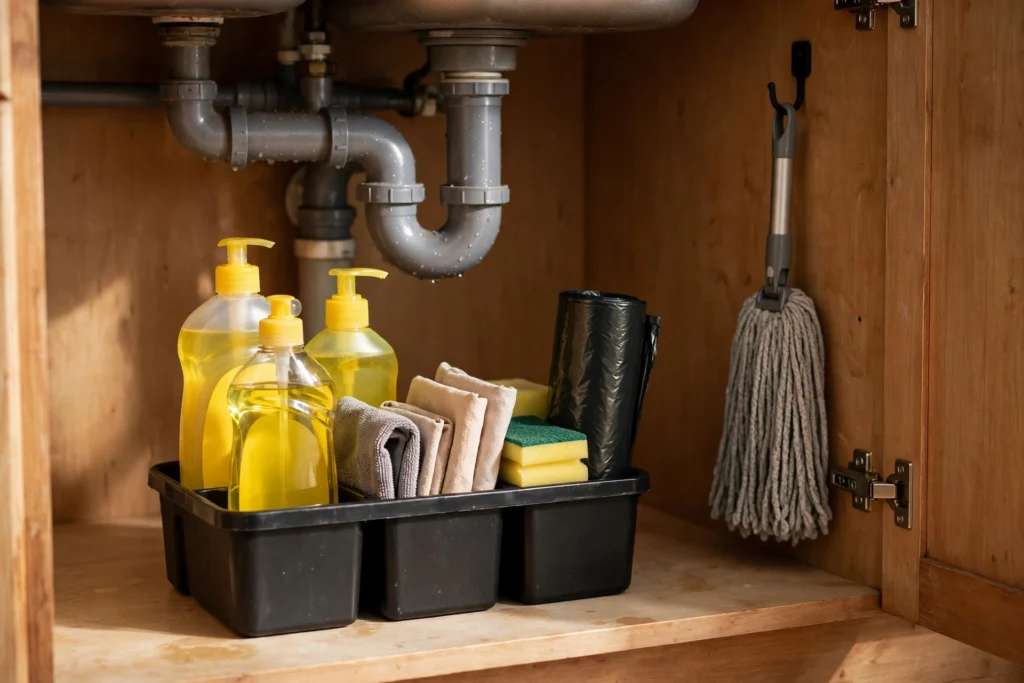
A routine needs very little equipment, kept together in one place — a caddy under the sink, or a small basket on a shelf — so the reset never starts with hunting for a cloth.
The basics are a washing-up liquid, a multi-surface cleaner, cloths, a sponge, a bin bag, and a brush and dustpan. Keep one spare of each, not five: a monthly check will catch what is running low.
Choose tools by their storage footprint as much as by their cleaning power.
A slim mop that hangs on a hook and a small dustpan and brush that fit in one cupboard are worth more than a bulky set that lives on the floor — and anything stored on the floor has to be moved before you can sweep.
When the Routine Breaks Down
Every routine breaks down sometimes — a busy week, a visitor, an illness — and the fix is not a bigger clean, it is a smaller restart. Do not try to catch up on three missed weeks in one evening: that is how a routine gets abandoned.
Instead, do the daily reset once, properly, and nothing else. Clear the counter, wash up, wipe the surfaces, and put things back. That takes twenty minutes even in a neglected kitchen, and it restores the kitchen to usable.
Then do the weekly hour at its normal time, and let the monthly check wait until next month. If the routine keeps breaking down in the same place, the routine is wrong, not you.
Common Mistakes to Avoid
- Trying to do everything every day. A daily deep clean is not a routine, it is a second job. Keep the daily part to two minutes.
- Starting a routine in a cluttered kitchen. Declutter first — no routine fixes a kitchen holding twice as much as it should.
- Skipping the reset after cooking. The reset is the routine. Miss it all week and the weekly hour becomes a rescue.
- Keeping the routine in your head. Write it down — daily, weekly, monthly — and put it where the household can see it. A routine nobody can remember is a routine nobody follows.
- Buying storage or cleaning gadgets to fix a habit problem. A new caddy does not make you wipe the counter. Fix the habit first.
- Making the weekly hour too long. An hour that grows to two gets skipped. Keep it to an hour, rotate one focus area, and stop when the time is up.
- Expecting the routine to stay perfect. Kitchens get messy when life gets busy. A routine that survives a bad week and restarts cleanly is a good routine.
Frequently Asked Questions
How long should a small kitchen cleaning routine take each day?
About two minutes after cooking: wash up or load the dishwasher, wipe the counter and the hob, and put everything back. Clean a little as you cook, and the kitchen stays usable without a daily deep clean.
What should I clean in my small kitchen every week?
Wipe the worktops, hob, sink, and cabinet fronts, clean the microwave, sweep and mop the floor, check the fridge for anything past its date, and spend ten minutes on one focus area — one cabinet, drawer, or shelf.
How do I keep a small kitchen organized long-term?
Keep the daily reset, a ten-minute weekly check of one area, and a monthly check of cabinets, fridge, and pantry. Use one-in, one-out for new items, and a short seasonal reset four times a year.
For containers and lids, the same habits apply — see How to Organize Food Storage Containers and Lids.
How do I share a kitchen cleaning routine with flatmates or family?
Agree it together first: divide the weekly hour fairly, write down who does what and on which day, and keep each turn short. Review the rota when someone moves in or out.
What do I do when my kitchen routine falls apart?
Do one proper daily reset and nothing else — clear the counter, wash up, wipe the surfaces, put things back. Then return to the normal rhythm. If the same part keeps failing, shorten it, move it, or share it.
Conclusion
A routine you can maintain is a short one: a two-minute reset after cooking, a weekly hour with one focus area, a monthly check of cabinets, fridge, and pantry, and a seasonal reset four times a year.
Declutter once at the start, keep supplies in one place, fit the routine to your household, and restart with a single reset when life gets in the way. Pick one part this week — the two-minute reset after cooking — and do it every day for seven days.
For your next step, read Small Kitchen Counter Organization: Keep Your Counters Clear and Useful, which covers the counter habits that make the daily reset easiest.