
Batch Cooking in a Small Kitchen: Tips to Save Time and Space
Batch cooking means making a large quantity of one meal, then eating it over several days or freezing it in portions — so one cooking session feeds you many times. Batch cooking in a small kitchen works best with one big pot or tray at a time, using the equipment you already have.
The secret is choosing meals that cook well in bulk, cooling and portioning them properly, and storing them where a small fridge and freezer can hold them.
Table of Contents
- What Batch Cooking Really Is — and How It Differs From Meal Prep
- What Makes a Meal Batch-Friendly
- Batch-Friendly Meals for a Small Kitchen
- How Much to Cook: Sizing a Batch to Your Fridge and Freezer
- Cooking in Sequence With Limited Equipment
- Batch Cooking in a Small Kitchen: A Session, Step by Step
- Cooling Cooked Food Safely
- Portioning and Labelling
- Freezing and Storing in a Small Freezer
- Reheating Without Drying Food Out
- Common Mistakes to Avoid
- Frequently Asked Questions
- Conclusion
What Batch Cooking Really Is — and How It Differs From Meal Prep
Meal prep usually means cooking several different things in one session — a grain, a protein, and some vegetables — then mixing them into different meals. Batch cooking is narrower: you make a large amount of one dish, such as a pot of soup, and eat it across several meals.
That difference matters in a small kitchen. A batch needs only one pot or one tray, one chopping board, and one set of containers — the same equipment as a normal dinner.
A single pot of lentil soup can become four dinners for one or two people — three or four days in the fridge, plus a few freezer portions, is the right size.
What Makes a Meal Batch-Friendly
Not every meal survives being cooked in bulk. A batch-friendly meal has four qualities. First, it scales: doubling the ingredients doubles the portions without changing the method.
A soup scales easily, while a stir-fry does not, because a crowded pan steams instead of frying. Second, it reheats well; third, it freezes well.
Fourth, it is flexible: the same base can be served in more than one way, so eating it three times does not feel like the same meal three times.
Meals that fail these tests have delicate textures: crisp fried food goes soft, salads wilt, and pasta turns stodgy. Cook the base in bulk and add fresh parts at serving time.
Batch-Friendly Meals for a Small Kitchen
Soups, stews, and curries
Soups, stews, and curries are the classic batch meals: they cook in one pot, use one hob ring, and taste as good on the third day as on the first.
A pot of lentil soup, a bean stew, or a vegetable curry needs a large pot with a lid, a chopping board, and a knife — and little else. They freeze well, so a Sunday pot can cover two fridge dinners and two freezer portions.
Grains and pulses in bulk
Rice, couscous, quinoa, lentils, and beans cook well in large quantities and keep for a few days in the fridge, as the base for grain bowls, wraps, and salads.
Cook one large pot, cool it promptly, and store it in two or three containers rather than one big one. Plain grains, without sauce, are the most flexible.
Sauces and roasted vegetables
A large batch of tomato sauce — onions, garlic, and tinned tomatoes — works with pasta one night, rice the next, and beans after that.
A tray of roasted vegetables does the same: with rice one night, in a wrap the next, and stirred into a soup on the third. Both need only one tray or one pot.
How Much to Cook: Sizing a Batch to Your Fridge and Freezer
The most common batch-cooking mistake is cooking more than the kitchen can store. Before you start, count the space, not the recipe: a small fridge holds a few days of containers, and a small freezer holds two or three portions.
A useful rule is to cook for the household plus one: a pot that makes six portions for a household of two gives two dinners, two lunches, and two freezer portions.
A pot that makes twelve is food that will sit in the fridge until it is thrown away. Start small — one pot, four to six portions — sized to what your fridge can hold and your household will eat within a few days.
Cooking in Sequence With Limited Equipment
A small kitchen rarely has four hob rings free and three large pots. Batch cooking works around that by cooking in sequence: one pot, then one tray, then the next batch.
Start with the longest, most hands-off job — the pot of soup or the tray of vegetables — because it cooks itself while you wash the board and knife and clear the counter.
When the first batch is done and cooling, the pot is free for the second batch. One large pot with a lid, one baking tray, one frying pan, one chopping board, and one good knife are enough for almost every batch.
Wash each tool the moment you finish with it, so the next batch starts with a clean pot and a clear counter. For the counter habits that make this possible, see How to Meal Prep with Limited Counter Space.
Batch Cooking in a Small Kitchen: A Session, Step by Step
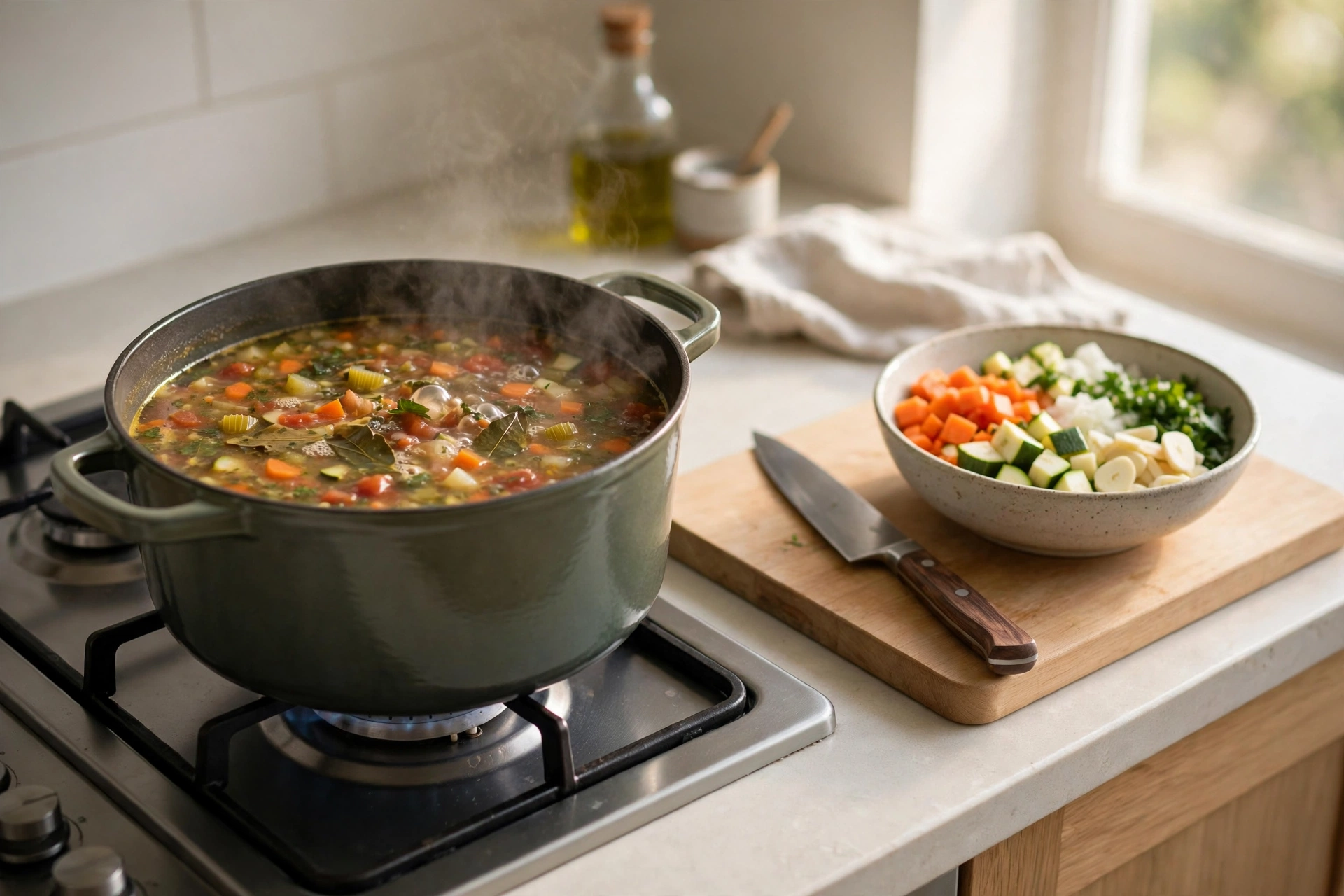
A batch-cooking session is one pot or tray, cooked once, then portioned and stored. First, choose the batch: one meal your household likes, built around ingredients you already have.
Check the fridge, freezer, and pantry before you shop, and buy only what the batch needs. For the planning steps in full, see A Beginner’s Guide to Meal Planning for a Small Household.
Second, clear the counter and set up one workstation — a board, a knife, and a bowl — and chop the vegetables in one wave, from dry to wet.
Third, start the batch: onions and garlic first, then the main ingredients, then liquid, then a lid and a low heat. While it cooks, wash up and wipe the counter.
Fourth, cool and portion: let the batch cool a little, spoon it into single-portion containers, label each one, and put fridge portions at the front and freezer portions at the back.
Fifth, reset: wash the pot and the board, wipe the counter, and return the kitchen to normal. The session is done when the kitchen is clean.
For the wider ideas behind a short session, see Easy Meal Prep Ideas for Small Kitchens. And if you want the batch to fit a timed hour, see One-Hour Meal Prep Plan for Busy Weekdays.
Cooling Cooked Food Safely
Cooling is the part of batch cooking that people rush, and it matters most. A large pot of hot food cools slowly in the middle, so do not leave a whole pot on the counter for hours.
Do not put a steaming pot straight into the fridge either, where it warms everything around it. Portion first: spoon the batch into shallow, single-portion containers, which cool much faster than one deep pot.
Leave the lids off while the food cools, then lid them once cool to the touch. Chill cooked food promptly and use fridge portions within a few days; if food looks or smells off, do not eat it.
Portioning and Labelling
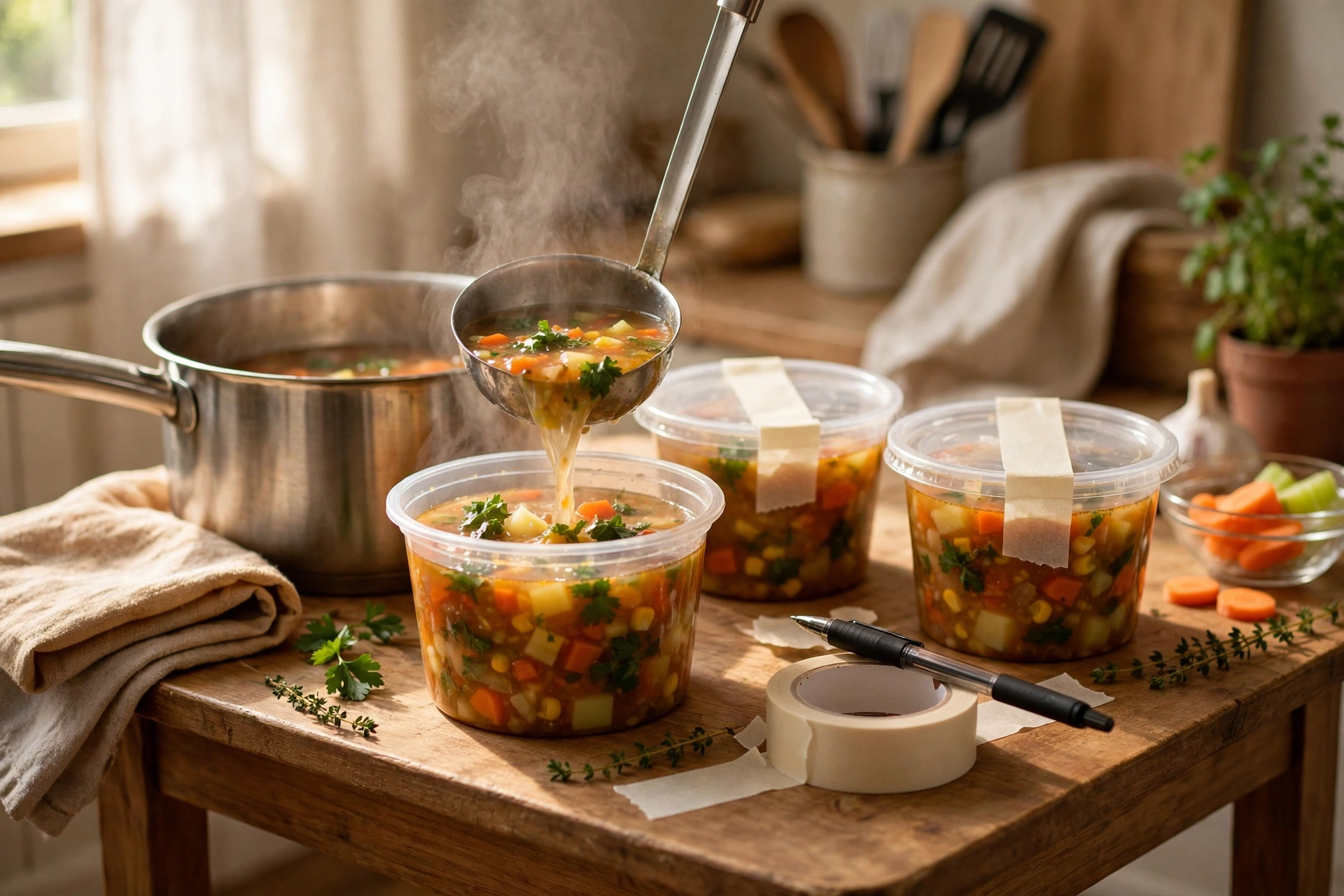
Portioning is what turns a pot of food into meals. Pack single portions, sized to one meal for one person, so you take out exactly what you need and the rest stays sealed.
A large container opened four times is food reheated four times; four small containers are four fresh meals. Label every container with what is inside and the date — a small piece of masking tape and a pen is enough.
Label the container, not the lid, because lids get swapped, and put the oldest food at the front of the fridge. For matching containers to lids, see How to Organize Food Storage Containers and Lids.
Keep the set small: six to eight containers is usually enough for one or two people. For where those containers live when they are not in use, see How to Store Meal Prep Containers in a Small Kitchen.
Freezing and Storing in a Small Freezer
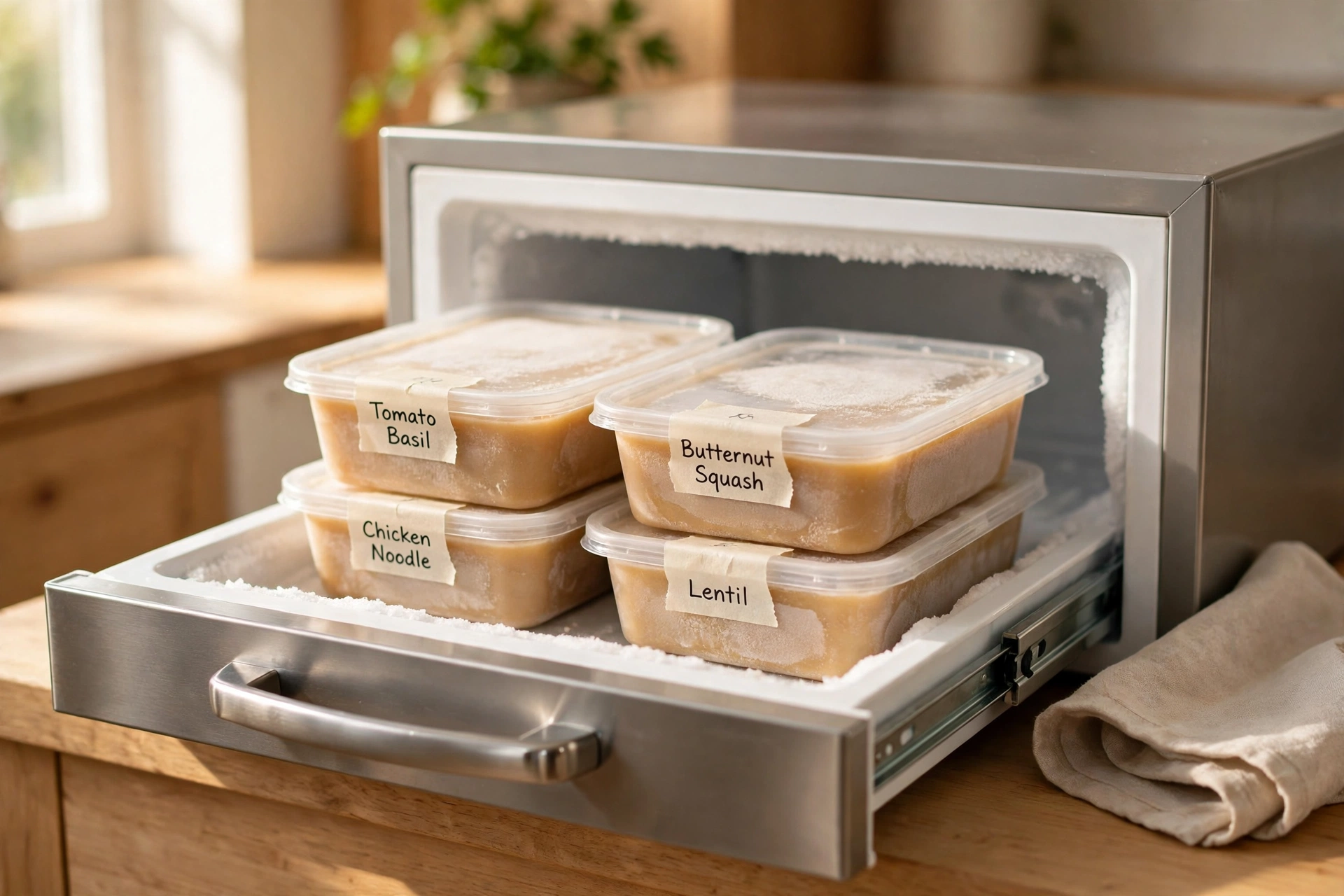
A small freezer is a batch cook’s best friend, but it has strict limits: it usually holds two or three portions of a cooked meal, plus a few basics. It is for the overflow of a batch, not for a month of cooking.
Freeze in flat, single portions: flat, rectangular containers stack better than tall round ones and thaw faster. Leave a little space at the top, because food expands as it freezes.
Label everything with the contents and the date, and put the newest portions at the back, so the oldest gets used first. Soups, stews, curries, cooked grains, and sauces freeze well.
Food that does not freeze well — fresh salads, fried food, and creamy dishes — is better eaten from the fridge within a few days. Use frozen portions within a reasonable time.
For a fuller freezer plan, see Freezer Meal Prep for Small Kitchens: Planning and Storage Tips.
Reheating Without Drying Food Out
The most reliable method is gentle and slow: a small pan on a low heat, with a splash of water or stock, stirred now and then until piping hot throughout.
In a microwave, reheat in short bursts and stir between them, adding a spoonful of water to grains and pasta first.
Reheat only the portion you will eat, never the same portion twice.
Common Mistakes to Avoid
Cooking more than the fridge and freezer can hold. A batch that fills every shelf is food that will be thrown away. Cook for the household plus one, not for a month.
Cooking five different batches in one session. Each extra pot needs counter space, washing up, and storage. One batch, done well, beats three half-finished ones.
Leaving a whole pot to cool on the counter. A deep pot cools slowly in the middle. Portion into shallow containers first, then chill promptly.
Storing everything in one big container. A large container opened four times is food reheated four times. Use single portions.
Forgetting to label containers. Unlabelled food gets opened, sniffed, and put back, then thrown away. Label everything with the contents and the date.
Freezing food that does not freeze well. Salads, fried food, and creamy dishes belong in the fridge for a few days, not in the freezer.
Reheating the same portion twice. Reheat only what you will eat, and reheat it once, until it is piping hot throughout.
Frequently Asked Questions
How do I start batch cooking in a small kitchen?
Start with one pot, four to six portions, of a meal your household already likes — a soup, a stew, or a curry. Cook it once, portion it into single containers, label them, and keep two in the fridge and the rest in the freezer.
How many portions should a batch make?
For a household of one or two, four to six portions is a good batch: two dinners, one or two lunches, and one or two freezer portions. A bigger batch only works if the fridge and freezer can hold it.
What is the best equipment for batch cooking in a small kitchen?
One large pot with a lid, one baking tray, one frying pan, one chopping board, and one good knife. Cook in sequence — one batch at a time — and wash each tool as soon as you finish with it.
How long does batch-cooked food keep?
Fridge portions should be eaten within a few days, following packet guidance where it applies. Freezer portions keep longer, but label them with the date and use the oldest first. If food looks or smells off, do not eat it.
Can I batch cook without a freezer?
Yes. Cook a batch that covers three or four days in the fridge, and eat it across those days.
Without a freezer, cook smaller batches more often — two short sessions a week instead of one big one. For the fridge layout, see Small Fridge Organization for Meal Prep.
Conclusion
Batch cooking in a small kitchen is a question of size, order, and storage — not of space. Choose meals that scale and reheat well, cook one pot or tray at a time, and size the batch to your fridge and freezer.
Cool it promptly in shallow, single portions, label every container, and reheat gently until piping hot.
Start this week with one pot and four to six portions: a soup, a stew, or a curry your household already likes. For your next step, see Small Kitchen Meal Prep Workflow: From Grocery Shopping to Storage, which takes the batch from the shop to the shelf.
6 thoughts on “Batch Cooking in a Small Kitchen: Tips to Save Time and Space”