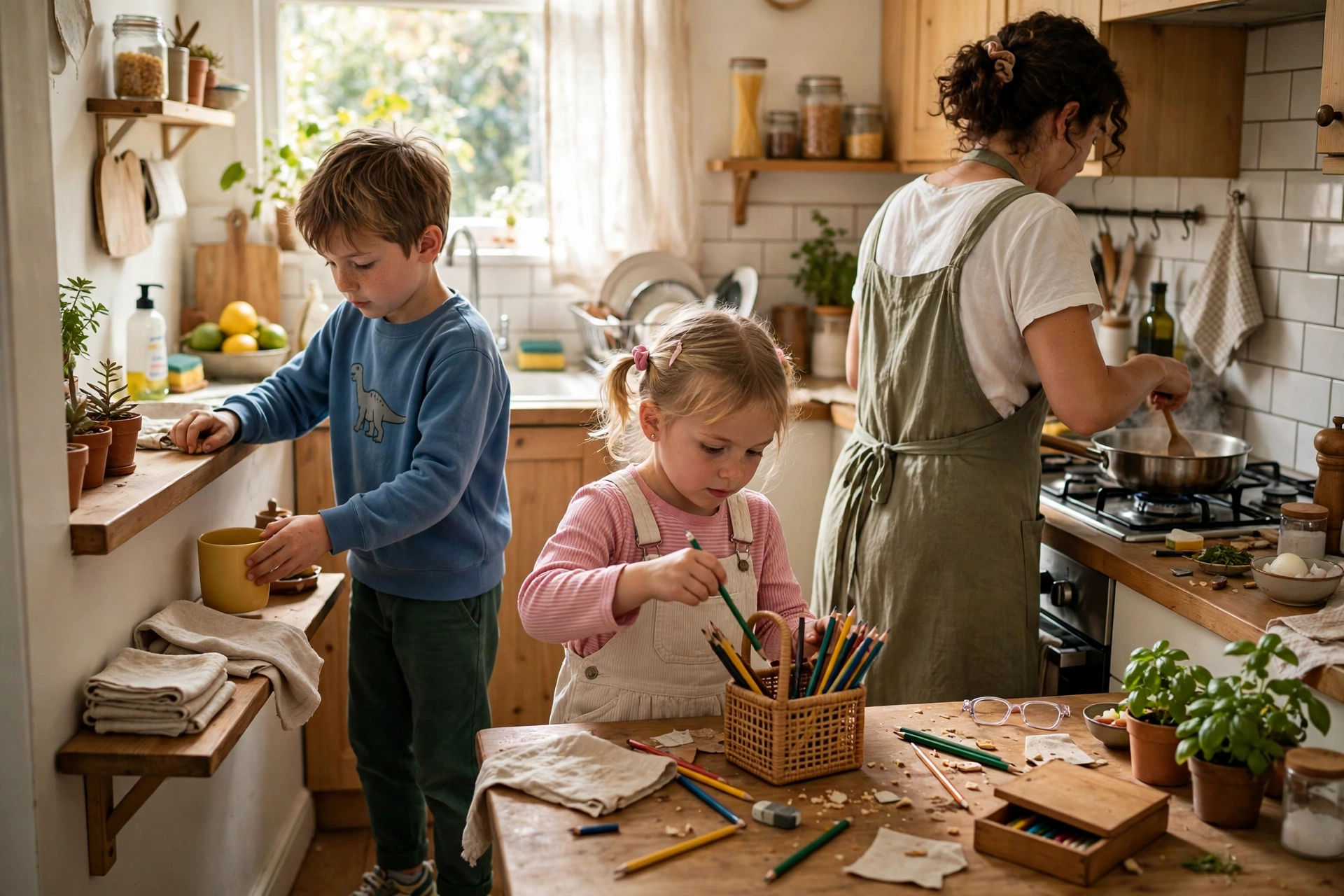
Yes, you can keep a small kitchen tidy with kids in the house. Good small kitchen organization with kids is not about stricter rules or a bigger room — it is about giving every child a colour, a corner, and one small job.
Kids bring their own clutter: cups by the sink, school papers, craft supplies on the table. When three people cook, eat, and do homework in one small room, the mess multiplies.
This guide takes a different angle from the usual family-kitchen advice. Instead of reorganizing the room around the kids, it shows you how to bring the kids into the system — that is what small kitchen organization with kids means: children who help keep the room tidy, not children kept out of it.
Table of Contents
- Why Small Kitchen Organization With Kids Feels Harder
- Give Every Child a Colour
- A Kids’ Corner That Packs Away
- Teach Kids to Put Things Back, One Age at a Time
- The After-School Landing Spot
- Cooking Dinner With Kids Underfoot
- When Kids’ Stuff Takes Over the Counter
- Common Mistakes to Avoid
- Frequently Asked Questions
- Conclusion
Why Small Kitchen Organization With Kids Feels Harder
A kitchen shared with kids has more users than one shared with adults, and the users are less predictable. A toddler empties a drawer just to see what is inside, a seven-year-old leaves snacks on every surface, and a teenager cooks at midnight and leaves the pan to soak.
The room also does more jobs at once. Breakfast, homework, crafts, and dinner all happen in the same few square feet, often in the same hour — so the counter ends up holding school bags, glue sticks, and a chopping board.
That is the real challenge of small kitchen organization with kids: more jobs, more users, one small room. The fix is not to ban kids from the kitchen — it is to give each child a small, clear part of the system, and to make putting things back easier than leaving them out.
The family kitchen guide covers the wider setup — zones, a lunchbox station, and a daily reset — while this guide focuses on the kids’ side: habits, colours, and corners they own.
Start by watching one normal afternoon. Notice where the kids stand, what they drop, and where things pile up. Those pile-up spots are where your new system needs to work hardest.
A quick clear-out helps too — the decluttering guide shows how to free a shelf without turning it into a weekend project.
Give Every Child a Colour
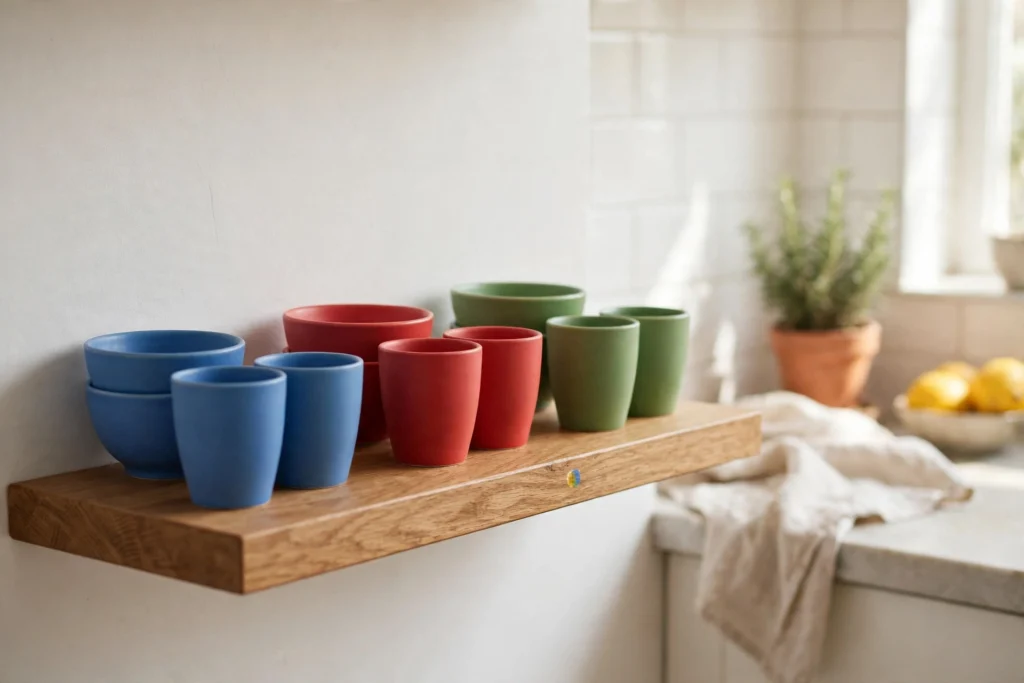
Colour is the simplest system a child can follow, because it works before reading. Give each child one colour, and use it on their cup, their bowl, their hook, and their storage box.
That is why colour sits at the heart of small kitchen organization with kids: when everything blue belongs to one child, there is nothing to argue about.
Keep the coloured things together on one low shelf, so each child finds their own cup without asking. A coloured dot on the shelf edge marks the spot, and a coloured peg holds their apron or water bottle.
The colour system also ends the mystery of the missing cup. A blue cup in the sink belongs to one child, and a red bowl on the table to another. That ownership makes children far more likely to put their own things away.
One colour per child is enough — add colours for every type of item and the system turns into a chart nobody follows. For help giving each shelf or drawer a single job, see How to Organize Kitchen Cabinets by Zone.
A Kids’ Corner That Packs Away
Kids do homework and crafts at the kitchen table because that is where you are. The problem is the homework that stays out all evening and turns the table into a desk.
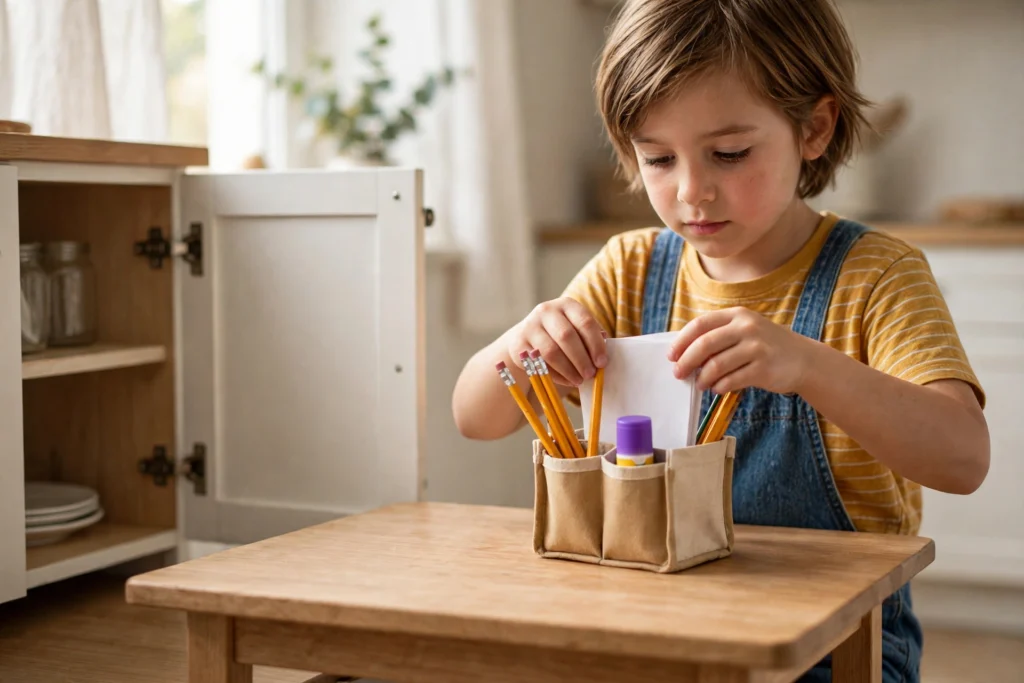
A corner that packs away is the answer in small kitchen organization with kids. Give homework and crafts one caddy — a small box that holds pencils, paper, scissors, and glue. It lives in one cupboard, comes out when the kids sit down, and goes back when they finish.
Set one rule for the table: when dinner starts, the table is clear. That keeps the evening meal separate from the school day, and it gives the kids a clear finish line. A timer helps younger children — ten minutes to pack the caddy away before dinner.
If you have an island, it can hold the caddy during homework time and free the main table for cooking. The small kitchen island guide shows how to give an island drawer a single job, which works well as the caddy’s home.
Keep the caddy light — if it holds everything a child owns, it becomes too heavy to carry and too full to close. A few pencils, a glue stick, and a small pad are enough.
For the drawer the caddy lives in, see How to Organize Kitchen Drawers in a Small Kitchen.
Teach Kids to Put Things Back, One Age at a Time
Small kitchen organization with kids works best when each age group has exactly one job. One job is easy to remember and easy to check. Four jobs are a chore chart nobody looks at.
Under Threes
Toddlers can put their own cup in the sink and push their chair in. That is enough. At this age the habit matters more than the result, so praise the trying and fix the spill yourself.
Ages Four to Seven
Children this age can clear their own plate, hang their cup on its hook, and pack the homework caddy away. Give the job a name they like — “cup captain” or “caddy closer” — and let them own it for a week.
Ages Eight to Twelve
Older children can wipe the table, load their own dishes, and check their shelf. They can also help with dinner prep — washing vegetables or tearing lettuce — which teaches them where things live.
Teenagers
Teenagers can take one evening job, such as clearing the table or wiping the counters. Agree it together, and keep it to one job — a teenager who owns one job will do it.
The After-School Landing Spot
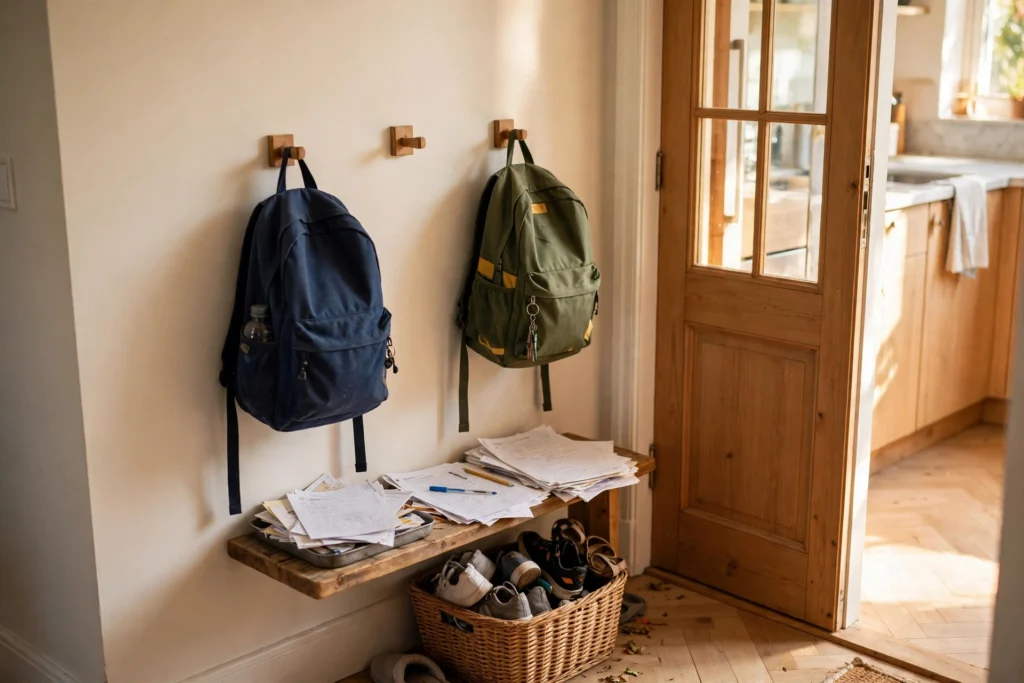
The after-school hour is where small kitchen organization with kids is tested most. Bags, coats, papers, and hungry children arrive at once, and the kitchen is the first room they reach. Without a landing spot, all of it ends up on the counter.
Pick one spot near the door — a low hook for each bag, a small tray for school papers, and a basket for shoes. It must be closer to the door than the counter, because children drop things at the first flat surface they meet.
Hungry children head straight for the food, so keep one basket of after-school snacks they can take themselves. Fruit, crackers, and cheese are easy to grab, and they keep small hands away from the cooking area.
Perishable snacks such as yogurt and cut fruit belong in the fridge, not on the counter, and the FDA’s guidance on storing food safely covers the same cool-and-dry rule for food kept at home.
For the bottles and boxes the kids carry each day, see How to Organize Food Storage Containers and Lids — one matching set in a single low cupboard stops the morning hunt for a missing lid.
Cooking Dinner With Kids Underfoot
Cooking with children is the hardest test of small kitchen organization with kids. You are cooking while the kids are hungry, bored, and underfoot.
The trick is to give them a job that keeps them in one spot. Mark a standing spot on the floor with a strip of tape or a small mat, beside the counter but away from the hob. That is the helper’s spot.
A child standing there can stir a cold mixture, wash vegetables, or tear lettuce — close enough to help, far enough from the heat. Give the helper one task per meal.
A child who tears the lettuce knows what to do and when to stop. A child handed three tasks wanders off, and the lettuce ends up on the floor.
Keep the tools you use in one place, so a small helper never reaches across you for a spoon. A child who watches a calm cook learns to cook calmly.
Sharing a small kitchen works the same way whether the other person is a child or a housemate — one cook, one helper, clear spots for both. Small Kitchen Organization for Shared Kitchens has more on keeping a small kitchen workable when two people use it at once.
When Kids’ Stuff Takes Over the Counter
The one-in, one-out rule is the simplest guardrail in small kitchen organization with kids. Even with a good system, things drift onto the counter: a half-built model, a library book, a hairbrush, a toy car.
The counter is the biggest flat surface in the room, and children treat it as a shelf. When a new cup, toy, or craft box arrives, an old one leaves — the rule stops the slow build-up nobody notices until the counter is full.
Keep one small box on a shelf as a lost-and-found. Anything left on the counter at bedtime goes into it, and anything still there after a week goes back to the bedroom or out of the house. The box makes the rule visible instead of a daily argument.
If the counter still fills up, the landing spot or the caddy is usually too small — not the children. Make the right spot bigger before you blame the kids.
A short weekly routine keeps the whole kitchen going between deeper cleans — for a fuller plan you can keep up all year, see A Small Kitchen Cleaning and Organization Routine You Can Maintain.
For more ways to keep counters clear, read Small Kitchen Counter Organization: Keep Your Counters Clear and Useful.
Common Mistakes to Avoid
Most small kitchen organization with kids fails in the same few ways — avoid these and the system will last much longer.
Expecting adult tidiness from children. A seven-year-old will not keep a shelf as neat as you would. Judge the system by whether things get put back, not by how straight they sit.
Too many rules at once. Five new rules in one week will last about a day. Start with one rule — the coloured cup, or the caddy — and add the next one only when the first one sticks.
A system only you understand. If the children cannot explain where their things live, the system lives in your head, not in the kitchen. Ask them to show you where their cup goes, and fix whatever they get wrong.
Punishing the mess instead of fixing the spot. A child who leaves a cup on the counter is telling you the hook is too high or the shelf is too full. Move the spot before you blame the child.
Doing the tidy-up for them. It is faster to clear the table yourself than to wait for a child. But every time you do it for them, the system teaches them someone else will tidy up. Let the job take five slow minutes, and let them own it.
Frequently Asked Questions
How do I get a child who refuses to tidy to help?
Make the job tiny, visible, and theirs alone. A child who will not “tidy the kitchen” will often carry one caddy back to its drawer, because the job has a clear end. Let them choose between two jobs.
My kitchen is tiny — where do I put a kids’ corner?
You do not need extra room. The corner is a caddy, not a piece of furniture: it lives in one drawer and comes out onto the end of the table. A wall hook and a coloured dot are enough to mark a child’s space.
How do I keep the kitchen organized when the kids have friends over?
Give guests the same simple rules, and keep one spare cup in a guest colour for the visiting child. After friends leave, run a two-minute reset — caddy away, cups in the sink, table clear — before the next meal.
What if two children share one small kitchen and keep arguing over space?
Split the shelf down the middle, one half per child, with shared items in the centre. Each child owns their half and their colour. Arguments drop fast when the line is visible.
Conclusion
Small kitchen organization with kids is not a project you finish once. It is a system that grows with your children — one colour, one corner, one job at a time.
Pick the easiest win first: give each child a colour this weekend, or set up the homework caddy. When that change sticks, add the next. A kitchen your kids help keep tidy stays tidy.