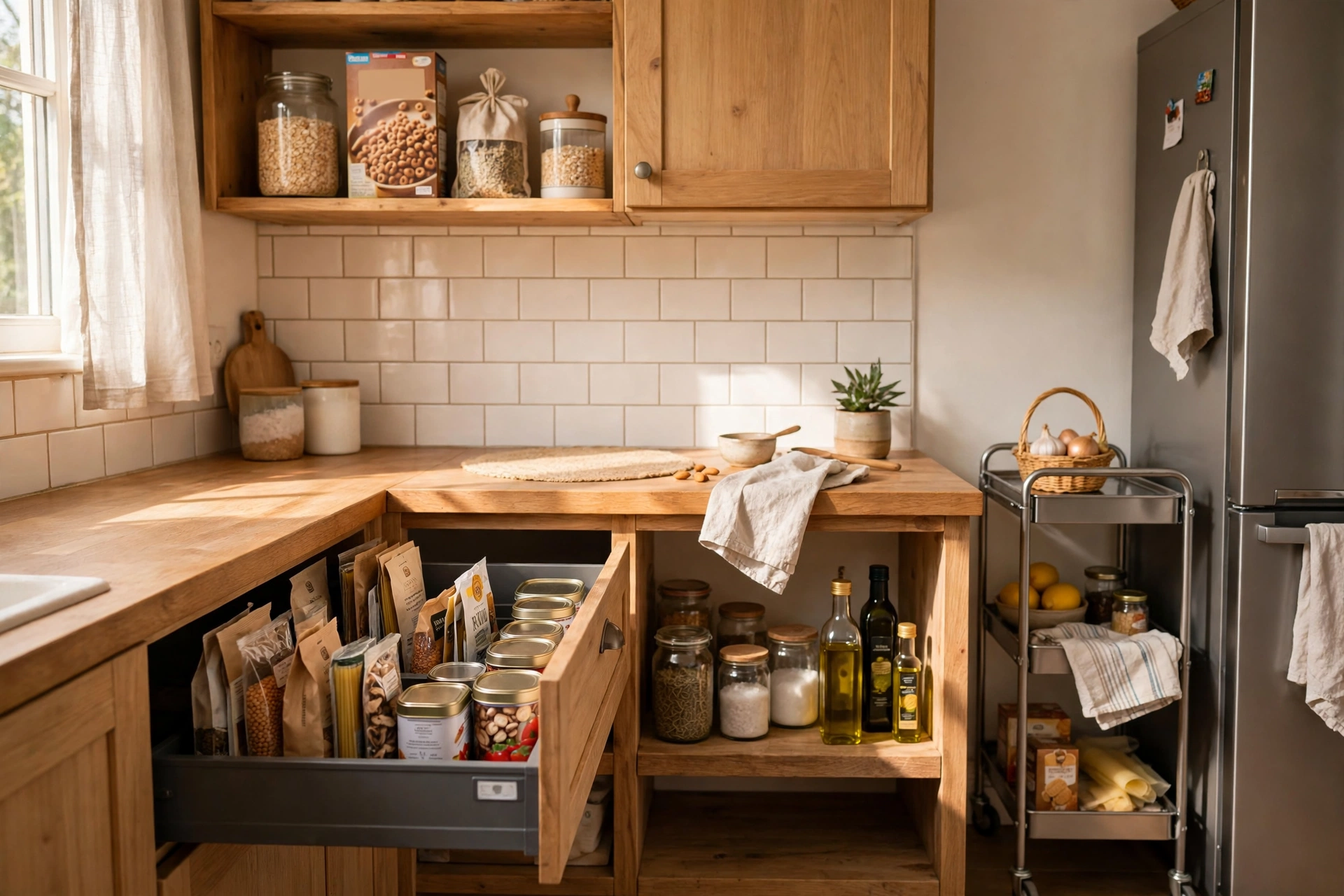
Yes, you can run a tidy kitchen with no pantry at all. Good small kitchen without pantry organization means giving your dry food a few fixed homes across the cabinets, shelves and a cart, so every tin, packet and jar has one place to live.
There is no single cupboard to open. Once each group has a home you can name — breakfast on the top shelf, cooking in the drawer — finding things becomes automatic.
This guide shows you how to build that system from what you already have: map your food into groups, give each group a home, and keep a list that stops you buying duplicates.
Table of Contents
- What “No Pantry” Really Means
- Start With a Pantry Map, Not a Shopping Trip
- The Five Homes That Replace a Pantry
- Small Kitchen Without Pantry Organization for a One-Wall Layout
- Keep Dry Food Safe Without a Pantry
- A Shopping List That Stops Duplicates
- Common Mistakes to Avoid
- Frequently Asked Questions
- Conclusion
What “No Pantry” Really Means
A kitchen with no pantry is not a failed kitchen. It usually means the dry food that would fill one cupboard is spread across several smaller spots instead.
In older flats and small rentals, the cupboards were built for plates and pans, not for a week’s worth of food. The tins end up above the fridge, the pasta lands in a drawer, and the cereal sits on top of a cabinet.
In small kitchen without pantry organization, that spread is only a problem when it is random. When the same food always lives in the same spot, the spread works just as well as a pantry, because nothing hides behind anything else.
For the wider picture of working with limited cupboards, see How to Organize a Small Kitchen with Limited Cabinet Space.
Start With a Pantry Map, Not a Shopping Trip
Before you move a single tin, write a short map on paper. List the dry food you actually keep at home, in the groups you cook with: breakfast, everyday cooking, baking, snacks, and drinks.
Next to each group, write the one home it will live in. Breakfast might take the top shelf of the wall cabinet, everyday cooking the deep drawer, and baking the high shelf above the fridge.
Small kitchen without pantry organization works best with five or six groups, and each group gets exactly one home, never two.
If a home you have chosen is already full of something else, clear that spot first. The decluttering guide shows how to free a shelf without turning it into a weekend project.
The map also stops a common trap: buying storage before you know what it has to hold. A home that fits your food is worth more than a clever container that does not.
For help giving each cabinet a single job, see How to Organize Kitchen Cabinets by Zone.
The Five Homes That Replace a Pantry
In small kitchen without pantry organization, no single spot holds a whole pantry’s worth of food, so the work is shared between five homes. Each one suits a different kind of food.
The trick is to match the food to the home, not the other way round. Heavy tins need a low, strong shelf, while light packets and cereal suit a high shelf you reach once a day.
For more ways to add storage without changing the room, see How to Create More Storage in a Small Kitchen Without Remodeling.
A High Cabinet Shelf
A high shelf in a wall cabinet is the best home for breakfast. Cereal, oats, tea, coffee and spreads are light, used once a day, and easy to lift down in one trip.
Keep only breakfast on that shelf, so the morning routine needs one reach and nothing else. Put the cereal you eat most at the front, and anything you use weekly behind it.
A small tray keeps the group together: lift it down for breakfast, and put it back as one piece when you are done.
A Deep Drawer
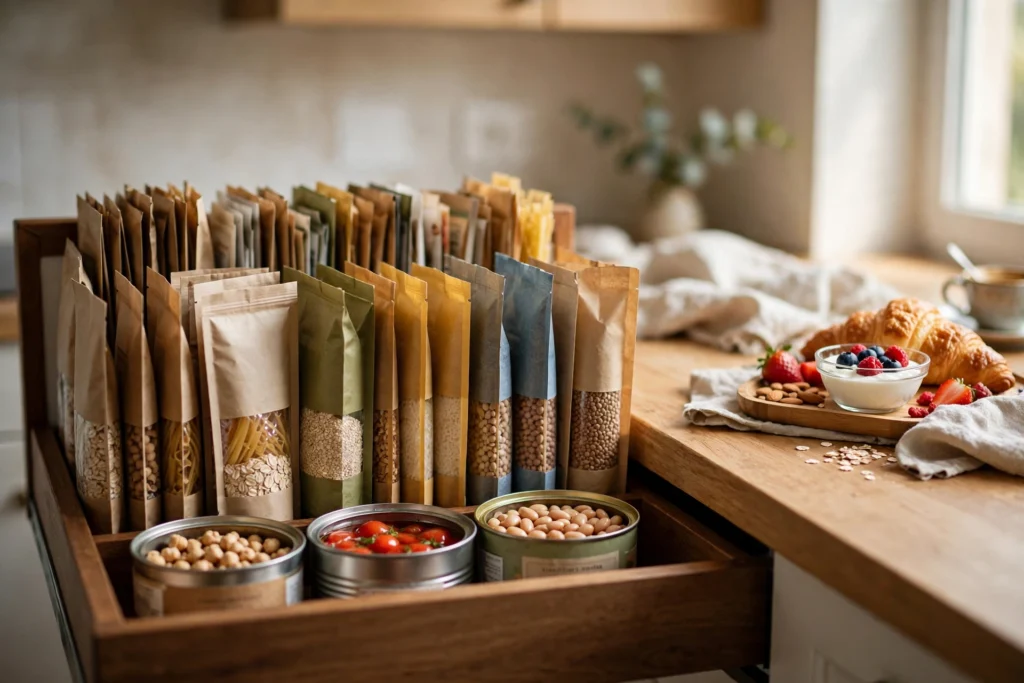
A deep drawer is the best home for everyday cooking food. Rice, pasta, tins, stock and sauces sit low and steady, and a drawer lets you see them all at once when you pull it open.
Stand packets upright in rows, like books on a shelf, so you can read every label without moving anything. Tins sit in a single layer at the front, where you can grab one without digging.
Keep the drawer for cooking food only, or plates and tools will push the food to the back and the system will quietly fall apart.
For more drawer ideas, see How to Organize Kitchen Drawers.
For the cabinet habits that keep a drawer like this working, see Small Kitchen Cabinet Organization: Practical Ideas for a Clutter-Free Space.
One Open Shelf
One open shelf on a wall is a useful home in small kitchen without pantry organization: it holds the food you reach for while you cook. Oils, sauces, salt, pepper and your most-used spices live here, close to the hob and easy to grab mid-recipe.
Everything on it is visible, so nothing gets forgotten at the back. Keep it to one row, with nothing stacked in front of anything else.
Only food you use most days earns a place here. Anything you touch once a month belongs in a cabinet, where it is out of the way but still easy to find.
The Top of the Fridge
The top of the fridge is a handy home in small kitchen without pantry organization, holding bulky, light food you use weekly. Large cereal boxes, spare packets of pasta, crackers and baking supplies sit up there without taking a single cupboard shelf.
Keep heavy things off it. A stack of tins up high is hard to lift down safely, and a falling tin can hurt, so tins stay low in the drawer.
Put a tray or a low box up there to stop packets sliding off the back. A tray also makes cleaning easy, since you lift one thing down instead of a dozen loose packets.
For ideas on using the height above your cabinets and fridge, see Vertical Kitchen Storage Ideas for Small Spaces.
A Slim Rolling Cart
A slim rolling cart is the moving home in small kitchen without pantry organization. It holds drinks, snacks or baking supplies, and it slides into the gap beside the fridge or between the counter and the wall when you are not using it.
Choose a cart a little narrower than its gap, so it rolls freely without scraping. Keep heavy items on the bottom shelf, so it stays steady when you pull it out.
Give the cart one job, just like every other home. A cart that holds a bit of everything becomes a second junk drawer within a month, and then it helps nobody.
Small Kitchen Without Pantry Organization for a One-Wall Layout

A one-wall kitchen has no corner to hide food in, so small kitchen without pantry organization has to work in a straight line. The order along the wall matters more than the number of cupboards.
Put breakfast at one end of the wall, near where you stand in the morning, and cooking beside the hob, so food travels the shortest distance to where you use it.
Keep the counter between the two homes clear, because that stretch is your working space. If the cart lives at the far end, roll it to the hob while you cook, then roll it back when you are done.
An island or a narrow table can help here too, if you have one. The small kitchen island guide shows how to give an island drawer a single job, which works well as one of your five homes.
Keep Dry Food Safe Without a Pantry

In small kitchen without pantry organization, food stored across several homes still needs the same care as food in a pantry: a cool, dry place, away from heat and steam. The homes you choose should meet that test first, before convenience.
Keep food away from the hob, the oven and the sink: steam and heat shorten the life of dry food, and a splash can ruin an open packet in seconds.
Sealed containers help for the dry foods you open often, such as flour, rice and cereal. A lid that closes firmly keeps out damp and stops spills when a packet gets knocked over in a drawer.
Check the guidance on storing food safely from the FDA, which covers the same cool-and-dry principle for food kept at home.
For keeping containers and their lids from taking over a shelf, see How to Organize Food Storage Containers and Lids.
A Shopping List That Stops Duplicates
In small kitchen without pantry organization, it is easy to buy a second bag of rice while one sits unopened on top of the fridge, with no pantry to glance into. A list that names the home stops that happening.
Before you shop, walk the five homes and check each one. Write down only what is low or missing, and add the home next to it, such as “oats — top shelf” or “tinned tomatoes — drawer.”
That home note matters. When you put the shopping away, it tells you exactly where each item goes, so nothing lands on the first free shelf and breaks the system.
Keep the list in your phone or on the fridge door, in one place you will actually check. A list you never look at is no better than no list at all.
Common Mistakes to Avoid
Storing food in its shopping bags. A paper or plastic bag tears, spills, and hides what is inside, so the food gets forgotten at the back of a shelf. Move each item into its home when you unpack, and keep the bag for the recycling.
Spreading everyday food across too many rooms. A few tins in the hallway cupboard or the bedroom feels like extra storage, but food you cannot see is food you forget. Keep the food you cook with each week inside the kitchen, and use an outside cupboard only for sealed spares.
Using open baskets for flour and rice. An open basket looks tidy, but it lets in damp and spills easily when you pull it out. Keep open baskets for sealed packets and snacks, not for food you pour.
Buying in bulk before the homes are set. A large pack needs a home as much as a small one does. Until each group has its place, buy the usual size, and let the bulk buying wait.
Forgetting to label food you pour into containers. Flour, rice and sugar all look the same in a clear tub, and an unlabelled tub means guessing at every meal. Write the name and the date on a small label when you fill it.
Hiding food behind appliances. The space behind the kettle or the toaster is not storage. Food hidden there gets knocked over, collects grease, and is forgotten within days.
Frequently Asked Questions
Can I use a cupboard outside the kitchen as a pantry?
You can, but use it as overflow, not your main store. Keep weekly food inside the kitchen, and use an outside cupboard only for sealed spares, such as an extra bag of rice you will fetch once a month.
How much dry food should I keep without a pantry?
Keep about one to two weeks of the food you cook with most, and less of anything you use rarely. A pantry-free kitchen has no spare shelf for a month of spares, so a smaller, fresher stock suits it better.
What if I rent and cannot drill or fit shelves?
Nothing in this system needs drilling. A rolling cart, a tray on top of the fridge, and the homes inside your existing cabinets and drawers all work without a single hole, and they move with you when you leave.
How do I share a pantry-free kitchen with a housemate?
Give each person their own shelf or their own row in the drawer, and keep shared cooking food in one agreed home. Agree that food goes back to its home after every meal.
Where should I keep food if I only have one free cabinet?
Give that cabinet the group you use most, usually everyday cooking, and let the other groups live on the fridge top and in a drawer. One cabinet plus a cart covers more than it looks like it will.
Conclusion
A kitchen with no pantry is not a kitchen that cannot be organized. Good small kitchen without pantry organization is simply five fixed homes, each with one job, and a list that keeps them honest.
Tonight, pick one home and start there: give breakfast the top shelf, or everyday cooking the deep drawer. Once the first home works, the next four follow quickly.