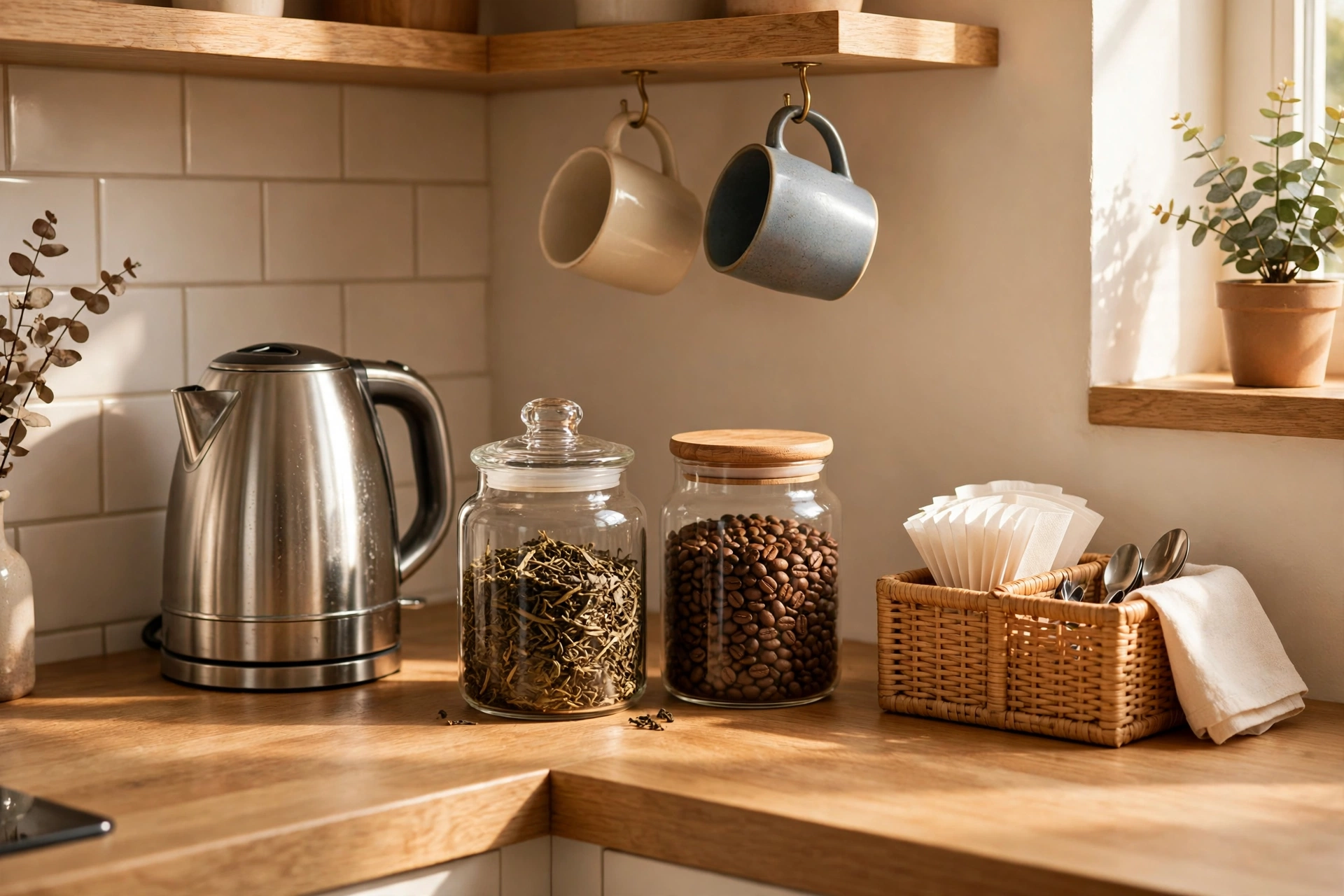
You can organize tea coffee supplies small kitchen style in a single corner, without giving up a whole cupboard or buying a wall of matching jars. The trick is giving every tin, bag, and mug one fixed home near the kettle, so making a cup stops feeling like a small search mission.
Most small kitchens fail at this because the supplies scatter: tea bags in one cupboard, coffee in another, mugs on a high shelf, and sugar behind the baking things — so every cup means four trips across the room.
This guide shows you how to organize tea coffee supplies small kitchen step by step: sorting what you actually drink, building a compact station, keeping everything fresh, and holding it together with a ten-minute weekly reset.
Table of Contents
- Start by Sorting What You Actually Drink
- Give Tea and Coffee Their Own Zone
- Organize Tea Coffee Supplies Small Kitchen: Build the Drink Station
- Keep Coffee and Tea Fresh
- Mugs, Filters, and the Small Extras
- Where to Store the Spares
- Small-Space Fixes When There Is No Spare Shelf
- The Weekly 10-Minute Reset
- Common Mistakes to Avoid
- Frequently Asked Questions
- Conclusion
Start by Sorting What You Actually Drink
Before you buy a single jar or hook, pull every tea and coffee item out of its hiding place and put it on the counter. Seeing it all at once shows how much you really own, and most people find twice what they expected.
Sort the pile into three groups: daily, weekly, and rarely. Daily is what you reach for every morning; weekly covers the weekend blend or the herbal tea before bed; rarely is the gifted tin you have never opened.
- Empty every spot where tea or coffee hides — cupboards, the top of the fridge, the drawer.
- Put each item in the daily, weekly, or rarely pile, and be honest about the rarely pile.
- Count your mugs, then set aside chipped ones and ones nobody uses.
- Check for duplicates — two open bags of the same coffee, three boxes of the same tea.
- Box the rarely used items and move them out of the prime spots.
Your daily group should fit in one small area — a shelf, half a cupboard, or one stretch of counter. The first step to organize tea coffee supplies small kitchen is knowing what you own; if the daily pile does not fit, you own more than you drink, and the extras need a new home.
Give Tea and Coffee Their Own Zone
A zone is one fixed area where everything for a single job lives together, and it is the heart of how you organize tea coffee supplies small kitchen. For tea and coffee, that means the maker, the mugs, the tea and coffee, and the sweeteners — all within one arm’s reach of the kettle and a plug socket.
Pick the spot closest to the water source and the socket, so you are not carrying a full kettle across the room. A corner of counter beside the sink, or a shelf above the maker, both work — what matters is that the zone has clear edges and nothing else moves in.
If the rest of the kitchen still feels scattered, start with the whole-room approach in our how to organize a small kitchen guide, then come back and carve out this one zone. Our organize kitchen cabinets by zone guide shows how to divide a cupboard the same way.
Renters: Keep It Removable
Renters can build the same zone without drilling a hole. A freestanding shelf, a tension rod with hooks, or a small caddy on the counter gives you the station without touching the walls — the same no-drill thinking in our small kitchen organization for renters guide.
Organize Tea Coffee Supplies Small Kitchen: Build the Drink Station
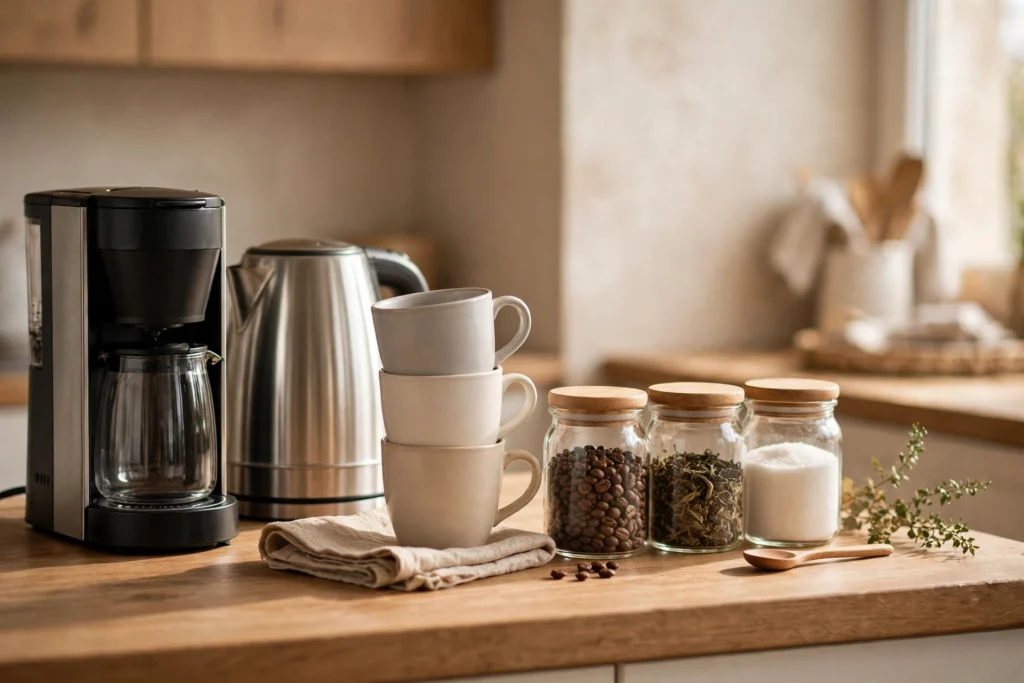
The drink station is the working heart of the zone: the maker at the back, the mugs in front of it, and the tea, coffee, and sweeteners in jars beside it. Arrange it in the order you use it — maker, then cup, then what goes in the cup — so your hands move in one smooth line.
Keep the small loose items in one caddy or basket: filters, stirrers, a small spoon, and the sweetener jar. When everything small lives in one container, it stops drifting across the counter, and the whole station lifts out in one move for wiping underneath.
Choose a maker that fits the space you actually have, not the one you wish you had. Our best compact coffee makers guide covers slim models that leave room for the mugs, and our small kitchen counter organization guide shows how to keep the counter clear around the station.
Keep Coffee and Tea Fresh
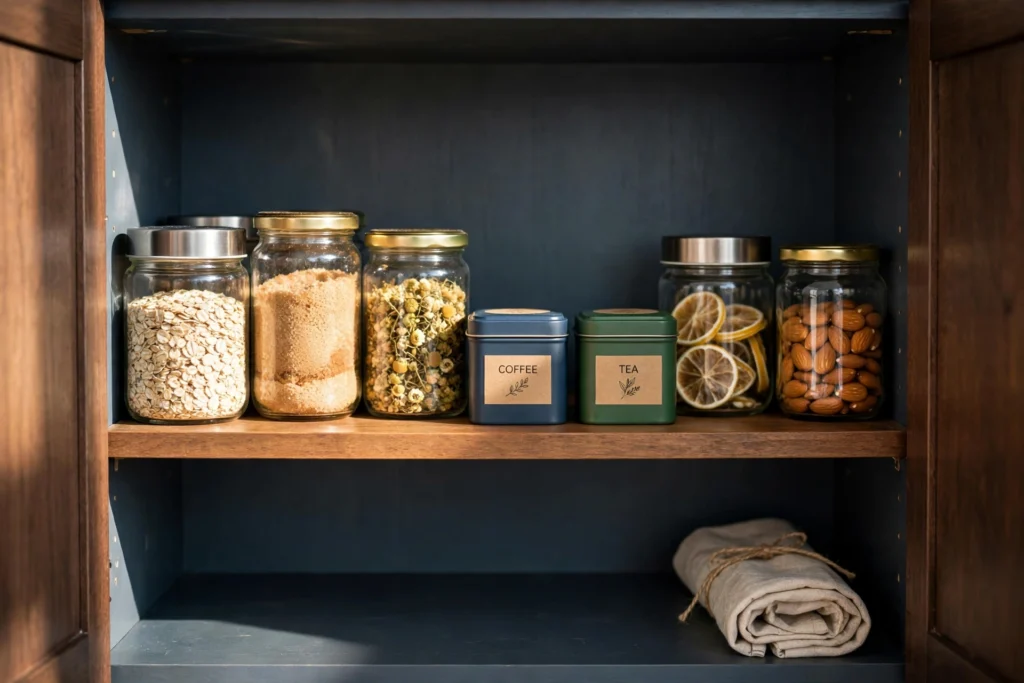
When you organize tea coffee supplies small kitchen, freshness comes first — tea and coffee lose flavour in warm, damp, or bright places. Store them in airtight containers in a cool, dark cupboard, away from the cooker and the kettle’s steam: a jar beside the hob goes stale faster than one on a pantry shelf.
Buy in small amounts that match how fast you drink. A bag of coffee that lasts three weeks tastes better at the end than a bulk bag lasting three months, because ground coffee fades once the bag is open.
Label every jar with what is inside and the date you opened it. A small label stops the morning guesswork between decaf and regular, and the same habit works for spices — see our small kitchen spice organization guide for jar ideas that transfer straight to tea and coffee.
Dry goods like tea, coffee, and sugar keep longest when they stay dry and sealed, and the food storage guidance from the FDA explains how to store food safely at home. It is worth a quick read if you are unsure how long an opened bag keeps.
Mugs, Filters, and the Small Extras
Mugs are the bulkiest part when you organize tea coffee supplies small kitchen, so keep the count small and the rest out of sight. Daily mugs belong in the station — hanging on hooks under a shelf or stacked two high — while the spares live in a cupboard for guests.
Filters, spare spoons, and stirrers belong in the drawer nearest the station, in a small tray or divider. Our how to organize kitchen drawers guide shows how one divider keeps these bits from sliding into a jumble.
Sugar, honey, and other sweeteners each get a small sealed jar in the station, not the bag they came in. A bag of sugar tears, spills, and takes up more room than the jar — and a sealed jar keeps out damp air from the kettle’s steam.
Where to Store the Spares
When you organize tea coffee supplies small kitchen, keep one spare of each daily item — one extra bag of coffee, one extra box of tea — in the pantry or on a high shelf. The rest stays in its shopping bag until the spare is needed, so the station never holds more than a week’s worth.
Use the oldest spare first. Put the new bag behind the old one, and refill the jar from the oldest bag — that way nothing sits at the back for months.
Our small pantry organization ideas guide covers how to keep backstock visible, so the spare bag of coffee is easy to find and impossible to forget. A spare you cannot see is one you will buy twice.
Small-Space Fixes When There Is No Spare Shelf
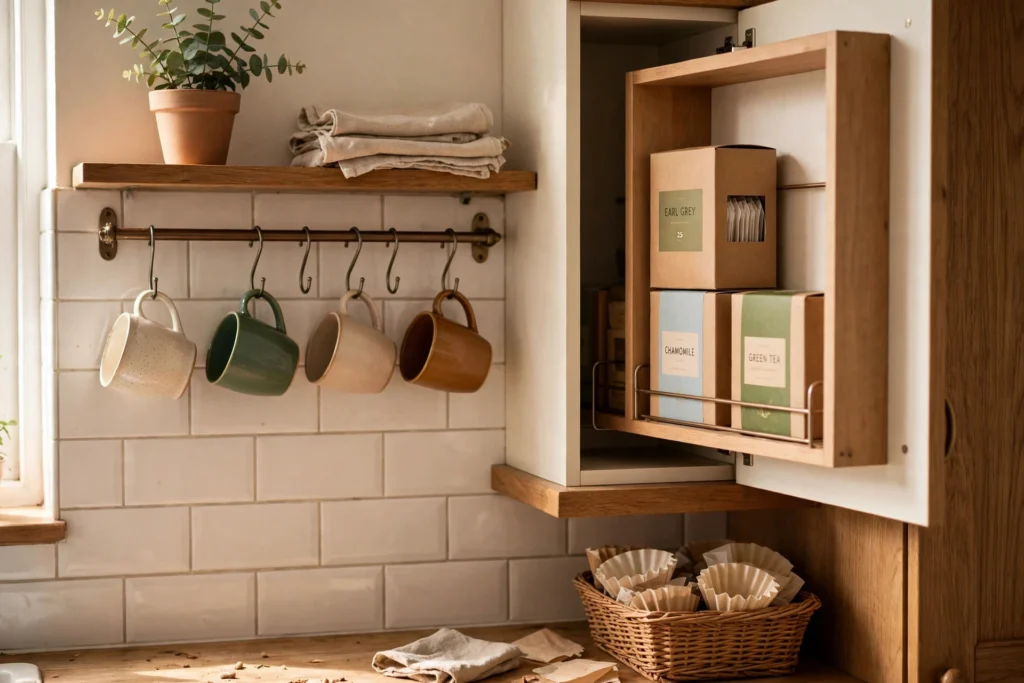
When there is no spare shelf, you organize tea coffee supplies small kitchen on the walls and doors instead. The inside of a cupboard door holds a slim rack for tea boxes, a wall rail holds mugs, and a basket under a shelf holds filters and sweeteners — none of them takes an inch of counter.
A slim rolling cart parked beside the counter can hold the whole station when there is truly no shelf to spare. Wheel it out to make a cup, wheel it back when you are done — and our 25 smart small kitchen organization ideas guide has more ways to squeeze storage from tight corners.
The Weekly 10-Minute Reset
The reset is what keeps your effort to organize tea coffee supplies small kitchen working week after week. Pick one evening — Sunday works for most people — and spend ten minutes putting the station right.
- Refill the jars from the spares, and move the new spare to the front of the shelf.
- Wipe the station surface and the outside of the jars.
- Throw out any tea bag that has gone soft or any coffee that smells flat.
- Check the mug hooks and the filter drawer, and put stray items back.
- Add anything running low to the shopping list while you are looking at it.
Ten minutes a week beats an hour of sorting every month, and the reset is when you notice what is running low — instead of finding out on a Monday morning.
Common Mistakes to Avoid
These five mistakes undo the work to organize tea coffee supplies small kitchen. Watch for the one that sounds familiar, and fix it before it costs you a morning.
Keeping every mug you own on display
A row of twelve mugs looks cheerful, but it eats the shelf your jars need. Keep the daily mugs out and store the rest.
Buying matching canisters before you sort
A set of pretty canisters feels like progress, but bought before sorting, you end up with the wrong sizes for what you actually drink. Sort first, measure what you use, then buy the jars that fit.
Keeping gifted tea and coffee you never drink
The tin from last Christmas is not a collection — it is clutter with a ribbon on it. If you have not opened it in three months, pass it on and free the shelf.
Letting the station creep across the counter
A station that grows by one jar a month ends up owning the whole counter. Give it a fixed edge — the caddy, the shelf, the rail — and anything that does not fit lives somewhere else.
Storing coffee in the fridge
The fridge feels safe for coffee, but every time the bag comes out, damp air condenses on the beans and the coffee picks up smells from the food around it. A cool, dark cupboard keeps it fresher than the fridge ever will.
Frequently Asked Questions
How many mugs should a small kitchen keep?
Two per person, plus two spares for guests, is a good rule. A couple keeps six mugs in the station; a family of four keeps ten. Anything beyond that goes to a high shelf until a guest needs it.
Should I decant coffee into a jar or keep it in the bag?
Decant it into a sealed jar. A folded bag still lets air in each time you open it, while a jar seals properly and shows at a glance when it is running low. Write the roast and the open date on a label.
What is the best container for loose-leaf tea?
A small tin with a tight lid beats a glass jar, because light fades loose leaf faster than it fades tea bags. If you love seeing the leaves, keep the glass jar inside a cupboard and take it out only to brew.
Can I keep a coffee maker inside a cupboard?
You can, but only if the cupboard has room for steam to escape and the maker pulls out easily for filling. A maker that needs lifting out and plugging in every morning will end up on the counter anyway, so give it a permanent spot.
How do I organize tea and coffee when two people drink different things?
Split the station in two when you organize tea coffee supplies small kitchen for two different drinkers. Each person gets a caddy with their own tea or coffee, sweetener, and mug, side by side on the same shelf. Sharing the maker and the kettle is easy; sharing one jumbled pile is what causes the morning hunt.
Conclusion
To organize tea coffee supplies small kitchen and all, the work is smaller than it looks: one sort, one zone, one station, and a ten-minute reset each week. Your tea and coffee stop wandering the kitchen, and the first cup of the day stops being a hunt.
Start tonight, and organize tea coffee supplies small kitchen one shelf at a time: pull every tea and coffee item onto the counter, sort it into daily, weekly, and rarely, and put the daily group in one spot near the kettle. Tomorrow will show if the spot fits — and you can move one thing at a time from there.