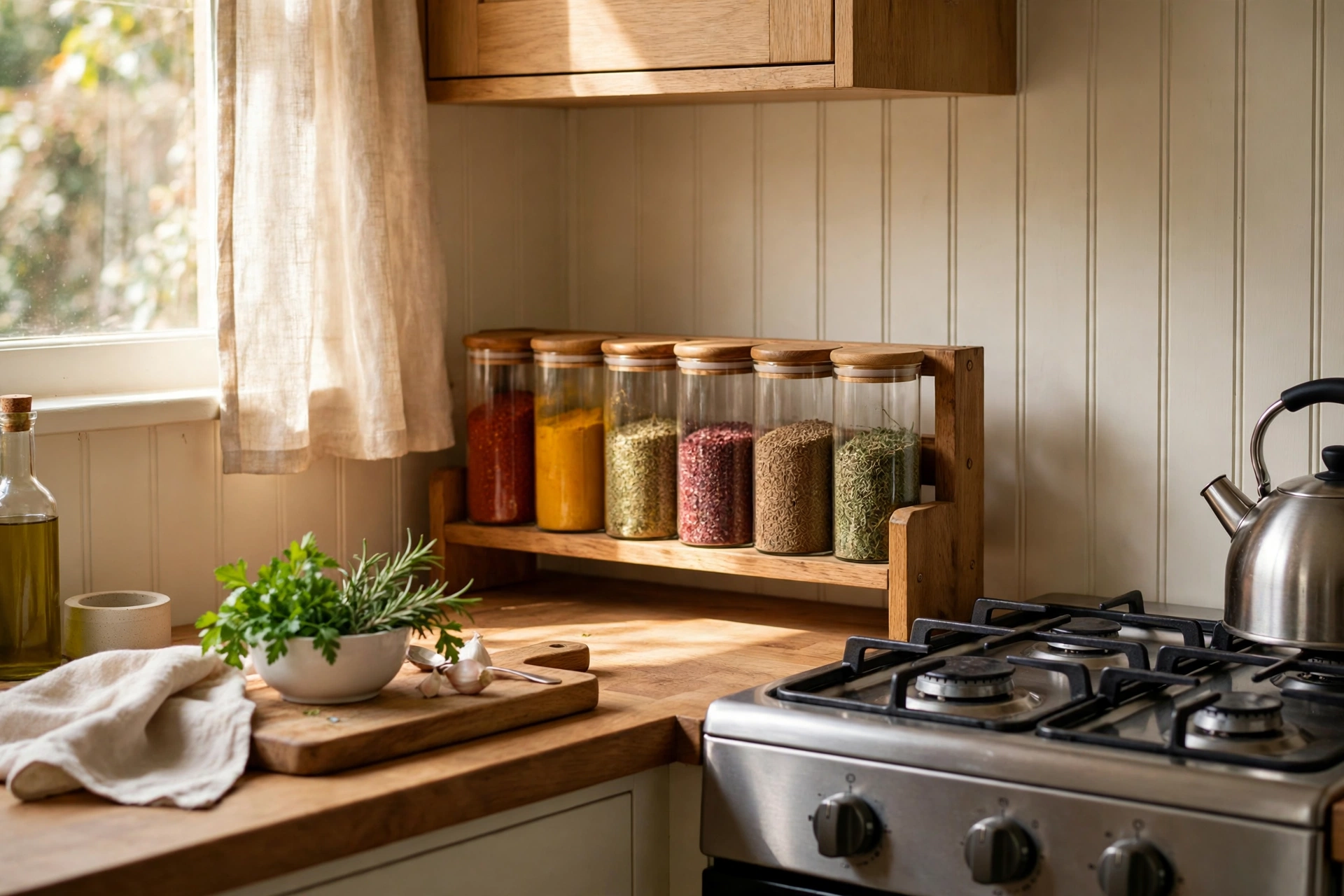
Spices are small, but they can take over a whole kitchen. One jar of paprika behind the flour and a bag of cumin lost at the back of a cupboard can turn a quick dinner into a ten-minute hunt — and small kitchen spice organization is what stops that from happening every night.
The fix is simpler than it looks. Small kitchen spice organization is mostly three jobs: keep only the spices you use, group them in a way that makes sense, and store them close to where you cook.
Table of Contents
- What Small Kitchen Spice Organization Really Means
- Start With a Spice Audit
- Sort Your Spices Into Groups That Make Sense
- Choose a Spot Near Where You Cook
- Storage Ideas That Fit a Small Kitchen
- Labels That Actually Help
- Keeping Your Spices Fresh
- Spices, Meal Prep, and the Weekly Cook
- Common Mistakes to Avoid
- Frequently Asked Questions
- Conclusion
What Small Kitchen Spice Organization Really Means
Good spice storage is not about a pretty rack. It is about reaching the right jar in seconds, without moving five other jars first.
Think about how you cook on a normal evening. You probably reach for the same five or six spices most of the time, then a few more on weekends, so your storage should match that pattern. That is the whole point of small kitchen spice organization.
A small kitchen makes this more important, not less. A loose pile of spice jars eats into the space you need for cooking, and a tidy system gives that space back and saves you money, because when you can see what you own, you stop buying a second jar of oregano.
Start With a Spice Audit
Before you buy a rack or matching jars, take everything out. Pull every spice jar, packet, and tin from the cupboard, the drawer, and the top of the fridge. A spice audit is the first step in small kitchen spice organization, and it takes about twenty minutes.
You will probably find duplicates, like two jars of cinnamon. Put them together and keep the freshest one.
Check each jar as you go. If a spice smells faint or dusty instead of strong and warm, it has lost its best flavour, and ground spices fade faster than whole ones.
Now sort what is left into three piles: use every week, use sometimes, and hardly ever. How to Declutter a Small Kitchen: A Step-by-Step Guide walks through the same clear-out idea for the whole kitchen.
Count the jars you are keeping before you shop for storage. A rack that holds twelve jars is no use if you own twenty.
Sort Your Spices Into Groups That Make Sense
There is no single right way to group spices. Pick the grouping that matches how you cook, and you will actually remember it.
By how often you use them
This is the simplest system. Put your everyday spices — salt, pepper, paprika, cumin, and garlic powder — in the easiest spot, and keep the weekend spices one step further away.
When the everyday group is always in the same place, cooking becomes faster, and you stop thinking about where things are.
By cuisine or dish
If you cook a lot of one kind of food, grouping by cuisine can help. Keep your curry spices together and your Italian herbs together, so you can grab a whole group at once.
This works well if you batch-cook the same meals: pull out one small group, cook with it, and put the whole group back in one move.
Pick one system and stick with it for a month. Good small kitchen spice organization bends to fit you, not the other way round, so if you keep reaching for the wrong shelf, change the system and try again.
Choose a Spot Near Where You Cook
Spices belong near the cooker, not across the room. Every extra step between you and the spice jar is a reason to skip seasoning.
Look at the space within one or two steps of your hob for a cupboard, a drawer, or a stretch of wall you could use. That is your spice zone, and it should hold only spices.
Keep the zone small on purpose, or it will push out the oils, the chopping board, and the cooking tools that also need to live near the hob.
Heat and light are the two things to watch. Spices keep their flavour longest in a cool, dark, dry spot, so avoid the shelf above the cooker or a sunny windowsill. A cupboard or drawer next to the cooker is the best compromise.
For more ideas on zoning around your cooker, see Small Kitchen Cabinet Organization: Practical Ideas for a Clutter-Free Space.
Storage Ideas That Fit a Small Kitchen
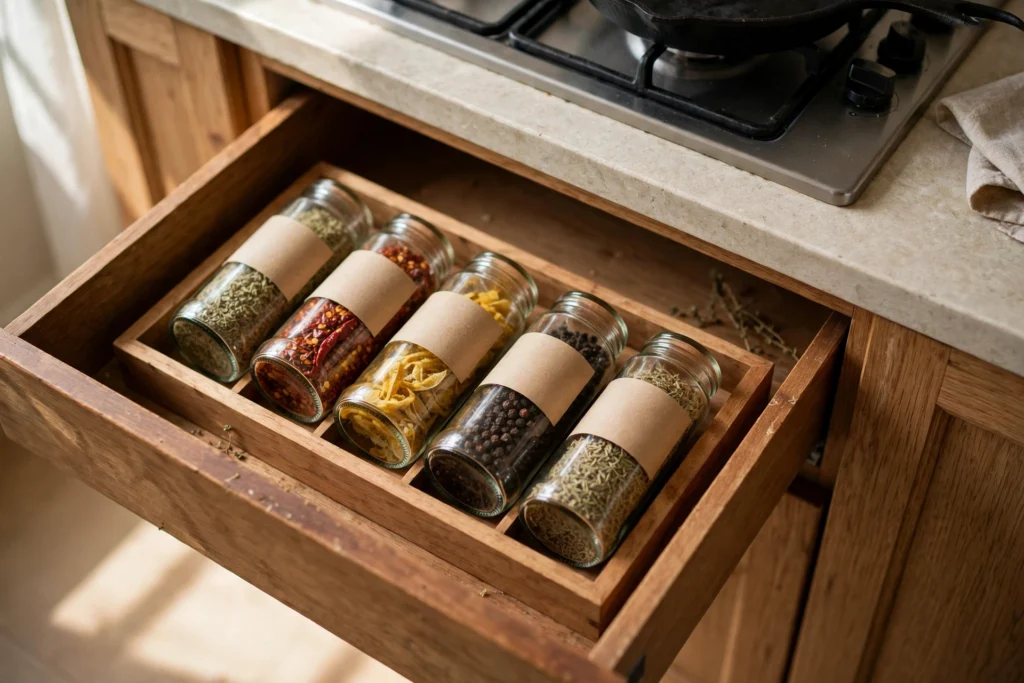
There is no one perfect spice rack. The right choice for small kitchen spice organization depends on your cupboards, your drawers, and your spare wall.
The spice drawer
A shallow drawer near the cooker is one of the best spice homes in a small kitchen. Lay the jars on their sides with the labels facing up, and use a small tray or insert to stop them rolling around.
For drawer layouts and inserts that last, see How to Organize Kitchen Drawers in a Small Kitchen and Drawer Organizers and Dividers for Small Kitchen Tools.
The cupboard shelf with a riser
If your spices live in a cupboard, a small stepped riser is the cheapest fix for the classic problem: jars hiding behind jars. The back row sits higher, so you can read every label without moving the front row.
Keep the everyday spices on the lowest shelf, and keep the riser to one row deep so nothing gets lost behind it.
A turntable can work in a deep corner cupboard, but keep it to one layer. For more cupboard ideas, see Small Pantry Organization Ideas for Tight Spaces.
The wall and the inside of a door
When cupboard space is gone, the wall is your friend. A narrow magnetic strip or a slim wall-mounted rack beside the cooker keeps spices visible and frees a whole shelf.
The inside of a cupboard door works the same way, and the door keeps the light out when it is closed. Check the depth before you buy, or a rack that sticks out too far will stop the door closing.
For wall storage that earns its place, see Vertical Kitchen Storage Ideas for Small Spaces and Small Kitchen Storage Racks and Organizers Worth Considering.
The countertop rack, kept small
A countertop spice rack can work if you have a spare corner, but keep it to your eight or ten most-used spices. A big rack takes the space you need for chopping and prepping.
Keep it away from the sink and the hob, where splashes and steam make labels peel and lids stick. For a fuller plan for keeping counters clear, read Small Kitchen Counter Organization: Keep Your Counters Clear and Useful.
Labels That Actually Help
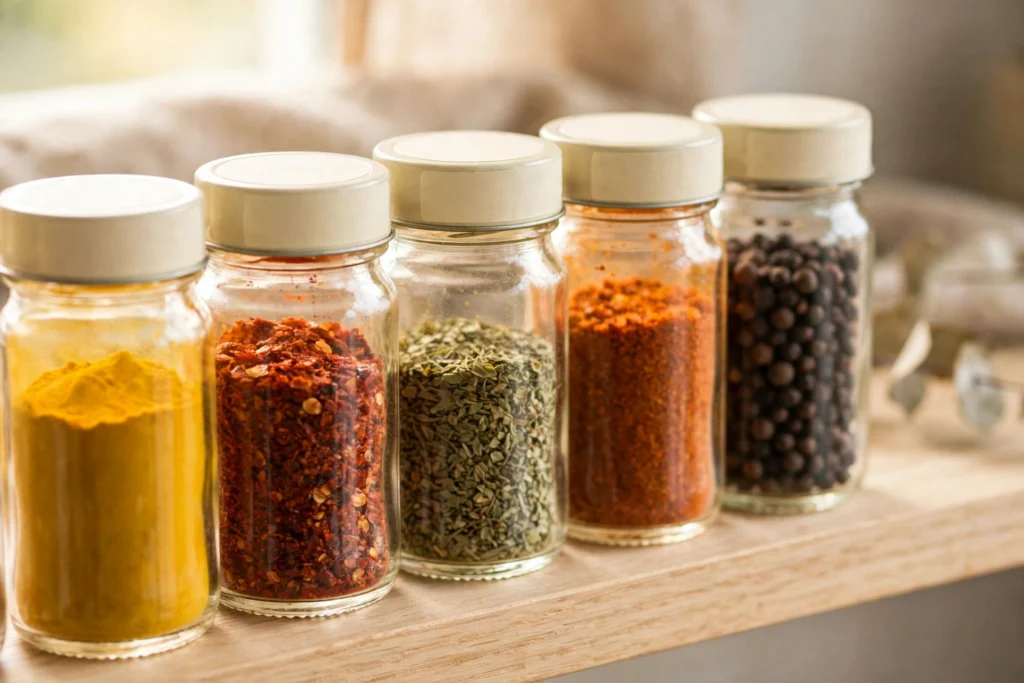
Small kitchen spice organization fails when you cannot read it. If you have to open three jars to find the cumin, the labels are not doing their job.
Label the top of the jar, not just the side. When jars lie flat in a drawer, the top is the only part you can see.
Use big, plain lettering you can read at arm’s length, and add the date you opened it. A small date helps you remember which jar to use first.
Keep the labels simple and consistent, with one style across all your jars. If you decant spices into matching jars, label them the day you fill them — an unlabelled jar of brown powder could be cinnamon, cumin, or cocoa.
Keeping Your Spices Fresh
Keeping spices fresh is part of small kitchen spice organization, not a separate job. Spices do not go off in a way that makes them unsafe, but they do lose their flavour, and a jar of paprika that smells of nothing will not season your food.
Whole spices keep their flavour longer than ground ones, so if you cook with a spice often, buying it whole and grinding a little at a time can be worth the extra step.
Store spices in airtight jars with lids that close properly. Open bags let in air and damp, and they spill, so decant them into jars as soon as you bring them home.
Keep them dry. Never shake a spice jar directly over a steaming pan, because the steam gets inside and clumps the spice. Sprinkle it into your hand or a small bowl first.
Check your collection every few months. Open each jar, smell it, and replace anything that has gone flat. A small collection of fresh spices beats a large collection of tired ones.
Spices, Meal Prep, and the Weekly Cook

A tidy small kitchen spice organization system pays off most when you cook in batches. If you prep a week of lunches, you will reach for the same spices again and again, and a good system makes that fast.
Before a prep session, pull out the spice group you need, cook with it, then put the whole group back in one move — much quicker than hunting for one jar at a time.
Keep a short list of the spices each of your regular meals needs. Taped inside a cupboard door, it turns meal prep into a checklist, and it helps you spot what you are running low on before shopping day.
For a fuller weekly cooking plan, see 25 Smart Small Kitchen Organization Ideas That Make Every Inch Count.
Common Mistakes to Avoid
Most small kitchen spice organization goes wrong in the same few ways. Avoid these and your system will last much longer.
Buying the rack before the audit. A beautiful rack full of spices you never use is still clutter. Count your jars first, then buy storage that fits.
Storing spices above the cooker. It feels handy, but heat and steam fade spices fast. Move them one cupboard along, or into a drawer beside the cooker.
Keeping every jar you have ever bought. That half-used jar from a recipe you tried once does not earn a place in a small kitchen. Let it go and keep the space for what you cook now.
No labels, or labels you cannot read. Tiny handwriting on the side of a jar is no help when you are cooking. Label the top, write it big, and keep one style across all your jars.
One big jumble instead of groups. A single shelf of mixed jars means digging every time. Even two groups — everyday and sometimes — will save you time every day.
Forgetting the lids. A jar with a loose or missing lid lets in damp and spills in the drawer. Check lids when you audit, and replace any that do not seal.
Frequently Asked Questions
Where is the best place to store spices in a small kitchen?
A cool, dark place within one or two steps of the cooker — a shallow drawer, a low cupboard shelf, or the inside of a cupboard door. Avoid the shelf above the hob and sunny windowsills, because heat and light fade flavour.
Should spices go in a drawer or a cupboard?
Both work. A shallow drawer is best if you have one spare near the cooker, because you can see every label at a glance. A cupboard with a stepped riser works well if your drawers are full.
How many spices should a small kitchen keep?
Keep the spices you actually use — for most cooks, eight to twelve everyday spices plus a few more for favourite dishes. A smaller collection of fresh spices beats a large one full of jars you never open.
How do I label spice jars so I can read them while cooking?
Label the top of each jar with big, plain lettering, and use the same label style on every jar. Add the date you opened it, so you know which jar to use first.
Do I need matching jars for good spice organization?
No. What matters is that every jar is airtight, labelled, and stored in a group you can remember. If you decant into matching jars, label them the same day you fill them.
Conclusion
Small kitchen spice organization is not about owning a perfect rack. It is about knowing what you have, finding it in seconds, and keeping it fresh enough to make cooking taste good.
Start with the audit: pull everything out, keep what you use, and let the rest go. Then pick one storage spot near the cooker, group your spices the way you cook, and label every jar on top.
Small kitchen spice organization grows one small change at a time, and the first change is the easiest: a drawer or a shelf where every spice has a home.