
Best Compact Coffee Makers for Small Kitchens
The best compact coffee makers for a small kitchen are the ones that fit your counter, brew the amount you drink, and clean up without a fuss. A maker too wide crowds out your cutting board, and one that brews too much wastes coffee every morning.
A small footprint does not mean weak coffee: a well-chosen compact machine can brew a proper cup from a corner that would otherwise hold nothing but a drying rack.
This guide walks through the types available, measuring your space, and the features that matter in daily use.
If you’re still deciding which appliances earn a place on your counter, see Best Compact Kitchen Appliances for Small Counters.
Table of Contents
- What Makes a Coffee Maker Compact?
- Types of Compact Coffee Makers
- How to Measure Your Space Before You Buy
- Choosing the Right Size for How Much Coffee You Drink
- Features That Matter in Daily Use
- Where to Put It in a Small Kitchen
- Storing Coffee, Filters, and Mugs Without Losing Counter Space
- Cleaning and Descaling a Compact Coffee Maker
- Common Mistakes to Avoid
- Frequently Asked Questions
- Start With the Tape Measure
What Makes a Coffee Maker Compact?
A coffee maker earns the word compact when it takes up little counter space, usually less than a standard sheet of paper, and fits under a wall cabinet. Height matters as much as width, because a tall machine can block a cabinet door.
Weight matters too. A lighter machine is easy to pull forward for filling, push back when you need the counter, and lift in and out of a cabinet if you tuck it away after each use.
Compact does not mean tiny in every way. Some compact coffee makers brew a full pot, while others make a single mug at a time. What changes is how much coffee comes out of each brew.
Types of Compact Coffee Makers

Most compact coffee makers fall into six broad types. The right choice depends on how many cups you drink and how much time you have.
Single-serve pod brewers
A single-serve brewer makes one mug at a time, usually in under a minute. You pop in a pod or a small filter basket, press a button, and the cup is ready. It suits one person, or a household where everyone wants a different flavour.
Small drip makers
A small drip maker brews several cups into a glass or thermal carafe, working like the familiar full-size machine, just narrower and shorter. It suits two people who drink coffee at breakfast, or anyone who likes a second cup later.
Pour-over brewers
A pour-over brewer is little more than a cone and a carafe, and it takes up almost no space at all. You heat water separately and pour it slowly over the grounds. The result is a clean, bright cup, and the set-up packs flat into a cabinet.
French press
A French press steeps grounds in hot water, then presses them down with a plunger. It needs no electricity and no paper filters, so it suits a kitchen with no spare outlet. The trade-off is a heavier cup and a little more washing up.
Compact espresso-style makers
An espresso-style maker forces hot water through finely ground coffee to produce a short, strong shot. Some models froth milk as well, so you can make drinks with steamed milk at home. They are the most hands-on of the group.
A machine that also froths milk does two jobs in one footprint. For more tools that pull double duty, see Multi-Functional Kitchen Tools.
Cold brew makers
A cold brew maker steeps grounds in cold water for many hours, usually overnight. The result is a smooth coffee that keeps in the fridge for days. It needs no counter space while it steeps, but plan a day ahead.
How to Measure Your Space Before You Buy
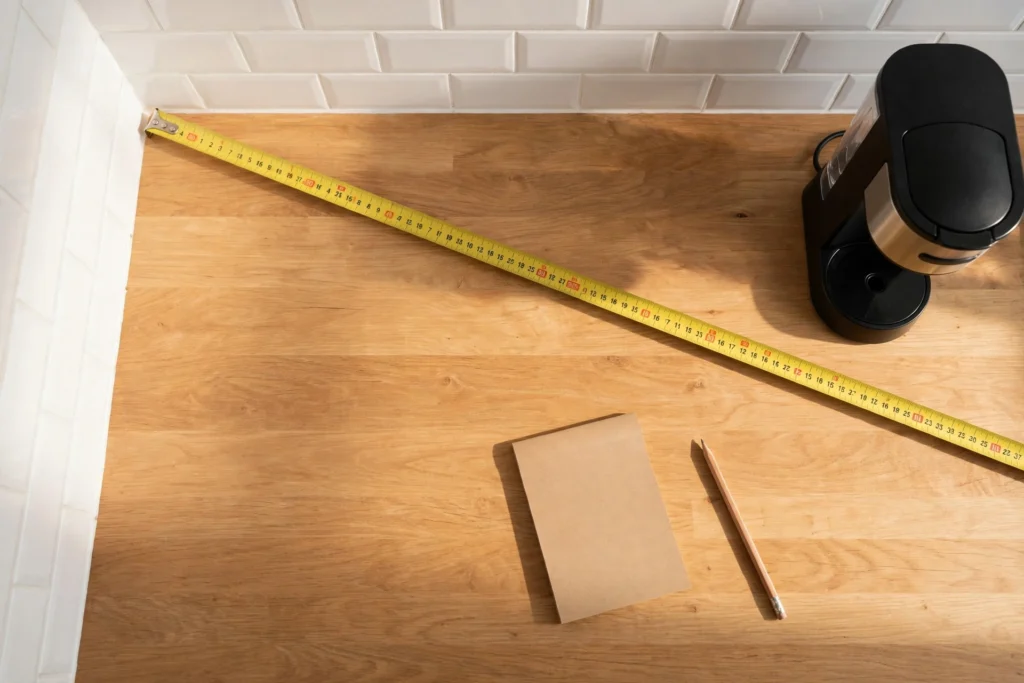
A tape measure takes two minutes and saves a return trip. Measure the spot where the maker will live, and check the height to the underside of the cabinet above it.
- Measure the width and depth of the space, and write both numbers down.
- Measure the height from the counter to the cabinet, then allow a few inches for steam and the lid.
- Check the distance to the nearest outlet, and make sure the cord reaches without crossing the sink or the hob.
- Open the cabinet doors above the spot, and check that they clear the top of the machine.
- Leave a few inches of breathing room on each side, so steam can escape.
Keep the numbers on your phone when you shop for compact coffee makers. A maker that fits on paper can still surprise you in the shop.
Choosing the Right Size for How Much Coffee You Drink
Capacity is where many compact coffee makers disappoint. A maker that is too small means two brews every morning, and one that is too big wastes coffee. Match the size to the cups you drink on a normal day.
One mug a day calls for a single-serve brewer or a pour-over cone. Both make exactly the amount you drink, so nothing is poured away.
Two people drinking together need a small drip maker that brews four to six cups, or a French press that holds two mugs. One brew then covers breakfast for both of you. Coffee is part of many breakfast routines, so plan the two together — see How to Meal Prep Breakfasts Ahead of Time.
A household of three or four coffee drinkers needs more capacity: a larger drip maker may fit if you measure carefully, or brew two smaller batches.
For ideas on fitting a bigger household into a small kitchen, see How to Organize a Small Kitchen for a Family.
Features That Matter in Daily Use
A long list of features looks impressive in the shop, but only a few change how the machine feels at 7 a.m. For the wider picture on tools that save space, see Best Space-Saving Kitchen Tools.
Water tank and filling
A removable water tank is the single most useful feature on compact coffee makers. You can fill it at the sink instead of carrying a jug to the machine, and you can see at a glance how much water is left. A tank that only fills from the top is awkward every morning.
Filter type
Paper filters give a clean cup and make cleaning easy, because you lift the grounds out with the paper. A permanent metal filter saves buying filters and cuts waste, but it needs rinsing after every brew. Either works, so choose the one you’ll keep up with.
Auto shut-off
Auto shut-off switches the machine off after a set time, which saves electricity and gives you peace of mind if you rush out the door. Check how long the shut-off delay is before you buy, since it varies.
Where to Put It in a Small Kitchen
The best spot is usually a corner of the counter near an outlet, where the machine can stay put and leave your main work area clear. A corner also keeps the cord short and away from the sink.
Keep compact coffee makers away from the hob and the sink, where steam can fog the controls and splashes can reach the electrics. A few inches of distance costs nothing.
For the wider rules on keeping a small counter clear, see Small Kitchen Counter Organization.
For help deciding which tools deserve that space, see Small Kitchen Essentials.
Storing Coffee, Filters, and Mugs Without Losing Counter Space
Compact coffee makers take up little counter space, but their supplies multiply fast: beans or grounds, filters, mugs, sugar, and a spoon. Give them one home.
A small airtight container keeps ground coffee fresh and stops it picking up smells from the kitchen. Store it in a cool, dark cupboard, and buy smaller bags more often.
The FDA’s guide to storing food safely covers how long opened food keeps, which is a useful check for coffee and other staples.
Keep filters in the cabinet above or beside the machine, in a small basket so the stack does not slide around.
Hang mugs on hooks under a cabinet or on a wall rail, and they stop taking up shelf space. Two or three mugs is enough for most households.
For stackable containers that keep supplies tidy, see Best Stackable Kitchen Storage Containers.
Cleaning and Descaling a Compact Coffee Maker
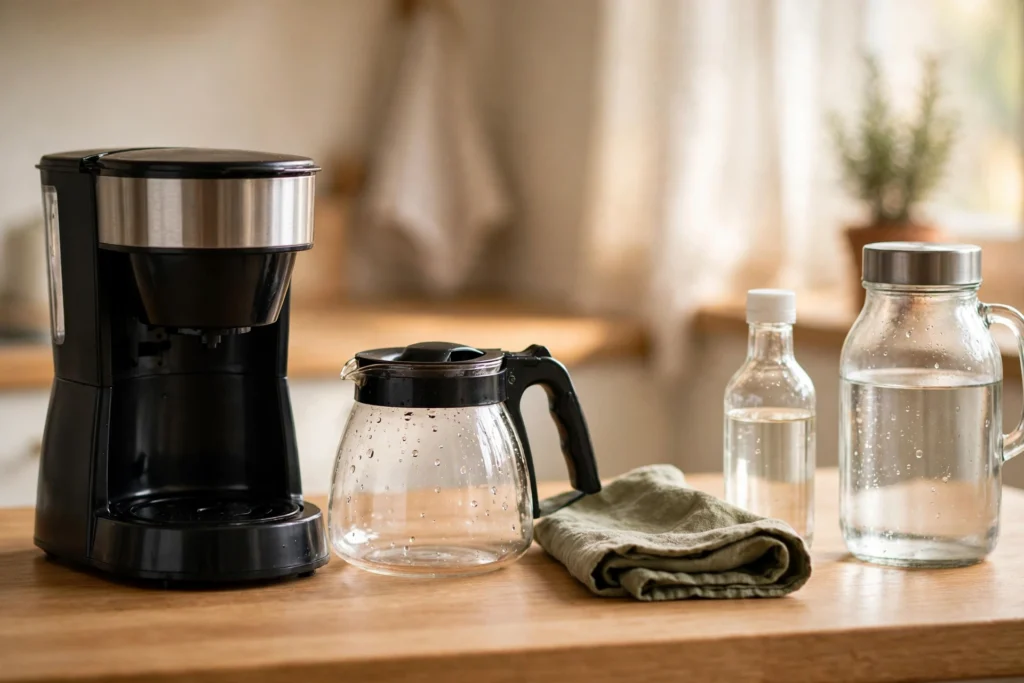
A clean machine brews better coffee and lasts longer. Grounds left in the filter go stale and bitter, and mineral scale from hard water slows the machine down over time. Regular cleaning keeps compact coffee makers working well for years.
- Empty the filter basket and rinse the carafe after every brew.
- Wash the removable parts with warm soapy water once a day, and let them dry fully before you put them back.
- Wipe the outside of the machine with a damp cloth once a week.
- Descale every one to three months, depending on how hard your water is, with a descaling solution or equal parts water and white vinegar.
- Run two cycles of plain water after descaling, so no vinegar taste reaches your coffee.
If your coffee tastes flat or the brew slows to a trickle, scale is the likely cause, and a descale cycle usually fixes it in under half an hour.
Common Mistakes to Avoid
These five mistakes cause most of the disappointment with a new machine, and each one has a simple fix.
Brewing a half-full pot every morning. A maker sized for a weekend of guests sits half-empty on a normal Tuesday, and a half-full pot brews weaker coffee than a full one. Size the maker to the mornings you actually have, and borrow a bigger pot for the rare crowd.
A lid that cannot open where the machine stands. A machine may fit under the cabinet, yet its lid still cannot swing open far enough to fill the tank. Test the lid in the exact spot, with the cabinet doors above it, before you commit.
A cord stretched across the worktop. Even when the cord reaches the outlet, a long run across the counter is a trip hazard and a spill waiting to happen. Pick a spot beside an outlet, or move the machine, rather than living with a cord in the way.
Using the wrong grind. Coffee ground too fine for a French press slips through the plunger and leaves grit in the cup, while coffee ground too coarse for a drip maker brews weak and watery. Match the grind to the brewing method.
Leaving water in the tank for days. Stale water in the tank picks up odours and can leave a film inside the machine. Empty the tank if you will not brew for a day or two.
Frequently Asked Questions
Do compact coffee makers use more electricity than full-size ones?
Compact coffee makers generally use less electricity than full-size machines, because they heat less water at a time. The biggest saving comes from brewing only what you drink.
Can I use a compact coffee maker in a rented flat?
Yes. A compact coffee maker needs no installation, no drilling, and no changes to the kitchen, so it suits a rented flat perfectly. It sits on the counter and moves with you when you leave.
Why does coffee from a new machine taste bitter?
A new machine can carry a faint taste from the factory, and the first few brews can pick it up. Run two or three cycles of plain water through the machine before your first proper brew, and use fresh water and the right amount of grounds.
If the bitterness stays, try a slightly coarser grind, which usually softens the flavour.
Can I take a compact coffee maker on holiday or to the office?
A manual brewer such as a pour-over cone or a French press travels well, because it needs no power and packs flat in a bag. An electric machine is less practical to carry, since it needs a stable surface and an outlet.
For a desk or a hotel room, a manual brewer and a small kettle are the simpler pair — just pack the glass carafe carefully, since it breaks easily.
Start With the Tape Measure
With the six types in mind and your measurements in hand, the choice comes down to one question: which of these compact coffee makers will you be glad to use on a Tuesday morning? The answer is usually the simplest one that covers your household’s cups without crowding the counter.
Next step: grab the tape measure tonight and write down the width, depth, and height of the corner you have in mind. With those three numbers, you can shop with confidence.
For help deciding which tools deserve that space, see How to Choose Space-Saving Kitchen Tools.