
Small Kitchen Organization for Renters: No-Drill Storage Ideas
Small kitchen organization for renters works best when nothing is drilled, screwed, or glued permanently into place. The answer is storage that holds with adhesive, tension, hooks, or its own weight — and comes off cleanly when you move out.
Start by reading your lease, photographing the kitchen as you found it, and choosing freestanding and removable storage. Heavy things go low in freestanding units, and removable fixings are for light things only.
Table of Contents
- Why Renting Changes the Rules
- Before You Buy: Read the Lease and Photograph the Kitchen
- How to Ask Your Landlord in Writing
- Adhesive Storage: What Works and What Does Not
- Tension Rods, Over-Door, and Magnetic Storage
- Freestanding Storage That Moves With You
- No-Drill Storage Inside Cabinets and Drawers
- The Counter, the Sink, and the Fridge
- Shared Rental Kitchens
- A No-Drill Plan in One Weekend
- Moving Out: Restoring the Kitchen
- Common Mistakes to Avoid
- Frequently Asked Questions
- Conclusion
Why Renting Changes the Rules
A rented kitchen is not yours to change. In most tenancy agreements in the US, UK, Canada, and Australia, drilling into tiles, fitting a shelf, or removing a cabinet counts as an alteration, and one made without written permission can cost you part of your deposit.
So the aim is different from a kitchen you own: build the best kitchen you can take with you.
The trade-off is weight. Nothing stuck or wedged holds as much as a screw in a solid wall. Heavy things go low in freestanding storage, and removable fixings are for light things only. For the wider picture, see 25 Smart Small Kitchen Organization Ideas That Make Every Inch Count.
Before You Buy: Read the Lease and Photograph the Kitchen
Read the sections on alterations, decoration, fixtures, and damage before you spend anything. Look for phrases such as “no alterations”, “no drilling”, “no fixing to walls or tiles”, and “written permission required”.
Most agreements ban holes in walls and tiles outright. Many also ban adhesive fixings that damage paint or plaster. If the wording is unclear, treat it as “ask first” rather than assuming it is allowed.
Before you fit a single hook, take dated photographs of the whole kitchen. Photograph the walls, tiles, cabinets inside and out, worktop, sink, and floor, with doors open so hinges and shelves are visible.
Photograph any existing mark or stain close up, and note it in the inventory or tell the landlord in writing.
How to Ask Your Landlord in Writing
If you want to fix anything with screws, ask first, in writing, and be specific. A vague request is easy to refuse; a specific one is easy to agree to.
Say what you want to fit, exactly where, how it will be fixed, and how you will remove it and repair the wall when you leave. Offer to restore the wall at your own cost.
Adhesive Storage: What Works and What Does Not

Adhesive hooks, rails, and strips are the most useful no-drill fixings in a rented kitchen, but they have strict limits. They hold light things — mugs, utensils, tea towels — not a shelf of plates or a heavy pan.
Check the weight limit and treat it as a maximum. A hook rated for 1 kg (about 2 lb) should hold a mug, not a litre of oil. When in doubt, use two hooks for one item.
Choose removable strips and hooks made to come off without leaving a mark. Strong mounting tape is not the same: it holds more, but it can pull paint off or leave residue.
If the packaging does not say “removable” or “damage-free”, assume it is not. Clean the spot, dry it fully, test a hidden spot first, and leave a new hook empty for a day before loading it.
Tension Rods, Over-Door, and Magnetic Storage
A tension rod is a spring-loaded bar that wedges between two surfaces with no screws at all. Under the sink, a rod across the cabinet holds spray bottles by their triggers, freeing the cabinet floor.
Measure the gap before you buy. Too short and it falls, too tight and it marks the surface. Choose one with rubber ends, and keep the load light: tension rods hold by friction, so they suit bottles, lids, and cloths, not a shelf of jars.
An over-door rack hangs over a cabinet door and holds lids, boards, or spices inside, or towels outside. Check the door still closes fully and keep only light items on it.
Magnetic hooks stick to the side of a steel fridge. Check first that your fridge is actually magnetic, because many modern fronts are not. For more on fitting storage around pipes and awkward shapes, see Under-Sink Organization Ideas for Small Kitchens.
Freestanding Storage That Moves With You
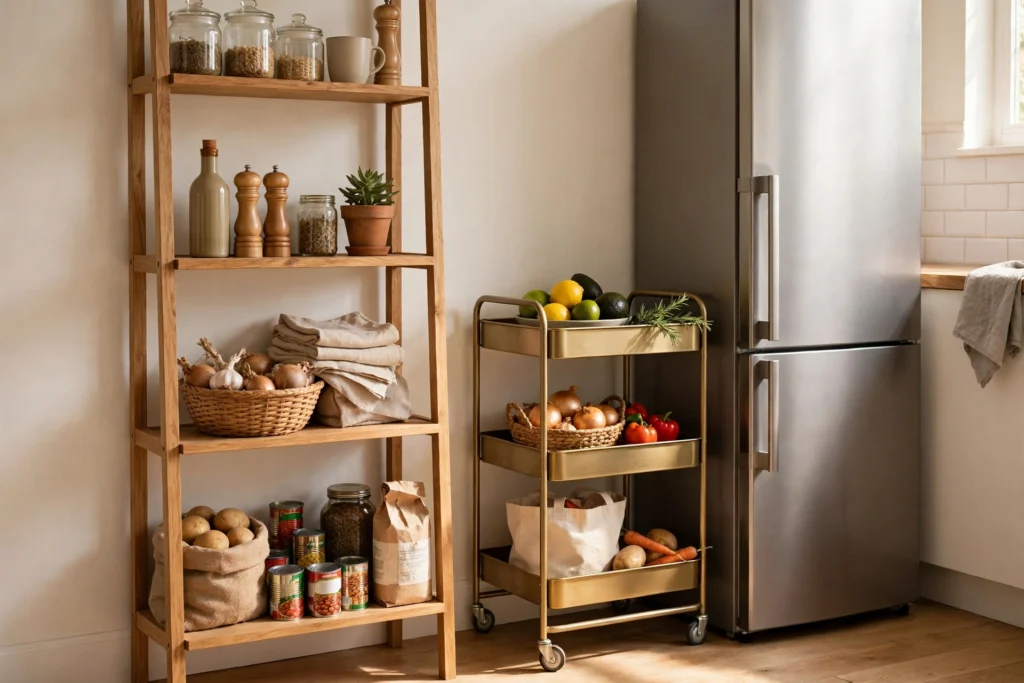
Freestanding storage is the backbone of a rented kitchen. It needs no fixing, holds the heaviest things, and moves with you.
A tall, narrow shelf unit against a free wall adds storage without drilling. Keep the heaviest items on the lowest shelf so it cannot tip, and keep daily items between knee and shoulder height.
A slim rolling cart between the fridge and the counter holds oils, spices, or snacks, pulls out when needed, and pushes back when not. Measure the gap first and choose a cart a little narrower than it.
Shelf risers and stacking shelves double the usable surface in a cabinet by turning one tall gap into two shorter ones. Under-shelf baskets hook over a shelf to hold mugs or small packets in wasted space.
For more on adding storage without changing the layout, see How to Create More Storage in a Small Kitchen Without Remodeling.
No-Drill Storage Inside Cabinets and Drawers
Inside a cabinet, nothing needs fixing at all. Pull-out caddies and sliding baskets sit on the cabinet floor and roll out towards you, so things at the back are reachable without kneeling.
Drawer dividers and expandable organizers keep cutlery, utensils, and gadgets in their own sections, and lift out when you move. For drawer layouts, see How to Organize Kitchen Drawers in a Small Kitchen.
For lids and baking trays, vertical dividers inside a cabinet or drawer file flat things upright, like files, so you can pull one out without lifting a stack.
Under the sink, a tension rod, a freestanding caddy, and a small stackable shelf organize cleaning supplies around the pipes. Declutter first, though — no organizer fixes a cabinet holding twice as much as it should. Work through the decisions in How to Declutter a Small Kitchen: A Step-by-Step Guide.
The Counter, the Sink, and the Fridge
The counter is where a rented kitchen feels smallest, because you cannot fix a shelf to free it. The rule is simple: only daily items earn counter space — a kettle, a chopping board, a small tray of oil, salt, and pepper.
Everything else goes in a cabinet or a drawer. A toaster used twice a week can live in a cabinet, and a stack of bowls does not need to sit out. For the full counter method, see Small Kitchen Counter Organization: Keep Your Counters Clear and Useful.
At the sink, a small freestanding caddy beside the tap holds washing-up liquid and a sponge, and a suction hook on smooth tiles holds a cloth. Keep the area under the sink for cleaning supplies only, in a caddy you can lift out.
Shared Rental Kitchens
A shared rented kitchen needs agreement as much as storage. Divide cabinets, shelves, and fridge space fairly and label the divisions: one shelf each, one fridge shelf each.
Keep shared items such as oil, salt, and bin bags in one agreed place, with an agreement on who replaces them. Label your food in a shared fridge with your name and the date you opened it.
Agree which tools are shared and which are personal, and store personal tools separately in a labelled box you can lift out. Agree together before anyone fits anything, even adhesive hooks — one flatmate’s hook on a shared wall is everyone’s problem at move-out.
A cleaning rota that says “wash up, wipe the counters, and take out the recycling on your day” works better than one that just says “clean the kitchen”.
A No-Drill Plan in One Weekend

Work in this order, one area at a time, and buy nothing until the plan is done. On Saturday morning, read your lease and photograph the kitchen, then declutter: empty the area that bothers you most and sort everything into keep, move elsewhere, donate, and throw away.
On Saturday afternoon, measure each cabinet, drawer, shelf, and free wall in inches and centimetres. Write down one problem per area — not one product, one problem.
Fit it, use it for a week, and only then buy the next one. For cabinet layouts that work with this plan, see Small Kitchen Cabinet Organization: Practical Ideas for a Clutter-Free Space.
Moving Out: Restoring the Kitchen
Plan the move-out as carefully as the move-in. A month before you leave, remove adhesive hooks one at a time, pulling each strip slowly down along the wall, and clean any residue.
Take down tension rods, over-door racks, and suction hooks. A week before, remove all freestanding storage, clean inside the cabinets and drawers, and check the walls against your move-in photographs.
On the last day, take dated photographs of the kitchen as you leave it, and hand the keys back with the kitchen clean and empty. If you fitted anything with written permission, remove it as agreed and repair the marks as promised.
Keep your photos, emails, and written permissions until the deposit is returned. For the same method applied to the whole kitchen, see How to Organize a Small Kitchen with Limited Cabinet Space.
Common Mistakes to Avoid
Fitting something before reading the lease. A drilled tile can cost you part of your deposit. Read the agreement first, and ask in writing.
Trusting adhesive with heavy things. Adhesive is for light items only; a shelf of plates needs a freestanding unit.
Using the wrong adhesive. Strong mounting tape is not removable — if the packaging does not say “removable” or “damage-free”, do not use it.
Skipping the test spot. Adhesive can pull paint off or leave residue. Test a hidden spot first, and wait a day before loading a new hook.
Buying storage before decluttering. A new cart cannot fix a kitchen holding twice as much as it should. Remove what you do not use first.
Forgetting you will move. Storage you cannot take with you, or remove without damage, is a poor buy for a rented flat.
Frequently Asked Questions
Can I organize a rented kitchen without drilling any holes?
Yes. Use adhesive hooks and rails for light items, tension rods under the sink and in drawers, over-door racks, suction hooks on smooth tiles, magnetic hooks on a steel fridge, and freestanding shelf units, carts, risers, and baskets.
Keep heavy items low, and read your lease first — some agreements also restrict adhesive fixings.
Will adhesive hooks damage the walls in my rental?
Removable hooks made for damage-free removal should not damage a smooth, clean surface if fitted and removed as instructed — pull the strip slowly down along the wall, never outwards.
They can pull paint off a weak or textured surface, so test a hidden spot first, check the weight limit, and do not use strong mounting tape.
What is the best no-drill storage for a small rented kitchen?
Freestanding storage is usually safest: a tall narrow shelf unit, a slim rolling cart, shelf risers, stacking shelves, and vertical dividers need no fixing at all and move with you.
For walls, removable adhesive hooks hold light items such as mugs and utensils, and a tension rod under the sink holds spray bottles without a single screw.
How do I get my deposit back when I move out?
Remove all adhesive hooks, tension rods, and racks, clean any residue, and restore anything you fitted with permission as agreed. Clean the kitchen, take dated photographs in the same order as your move-in photos, and keep your emails and written permissions until the deposit is returned.
Conclusion
Small kitchen organization for renters works when you respect the lease and work with it. Read the tenancy agreement, photograph the kitchen as you found it, and choose storage that holds with adhesive, tension, or its own weight.
Use removable hooks for light things, tension rods under the sink, over-door racks, and freestanding shelf units and rolling carts for the heavy work. Declutter before you buy anything, buy one solution at a time, and plan the move-out from the start, so every hook comes down cleanly and the kitchen goes back as you found it.
For your next step, read Small Apartment Kitchen Organization Ideas That Actually Work, which covers zones, shared kitchens, and small fridges in more detail.
1 thought on “Small Kitchen Organization for Renters: No-Drill Storage Ideas”