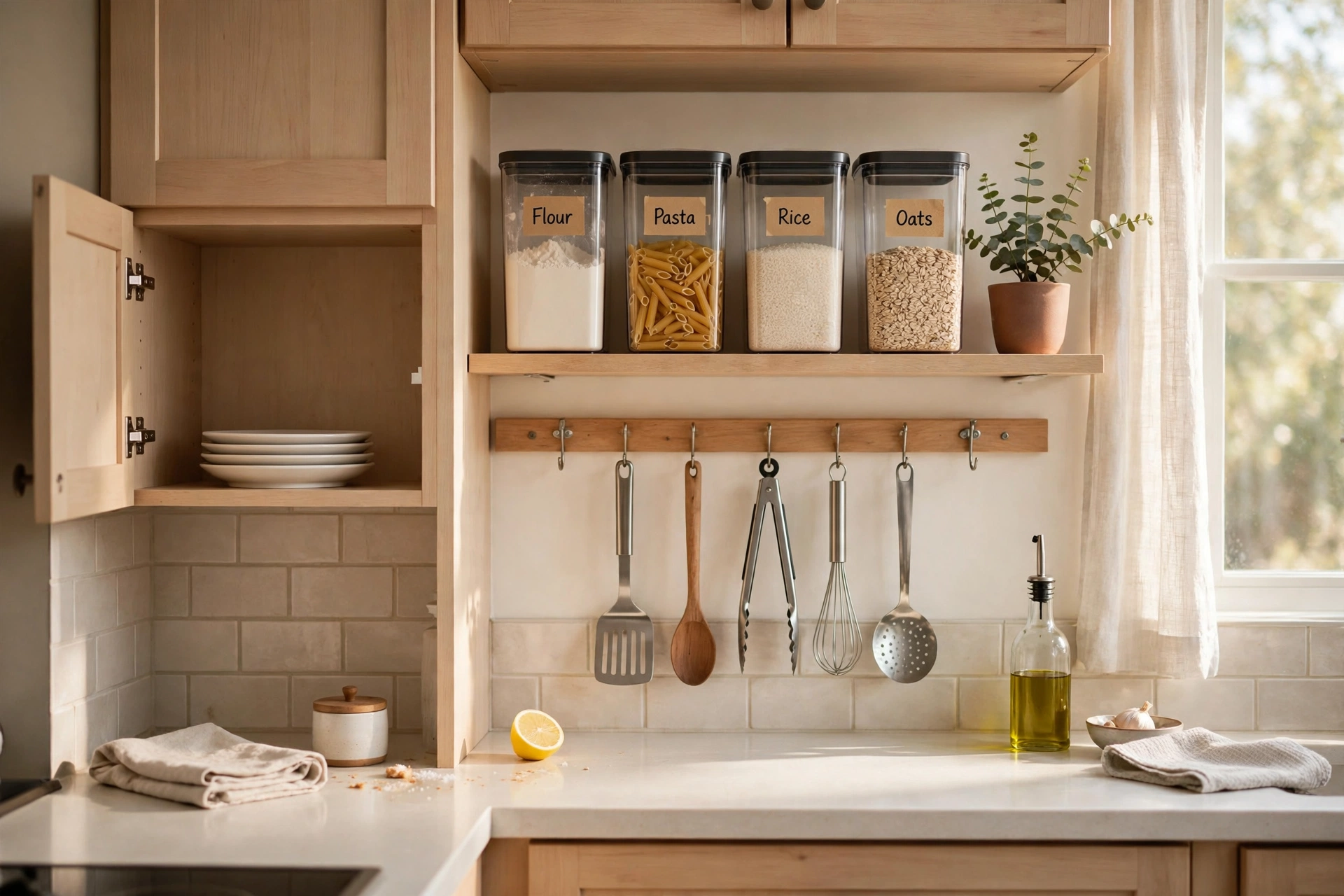
25 Smart Small Kitchen Organization Ideas That Make Every Inch Count
A small kitchen can still feel calm and easy to cook in. You do not need a remodel to get there.
The best small kitchen organization ideas are simple: take out what you do not use, group the rest by how you cook, and give every item a clear home close to where you use it.
These 25 ideas cover cabinets, drawers, counters, walls, the pantry, under-sink storage, pots and pans, and containers. Most are renter-friendly.
Table of Contents
- Before You Buy Anything: A 5-Step Starting Point
- Cabinet Ideas (Ideas 1–5)
- Drawer Ideas (Ideas 6–8)
- Counter Ideas (Ideas 9–11)
- Wall and Vertical Ideas (Ideas 12–15)
- Pantry Ideas (Ideas 16–19)
- Under-Sink Ideas (Ideas 20–21)
- Pots, Pans, and Lids (Ideas 22–23)
- Containers and Narrow Gaps (Ideas 24–25)
- Common Mistakes to Avoid
- Frequently Asked Questions
- Conclusion
Before You Buy Anything: A 5-Step Starting Point
Before you buy a single organizer, spend twenty minutes on the basics. A tidy system only works when it holds the right things.
Step 1: empty one area. Work on one cabinet, drawer or shelf at a time. Take everything out and wipe it.
Step 2: sort ruthlessly. Make four piles: keep, relocate, donate, and recycle or throw away. Keep only what you use regularly, and if you own two of the same tool, keep the better one.
Step 3: group by task. Group cooking tools, baking tools and cleaning supplies by task. It stops the endless searching.
Step 4: measure the space. Measure width, depth and height in inches and centimetres, and note hinges, pipes or a shelf lip.
Step 5: put daily items at hand height. Keep everyday items between knee and shoulder height. If you have to climb for the pan you use every night, you will stop putting it back.
If the sorting feels like a lot, start with decluttering alone. How to Declutter a Small Kitchen: A Step-by-Step Guide walks through it one area at a time.
Cabinet Ideas (Ideas 1–5)

Cabinets hold the most in a small kitchen, so start here. For a deeper look, see Small Kitchen Cabinet Organization: Practical Ideas for a Clutter-Free Space.
1. Add shelf risers inside cabinets
A shelf riser is a small shelf that creates a second level inside a cabinet. Use one for mugs, small bowls or plates, so you can store two layers instead of piling things up.
2. Hang baskets under a shelf
An under-shelf basket clips onto a shelf and uses the empty space below it. It suits light items such as tea bags, small packets or sandwich bags. Do not overload it.
3. Use the inside of cabinet doors
A slim rack or small adhesive hooks on the inside of a cabinet door can hold measuring spoons, a small spice rack, cleaning cloths or a bin-bag holder. Choose one shallow enough for the door to close fully.
4. Put a turntable in deep or corner cabinets
A turntable spins the contents of a deep cabinet, so you can find what is at the back without reaching past the front items. It suits oils, sauces, spices and small jars. Pick one with a low edge.
5. Zone your cabinets by how you cook
Give each cabinet one job: pots, pans and oils near the cooker; cleaning supplies near the sink; bowls, boards and measuring tools near your preparation area.
Drawer Ideas (Ideas 6–8)
Drawers are where small kitchens lose the most time. For the full drawer guide, see How to Organize Kitchen Drawers in a Small Kitchen.
6. Use dividers for utensils and small tools
A drawer divider stops cutlery, spatulas, peelers and measuring spoons from sliding into one pile. Put the items you use most at the front, and keep sharp items in a separate section.
7. File baking trays and chopping boards upright
Baking trays, chopping boards and cooling racks are easier to use standing upright, like files, than lying flat in a stack. Use a vertical divider in a deep drawer.
8. Keep lids in their own drawer section
Lids slide, nest badly and take up more room than they should. Give them a dedicated drawer section, with a divider or small rack to keep them upright and separated by size. Match lids to containers first and let go of extras.
Counter Ideas (Ideas 9–11)
Counter space is the most valuable surface in a small kitchen. For more, see Small Kitchen Counter Organization: Keep Your Counters Clear and Useful.
9. Keep only daily-use items on the counter
Choose a few items that earn counter space: a kettle, a coffee maker or a knife block. Move appliances used once a week or less into a cabinet. If you store an item away for two weeks and never reach for it, it does not need to live on the counter.
10. Use a tray to group items together
A tray turns several small items into one neat group that is easy to move. Use one for a tea and coffee station, for oils and salt near the cooker, or for soap and a sponge by the sink. Cleaning is faster too: lift the tray, wipe, and put it back.
11. Add an over-sink board or rack for extra preparation space
An over-sink cutting board or drying rack gives you extra preparation or drying space without using counter space. Make sure it fits your sink securely and does not wobble.
Wall and Vertical Ideas (Ideas 12–15)
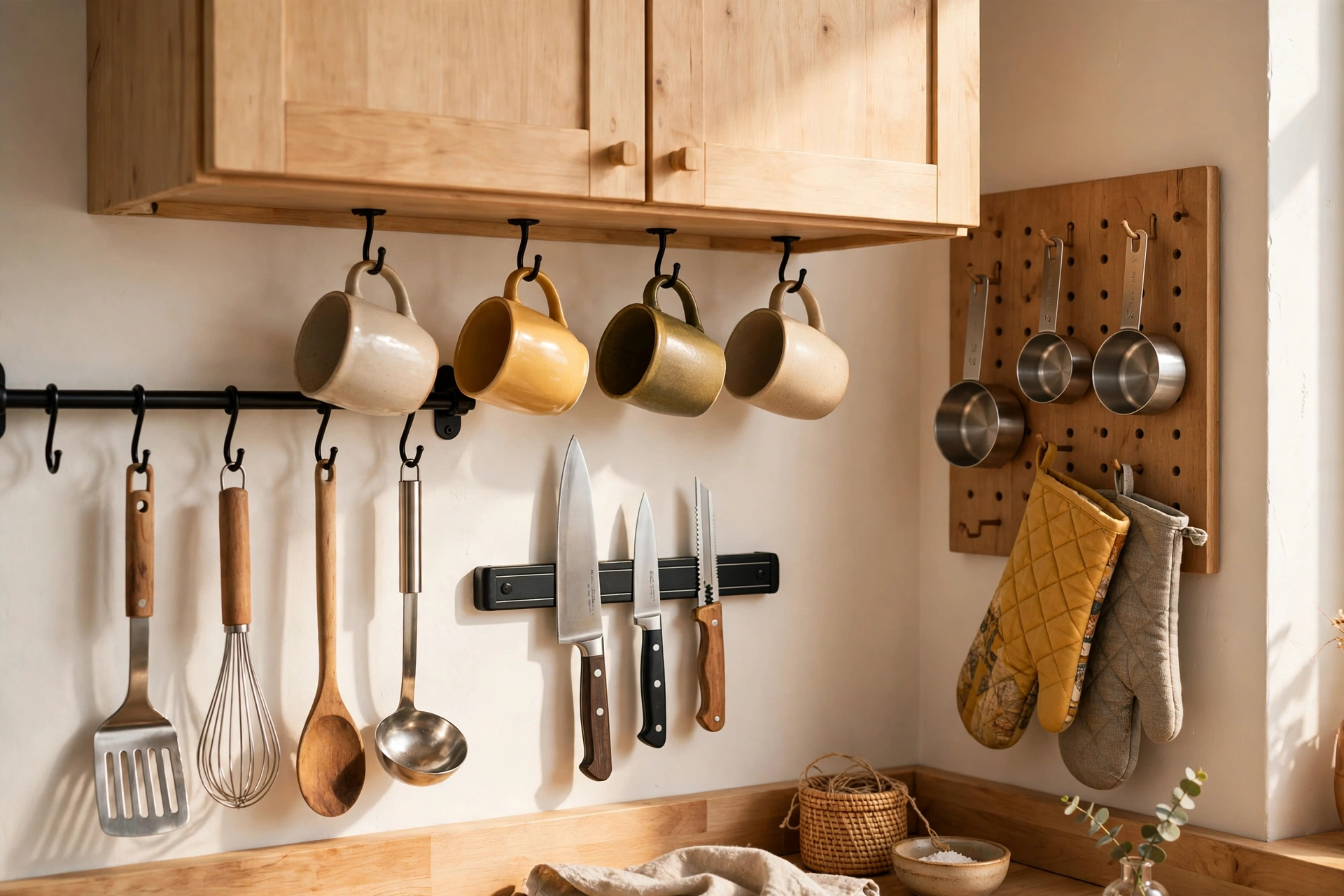
When the cabinets and drawers are full, look up. If you rent, most of these ideas work without drilling — see Small Kitchen Organization for Renters: No-Drill Storage Ideas for the removable options.
12. Use a wall rail or magnetic strip for knives and utensils
A wall rail with hooks, or a magnetic strip for knives, moves everyday tools off the counter. If you rent, look for a rail that mounts with strong adhesive strips, and check its weight limit first.
13. Try a pegboard for flexible storage
A pegboard with hooks and small shelves lets you change the layout as your needs change. Hang measuring cups, small pans, scissors and oven gloves where you can reach them. Move the hooks when you buy a new tool.
14. Hang mugs under a cabinet
Mugs take up a lot of shelf space for their size. A row of small hooks under a wall cabinet lets you hang mugs by their handles, freeing a whole shelf for plates or bowls. Leave space between the hooks.
15. Use the side of the fridge or the end of a cabinet
The side of a fridge or the end panel of a cabinet is often blank space. A magnetic rack on the fridge side can hold spices, while hooks on a cabinet end panel can hold towels or oven gloves. Check that nothing blocks a door, drawer or walkway.
Pantry Ideas (Ideas 16–19)

A small pantry works when you can see what is in it. For the full pantry guide, see Small Pantry Organization Ideas for Tight Spaces.
16. Use uniform, clear, stackable containers for dry goods
Store rice, pasta, flour, sugar and cereals in clear containers of the same shape. They stack neatly, and you can see what is left without opening each one. Label each container, and keep the original packet for cooking times or allergen information.
17. Group pantry food into labelled bins by category
Use a bin or small basket for each category: breakfast, baking, snacks, tinned food and sauces. Pull out one bin, find what you need, and put it back. Label the bins so everyone puts things back in the same place.
18. Add stepped risers so back rows are visible
In a pantry, items at the back are often hidden behind items at the front. A stepped riser raises the back row so you can see it. It also reduces the chance of buying a second jar of something you already have.
19. Keep a simple rotation habit
When you buy a new bag or jar, put it behind the one that is already open, so older stock is used first. Once a month, check the pantry and move anything nearly finished to the front.
Under-Sink Ideas (Ideas 20–21)
The cabinet under the sink is awkward, thanks to the pipes — see Under-Sink Organization Ideas for Small Kitchens for more.
20. Use a pull-out caddy or tiered shelf under the sink
A pull-out caddy or small tiered shelf lets you reach cleaning products without crouching to the back of the cabinet. Keep the most-used items at the front and heavier bottles low. Measure around the pipes first.
21. Hang spray bottles from a tension rod
A tension rod across the inside of the under-sink cabinet gives you a place to hang spray bottles by their triggers, freeing the floor for boxes, cloths and bin bags. Check that the rod is secure and bottles do not block the pipes. Adhesive hooks on the door can hold cloths or gloves.
Pots, Pans, and Lids (Ideas 22–23)
Pots and pans are the hardest things to store. For the full guide, see How to Organize Pots, Pans, and Lids in a Small Kitchen.
22. Store pans upright with dividers
Use a vertical divider or pan rack inside a cabinet so frying pans and baking trays stand on their sides. You can slide one pan out without lifting the ones on top of it.
23. Nest pans carefully, and hang them only if you have the space
If you do not have room for vertical storage, nesting pans can save space. Put a cloth or pan protector between them to reduce scratching. Hanging pans from a wall rail can work, but only with a strong fixing and enough headroom.
Containers and Narrow Gaps (Ideas 24–25)
The last two ideas are about the things that fill the gaps: food containers and narrow spaces that most kitchens waste.
24. Standardise your containers and store lids separately
Choose one stackable container set that fits your fridge. Matching containers stack neatly and take up less room than a mixed collection. Store lids upright in a separate section, grouped by size, and let go of any container or lid with no match.
25. Use a slim rolling cart for a narrow gap
Many small kitchens have a narrow gap between the fridge and the counter — too small for a cabinet, but wide enough for a slim rolling cart. A cart on wheels can hold oils, spices or cleaning supplies. Measure the gap and choose a cart a little narrower than it.
Common Mistakes to Avoid
Most small kitchens are not short on storage ideas — they are short on follow-through.
Buying organizers first. An organizer cannot fix a cabinet that holds twice as much as it should. Remove what you do not use first.
Buying without measuring. A basket, rack or divider that does not fit is wasted money. Measure width, depth and height first.
Keeping duplicates “just in case.” Two whisks, three peelers and four water bottles take up space your everyday items need. Keep the best one and let the rest go.
Daily items out of easy reach. If you have to climb or crouch for the pan you use every night, you will stop putting it back.
No home for each item. If an item has no fixed place, it will end up on the counter.
Frequently Asked Questions
Where should I start when organizing a small kitchen?
Start with one cabinet or drawer, not the whole kitchen. Empty it, remove what you do not use, and group what is left by task.
How can I organize a small kitchen without spending much?
Start with decluttering, which costs nothing. Use what you already have: a tray to group items, a box as a pantry bin, and a hook for mugs or towels.
How do I keep a small kitchen organized in the long term?
Give every item a fixed home, keep counters to daily-use items only, and do a short reset each evening.
What are the best renter-friendly organization ideas for a small kitchen?
Choose ideas you can remove without damage: freestanding shelf risers, under-shelf baskets, pull-out caddies, over-sink boards, trays, bins and a slim rolling cart.
How many items should I keep on my kitchen counter?
Keep only the items you use every day, and leave at least one clear stretch of counter for preparation. If you cannot chop, mix or plate a meal without moving things first, the counter is holding too much.
Conclusion
A small kitchen becomes easier to use when you remove what you do not need, group the rest by how you cook, and use the space you already have.
You do not need to buy everything at once, and you do not need to remodel. Pick three ideas that solve your biggest frustration and try them this week.
Once those three are working, add one or two more. For your next step, read How to Organize a Small Kitchen with Limited Cabinet Space, the next guide in this series.
11 thoughts on “25 Smart Small Kitchen Organization Ideas That Make Every Inch Count”