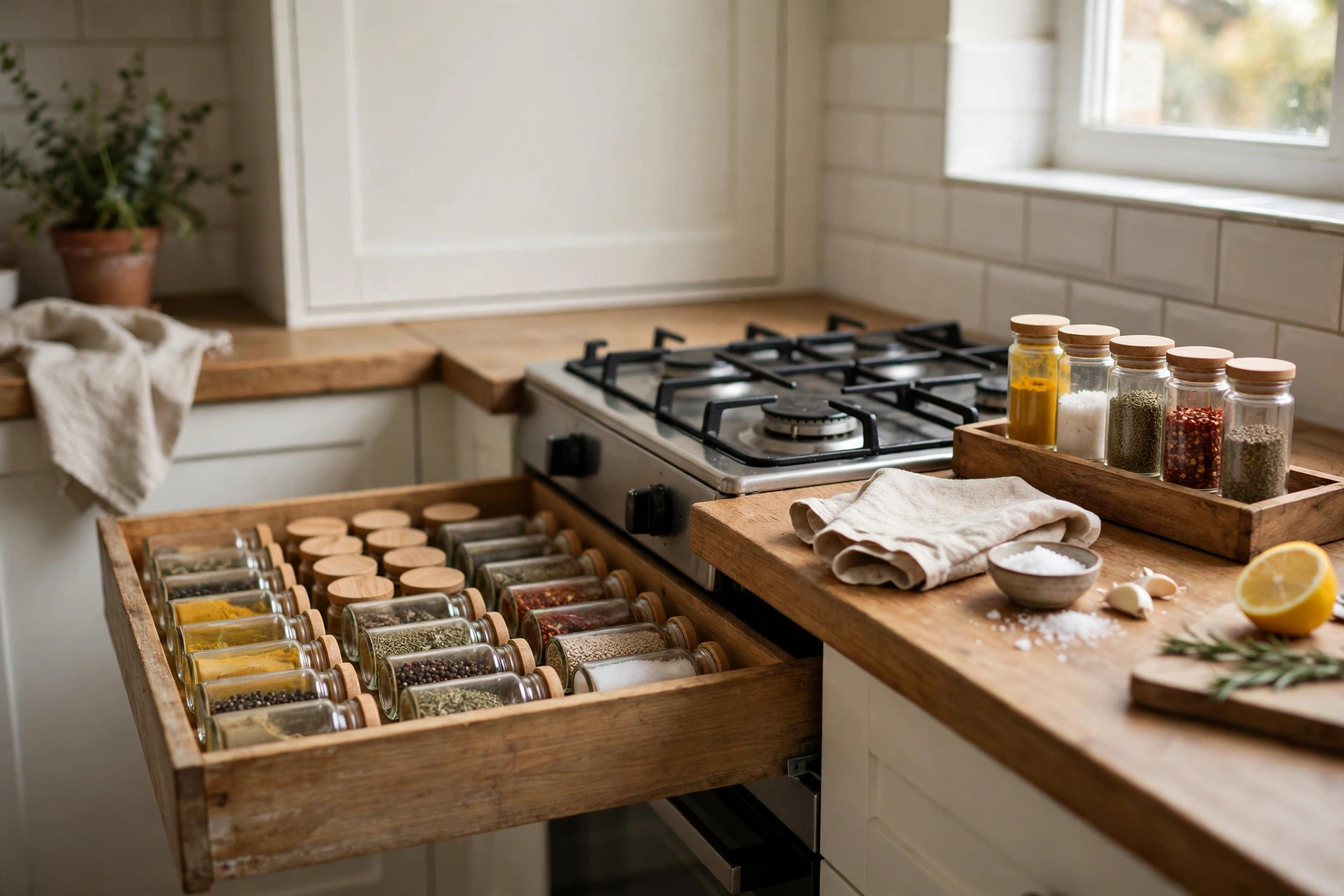
You do not need a spice rack to keep your spices tidy. If you organize spices without a rack, you use the space you already have: a drawer, the back of a cabinet door, a small tray, and jars you already own.
The trick is to pick one home for your spices. Once the jars have a fixed place near the cooker, cooking gets faster and you stop buying a second jar of something you already own.
This guide shows you how to organize spices without a rack, step by step: choose a home first, set up a drawer or a door back, decant only what you use, and keep it working with a simple rotation habit.
Table of Contents
- What It Means to Organize Spices Without a Rack
- Choose Your Spice Home First
- The Drawer Method
- The Inside of a Cabinet Door
- The Travelling Tray
- Jars You Already Own
- Rotation and Refills
- Small Spaces and Shared Kitchens
- Common Mistakes to Avoid
- Frequently Asked Questions
- Conclusion
What It Means to Organize Spices Without a Rack
A rack is only one way to store spices, and it is not the only way. When you organize spices without a rack, you are not settling for second best — you are using flat surfaces and hidden spaces that a rack would never touch.
The places that work are the ones you already walk past: a shallow drawer beside the cooker, the inside of a cupboard door, or a tray on top of the fridge can each hold a full spice collection.
The real change is in how you think about it: instead of asking what to buy, ask what is empty. An empty drawer, an empty door back, and an empty shelf are storage waiting to happen, and they cost nothing.
Choose Your Spice Home First
Most spice mess starts the other way round: people buy storage first, then try to fit their spices in. When you organize spices without a rack, start with the home instead, and let the home decide how many jars you keep.
Look for one spot within two steps of the cooker. A shallow drawer is the best candidate, but the inside of a cupboard door or a short stretch of shelf works just as well.
Now count how many jars that spot can hold comfortably. That number is your limit — if the drawer holds fourteen jars, fourteen is the size of your collection.
This limit keeps the system working. A home that is three-quarters full stays tidy, while one packed to the brim turns into a jumble within a week.
If you are torn between two spots, try the drawer first. A kitchen drawer guide will help you clear one out, and the cabinet organization basics can free a shelf if a door back suits you better.
The Drawer Method
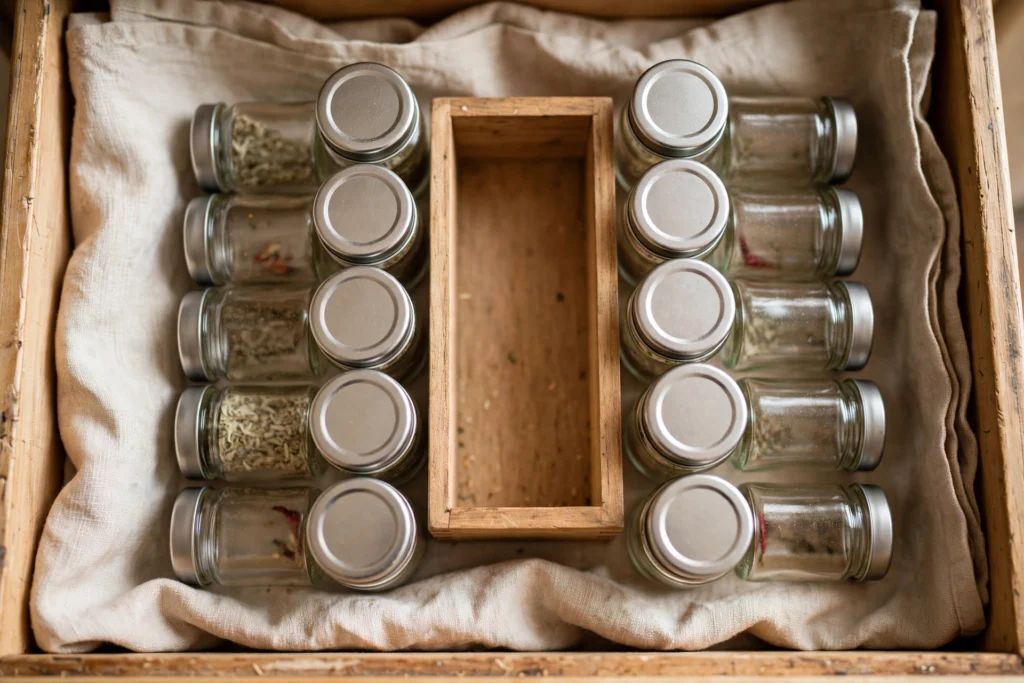
A shallow drawer near the cooker is the best home when you organize spices without a rack: it hides the jars, keeps them dark, and puts every label at eye level when you pull it open.
First, empty the drawer and wipe it out. A clean drawer shows its true size, and whether your jars will lie flat or stand upright.
If the drawer is shallow, lay the jars on their sides with the lids facing you, on a folded tea towel to stop them rolling. If it is deep enough for jars to stand, line them up in rows instead, tallest at the back.
Keep everyday spices at the front of the drawer. The ones you reach for once a month go to the back, where they are still easy to find but never in the way.
A short cereal box cut down to size makes a good divider and keeps the rows from sliding. If you want a sturdier setup, the drawer organizer guide shows inserts that fit most standard drawers.
One drawer is usually enough. If your collection is bigger than the drawer, that is a sign to trim the collection, not to take over a second drawer.
The Inside of a Cabinet Door
The back of a cabinet door is the most overlooked spice home in a small kitchen. It is hidden, right where you cook, and uses space that would otherwise hold nothing — a handy spot when you organize spices without a rack.
The simplest version needs no tools: small adhesive hooks or a slim stick-on pocket can hold light spice jars, and both peel off cleanly when you move out. The renter-friendly storage guide has more no-drill ideas.
Measure the depth before you stick anything on, and close the door slowly to check the jars clear the shelf edge. A jar that stops the door closing will drive you mad within a day — the fix is a shorter jar, not a stronger hook.
Keep the door back for your lightest, most-used jars. Heavy glass jars belong in a drawer, where their weight is supported, while anything you use rarely belongs on a shelf.
The Travelling Tray
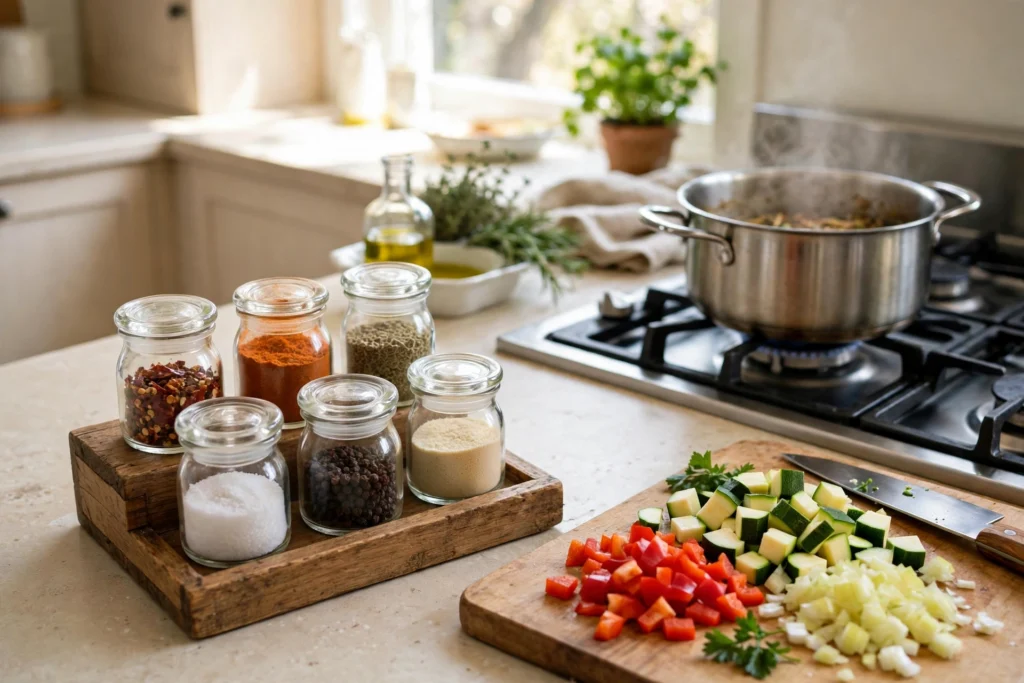
Not every spice needs a permanent home. The six or eight spices you cook with daily can live on a small tray that travels to the hob and back.
Pick a tray that fits your daily group with room to spare — a baking tray or a shallow box both work — and keep it somewhere fixed when you are not cooking, like a shelf or the top of the fridge.
The tray does two jobs at once: it keeps your daily spices together in one move, and it protects the counter, because drips land on the tray instead of the worktop.
The rule that makes it work is simple: the tray goes back after every meal. A tray left on the counter becomes a clutter pile within days. If your counters are crowded, the counter organization guide will help you find the tray a proper home base.
This pairs well with the drawer: keep the full collection there and the daily group on the tray, refilling the tray once a week.
Jars You Already Own
You do not need matching jars. Small glass jars from jam, honey, or pasta sauce, washed and dried, hold spices just as well as anything sold for the purpose.
The key is size, not style. Small jars — about 100 to 150 ml, or half a cup — suit spices best. A big jar half full of paprika looks tidy on day one and stale by month three.
Use jars of roughly the same height in each home. A row of similar jars lets you spot the one you want in a second, while mixed heights are hard to read at a glance.
Decant only the spices you use every week. The rest can stay in their original packets, folded shut in a small box — they take up less room than a row of half-empty jars.
Wash and dry each jar completely before you fill it. Even a few drops of water will clump the contents, and damp is the fastest way to ruin a good spice.
Rotation and Refills

A no-rack system stays tidy because of one habit: use the oldest spice first. When you organize spices without a rack, rotation replaces the rack’s display and keeps the collection fresh and the right size.
When you refill a jar, pour the new spice underneath the old, or finish the old jar first. It takes ten seconds, and stops a jar of cumin sitting untouched for two years while a fresh bag waits behind it.
Keep your refill packets in one small box, separate from the daily jars. It holds every refill at once, and tells you at a glance what you are running low on before shopping day.
Twice a year, open each jar and smell it. A spice that smells faint or dusty has lost its best flavour. Replace it, and let the jar go back into the drawer empty until you buy more.
Seasonal cooking changes what you reach for, so let the daily tray change too — more herbs for salads in summer, more warming spices for slow cooking in winter.
Spices keep best in a cool, dry place away from steam, so keep the jars and the refill box away from the sink and the hob. The FDA’s advice on storing food safely covers the same cool-and-dry principle for pantry food.
Small Spaces and Shared Kitchens
A no-rack system bends to fit kitchens that a rack never would. In a one-wall kitchen, the drawer beside the hob and a tray on top of the fridge can hold everything.
In a shared kitchen, give each person their own small tray or their own row in the drawer. Two labelled rows keep everyone’s spices separate without any extra furniture.
If your kitchen has an island or a narrow cart, its drawer can become your spice home, close to the worktop where you chop. The small kitchen island guide shows how to give an island drawer a single job like this.
Think in zones, not in furniture. The zone organization guide explains how to give every cabinet one task, and spices fit neatly into the cooking zone.
A tiny kitchen does not need a smaller system, just a stricter one: fewer jars, one home, and a tray for the daily group. That is the heart of how you organize spices without a rack.
Common Mistakes to Avoid
When you organize spices without a rack, a few habits can quietly undo the whole system.
Labelling the side of the jar. When jars lie flat, the lid is the part you see. Write the name on the lid, so you can read it at a glance.
Using jars with loose lids. A lid that does not seal lets in air and damp, and the spice goes stale. Check every lid closes snugly before you fill the jar.
Letting the tray grow. A tray that grows from eight spices to twenty is no longer a daily set — it is a second spice collection on your counter. When a spice joins the tray, one leaves it.
Mixing sweet and savoury in one row. Cinnamon beside cumin looks harmless, but a pinch of the wrong one can spoil a dish. Keep sweet spices in their own small group.
Stacking jars two deep. A second layer hides the jars underneath, and you forget they are there. Keep one layer, and let the drawer size set the limit.
Parking the tray mid-prep. A tray in the middle of the chopping area gets in the way. Keep it at the back of the counter, and slide it forward only when you need it.
Frequently Asked Questions
Can I store spices in the fridge?
It is not a good idea for most spices. Fridges are damp, and every time you take a jar out, condensation forms inside it. A cool, dark cupboard or drawer keeps them fresher.
What if I have no spare drawer at all?
Use the inside of a cabinet door, or a small box on a shelf. A shallow box holding jars upright works on any shelf — pull the whole box out like a drawer. If even that is full, the travelling tray on top of the fridge works on its own.
Can I use the same jars for whole and ground spices?
Yes, but keep them in separate rows. Whole spices last longer, so they need refilling less often. Ground spices go nearer the front, where you reach for them daily, and the food container and lid guide has more on keeping small jars and lids from taking over a shelf.
How many spices can a drawer actually hold?
A standard shallow drawer holds about twelve to eighteen small jars lying flat. Measure your drawer first, then count the jars you use weekly — if the number is bigger than the drawer, the collection needs trimming, not a second drawer.
Does this work if I cook with a lot of spices?
Yes, but the split matters more. Keep the daily group on the tray, the full collection in the drawer, and refills in their box. If you cook with more than twenty spices regularly, give the collection two homes — a drawer and a door back — instead of crowding one.
Conclusion
You do not need a rack, a new purchase, or a single hole in the wall. A drawer, a door back, a small tray, and jars you already own can hold a full spice collection within reach every time you cook.
Start this afternoon with the drawer nearest your cooker: empty it, lay your daily spices inside, and put the rest in a refill box on a shelf. When you organize spices without a rack one drawer at a time, the spice you need will be exactly where your hand expects it.