
The best small air fryers fit your counter, your cupboard and the amounts you actually cook. A machine that never leaves its box is no help at all, so size and storage matter as much as cooking power.
This guide covers types, capacity, footprint and cleaning, plus safety, storage and a step-by-step way to choose. No brand names, no prices.
Table of Contents
- What Makes Small Air Fryers Work in a Small Kitchen
- The Three Main Types of Small Air Fryers
- Capacity: How Much Food Do You Cook at Once?
- Footprint, Height and Where It Will Live
- Basket or Tray: How the Cooking Space Works
- Heat, Airflow and Cooking Results
- Controls and Settings Worth Having
- Safety: Heat, Steam and the Counter
- Cleaning and Looking After It
- Storage Ideas When Counter Space Is Short
- A Step-by-Step Way to Choose One
- Common Mistakes to Avoid
- Frequently Asked Questions
- Conclusion
What Makes Small Air Fryers Work in a Small Kitchen
An air fryer is a small oven that cooks with fast-moving hot air, which is why food turns crisp with far less oil than frying. The same hot air also roasts vegetables and reheats leftovers, so one machine can cover several jobs.
If your counter is already crowded, look at the wider picture first. The compact kitchen appliances guide shows how small air fryers fit alongside your other machines.
If mornings start with a smoothie, the best compact blenders guide covers the other machine that earns counter space.
The Three Main Types of Small Air Fryers
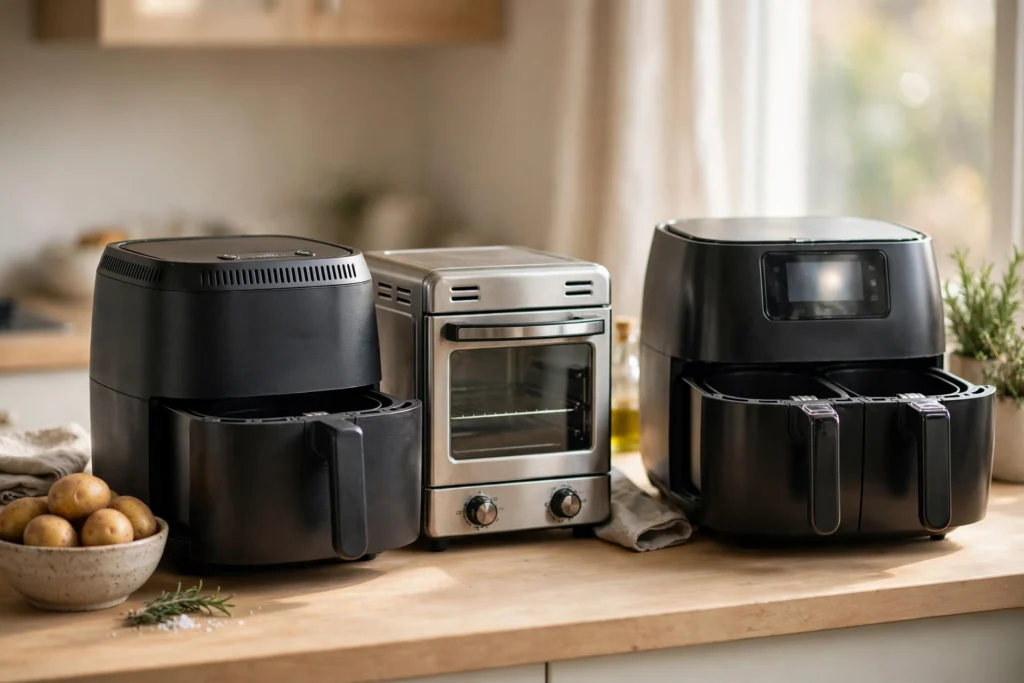
Air fryers come in three broad shapes, and the shape matters more than any single feature. Picking the wrong one is the most common regret.
Basket-style air fryers
A basket-style fryer has a pull-out drawer with a basket inside, and it is the most common shape for a small kitchen. Slide the basket out, tip the food in, slide it back and set the timer.
Its strength is simplicity: one cooking space, one basket to wash, and a machine compact enough for a small counter.
Its limit is that single space. You cook one thing at a time, so a full meal needs two rounds or a second pan on the hob.
Oven-style air fryers
An oven-style fryer looks like a small toaster oven, with a door that opens down and racks inside. Food sits on racks, so you can cook on two levels at once.
Its strength is flexibility: racks let you cook a main and a side together, and the flat shape suits foods that need to lie in one layer.
Its limit is size and cleaning. It takes up more counter than a basket model, and the racks, door and walls all need wiping after use.
Dual-basket air fryers
A dual-basket fryer has two drawers side by side, so you can cook two foods at different temperatures and finish them together.
Its limit is the footprint. Two drawers mean a wide machine, and most small kitchens cannot spare that much counter.
If you chop more than you fry, the small kitchen food processors guide explains when a processor earns its place.
Capacity: How Much Food Do You Cook at Once?
Capacity is the first decision when choosing small air fryers, and it is worth getting right. Too small means cooking in rounds; too big means a single portion rattles around inside.
Capacity is measured in quarts or litres. A fryer of about 2 quarts (about 2 litres) suits one person, while about 3 to 4 quarts (about 3 to 4 litres) suits two people.
Think about your largest regular meal, not your average one. A fryer used mainly for snacks can be small, but one that cooks dinner for two needs more room.
Small air fryers in the middle range are the easiest to live with: big enough for a weeknight dinner for two, small enough to keep within reach.
Footprint, Height and Where It Will Live
Measure where the fryer will live before you buy it. Check the width and depth of the counter or shelf, and the height under your wall cabinets.
Leave room to open the drawer or door fully. A basket that cannot slide all the way out is awkward to load, and a door that hits the wall will annoy you daily.
Weight matters as much as size. A heavy machine stays steady while it runs, but you must lift it in and out of a cupboard, so a lighter machine is safer up high.
Check the cord length too. A short cord limits where the machine can sit, and the socket it reaches decides its home.
Small air fryers work best when their home is decided before they arrive. The small kitchen counter organization guide shows how to clear that corner, and the under-cabinet kitchen tools guide covers the space above it.
Basket or Tray: How the Cooking Space Works
The basket is the part you handle every day, so its shape matters. A round basket suits a small counter, while a square one holds more food.
Some baskets have a raised plate inside that lifts food above the drips. Fat and juices collect underneath, which keeps food crisp.
Check how the basket comes apart. A basket that lifts out of its drawer is easier to wash and empty, and a handle that stays cool is easier to grip.
A full basket of hot food is heavy, so lift it with both hands and set it down on a heat-safe surface.
Heat, Airflow and Cooking Results

Hot air does the work in an air fryer, moving fast around the food so the outside crisps while the inside cooks through. A light brush of oil helps some foods crisp.
Temperature control is the most useful feature on any fryer. Lower heat suits foods that need time to cook through, while higher heat suits foods you want crisp quickly.
Cooking times vary with the food, the amount and the machine, so treat any timing as a starting point and check food as it cooks.
Check meat and poultry with a food thermometer before serving. The USDA’s safe minimum internal temperature chart lists the temperatures different foods must reach to be safe to eat.
Controls and Settings Worth Having
Controls range from simple dials to touchscreens, and simpler is often better in a small kitchen. A dial you can turn without looking beats a menu you must study.
Presets are shortcuts for common foods, such as chips or chicken. They are handy, but they are guesses, so check the food before the timer ends.
A clear timer matters more than extra presets. You need to see at a glance how long is left, especially when you are cooking something that can burn quickly.
Small air fryers with fewer parts are often the better buy.
Safety: Heat, Steam and the Counter
An air fryer gets very hot outside as well as inside, so treat it with the same care as an oven. Keep it away from the counter edge, where a passing elbow could knock it.
Hot air escapes when you open the basket, and the steam can burn. Open the drawer away from your face, and let the steam clear before you reach in.
Leave clear space around the machine while it runs. The vent needs room to release hot air, so do not push the fryer tight against a wall or under a low shelf.
Let the machine cool before you move it or put it away. Moving it while hot risks a burn or a spill.
Keep little hands away from the buttons and the hot basket, and unplug the machine after use if children can reach the counter.
Cleaning and Looking After It
Cleaning is where many small air fryers earn their bad reputation. A basket full of baked-on grease takes longer to wash than the cooking saved you.
Check whether the basket, tray and drawer can go in the dishwasher. Parts that come apart are easier to wash and dry.
Soak the basket in warm soapy water if food has stuck to it. A short soak loosens most residue, and a soft sponge finishes the job.
Wash the parts straight after use and dry them fully before you put them away. Food left to dry is much harder to scrub off, and a damp basket stored away can smell.
Wipe the inside of the machine with a damp cloth once it has cooled. Crumbs and grease left inside can smoke the next time you cook.
Never put the main body under the tap. It holds the fan, heater and electrics, and water inside can ruin the machine.
Storage Ideas When Counter Space Is Short
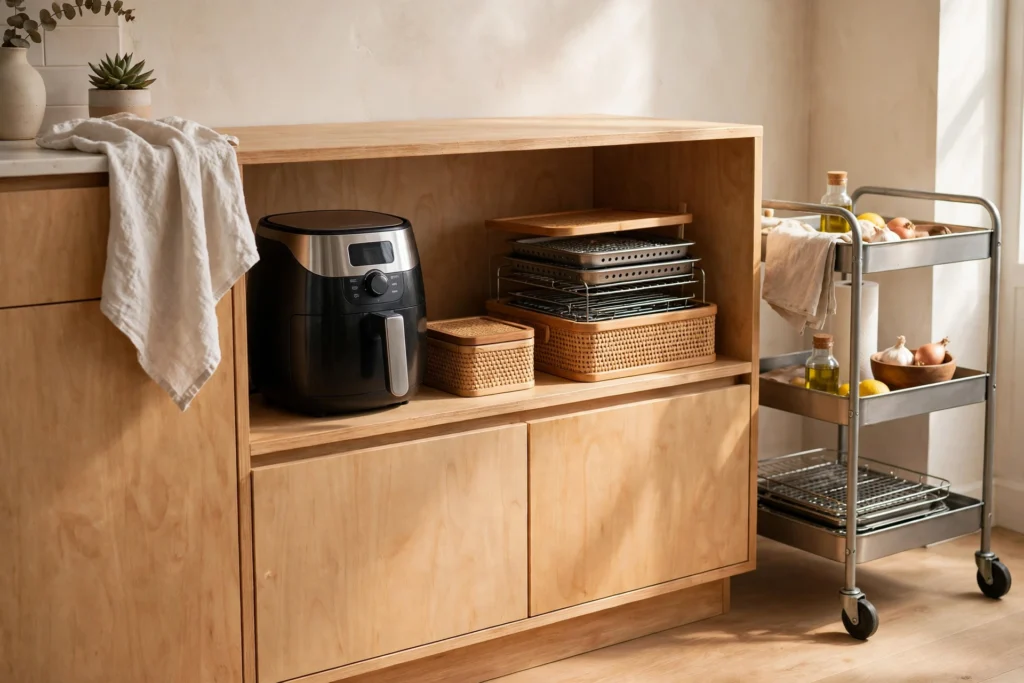
A fryer needs a home within reach but out of the way, because a machine that takes five minutes to dig out will stay in the cupboard.
Keep spare trays, racks and liners in one container in the same cupboard as the machine. The cookware sets guide shows why keeping matching parts together saves time daily.
Cook only what you will eat soon, and keep any leftovers sealed and chilled. The FDA’s advice on storing food safely explains how long prepared food keeps.
If you are still deciding which tools deserve your limited space, the small kitchen essentials guide helps you rank them. Small air fryers that earn their shelf are keepers.
A Step-by-Step Way to Choose One
Work through these steps in order to end up with a machine that fits your kitchen and your cooking.
- Count how many portions you cook at once on a busy evening, and note your largest regular meal.
- Measure the counter or cupboard space where it will live, including height and room to open the drawer.
- Choose the capacity that fits that cooking — small air fryers come in basket, oven-style and dual-basket types.
- Check the weight and whether you can lift it comfortably with one hand.
- Look at the controls and basket, and keep only the features you will actually use.
- Check how the parts wash and whether they fit in your dishwasher.
- Compare your shortlist against your measured space, then pick the smallest one that meets your needs.
Before you buy, run the same test you would use for any new tool. The how to choose space-saving kitchen tools guide walks through that check, and the best space-saving kitchen tools guide shows what else competes for the shelf.
Common Mistakes to Avoid
Overcrowding the basket. Food piled in a heap cooks unevenly, because hot air cannot reach the pieces in the middle. Spread food in a single layer and cook in batches if you need to.
Cooking wet batter. Runny batter drips straight through the basket and burns onto the bottom of the drawer. Save wet batters for the oven, and use the fryer for foods that hold their shape.
Setting the heat too high for everything. High heat crisps the outside fast, but thick foods can stay undercooked inside. Start lower for thick pieces.
Forgetting to turn the food halfway. Food that sits still browns on one side and stays pale on the other. Flip or shake it once midway.
Washing the basket while it is still hot. Plunging a hot basket into cold water can warp it over time and damage the coating. Let it cool first, then wash it as usual.
Frequently Asked Questions
Can I use foil or parchment paper in an air fryer?
Yes, but use it with care. Leave gaps so air can still move, and weigh the paper down with food. Never cover the whole basket.
Can I cook frozen food straight from the freezer?
Yes, most frozen foods cook well straight from frozen. Add a few extra minutes, and check the food is cooked through first.
Do I need to preheat a small air fryer?
A short preheat helps foods that need a crisp start, such as chips or breaded chicken. Use it for those foods and skip it for slower dishes.
Can I plug an air fryer into an extension lead?
Plug it straight into a wall socket instead. Air fryers draw a lot of power while they heat, and an extension lead can overheat.
Can a small air fryer replace my oven?
It can replace your oven for small batches, such as dinner for one or two and reheating. It cannot handle a large roast or a family-sized meal, so think of it as a partner to your oven.
Conclusion
Small air fryers pay off when they match the kitchen you have and the meals you actually cook. Pick the type that fits your routine and the basket that fits your household.
Measure your counter tonight and count the portions you cook most often. Those two numbers will rule out half the machines you might buy, and the rest of the choice follows from there.