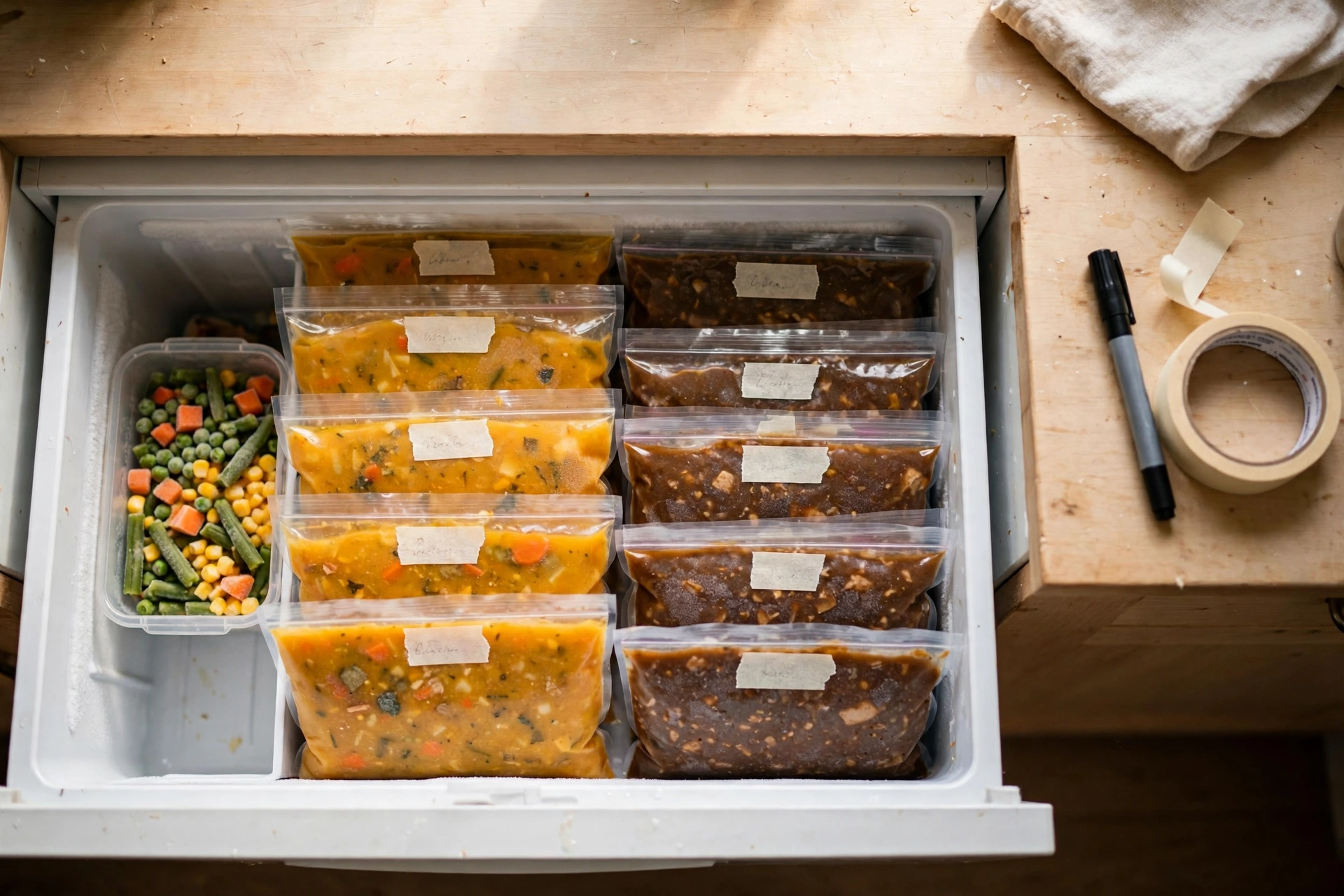
Freezer meal prep for small kitchens means cooking a few meals ahead, freezing them in single portions, and pulling one out when the day is too busy to cook. A small freezer cannot hold a month of food, but it can hold the difference between a home-cooked dinner and a takeaway on a hard evening.
The secret is choosing meals that freeze well, packing them flat so they stack, and keeping a simple system so nothing gets lost at the back. This guide shows you how to plan, pack, organize, thaw, and reheat — all inside a small freezer.
Table of Contents
- What Freezer Meal Prep Really Is — and Why Small Kitchens Benefit Most
- How Much Freezer Space Do You Actually Have?
- What Freezes Well — and What Does Not
- Planning a Freezer-Friendly Week
- Freezer Meal Prep for Small Kitchens: A Session, Step by Step
- Packing for a Small Freezer: Flat, Labelled, Stacked
- Organizing a Small Freezer: Zones and Rotation
- Thawing Safely
- Reheating Frozen Meals Without Ruining Them
- Common Mistakes to Avoid
- Frequently Asked Questions
- Conclusion
What Freezer Meal Prep Really Is — and Why Small Kitchens Benefit Most
Freezer meal prep is cooking food now and eating it later, after a spell in the freezer. Unlike fridge meal prep, where cooked food is eaten within a few days, the freezer lets a batch last beyond the week.
That matters most in a small kitchen. A small fridge holds three or four days of food, and a small household cannot cook a fresh dinner every night.
A freezer, even a small one, breaks that limit. Two or three frozen portions mean two or three evenings when dinner is already made. It is a small reserve of ready meals, kept in rotation.
For the simple meals that need no freezer at all, read Easy Meal Prep Ideas for Small Kitchens.
How Much Freezer Space Do You Actually Have?
Before planning anything, look at the freezer you actually have. It might be a compartment above or below the fridge, a single drawer in a fridge-freezer, or a small chest or upright freezer.
The compartment or drawer usually holds two or three cooked meals in single portions, plus a few basics such as frozen vegetables and bread. That is the whole capacity — plan for it.
Measure the inside before buying containers or bags: width, depth, and height, and the height of any drawer. Keep the numbers on your phone, because a container a centimetre too tall for the drawer will not close.
What Freezes Well — and What Does Not
Not every meal survives freezing. Meals that freeze well are moist, sturdy, and reheat without falling apart.
Soups, stews, curries, and chilli freeze best of all. They are mostly liquid, so they thaw evenly.
Cooked grains and pulses freeze well in portions: rice, quinoa, lentils, chickpeas, and beans. Freeze grains plain, and add a spoonful of water when reheating.
Sauces freeze well on their own: tomato, curry, and pasta sauce in single portions, ready to pour over freshly cooked pasta or rice.
Cooked meat in sauce — chicken in a curry, beef in a stew — freezes well, because the sauce stops the meat drying out. Plain cooked meat can turn dry and stringy.
Meals that freeze badly have delicate textures. Fresh salads, raw vegetables, and fried food go soft or soggy. Creamy dishes can split or turn grainy when thawed.
Cooked pasta in sauce can turn stodgy, so freeze the sauce separately. Potatoes can go grainy, and eggs do not freeze well whole.
The rule is simple: if a meal is mostly liquid or sauce, it probably freezes well. If its appeal is crispness or creaminess, eat it from the fridge instead.
Planning a Freezer-Friendly Week
A freezer plan is a small, rolling reserve: a few portions cooked this week, eaten over the next two or three weeks, and replaced as they are used.
Start with two freezer meals a week, not ten. Choose meals your household already likes and that freeze well — a soup and a curry, for example — and cook a double batch when you make them anyway, freezing the extra half in single portions.
Keep a short list of the freezer meals that worked, and repeat them. Five reliable freezer meals beat twenty untried recipes. A freezer plan built around cheap staples also saves money — see Budget-Friendly Meal Prep for Small Households.
For the planning steps in full, see A Beginner’s Guide to Meal Planning for a Small Household.
Freezer Meal Prep for Small Kitchens: A Session, Step by Step
A freezer prep session is one pot or tray, cooked once, then cooled, packed, and frozen. It works best on a day you already cook.
First, choose the freezer meal: one dish your household likes, built around ingredients you already have, that freezes well. If the freezer is full, cook for the fridge instead.
Second, set up one workstation — a board, a knife, a bowl, and your containers or bags — and cook the meal in one pot or one tray.
Third, cool the food before it goes anywhere near the freezer. A large pot cools slowly in the middle, so spoon the food into shallow containers, lids off, until cool to the touch.
Never put a steaming container into the freezer: it warms everything around it.
Fourth, portion and pack in single portions, sized to one meal for one person. Squeeze the air out of bags, leave a little space at the top of containers, because food expands as it freezes, and label every pack with the contents and the date.
Fifth, freeze flat: lay bags flat until solid, then stack them upright like files, newest at the back so the oldest gets used first. Wash up, and note what went into the freezer — a short list on the fridge door stops food being forgotten.
For the batch method behind this session, see Batch Cooking in a Small Kitchen: Tips to Save Time and Space.
Packing for a Small Freezer: Flat, Labelled, Stacked
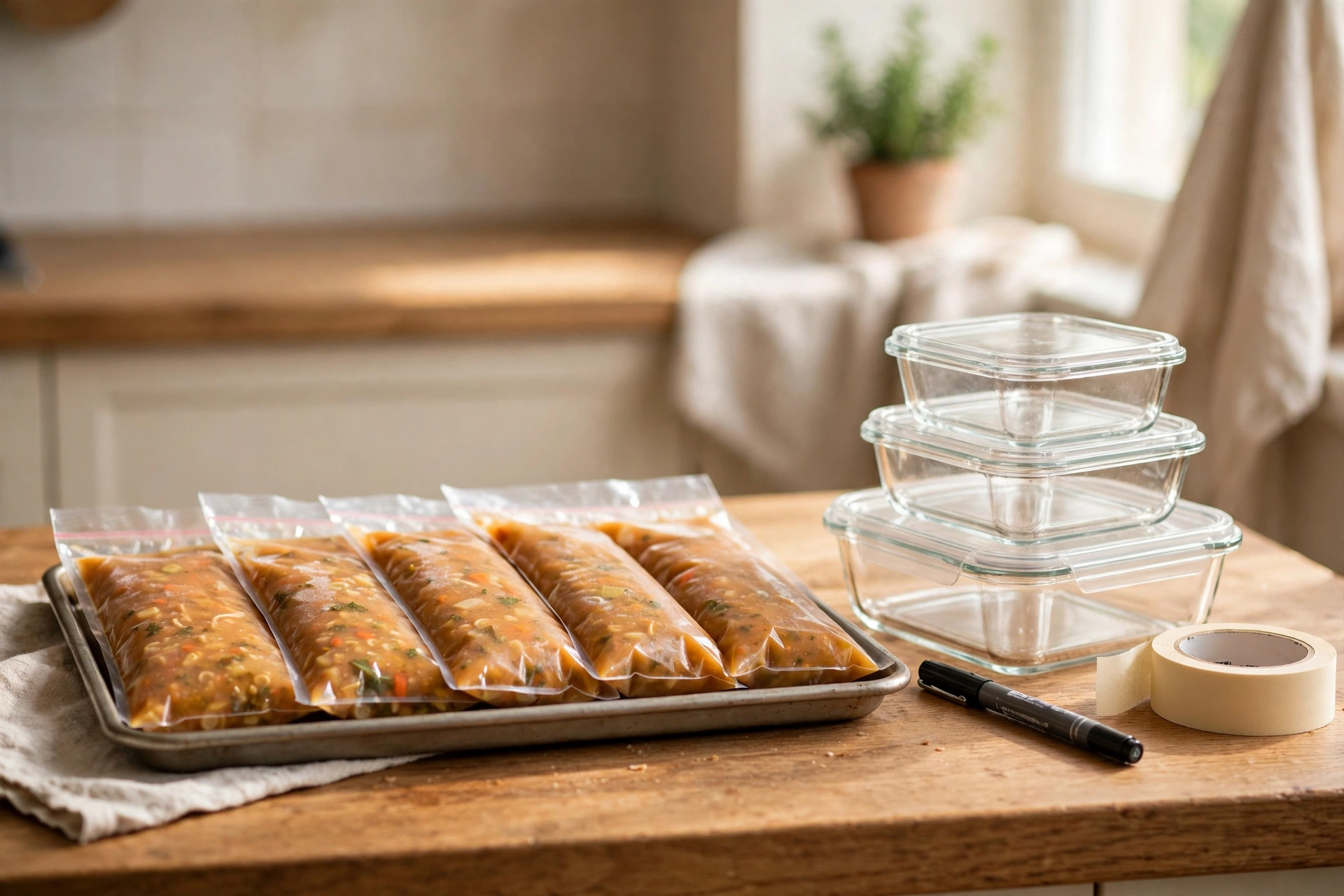
Packing is what makes a small freezer work. Tall round tubs waste the corners and the air between them, while flat packs use almost every centimetre.
Freeze flat. Freezer bags, laid flat with the air squeezed out, freeze into thin slabs that stack in rows or stand upright like files. They also thaw far faster than a deep container.
Choose one shape and one size. Square or rectangular containers stack far better than round ones, because they sit flush with no wasted gaps.
Pick one matching set in two sizes: medium, about 750 ml to 1 litre (3 to 4 cups), for meals, and small, about 250 to 500 ml (1 to 2 cups), for sauces. Use bags for soups and stews, and containers for grains.
Label everything, on the pack, not the lid. Write the contents and the date on masking tape or directly on the bag with a marker pen. Lids get swapped.
Squeeze the air out. Air in a bag is the main cause of freezer burn — the dry, pale patches that spoil flavour and texture.
Press the bag flat, push the air out from the bottom, and seal it. For containers, press cling film onto the surface of the food before lidding it.
For the container system in full, see How to Store Meal Prep Containers in a Small Kitchen.
Organizing a Small Freezer: Zones and Rotation
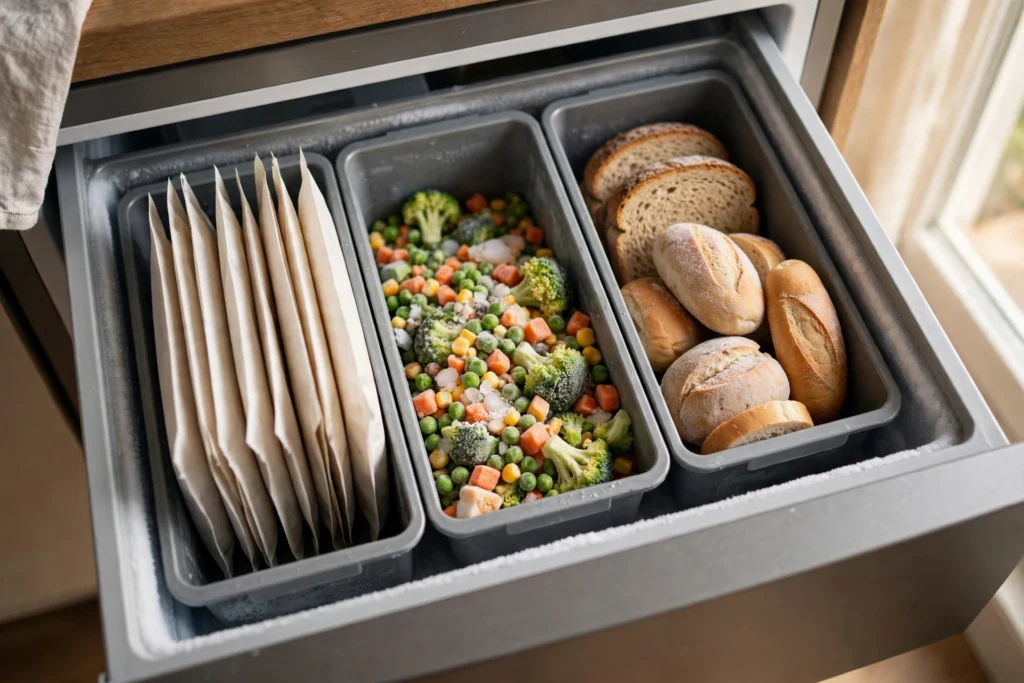
A small freezer needs the same kind of map as a small fridge: a fixed place for each type of food.
Divide the freezer into three zones. Ready meals — soups, stews, curries, and sauces in flat packs — go in one row or bin, standing upright like files.
Ingredients — frozen vegetables, berries, and bread — go in another bin. The overflow, the extra portion from tonight’s dinner, goes in the remaining space and gets eaten first.
Use bins or small boxes to hold the zones apart. A narrow bin keeps flat packs upright in a drawer, and baskets do the same job in a chest freezer.
Rotation keeps the system honest: newest at the back, oldest at the front, and the oldest portion is the next freezer dinner. Keep a short inventory — a list on the fridge door — and cross things off as you use them.
For the fridge version of this map, see Small Fridge Organization for Meal Prep.
Thawing Safely
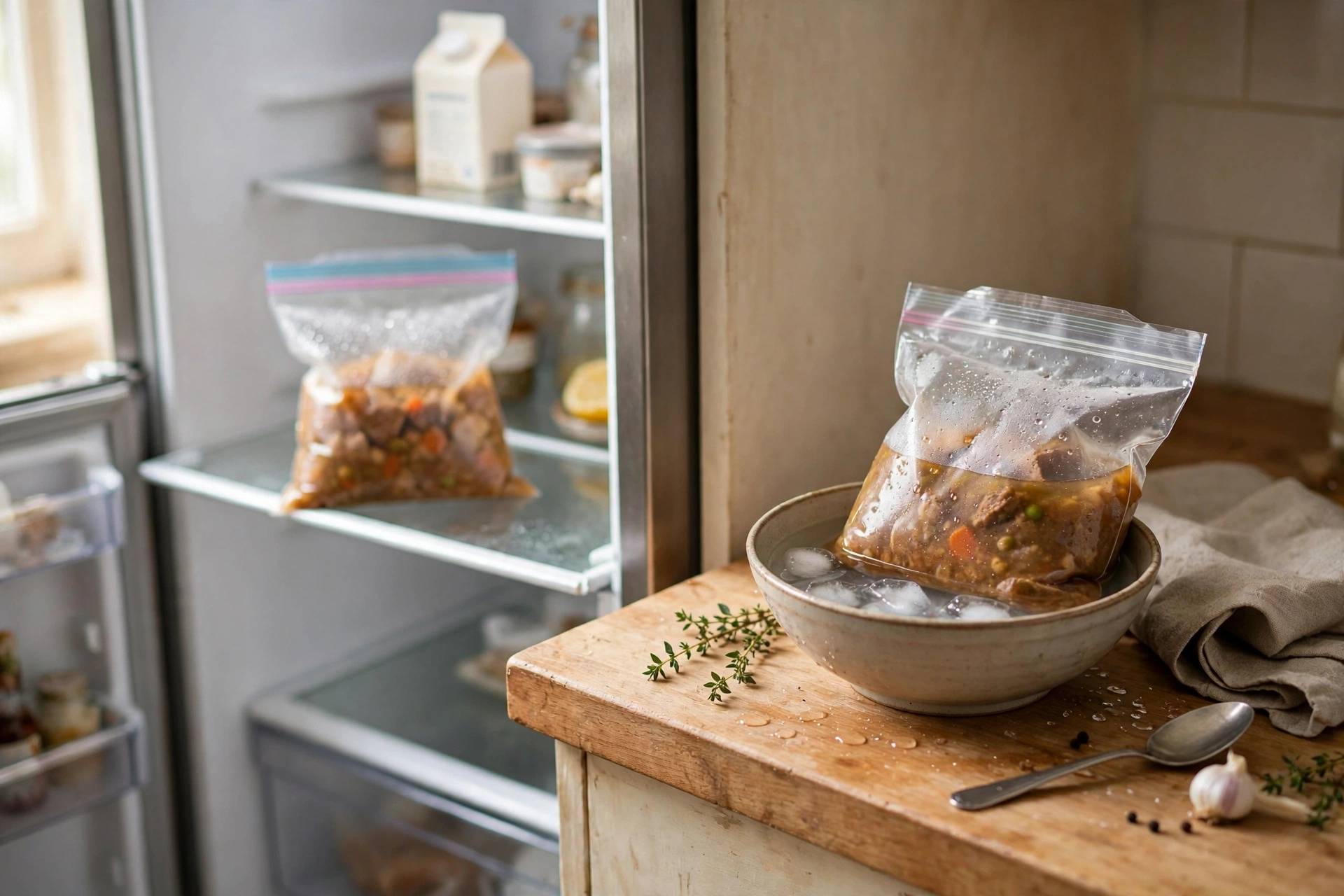
Thawing is where freezer meals are most often spoiled. The rule is simple: thaw slowly, in the fridge, and never leave thawed food sitting out.
In the fridge, overnight. Move the portion from the freezer to the fridge the evening before you want it. A single portion usually thaws overnight; a larger one may need a full day.
In cold water, for a hurry. Put the sealed bag or container in a bowl of cold water, changing the water every half hour or so. Do not use hot water. Cook the food straight after thawing this way.
In the microwave, if it must be eaten now. Use the defrost setting, in short bursts, and cook the food immediately afterwards — it should not go back into the fridge to wait.
Never thaw food on the counter for hours, and never refreeze food that has been fully thawed. Once thawed, eat it within a few days, and if it looks or smells off, do not eat it.
For the freshness rules behind thawing and storage, see How to Keep Meal Prep Ingredients Fresh Throughout the Week.
Reheating Frozen Meals Without Ruining Them
A freezer meal that reheats badly does not get eaten, so reheating is part of the plan — gentle and slow.
Reheat a thawed portion in a small pan on a low heat, with a splash of water or stock, stirring now and then, until it is piping hot throughout.
In a microwave, reheat in short bursts and stir between them. Add a spoonful of water to grains before reheating, and a squeeze of lemon or fresh herbs at the end can lift a stew frozen for a few weeks.
Reheat only the portion you will eat, and reheat it once, until it is piping hot throughout.
Common Mistakes to Avoid
Cooking a month of freezer meals at once. A small freezer holds two or three portions, not a month of cooking. Cook two freezer meals a week.
Freezing food that does not freeze well. Salads, fried food, creamy dishes, and pasta in sauce belong in the fridge, not in the freezer.
Putting hot food straight into the freezer. A steaming container warms everything around it. Cool the food first, in shallow containers.
Leaving air in the bag. Air causes freezer burn — dry, pale patches that spoil flavour. Squeeze the air out and seal bags flat.
Forgetting to label. Unlabelled food gets thrown away. Label every pack with the contents and the date.
Freezing everything in one big container. A large container thawed four times is food reheated four times. Use single portions.
Thawing on the counter all day. Thaw in the fridge overnight, or in cold water, and cook thawed food promptly.
For the wider system from shopping to storage, see Small Kitchen Meal Prep Workflow: From Grocery Shopping to Storage.
Frequently Asked Questions
How many freezer meals can a small freezer hold?
A small freezer compartment or drawer usually holds two or three single-portion cooked meals, plus a few basics such as frozen vegetables and bread.
What are the best freezer meals for a small kitchen?
Soups, stews, curries, chilli, cooked grains and pulses, and sauces. They freeze well, thaw evenly, and reheat without drying out — and they cook in one pot.
How long does freezer meal prep last?
Frozen meals keep their quality best when used within a few weeks, oldest first. Label every pack with the date. If food looks or smells off after thawing, do not eat it.
Do I need special containers for freezer meal prep?
No. Any clean container with a lid that seals works, but flat freezer bags use a small freezer far better than tall tubs.
Can I freeze meals without a big freezer?
Yes — a small freezer is enough for two or three portions in rotation. Cook a double batch when you make a freezer-friendly meal anyway, and replace each portion as you use it.
Conclusion
Freezer meal prep for small kitchens comes down to three things: cook meals that freeze well, pack them flat and label them, and keep a small reserve in rotation, oldest first.
Start this week with one pot of soup or stew, frozen in single portions. For the cooking method, read Batch Cooking in a Small Kitchen: Tips to Save Time and Space, and for breakfasts that freeze well too, see How to Meal Prep Breakfasts Ahead of Time.
2 thoughts on “Freezer Meal Prep for Small Kitchens: Planning and Storage Tips”