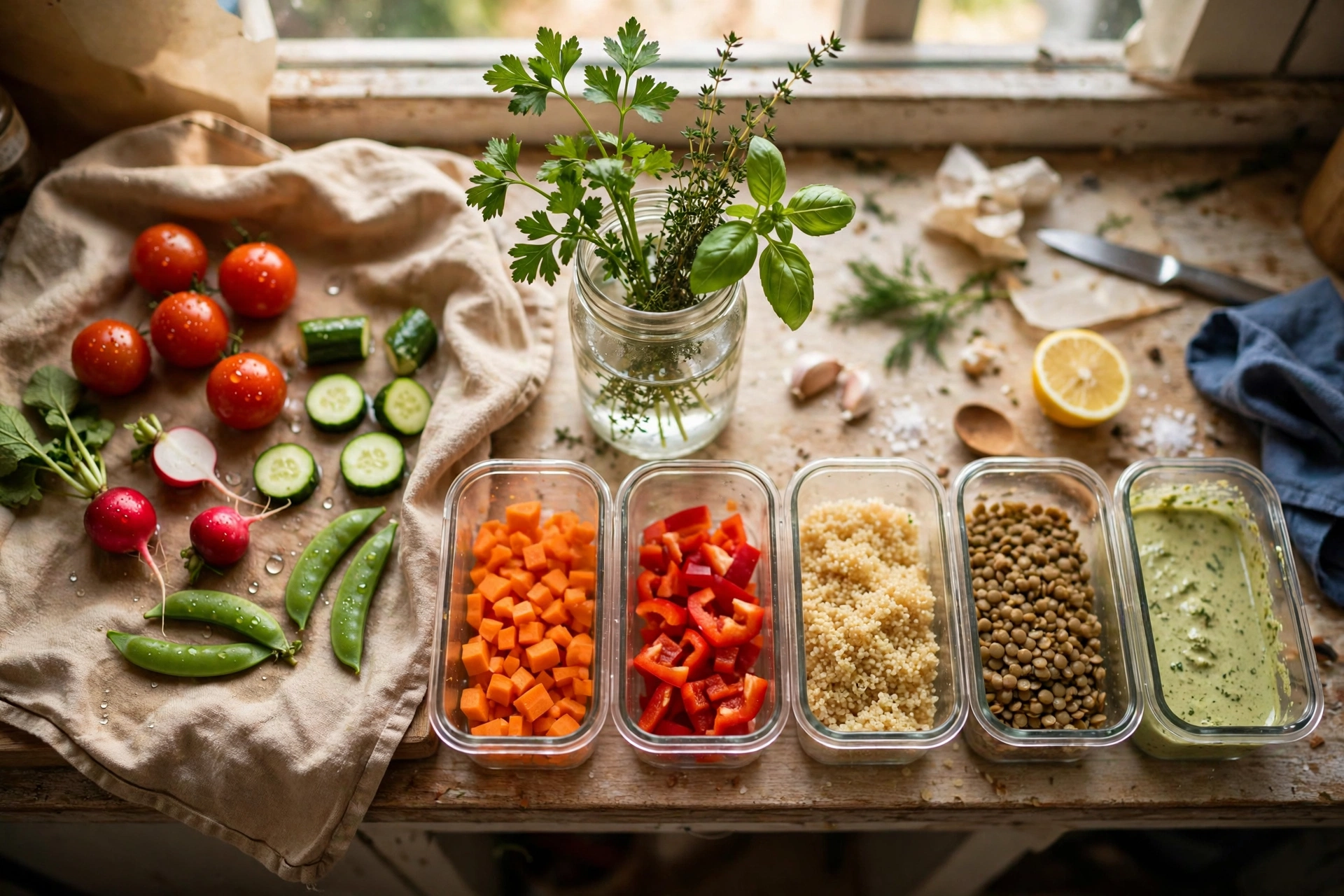
You can prep a whole week of meals on Sunday and still eat well on Thursday — but only if each ingredient is stored the way it likes to be stored. To keep meal prep ingredients fresh, know which ingredients last, which ones fade fast, and what to prepare early and what to leave until later in the week.
This guide covers the freshness clock for common ingredients, how to store each type, and a simple two-session rhythm that keeps Thursday’s food as good as Monday’s.
Table of Contents
- Why Ingredients Go Off — and What Freshness Really Means
- The Freshness Clock: Which Ingredients Last, and Which Do Not
- How to Store Vegetables So They Stay Fresh
- How to Store Fruit, Herbs, and Salad Leaves
- How to Store Cooked Grains, Proteins, and Sauces
- Keep Meal Prep Ingredients Fresh: A Timeline for the Week
- A Freshness Routine for Prep Day, Step by Step
- Keeping Wet and Dry Parts Separate
- The Midweek Check: Use It, Freeze It, or Let It Go
- Common Mistakes to Avoid
- Frequently Asked Questions
- Conclusion
Why Ingredients Go Off — and What Freshness Really Means
Food goes off for three reasons. The first is moisture in the wrong place: wet salad leaves go limp, cut vegetables dry out in open air, and bread goes stale when it loses water. The second is air: cut surfaces dry out and change colour when they sit exposed.
The third is warmth and time: food kept too warm, or kept too long, loses flavour and texture first.
Freshness is not the same as safety, but the two are connected. A carrot that has gone limp is still safe to eat; a container of cooked rice left out all day is not. Chill cooked food promptly, and if food looks or smells off, do not eat it.
The Freshness Clock: Which Ingredients Last, and Which Do Not
Not every ingredient keeps for the same length of time. Think of your ingredients in three groups, and plan the week’s eating order around them.
The sturdy group lasts several days without much help: carrots, cabbage, onions, potatoes, cooked grains, cooked beans and lentils, hard cheese, and most sauces. Prep these early — they will still be good on Thursday.
The middle group lasts a few days with good storage: cooked chicken and fish, boiled eggs, cooked pasta, chopped peppers and cucumbers, and most fruit. Prep these on Sunday for Monday and Tuesday.
The delicate group fades fast: salad leaves, soft herbs, cut tomatoes, avocado, berries, and anything already dressed. These should be prepped the day they are eaten, or at most the evening before. A salad dressed on Sunday is a salad you will not want on Wednesday.
How to Store Vegetables So They Stay Fresh
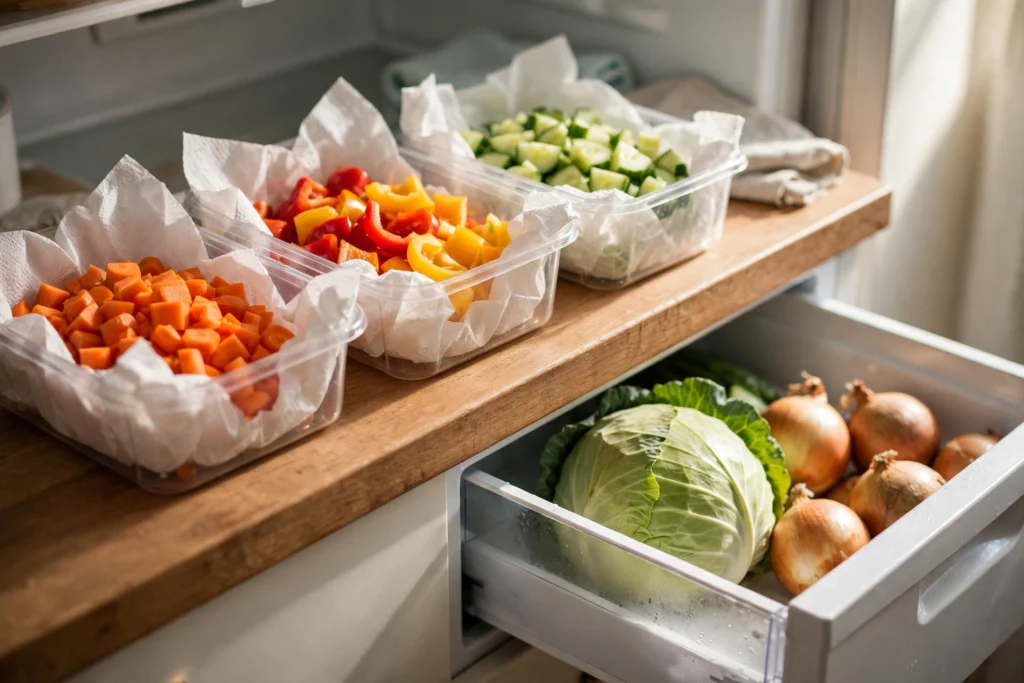
Vegetables keep best when they are stored dry on the outside, cool, and out of the air where it matters.
Root vegetables and onions — carrots, parsnips, potatoes, and onions — keep for days in the fridge drawer or a cool cupboard. Chop carrots and celery ahead of time and store them in a sealed container lined with damp kitchen paper. Keep onions away from potatoes, which can make both go off faster.
Cabbage, broccoli, and cauliflower keep well for several days in the fridge drawer, whole or cut. Cut cabbage into wedges rather than shredding it — shredded vegetables dry out faster.
Peppers, cucumbers, and courgettes keep for a few days in the fridge, chopped or whole. To store prepped vegetables like these, use a sealed container with kitchen paper to absorb moisture.
Tomatoes are the exception: whole tomatoes taste better at room temperature, out of direct sunlight. Once cut, they belong in the fridge in a sealed container, and should be eaten within a day or two.
Cooked vegetables keep for a few days in a sealed container in the fridge. Let them cool before you lid the container, or condensation will make them soggy.
How to Store Fruit, Herbs, and Salad Leaves

Fruit, herbs, and leaves are the most delicate part of the week’s food, and the part where good food freshness tips make the biggest difference.
Salad leaves stay crisp when they are washed, dried properly, and stored in a container lined with kitchen paper. The leaves must be dry before they go in, because wet leaves go limp. Keep the container in the fridge drawer, and change the paper if it gets damp.
Soft herbs — parsley, coriander, dill, and basil — last longest treated like flowers: trim the stems and stand them in a jar with a little water in the fridge. Woody herbs such as rosemary and thyme keep well wrapped in a damp cloth.
Berries should be washed only when you are about to eat them. Store them dry, and pick out any soft ones before they spoil the rest.
Cut fruit — apple slices, melon, and citrus segments — keeps better with a squeeze of lemon juice in a sealed container in the fridge. Eat cut fruit within a day or two.
How to Store Cooked Grains, Proteins, and Sauces
Cooked food needs to cool promptly, stay sealed, and be eaten within a few days.
Cooked grains — rice, quinoa, couscous, and pasta — keep for a few days in sealed containers in the fridge. Cook them plain, without sauce, so they stay flexible. Add a spoonful of water before reheating.
Cooked beans, lentils, and chickpeas are among the best keepers: they hold their texture for several days in the fridge and freeze well in portions. They are the most forgiving ingredient in a week’s prep.
Cooked meat, fish, and eggs need the most care. Keep them in sealed containers on a middle or upper shelf, away from raw food, and eat them within a few days. Fish is the most perishable cooked protein — plan to eat it first.
Sauces and dressings last longer than the food they go with, and should always be stored separately. A sauce or dressing in a small sealed pot keeps for several days in the fridge door — and keeping it separate stops salads and grain bowls going soggy.
Meal prep containers matter too: clear containers let you see what is inside, and lids that seal properly keep air out. For the container system in full, see How to Store Meal Prep Containers in a Small Kitchen.
Keep Meal Prep Ingredients Fresh: A Timeline for the Week
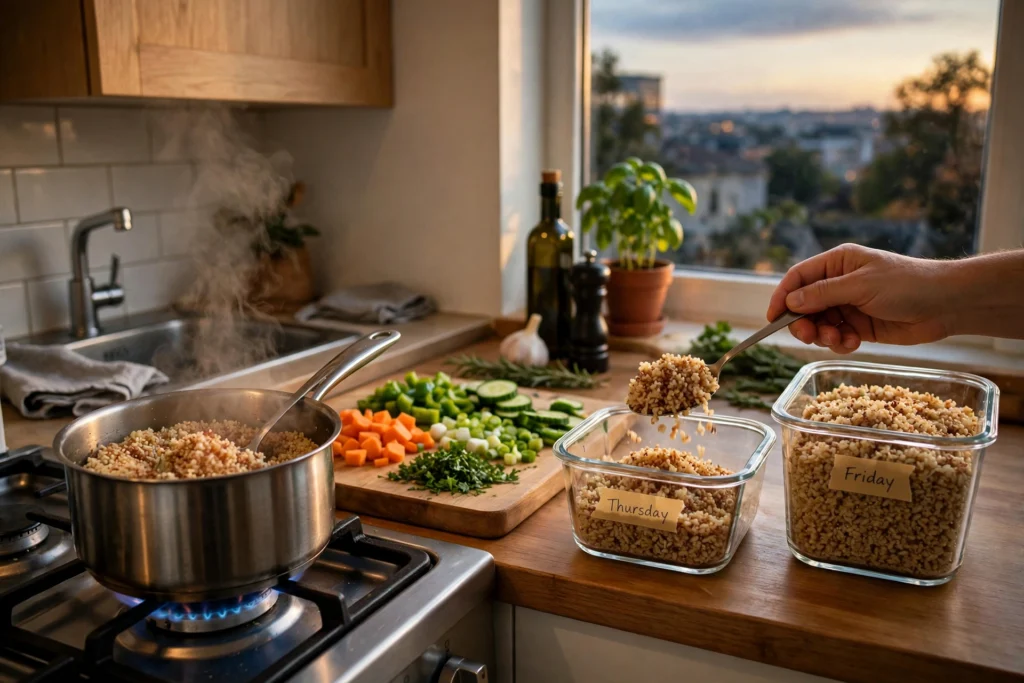
The simplest way to keep everything fresh is to split the week’s prep into two sessions: sturdy food early, delicate food late.
Sunday, or prep day: cook the grains, beans, and lentils; roast the sturdy vegetables; wash and chop the carrots, cabbage, and peppers; portion the sauces into small pots. This session covers Monday to Wednesday.
Wednesday, the top-up: chop the delicate vegetables, wash the salad leaves, cut the fruit, and assemble Thursday and Friday’s wraps and salads. For the full two-session rhythm, see How to Prep a Week of Lunches in a Small Kitchen.
Every evening: pack tomorrow’s lunch from what is already prepped, adding the fresh parts — leaves, dressing, cut fruit — at the last moment.
That split is the difference between food that is still good on Friday and food that was good on Monday and tired by Wednesday. For the full sequence from shopping to storage, see Small Kitchen Meal Prep Workflow: From Grocery Shopping to Storage.
A Freshness Routine for Prep Day, Step by Step
First, put the shopping away properly: perishable food into the fridge, grains and tins into the pantry, frozen food into the freezer.
Second, wash and dry the vegetables that need washing — salad leaves, herbs, carrots, and peppers — before they go into containers. Wet food stored wet goes off faster than dry food stored dry.
Third, chop the sturdy vegetables and store them in separate containers, not one big mixed bowl. A chopped pepper stays crisp for days on its own.
Fourth, cook the grains and the batch meal, cool them promptly in shallow containers, and label each one with the contents and the date.
Fifth, reset the kitchen: wash the board and the knife, wipe the counter, and check that every container is sealed and labelled. For the fridge system in full, see Small Fridge Organization for Meal Prep.
Keeping Wet and Dry Parts Separate
The most useful freshness habit is keeping wet and dry parts apart until eating time. Dressings, sauces, and anything juicy belong in small separate pots. Dry parts — grains, leaves, chopped vegetables, and proteins — belong in the main container.
A grain bowl with the dressing poured over it on Sunday tastes tired by Tuesday; the same bowl with the dressing in a small pot tastes fresh. The same applies to wraps: tomatoes and pickles should be added at eating time.
This one habit is also what makes no-cook meals work all week. Wraps, grain bowls, and salads assembled from separately stored parts stay fresh for days — see Simple No-Cook Meal Prep Ideas for Busy Days for meals built on exactly this rule.
The Midweek Check: Use It, Freeze It, or Let It Go
Halfway through the week, open the fridge and look at what is actually there. This five-minute check stops food being forgotten at the back.
Use it: anything that needs eating soon — soft fruit, cooked fish, dressed salads, opened dairy — goes into the next meal. Move it to the front of the shelf so it is seen first.
Freeze it: cooked grains, soups, stews, and sauces that will not be eaten soon can be frozen in flat, single portions, labelled with the contents and the date. Freezing on Wednesday saves food that would otherwise be thrown away on Friday.
For the freezer plan in full, see Freezer Meal Prep for Small Kitchens: Planning and Storage Tips. For the batch-cooking side of the top-up, see Batch Cooking in a Small Kitchen: Tips to Save Time and Space.
Let it go: food that looks or smells off should be thrown away. Keeping it does not save money — it risks making someone ill. When in doubt, throw it out.
Common Mistakes to Avoid
Washing everything as soon as you get home. Berries, mushrooms, and salad leaves washed too early go soft fast. Wash them when you are about to use them.
Storing cut vegetables in one big mixed bowl. Ingredients stored separately stay crisp for days; mixed together, they go soft.
Dressing salads when you pack them. A dressed salad goes soft within hours. Keep dressing in a small pot and add it at eating time.
Putting hot food straight into the fridge. A steaming container warms everything around it. Let cooked food cool a little first, in shallow containers, before it goes in.
Leaving containers unlabelled. Food without a date gets opened, sniffed, and put back. Label everything with the contents and the date.
Prepping delicate food for the whole week. Salad leaves, cut fruit, and wraps made on Sunday will not be good on Friday. Prep the delicate parts midweek. For the wider list of errors to watch for, see Meal Prep Mistakes to Avoid in a Small Kitchen.
Frequently Asked Questions
How long do prepped vegetables last in the fridge?
Sturdy chopped vegetables such as carrots, cabbage, and peppers usually keep well for three or four days in sealed containers. Delicate ones such as salad leaves and cut tomatoes are best eaten within a day or two.
Should I wash vegetables before storing them?
Wash vegetables when you are about to use them, or wash and dry them properly first — wet leaves and vegetables go limp and spoil faster.
How do I keep salad leaves crisp all week?
Wash them, dry them thoroughly, and store them in a container lined with kitchen paper, in the fridge drawer. Change the paper if it gets damp. Even with good storage, leaves are best eaten within a few days.
Can I freeze meal prep ingredients to keep them fresh longer?
Yes, for the right foods. Cooked grains, soups, stews, curries, beans, and sauces freeze well in flat, single portions. Fresh salads and cut fruit do not freeze well — eat those from the fridge within a few days instead.
Why does my prepped food go soggy?
The usual cause is moisture in the wrong place: dressing added too early, wet leaves stored wet, or hot food lidded before it cooled.
Conclusion
To keep meal prep ingredients fresh throughout the week comes down to three habits: store each ingredient the way it likes to be stored, keep wet and dry parts separate, and split the prep — sturdy food early, delicate food late.
Start this week with one change: prep the sturdy food on Sunday and leave the leaves, cut fruit, and wraps for a short Wednesday top-up. For the meals that use these ingredients, read Easy Meal Prep Ideas for Small Kitchens.
4 thoughts on “How to Keep Meal Prep Ingredients Fresh Throughout the Week”