
Budget meal prep for small households is not about eating the cheapest food you can find. It is about planning so nothing you buy goes to waste, cooking in a way that stretches good ingredients across several meals, and shopping with a list built around what you already have.
For one or two people, that matters most: a forgotten bag of salad is a whole week’s salad wasted, and a recipe that serves six is food for the bin. This guide shows you how to plan, shop, cook, and store so a small household eats well on a small budget.
Table of Contents
- What Budget Meal Prep Really Means — and What It Does Not
- Start With What You Already Have
- The Cheap Staples That Carry a Small Household
- Build Meals Around One Cheap Base
- Budget Meal Prep for Small Households: A Sample Week
- Shopping Smarter on a Small Budget
- Use Everything: The Waste-Free Kitchen
- A Budget Meal Prep Session, Step by Step
- Storing and Freezing to Stop Waste
- Common Mistakes to Avoid
- Frequently Asked Questions
- Conclusion
What Budget Meal Prep Really Means — and What It Does Not
Budget meal prep is planning so the money you spend on food becomes meals you actually eat. The saving comes from three habits: buying only what the week’s meals need, cooking amounts a small household can finish, and using leftovers on purpose.
It does not mean eating the same plain meal every day, or buying food you do not like because it is cheap. Meals should be ones your household actually wants to eat, or the food will sit in the
fridge until it is thrown away — the most expensive outcome of all.
Start With What You Already Have
The cheapest meal is the one made from food already in the house. Before you plan or write a shopping list, take stock of the fridge, freezer, and pantry — ten minutes that change the whole week.
Start with the fridge, where food goes off first: note vegetables that need using, half-used sauces, and cheese near the end of its life. Then check the freezer and the pantry — a tin of chickpeas, rice, and frozen peas are already a dinner.
Plan the week’s meals around those items first. When you do shop, buy only what the plan needs on top of what you have. That single habit can cut a weekly shop noticeably, because it stops you buying a second bag of rice when the cupboard already holds one.
Write the stock-take down: a short note on the fridge door — “use carrots, feta, half a jar of pesto” — turns into Monday’s meals instead of Thursday’s waste. For the planning steps in full, see A Beginner’s Guide to Meal Planning for a Small Household.
The Cheap Staples That Carry a Small Household
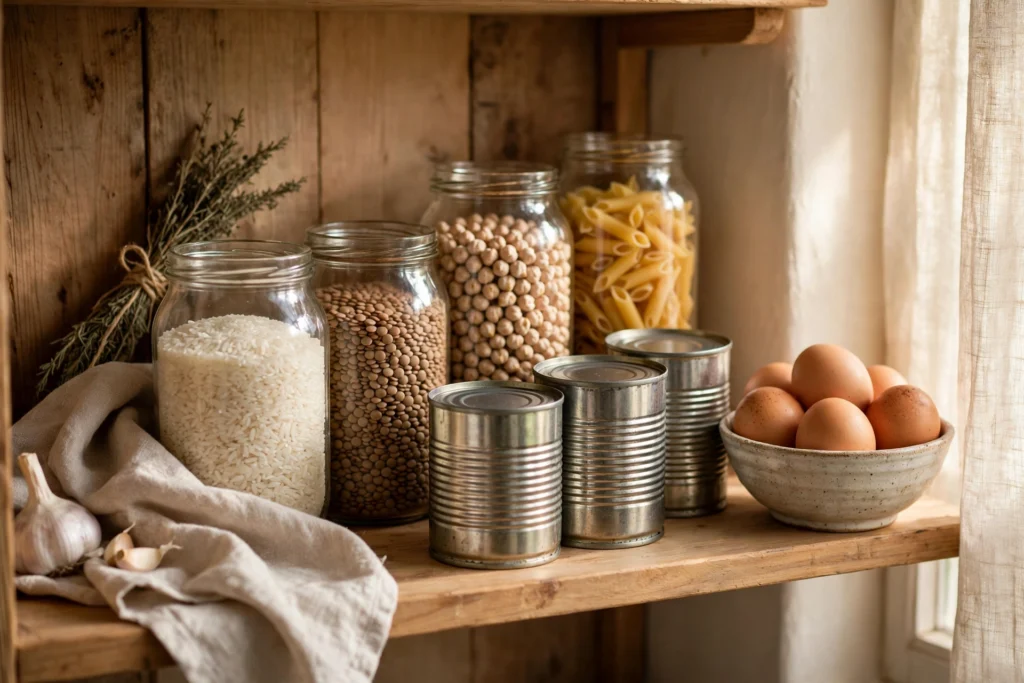
Every budget kitchen runs on a small set of staples: foods that cost little, keep well, and become many different meals. Affordable weekly meal planning starts here.
Grains and pulses. Rice, pasta, oats, couscous, lentils, chickpeas, and beans keep for months, cook in bulk, and turn into soups, salads, curries, and grain bowls. Dried is usually cheapest; tinned saves time and still costs little.
Eggs. Eggs keep for a couple of weeks, cook in minutes, and work in fried rice, omelettes, grain bowls, and sandwiches. A boiled egg turns a plain salad into a proper lunch.
Tinned foods. Tinned tomatoes, tuna, sardines, beans, and sweetcorn keep for months and need no fridge space until opened. Tomatoes plus pasta and garlic is a dinner; with beans and spices, a chilli.
Frozen vegetables. Frozen peas, sweetcorn, spinach, and mixed vegetables cost little, do not go off, and go straight into a pan or a soup. They are a good answer to fresh vegetables going soft before they are used.
Build Meals Around One Cheap Base
The simplest way to keep meal prep affordable is to cook one cheap base and change what goes with it: a pot of rice, a tray of roasted vegetables, a pot of lentil soup, or a batch of tomato sauce, cooked once and served in different ways.
A pot of rice becomes five meals: chickpeas and feta, a fried egg and soy sauce, tinned tuna and sweetcorn, beans and salsa, and leftover roasted vegetables. The cooking stays the same; only the toppings change. Tomato sauce works the same way — pasta one night, rice the next, beans after that.
This also solves the recipe problem. Most recipes serve four or six, too much for one or two people.
Cooking a base and serving it in different ways means you cook once and eat differently all week, instead of cooking four different recipes. For the batch method in full, see Batch Cooking in a Small Kitchen: Tips to Save Time and Space.
Budget Meal Prep for Small Households: A Sample Week
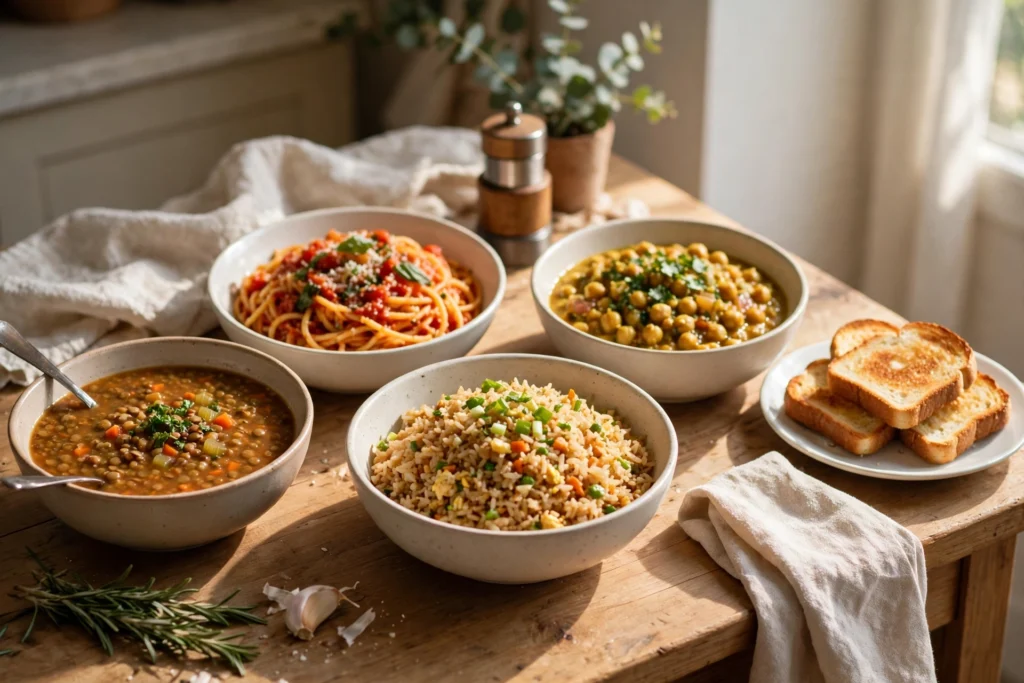
A sample week shows how the pieces fit together. This is one example for one or two people, built around one shop and food already in the pantry — swap any meal for another your household likes, keeping the same structure.
Monday: lentil soup and bread. Lentils, onion, carrots, and stock in one pot. Make enough for two nights and freeze one portion for Friday.
Tuesday: tomato pasta with beans. Pasta in a sauce of tinned tomatoes, garlic, and kidney beans, topped with grated cheese.
Wednesday: egg fried rice. Leftover rice, fried with an egg, frozen peas, and soy sauce — ten minutes, one pan.
Thursday: chickpea and vegetable curry. Chickpeas, tinned tomatoes, frozen spinach, and spices, served with rice.
Friday: soup and toast, plus whatever is left. The frozen soup portion from Monday, or the remaining curry with bread. Friday clears the fridge; it is not a new cooking day.
The pattern is the point: two cooked bases, one pot of grains, and a fridge cleared by Friday. Lunches work the same way — see How to Prep a Week of Lunches in a Small Kitchen.
Shopping Smarter on a Small Budget
Shopping is where most food money is lost — not on expensive ingredients, but on food bought without a plan and never eaten. A few habits keep the shop in check.
Shop with a list written from the plan. The list should come from the week’s meals, not from walking the aisles. It stops the small extras a small household will not finish.
Buy loose vegetables where you can. A small household rarely needs a whole bag of carrots or onions. Buying two loose carrots instead of a kilogram is cheaper in practice, because the food actually gets eaten.
Choose own-brand and larger packs of staples. For rice, pasta, oats, tinned tomatoes, and beans, the own-brand version is usually much the same, and a larger bag costs less per meal. Do not buy a large pack of anything perishable, though.
Use Everything: The Waste-Free Kitchen
In a small household, waste is the biggest budget leak. Food thrown away is money thrown away, and a small fridge makes food easy to forget. Reducing food waste is not a separate chore — it is the budget strategy.
Use the whole vegetable. Broccoli stems go into soups and stir-fries, and bread ends become breadcrumbs or croutons. Leftover rice becomes fried rice the next day.
Plan leftovers in, do not discover them. A leftover should have a job before it goes into the fridge: tonight’s roast vegetables are tomorrow’s lunch wrap, and today’s rice is tomorrow’s fried rice. A container labelled with its planned meal gets eaten.
Cook with the most perishable food first. Salad leaves, herbs, and soft fruit should be eaten in the first days of the week; grains, tins, and frozen food can wait. Put the most perishable meal first — Monday’s salad, not Friday’s.
A Budget Meal Prep Session, Step by Step
A budget prep session is one short session that sets up several days of meals. It works best on the day you shop, when the fridge is full and the plan is fresh.
First, put the shopping away by the plan: perishable food at the front of the fridge, grains and tins in the pantry, frozen food in the freezer. Food you can see gets eaten; food buried at the back does not.
Second, cook the week’s base — one pot of grains and one pot of soup, stew, or sauce — in sequence, starting with the longest, most hands-off job. While it simmers, wash the board and clear the counter.
Third, while the base cooks, wash and chop the vegetables for the next few days into separate containers. A chopped pepper stays crisp on its own, but goes soft in a dressed salad.
Fourth, portion the cooked food into single containers, label each one with the contents and the date, and put fridge portions at the front and freezer portions at the back. Single portions are easier to reheat and easier to count. For the timed version of this session, see One-Hour Meal Prep Plan for Busy Weekdays.
Storing and Freezing to Stop Waste

Storage is a budget tool: food that is stored well gets eaten, and food that is stored badly gets thrown away.
In the fridge, keep cooked meals in clear, labelled containers on the middle shelf, oldest at the front, vegetables in the drawer, and sauces in the door. For the fridge system in full, see Small Fridge Organization for Meal Prep.
In the freezer, freeze in flat, single portions, labelled with the contents and the date. A small freezer usually holds two or three portions — it is for the overflow of a batch, not a month of cooking.
Soups, stews, curries, grains, and sauces freeze well; use the oldest first. For the freezer plan in full, see Freezer Meal Prep for Small Kitchens: Planning and Storage Tips.
For the freshness rules that keep stored food good all week, see How to Keep Meal Prep Ingredients Fresh Throughout the Week. Chill cooked food promptly, eat fridge portions within a few days, and if food looks or smells off, do not eat it.
Common Mistakes to Avoid
Buying a big pack of something perishable. A large bag of salad is cheap per kilo and expensive in practice, because a small household will not finish it.
Shopping without a plan. A shop without a list is full of food with no meal attached to it. Write the plan first, then the list.
Cooking recipes that serve six. A recipe that serves six is food for the bin in a one-person household, unless the extra portions are frozen on purpose. Halve recipes, or freeze the surplus the same day.
Forgetting what is in the fridge. Food you cannot see will not be eaten — keep containers clear, labelled, and the oldest at the front.
Throwing away leftovers instead of planning them in. A leftover with a planned meal is tomorrow’s lunch. A leftover with no plan is waste.
Prepping a whole week at once. Food prepped on Sunday is tired by Thursday — prep for three or four days, then top up midweek. Not every meal needs cooking: wraps and grain bowls from prepped ingredients save time and money — see Simple No-Cook Meal Prep Ideas for Busy Days.
Frequently Asked Questions
How much should a small household spend on meal prep each week?
There is no single right figure — it depends on where you live and what your household likes to eat. What matters is the pattern: a plan built around staples, a list written from the plan, and nothing bought without a meal attached.
What are the cheapest meal prep ingredients?
Grains and pulses — rice, pasta, oats, lentils, chickpeas, and beans — are usually the cheapest base, with eggs, tinned tomatoes, and frozen vegetables close behind.
Can I meal prep on a budget without a freezer?
Yes. Cook a batch that covers three or four days in the fridge, and plan the most perishable meals first.
How do I stop food going to waste in a small household?
Plan meals around what is already in the fridge and pantry, buy perishable food in small amounts, and keep the oldest food at the front. Most waste comes from food bought without a plan.
Is budget meal prep healthy?
It can be. Meals built around vegetables, beans, lentils, whole grains, eggs, and fruit are naturally balanced, and cooking at home means you control the salt, sugar, and fat.
Conclusion
Budget meal prep for small households comes down to three habits: start with what you already have, build meals around cheap staples, and use everything before it goes off.
Start with one change this week: take stock before you shop, and plan two meals from what is already there. For the wider system, read Easy Meal Prep Ideas for Small Kitchens, which covers the whole small-kitchen meal prep approach in one place.
3 thoughts on “Budget-Friendly Meal Prep for Small Households”