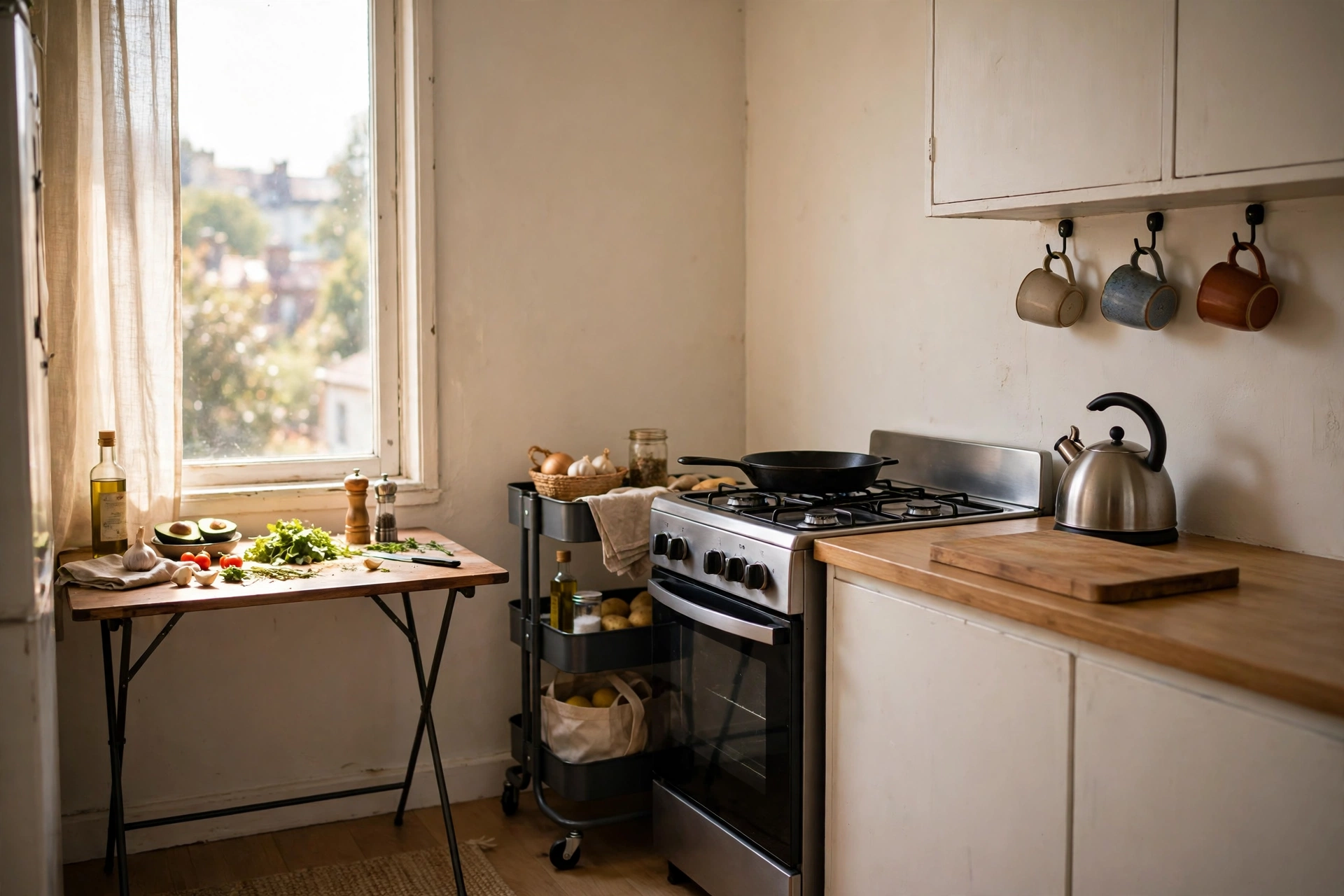
A small apartment kitchen needs a different plan from a small kitchen in a house. You probably cannot drill, fit new cabinets, or change the layout, and the kitchen may share its space with the living room or hallway.
Small apartment kitchen organization is not about more storage. It is a smaller set of things, a clear place for each one, and storage you can remove, move, or take with you when your tenancy ends.
Table of Contents
- Small Apartment Kitchen Organization: What Makes It Different
- Start With the Rules: Your Lease and Your Landlord
- A One-Weekend Plan for a Tiny Kitchen
- Decide What Your Apartment Kitchen Has to Do
- Zones When the Kitchen Shares a Room
- Storage Beyond the Kitchen
- Shared Kitchens: Living With Flatmates
- Small Fridges and No Pantry
- Furniture That Does Two Jobs
- Keeping It Working When You Move
- Common Mistakes to Avoid
- Frequently Asked Questions
- Conclusion
Small Apartment Kitchen Organization: What Makes It Different
An apartment kitchen is small in three ways at once: the room is small, the storage is fixed and often awkward, and the kitchen is not yours to change.
Most tenancy agreements in the US, UK, Canada, and Australia say you cannot drill into tiles, fit shelves, or remove a cabinet without the landlord’s permission, and breaking those rules can cost you part of your deposit.
So start by working out what you are allowed to do, what the kitchen has to do for the people who live there, and what you can take with you when you leave. For cabinet layouts, see how to organize a small kitchen with limited cabinet space, and for the wider picture, see 25 Smart Small Kitchen Organization Ideas That Make Every Inch Count.
Start With the Rules: Your Lease and Your Landlord
Read the sections of your tenancy agreement on alterations, decoration, and damage. Most say you must not make holes in walls or tiles, fix anything permanently, or change fixtures without written permission.
If the wording is unclear, treat it as “ask first”. If you want a rail or shelf, ask the landlord in writing, describing exactly what, where, and how it will be fixed. A removable adhesive rail is a different request from a drilled shelf.
Take dated photos of the cabinets, worktops, sink, and walls when you move in, and again before you move out. Adhesive strips can pull paint off or leave residue, so test a small, hidden spot first and remove hooks slowly.
A One-Weekend Plan for a Tiny Kitchen
Work one area at a time, in this order: remove, decide, place, and only then buy. On Saturday morning, empty the area that bothers you most and sort everything into four groups: keep, move elsewhere in the flat, donate or pass on, and recycle or throw away.
In an apartment, the “move elsewhere” group matters, because a vase or spare appliance may belong in the living room, not the kitchen. Ask of each item: do I use it at least once a month, does it have a job nothing else does, and is it in working order?
On Saturday afternoon, measure each cabinet, drawer, and shelf in inches and centimetres, noting hinges, pipes, and doors that do not open fully. On Sunday, put things back by job: plates near where you eat, pots near the cooker, food near your preparation area, cleaning supplies under the sink. Daily items go between knee and shoulder height, and only then buy one organizer, for one specific problem.
Decide What Your Apartment Kitchen Has to Do
Count what you actually use in a normal week, not what you think you might need. A household of one or two can often manage with four plates, four bowls, four mugs, and four glasses, plus a guest set kept together on a high shelf.
If you cook from scratch most evenings, you need easy access to pans, knives, boards, and spices, and a clear preparation surface. If you mostly reheat or order in, you need less cooking equipment and more space for plates and food storage.
In a studio, the kitchen is part of the living room, so it must look tidy even when you are not cooking. Keep the counter clear except for one or two daily items, and put the drying rack away once dishes are dry. For counter rules, see Small Kitchen Counter Organization: Keep Your Counters Clear and Useful.
Zones When the Kitchen Shares a Room
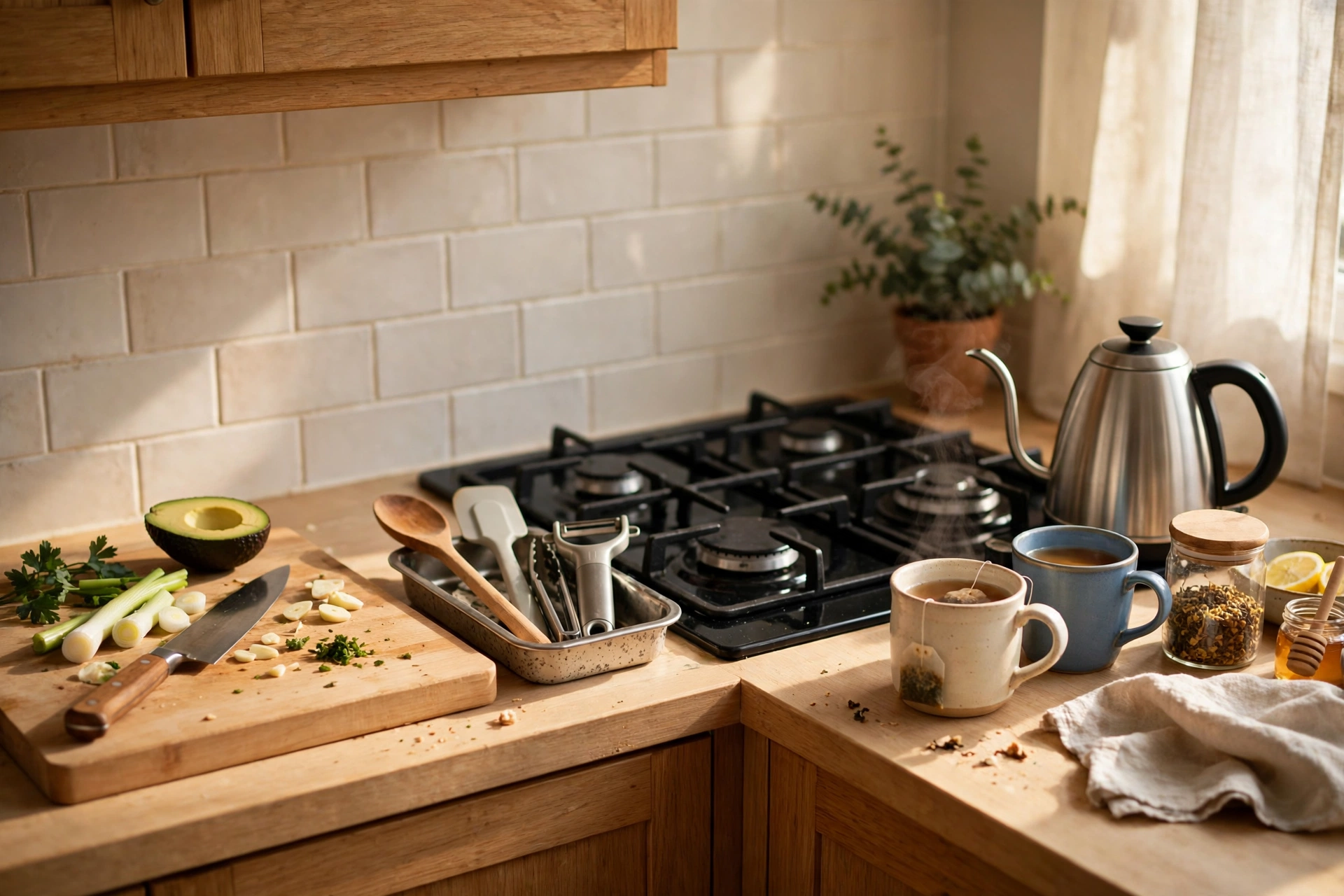
Zones in an apartment are marked by use, not by walls. Pick one stretch of counter, ideally near the sink, as your preparation zone, and keep it clear except for a board and knife while you cook.
If the counter is too small, use a board that fits over the sink. The preparation zone is never a storage zone. Keep cooking tools — spatula, tongs, oil, salt, pepper — within arm’s reach of the hob, on a small tray you can move when you clean.
Group breakfast together in one place: kettle, mugs, tea or coffee, and sugar. If there is no dining table, the eating zone may be a folding table; keep plates near where you eat, and fold the table away after eating, or it becomes a second counter that collects clutter.
Storage Beyond the Kitchen
When the kitchen is full, the answer is often elsewhere in the flat. A hallway cupboard or shelf above a door can hold spare containers, a picnic set, or a slow cooker you use once a month, as long as the hallway stays clear enough to walk through.
Do not store food in a hallway that gets hot in summer, and do not block a fire exit. A sideboard, bookcase with baskets, or storage ottoman in the living room can hold cookbooks, table linen, and serving dishes, but only if it closes properly.
Under-bed boxes and the top of a wardrobe suit light, rarely used items in labelled boxes with lids. A balcony is not a pantry: check your tenancy and building rules first, and if storage is allowed, use a weatherproof box with a lid, for non-food items only.
Shared Kitchens: Living With Flatmates
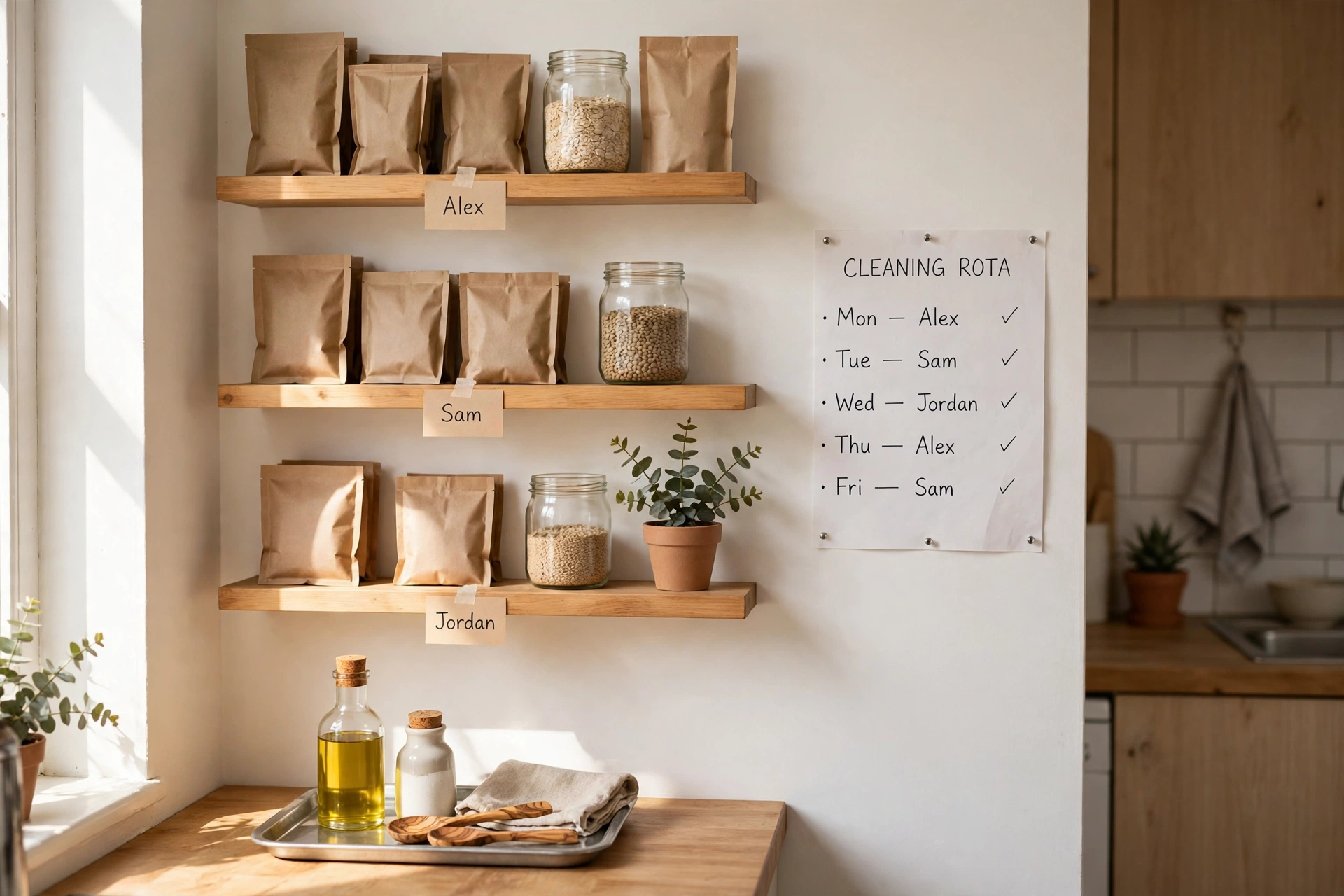
A shared kitchen must work for people with different habits, so the fix is agreement, not more storage. Divide cabinets, shelves, and fridge space fairly and label the divisions — one shelf each, one fridge shelf each — and keep shared items such as oil, salt, and bin bags in one agreed place, with an agreement on who replaces them.
Label your food in a shared fridge with your name and the date you opened it. A rota that says “clean the kitchen” fails; one that says “wash up, wipe the counters, and take out the recycling on your day” is more likely to work.
Keep each turn short — ten minutes after cooking — and review the rota when someone moves in or out. Agree which tools are shared and which are personal, and store personal tools separately.
Small Fridges and No Pantry
A small fridge rewards short shopping trips: a weekly shop for one or two people, plus a top-up for fresh food, is easier to store than a fortnightly shop that fills every shelf. Plan meals before you shop, and buy only what the plan needs.
Keep the fridge visible: store food in clear containers, label them with the date, put the oldest food at the front, and do not stack containers so high you cannot see what is underneath. For the full fridge guide, see Small Fridge Organization for Meal Prep.
If there is no pantry, one cabinet must do the job. Give it one job — dry food — and zone it by use: breakfast, baking, tinned food, and snacks together in their own groups.
Keep food out of a cabinet above the cooker, where heat rises, and away from cleaning products, which belong under the sink. For pantry zoning, see Small Pantry Organization Ideas for Tight Spaces.
Furniture That Does Two Jobs
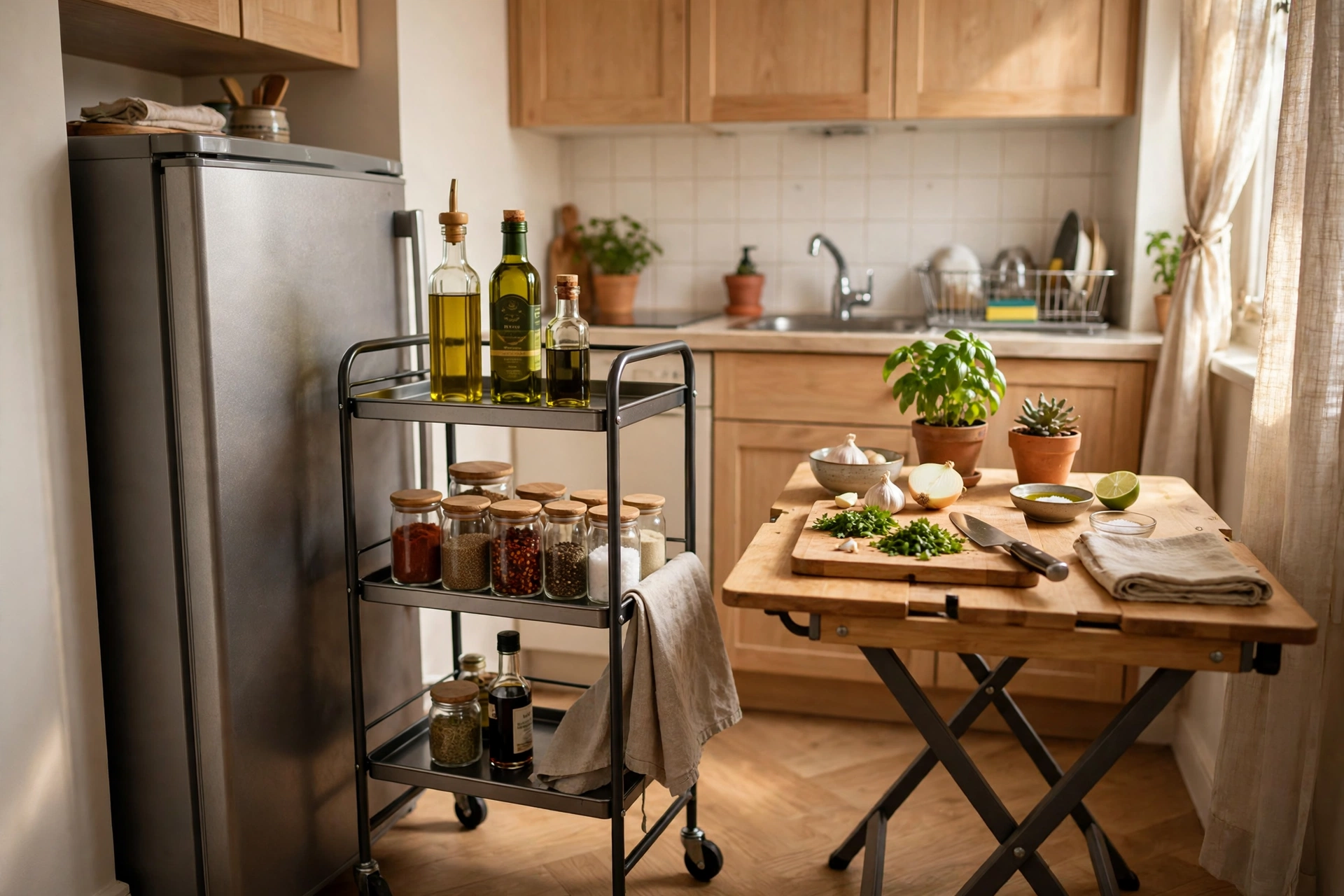
In a tiny apartment, furniture that does two jobs earns its floor space. A slim rolling cart, narrow enough to fit between the fridge and the counter, can hold oils, spices, or snacks, and can be pulled out when needed and pushed back when not.
Measure the gap first and choose a cart a little narrower than it, and do not overload the top shelf, or it will tip. A folding table can be a preparation surface, a dining table, and a desk, but only if it folds easily and has a home when folded.
A tall, narrow, freestanding shelf unit adds storage without drilling and can move to another room or flat; keep the heaviest items on the lowest shelf so it does not tip. Do not buy a large kitchen island unless you can walk around it with the fridge and cabinet doors open, and do not buy storage for things you have not yet decluttered.
Keeping It Working When You Move
Apartment life often means moving every year or two, so choose storage you can pack, move, and set up again. Freestanding shelf units, rolling carts, trays, bins, and containers can all move with you; fitted shelves and drilled rails cannot.
When you buy storage, ask: can I take this with me, and will it fit in the next kitchen? Keep a short list of what lives where, so it becomes a packing list when you move and a setting-up list when you arrive.
Label boxes by room and job, such as “kitchen — daily plates”, and unpack the kitchen first. Before you move out, remove all adhesive hooks, clean any residue, and take dated photos of the kitchen as you leave it.
For the full renter guide, see Small Kitchen Organization for Renters: No-Drill Storage Ideas.
Common Mistakes to Avoid
Buying storage before decluttering. A new cart or shelf cannot fix a kitchen that holds twice as much as it should. Remove what you do not use first.
Ignoring the tenancy agreement. A drilled tile or fitted shelf can cost you part of your deposit. Read the agreement, ask in writing, and keep the answer.
Filling every surface. A counter, table, and shelf that are all full have nowhere for cooking, eating, or shopping to go. Leave a little empty space.
Using the kitchen as a general store. Tools, paperwork, and coats belong in the hallway or a bedroom, not in a food cupboard.
Buying furniture that does not fit. Measure first, and check that doors, drawers, and the fridge can still open fully.
Having no agreement with flatmates. A shared kitchen without agreed space, food rules, and a cleaning rota will get messy, and the mess will cause arguments.
Forgetting you will move. Storage that cannot be taken with you, or removed without damage, is a poor buy for a rented flat.
Frequently Asked Questions
How do I organize a tiny apartment kitchen with almost no storage?
Check what you are allowed to fix, then empty one area at a time and remove what you do not use. Give what is left one job and one place, use freestanding and removable storage, and borrow space from the hallway or living room for the overflow.
What is the best renter-friendly storage for an apartment kitchen?
Freestanding storage is usually safest: a slim rolling cart, a tall narrow shelf unit, trays, bins, and containers that can be moved. For walls, use adhesive hooks made for removable mounting, test a hidden spot first, and ask the landlord in writing before fixing anything permanently.
How do I organize a kitchen I share with flatmates?
Divide the space fairly, label the divisions, and agree the rules in advance: whose food is whose, what is shared, who replaces shared items, and who cleans on which day. Keep the rota short and specific, and review it when someone moves in or out.
How do I keep a small apartment kitchen organized long-term?
Keep the preparation zone clear, do a short daily reset — wash up, wipe the counters, and put things back — and do a ten-minute weekly check of one cabinet or drawer. When something new comes in, decide what leaves.
Conclusion
Small apartment kitchen organization works when you respect the limits of the flat and work with them. Check your tenancy agreement, sort and measure before you buy anything, give each area one job, and use storage you can remove, move, or take with you.
Borrow space from the hallway and living room for the overflow, agree the rules if you share the kitchen, and keep food visible in a small fridge and a single pantry cabinet.
Pick one area this week — the counter, one cabinet, or the fridge — and work through the steps for that area alone. For your next step, read how to create more storage in a small kitchen without remodeling, which goes deeper into freestanding and no-drill storage.
For the under-sink cabinet, see Under-Sink Organization Ideas for Small Kitchens, and if the clutter is the real problem, start with How to Declutter a Small Kitchen: A Step-by-Step Guide.
3 thoughts on “Small Apartment Kitchen Organization Ideas That Actually Work”