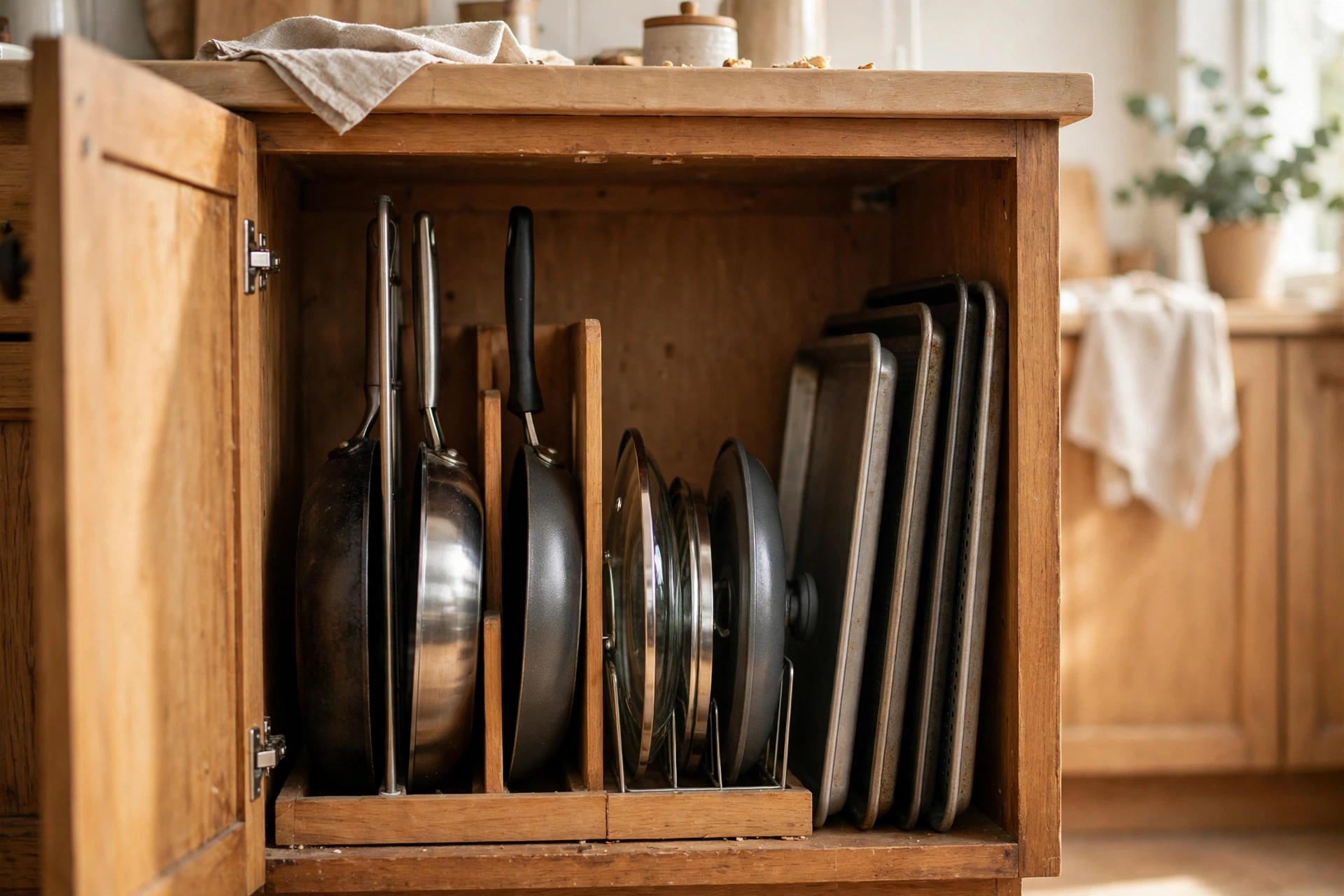
Pots, pans, and lids are the hardest things to organize in a small kitchen. They are heavy, awkwardly shaped, and used every day.
To organize pots and pans in a small kitchen, keep fewer pieces, give each one a fixed place near the cooker, store pans upright or in a short protected stack, and give lids their own rack.
Table of Contents
- Why Pots, Pans, and Lids Are So Hard to Store
- Step 1: Audit Your Cookware
- Step 2: Decide What to Keep or Let Go
- Step 3: Give Cookware a Home Near the Cooker
- Nesting or Vertical Storage: Which One Wins?
- Lids: Five Ways to Tame Them
- Baking Pans, Trays, and Boards
- Protecting Cooking Surfaces
- Storage for Awkward Kitchens
- Renter-Friendly Cookware Storage
- Choosing an Organizer That Fits
- Common Mistakes to Avoid
- Frequently Asked Questions
- Conclusion
Why Pots, Pans, and Lids Are So Hard to Store
Cookware breaks the usual rules: plates stack neatly and cutlery lies flat, but a frying pan has a long handle, a stockpot is tall and heavy, and a lid is a flat disc that slides off every pile.
Put them all in one cabinet and you get the classic small-kitchen pile: three pans stacked, two lids wedged on top, and the one you want at the bottom — and three problems hide in that pile.
First, quantity: most small kitchens hold more cookware than the household cooks with. Second, placement: cookware often lives wherever there was an empty shelf, not where it is used.
Third, the method itself: stacking means lifting everything to reach one piece, and every lift risks a scratched surface or a dropped lid. Fixing only one of these rarely lasts, so work through the steps in order.
Step 1: Audit Your Cookware
Take every pot, pan, lid, and baking tray out of its cabinet or drawer and put it on the counter — in a small kitchen this usually takes an afternoon at most.
Empty the space, wipe the shelf, and sort the pieces into groups: saucepans, frying pans, large pots, lids, and baking trays together.
This alone often reveals the problem: two saucepans of almost the same size, three frying pans, and lids with no matching pan. Now measure the cabinet or drawer in inches and centimetres.
Check each piece for damage too: a warped base, a wobbling handle, a badly scratched non-stick surface, or a cracked lid knob.
Step 2: Decide What to Keep or Let Go
For each piece, ask four questions: do I use it at least once a month, does it do a job nothing else does, is it in good, safe condition, and can I store it where I can reach it easily?
A pan that fails two or more of those tests is a candidate to move or let go. Start with duplicates: two medium saucepans or two frying pans of the same size rarely both earn space in a small kitchen.
Keep the better one, and let the other go. The same applies to single-use pieces: a pan bought for one recipe or a large stockpot for a household of two can move to a high shelf or out of the home.
Match every lid to a pan first: a lid with no pan, a cracked glass lid, or a loose knob is taking up space for no reason. If the sorting feels like a lot, the same method works for the whole kitchen — see How to Declutter a Small Kitchen: A Step-by-Step Guide.
Step 3: Give Cookware a Home Near the Cooker
Cookware belongs near the cooker, in a low cabinet or a deep drawer — not in a high cabinet or across the kitchen — so heavy items live low, between knee and shoulder height.
Put the most-used frying pan and saucepan at the front, where they slide out easily. Give each group one place.
Saucepans and stockpots can share a low cabinet, frying pans and woks a deep drawer or a second low cabinet, and baking trays a narrow cabinet or tall drawer, filed upright.
Lids get their own section, not a shelf on top of the pans. When each group has one home, you stop opening three doors to find one pan, and everyone puts things back in the same place. For the wider picture, see 25 Smart Small Kitchen Organization Ideas That Make Every Inch Count.
Nesting or Vertical Storage: Which One Wins?
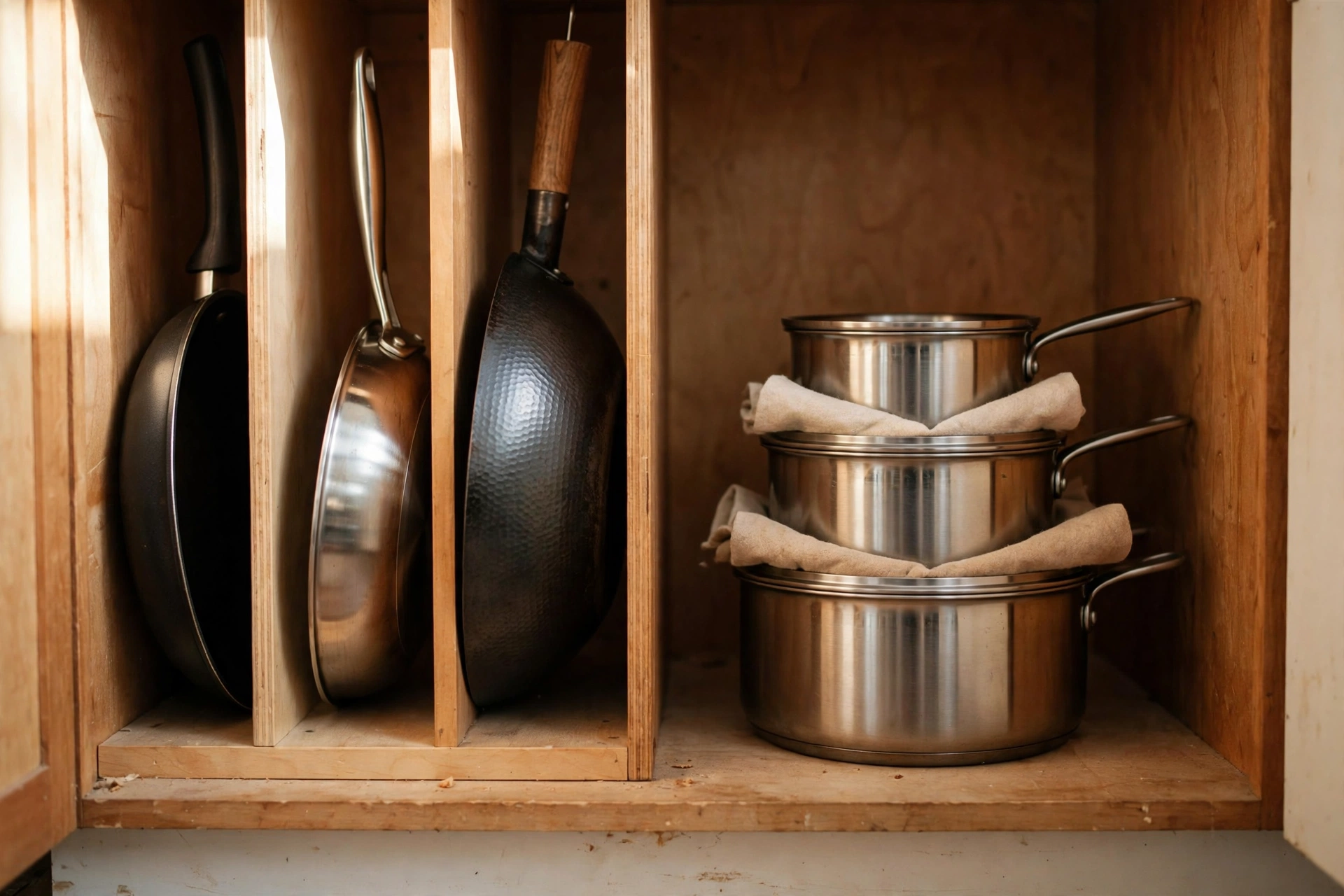
Nesting means stacking pans inside each other, smallest inside largest, with protection between them. Vertical storage means standing pans on their sides in a divider, like files, so you can pull one out without lifting the rest.
Nesting wins when space is very tight and your pans are similar in shape. A set of saucepans that nest neatly can take up little more room than the largest pan alone.
The trade-off is access: to reach the pan at the bottom, you still have to lift the ones above it, so put a cloth, a pan protector, or kitchen paper between each pan and keep the stack short — two or three pans at most.
A tall stack is heavy, unstable, and hard to lift. Vertical storage wins when you use your pans often. A divider lets you slide out the frying pan you want while the others stay in place.
It suits flat pans, trays, and boards, but not deep pots. Many small kitchens use a mix: nest the saucepans and stand the frying pans upright. For cabinet layouts, see Small Kitchen Cabinet Organization: Practical Ideas for a Clutter-Free Space.
Lids: Five Ways to Tame Them
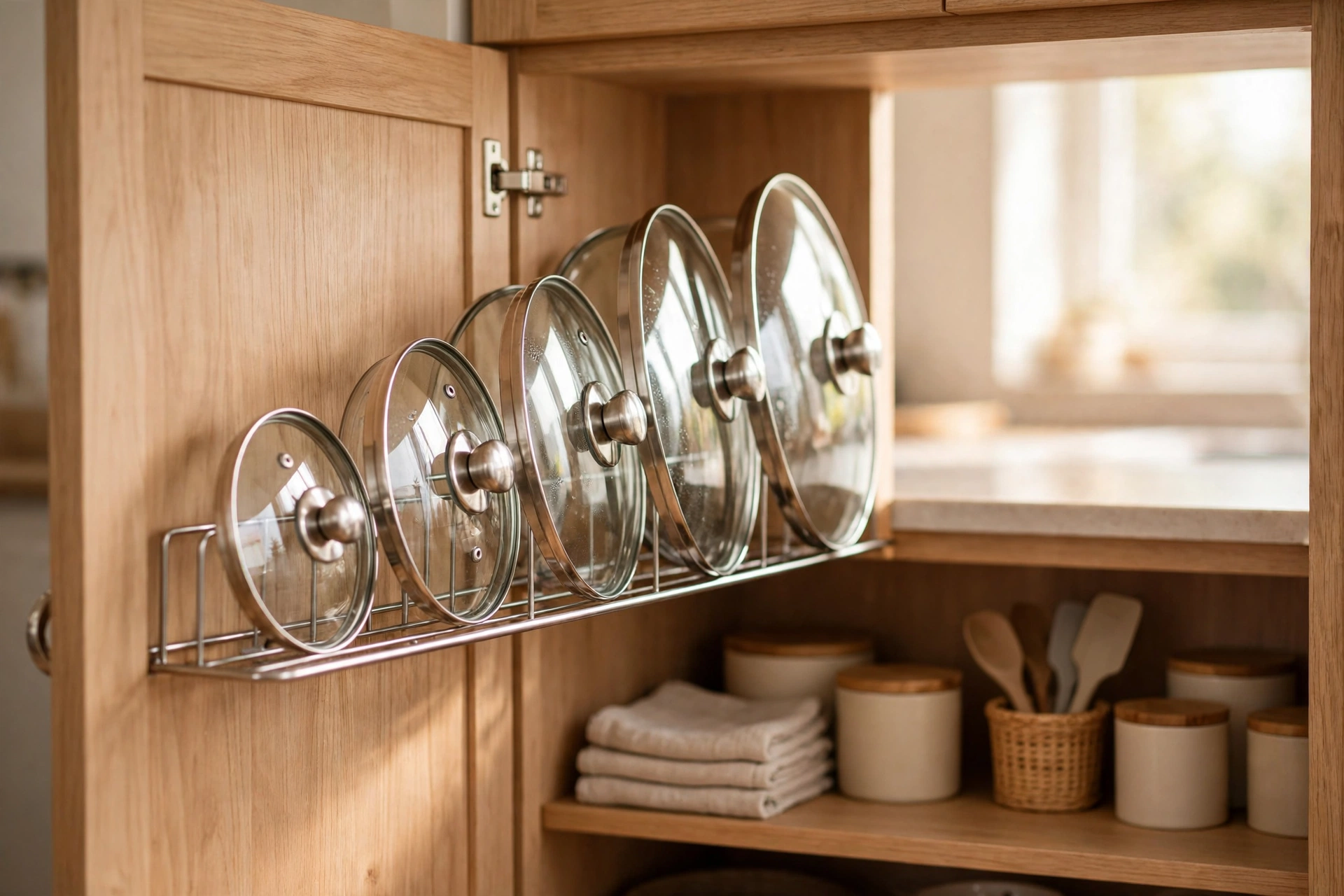
Lids cause more frustration than pans: flat and round, a pile of them slides, clatters, and hides the one you need.
Give lids their own home, separate from the pans, and store them upright or on a rack rather than in a pile. First, a lid rack inside a cabinet door: a slim rack or hooks holds lids upright and uses space that is otherwise wasted.
Choose one shallow enough for the door to close fully, and keep only light lids there. Second, a vertical divider in a drawer or cabinet: a small divider, file organizer, or tension rod can hold lids upright in a row, sorted by size.
Third, a pull-out lid organizer: a narrow pull-out shelf in a low cabinet holds lids in slots, so you pull the whole shelf towards you and pick the lid you need. This suits deep cabinets where lids would otherwise disappear at the back.
Fourth, a lid section in a deep drawer, stored upright in a divider beside the containers, as in How to Organize Food Storage Containers and Lids. Fifth, a small rack on the wall for the one or two lids you reach for every day.
Whichever method you choose, sort lids by size, and keep the lid for your most-used pan in the easiest spot.
Baking Pans, Trays, and Boards
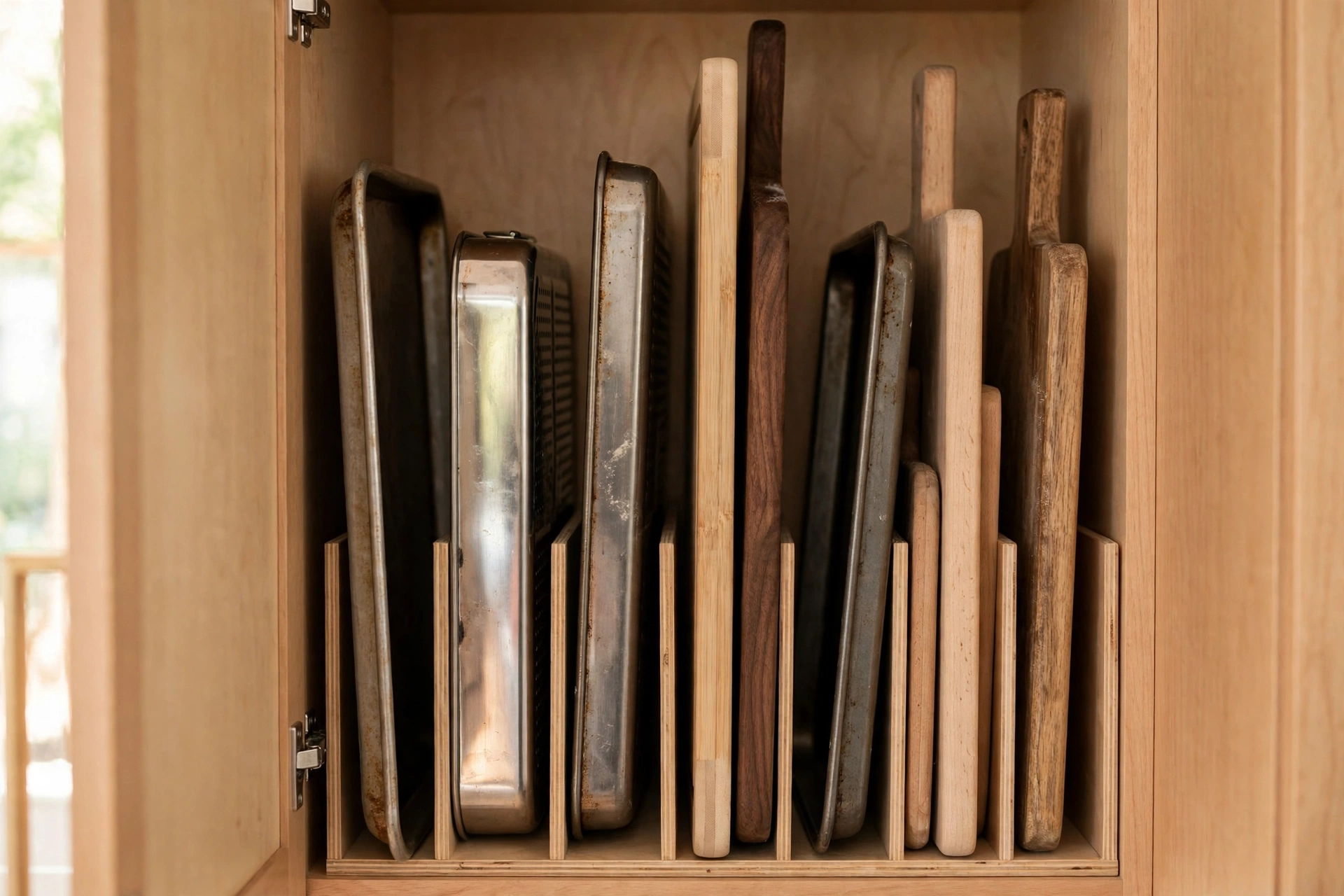
Baking pans, roasting tins, cooling racks, and chopping boards are flat, so they store well upright — and badly in a pile, which is heavy, hard to sort through, and easy to drop.
File them upright instead. Use a vertical divider in a tall cabinet, a deep drawer, or a narrow cabinet. A divider, file organizer, or tension rod keeps trays standing on their sides, so you can pull out the one you want without lifting the stack.
Put the tray you use most at the front and the rarely used ones at the back. The same method works for chopping boards and cooling racks. For drawers, see How to Organize Kitchen Drawers in a Small Kitchen.
Protecting Cooking Surfaces
How you store a pan affects how long it lasts. Scratches, dents, and chips often happen in the cabinet, not on the hob, when pans are stacked without protection or lids are dropped on top of them.
For non-stick pans, avoid stacking metal on the cooking surface: if you nest them, put a protector, a clean cloth, or kitchen paper between each one, and never put a heavy pan on a light non-stick one.
Store lids separately, where a metal rim cannot scratch the surface. Follow the maker’s care instructions, and replace a pan whose coating is badly scratched or peeling.
Keep cast iron dry in a low, stable place you can lift from with both hands, and store glass lids upright in a rack rather than in a pile.
Store pans with handles pointing the same way, so they do not catch each other or stop a door closing.
Storage for Awkward Kitchens
Not every small kitchen has a deep low cabinet or a wide drawer for cookware. If your only cabinet is shallow, nest saucepans and hang frying pans on a wall rail or hooks, if your lease allows it.
If you have no wall space either, a stable freestanding pan rack on the counter can hold the few pans you use most, as long as it does not block your prep space.
If the counter is already full, check whether the pans belong in a drawer instead — see Small Kitchen Counter Organization: Keep Your Counters Clear and Useful. For the same rule in cabinets, see How to Organize a Small Kitchen with Limited Cabinet Space.
Renter-Friendly Cookware Storage
Renters can organize pots, pans, and lids well without drilling or changing the kitchen. Freestanding dividers, pull-out caddies, pan protectors, and lid racks that sit inside a cabinet or drawer need no fixing at all, and they can move with you.
A tension rod across a drawer holds lids upright without a single screw, and a small rolling cart holds baking trays in a narrow gap. For more no-drill ideas, see Small Kitchen Organization for Renters: No-Drill Storage Ideas.
Choosing an Organizer That Fits
Buy organizers one at a time, for a specific problem, after you have audited, measured, and zoned. The ones that earn their place in most small kitchens are vertical dividers for frying pans and baking trays, a slim lid rack or divider, pan protectors for nesting, and a pull-out shelf or sliding basket for a deep low cabinet.
Before you buy, check that it fits your cabinet and your widest pan or lid, that it is sturdy enough for the weight, and that it is easy to clean and remove — then buy one, try it for a week, and only then buy a second.
Common Mistakes to Avoid
Keeping a full set you never use. Keep the pieces you cook with, and let the rest go.
Stacking pans in a tall pile. It is heavy, unstable, and scratches surfaces. Nest short stacks with protection, or stand pans upright.
Piling lids on top of pans. Lids slide and hide the pan underneath. Give lids their own rack or section.
Storing heavy pans up high. Heavy items belong low, between knee and shoulder height.
Buying organizers before measuring. Measure the cabinet, the pan, and the lid first.
Forgetting the handles. Store pans with handles pointing the same way, so they do not stop a door closing.
Ignoring damage. A warped base, a wobbly handle, or a badly scratched coating will not get better in storage.
Frequently Asked Questions
What is the best way to store pots and pans in a small kitchen?
Store the pans you use most near the cooker, in a low cabinet or deep drawer. Stand frying pans upright, nest saucepans in a short protected stack, and give lids their own rack.
Should I stack pots and pans or store them upright?
Nesting suits similar saucepans in a very tight cabinet, with protected surfaces and a short stack. Vertical storage suits frying pans and trays you reach for often. Many small kitchens use both.
How do I organize pan lids in a small kitchen?
Give lids their own home: a rack on a cabinet door, a divider in a drawer, or a pull-out organizer, sorted by size — and let go of lids with no pan.
How do I protect non-stick pans when storing them?
Do not stack metal directly on a non-stick surface. Put a protector or cloth between nested pans, store lids separately, and replace a pan whose coating is badly scratched or peeling.
Where should I store baking pans in a small kitchen?
File baking pans and roasting tins upright in a vertical divider, with the tray you use most at the front.
Conclusion
To organize pots and pans in a small kitchen, audit what you own, keep only the pieces you cook with, give each group a home near the cooker, and store pans upright or in a short protected stack. Lids need their own rack, baking pans need filing upright, and heavy pans need to live low.
Protect the surfaces while you store them, and buy organizers one at a time, only after you have measured — then pick the cabinet that frustrates you most and start there this week.
For your next step, read Vertical Kitchen Storage Ideas for Small Spaces, which shows how to use wall height for the cookware that does not fit low down.
4 thoughts on “How to Organize Pots, Pans, and Lids in a Small Kitchen”