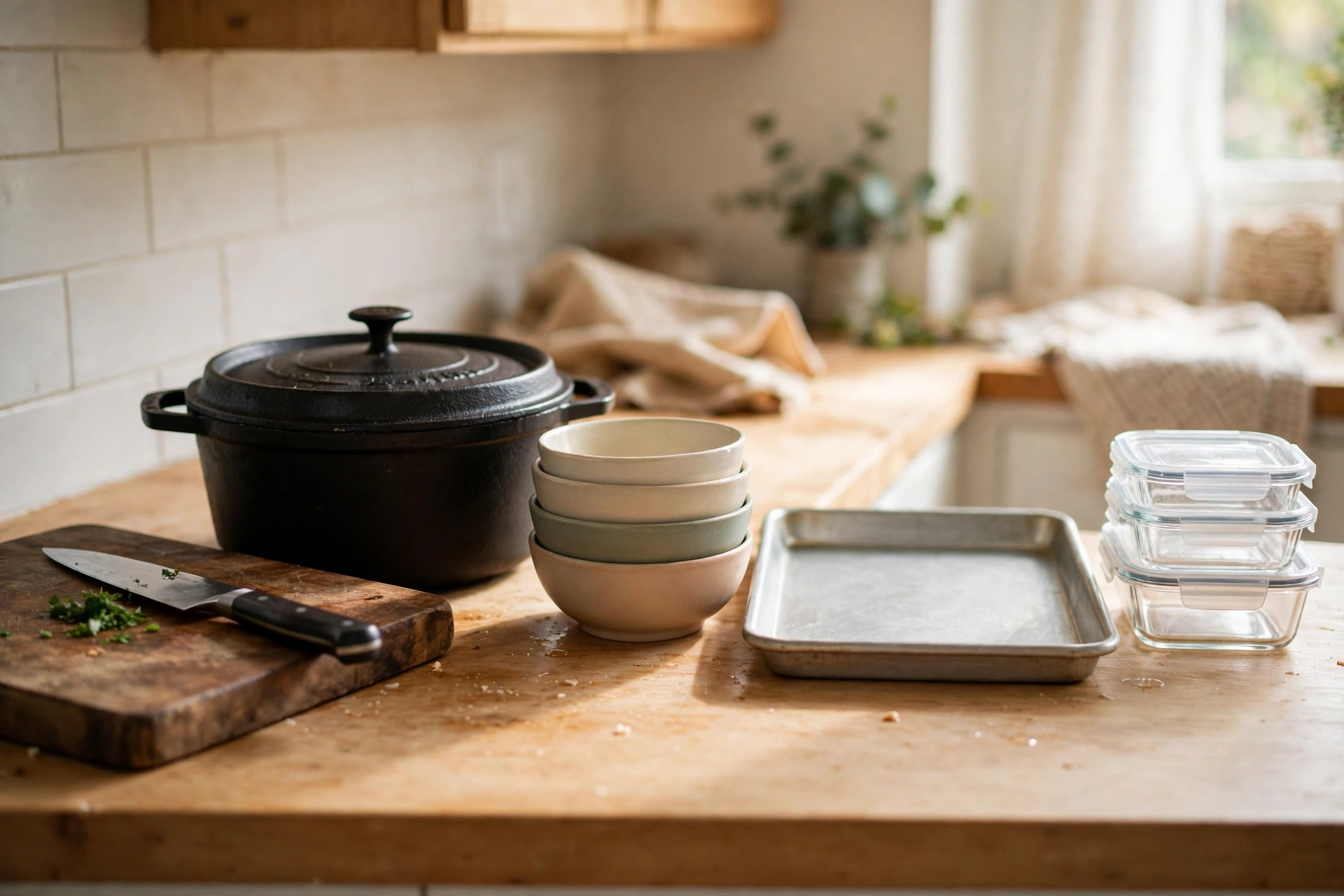
The small kitchen essentials are the tools you reach for every week, that do more than one job, and that fit the space you actually have: one good knife and two boards, one heavy pot and one pan, a sheet pan, nesting bowls, measuring cups and spoons, and stackable containers with lids that fit. That is the whole kit for most small households — about a dozen tools.
This guide covers the core kit by job, the test each tool must pass, and how to build it and keep it minimal.
Table of Contents
- What “Essential” Really Means in a Small Kitchen
- The Earn-Your-Space Test
- Small Kitchen Essentials: The Core Kit
- How to Build the Kit Over Time
- What to Look For Before You Buy
- Common Mistakes to Avoid
- Frequently Asked Questions
- Conclusion
What “Essential” Really Means in a Small Kitchen
In a large kitchen, “essential” can mean anything you use once a month, because there is a cupboard for it. In a small kitchen it is stricter: the tool must do a job you do every week, in the space you have, better than the tool you already own. Everything else is optional.
Count the jobs, not the tools: the same ten or twelve meals need the same few actions — chop, fry, boil, roast, mix, store — each needing one good tool, not three.
A minimalist kitchen is not an empty kitchen: it still has a knife, a pot and a bowl, just not three knives, two pots and a drawer of single-use gadgets.
The kit is small because every tool works hard. For apartment kitchens, the essential kit is the difference between cooking comfortably and cooking around clutter. For more, see Small Apartment Kitchen Organization Ideas That Actually Work.
The Earn-Your-Space Test
Every tool rents its space, and the rent is paid in use. Before a tool joins the kit — and every few months after — run it through three questions.
Does it do a job I do every week? A peeler earns its slot; an egg separator does not — most households crack two eggs a week, and a bowl does the job.
Does it do the job better than what I already own? A new tool only earns space if it replaces something or does a job nothing else does. A sheet pan earns its shelf because it roasts, bakes and reheats — three jobs that would otherwise need three trays.
Does it fit the space it will live in? A tool that does not fit its home is not essential, however good it is. A board that will not fit the drawer or a pot too tall for the cupboard costs space every day.
A tool that passes all three tests earns its space. One that fails one belongs at the back of the cupboard; one that fails two should leave the kitchen. For the full buying method, see How to Choose Space-Saving Kitchen Tools Without Wasting Money.
Small Kitchen Essentials: The Core Kit
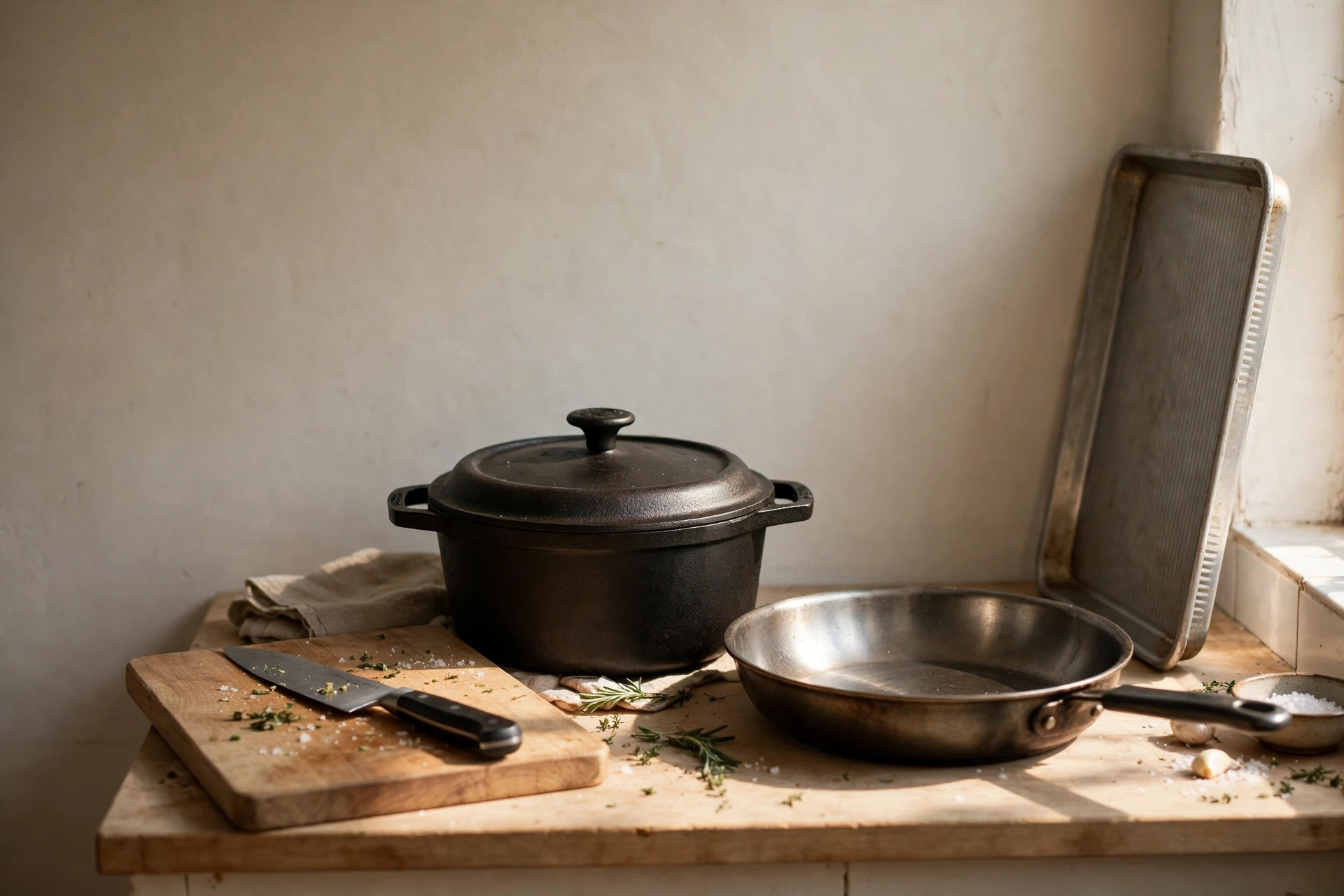
The small kitchen essentials are a short kit, grouped by job: cutting and prep, cooking, bowls and measuring, and storage. Each group below covers one job with one or two tools — nothing in the kit does a job another tool already covers.
Cutting and Prep
The kit here is small: one good knife, two boards, and two or three small tools.
The knife is the one tool worth choosing carefully: a chef’s knife, around 20 cm (8 in), chops, slices and dices, and a small paring knife covers peeling and trimming. One good knife beats a drawer of knives — keep the edge sharp and the blade guarded.
Two boards cover the work: one large board for vegetables and bread, and one small board for quick jobs or for keeping raw meat separate from ready-to-eat food. A board that fits across the sink adds a second work surface. For board sizes and materials, see Space-Saving Cutting Boards and Prep Tools for Small Kitchens.
The small prep tools are the ones you use without thinking: a peeler, a small grater and kitchen scissors. A peeler beats a knife at peeling; a small box grater grates cheese, shreds carrots and zests citrus; scissors cut herbs and open packets. Each earns its space by doing a weekly job nothing else does as well.
Cooking
The cooking kit is the heaviest part of the set: one heavy, lidded pot, one frying pan, and one sheet pan.
The heavy pot is the workhorse. It makes soups, stews, rice and pasta, and a heavy base stops food catching and holds heat evenly.
Choose one big enough for a full meal, with a lid that fits. If you cook for one or two, a medium pot is plenty; a pot sized for six is dead weight on a high shelf.
The frying pan is the second piece: one pan, around 24 to 28 cm (9 to 11 in) across, for frying eggs, searing meat and cooking vegetables. A pan that goes from hob to oven earns more, because it replaces a baking dish.
The sheet pan is the quiet essential. It roasts vegetables, bakes biscuits, reheats leftovers and catches drips under a roasting tin.
One low-rimmed pan that fits your oven covers all of it — a pan that does not fit the oven is useless, so measure first. For storing pots, pans and lids, see How to Organize Pots, Pans, and Lids in a Small Kitchen.
Bowls, Measuring and Serving
Three nesting bowls cover most households: one large bowl, around 28 cm (11 in) across, for mixing batter and tossing salads; one medium bowl for vegetables and marinades; and one small bowl for eggs and sauces. A large bowl that also serves at the table earns double space. Keep the stack short and dry bowls before stacking, or the stack will smell.
Measuring tools are the second half of this group: nesting measuring cups and spoons, and a slim kitchen scale. Cups and spoons are enough for everyday cooking; a scale is the tool for baking, and it weighs straight into the bowl, so there is less washing up.
A slim scale slides into a drawer — one left on the counter takes up worktop and gets wet. For the measuring set in detail, see Best Measuring and Prep Tools for Small Kitchens.
Storage and Everyday Extras
Stackable containers with lids that fit are the core of it: one matching set, in two or three sizes, that stacks into a stable tower instead of sliding around a shelf. Matching footprints matter more than matching colours — mixed sizes do not stack, and a lid that fits nothing is clutter. For containers and lids, see Best Stackable Kitchen Storage Containers for Small Spaces.
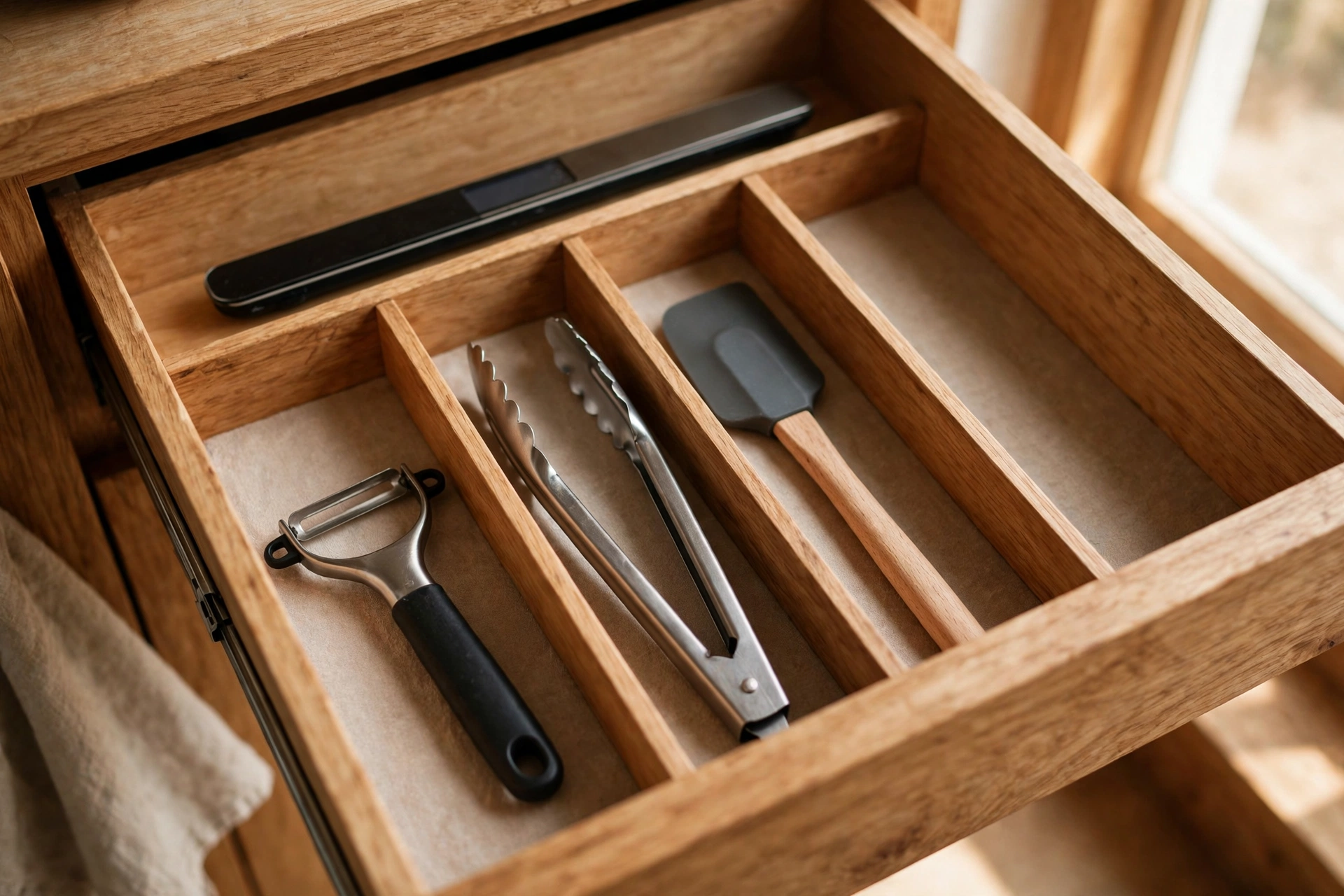
The everyday extras are the small tools that finish a meal: tongs and a heatproof spatula. Tongs turn, lift and serve, and they replace a fork for most jobs at the hob.
A heatproof spatula stirs, scrapes and folds without melting against a hot pan. A wooden spoon is the third extra, for stirring soups and stews.
Keep the extras to three or four, in a drawer slot or on a wall hook — a crock takes up worktop. For drawer layouts, see Drawer Organizers and Dividers for Small Kitchen Tools.
How to Build the Kit Over Time
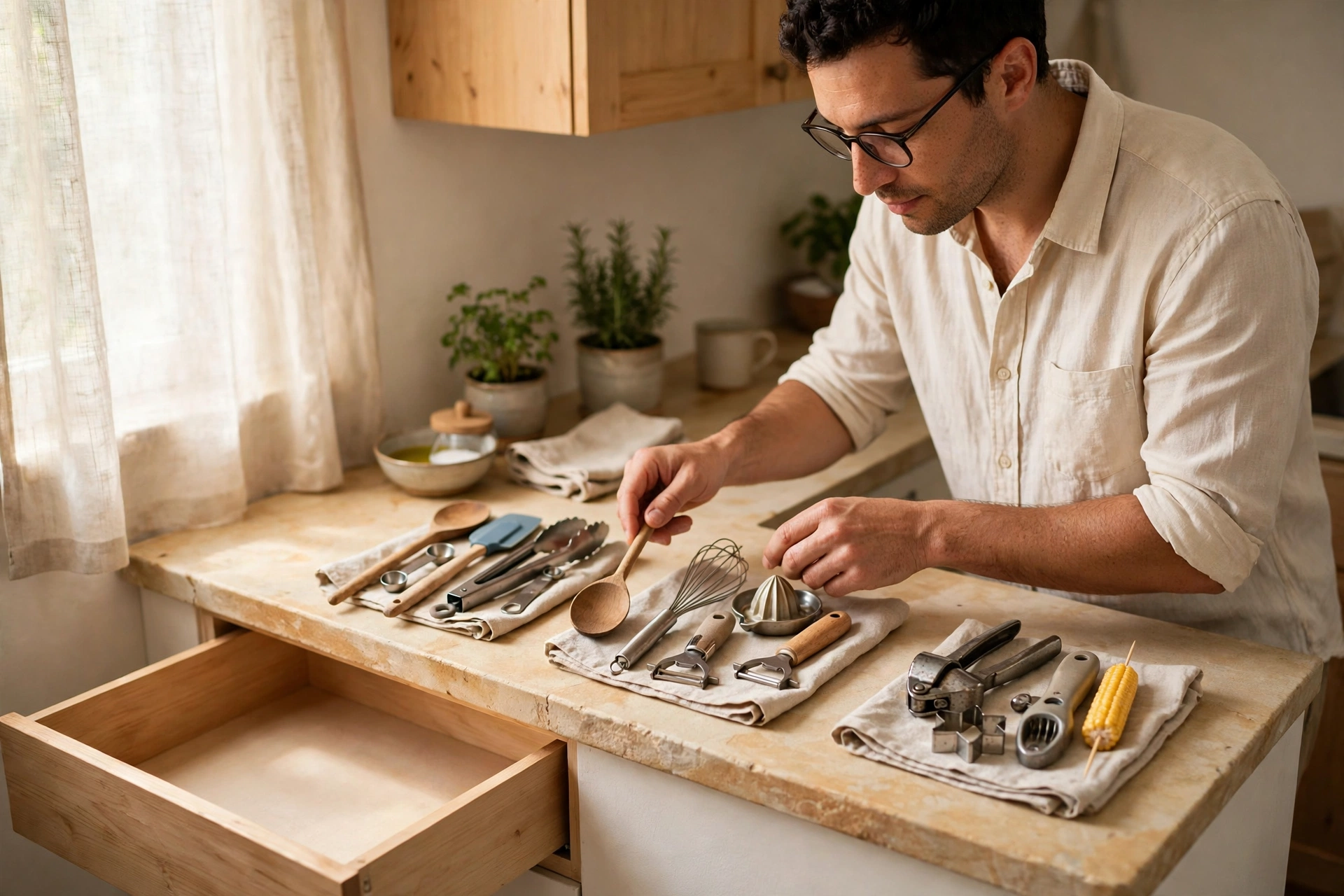
Buy the kit in stages, one drawer or cupboard at a time — buying it all at once is the fastest way to end up with tools you never use.
Step 1: Start with the tools you already own. Empty one drawer and one cupboard and sort: used weekly, used monthly, not used in six months. The weekly group starts your kit; the unused group leaves.
Step 2: Buy the missing core first. Compare what is left with the core kit in this guide: knife and boards, pot and pan, sheet pan, nesting bowls, measuring cups and spoons, containers. The gaps are what you need — usually two or three tools. Buy the one that fixes your biggest frustration first.
Step 3: Add one tool at a time, each passing the test. Before each purchase, run the earn-your-space test. If a tool fails, it waits. If it passes, it joins the kit and something leaves — one in, one out.
Step 4: Give every tool a fixed home. A drawer slot for the cups, a hook for the tongs, a shelf for the pot — a tool with no home lives on the counter.
Step 5: Cook a normal month with the kit. Reach for something outside it twice, and it earns a place; never reach for something inside it, and it leaves.
Step 6: Review the kit every season. Four times a year, empty one drawer and ask the three questions again. Cooking changes with the seasons, and the kit should change with it.
Habits change, and the kit should change with them: keep the better of each duplicate when two kitchens become one, and let the tools you stop using leave first. Renters have one extra reason to keep it minimal — everything in it has to move, and a dozen nesting, stacking tools fit in two boxes. For the full decluttering method, see How to Declutter a Small Kitchen: A Step-by-Step Guide.
What to Look For Before You Buy
Dimensions. Stored size, not open size, against the space you measured.
Materials. Stainless steel is durable and easy to clean but heavy; silicone must be thick enough to hold its shape; wood should not be soaked; plastic can warp and stain.
Durability. Check joints, hinges and handles first — a folding tool lives or dies by its hinge, and a tool used every week wears out fastest at its weak points.
Cleaning. Smooth surfaces wash fastest; a tool with hidden corners where food collects will be left in the sink.
Capacity. Size it for the meals you cook — a tool that is too small creates extra work.
Storage footprint. If you cannot picture where it will live, do not buy it.
Common Mistakes to Avoid
Buying the whole kit at once. Start with what you own, find the gaps, and buy one tool at a time.
Keeping duplicates “just in case.” Two sets of cups do not measure better than one. Keep the best of each and let the rest go.
Choosing the smallest version of everything. Size tools for the meals you cook, not for the shop shelf.
Collecting single-use gadgets. Five of them fill a drawer that could hold the tools you use every day.
Letting the kit grow without a review. Without a seasonal review it drifts back to clutter, one gadget at a time.
Frequently Asked Questions
How many tools does a small kitchen actually need?
About a dozen — knife and boards, pot, pan and sheet pan, nesting bowls, measuring cups and spoons, a slim scale, peeler, grater, tongs, spatula and stackable containers.
What is the single most important small kitchen essential?
A good chef’s knife, around 20 cm (8 in). It chops, slices and dices, and it is the tool your hand reaches for first. Keep it sharp and guarded.
Can a minimalist kitchen still cook proper meals?
Yes — the kit covers almost every everyday meal: chopping, frying, boiling, roasting, mixing and storing. A minimalist kitchen is not an empty kitchen; it is a kitchen where every tool works hard.
How do I keep the kit minimal in a rented flat?
Keep it to the dozen core tools, choose nesting and stacking pieces that travel well, and run the seasonal review — one drawer, four times a year. Avoid tools that need drilling unless the landlord has agreed.
Should I replace tools one at a time or all at once?
One at a time — replace the tool that frustrates you most, and let the old one go.
Conclusion
Small kitchen essentials are not a shopping list — they are a test: does the tool do a weekly job, better than what you own, in the space you have? The core kit is about a dozen tools: a knife and two boards, a heavy pot, one pan and a sheet pan, nesting bowls and measuring tools, tongs, a spatula and stackable containers.
Build it over time: start with what you own, buy the missing core first, add one tool at a time, give each one a home, and review it every season. That is how a small kitchen stays a kitchen you can cook in, not a cupboard you have to work around. For the wider picture, see Best Space-Saving Kitchen Tools for Small Kitchens — the hub for everything in this guide.
4 thoughts on “Small Kitchen Essentials: Tools That Earn Their Storage Space”