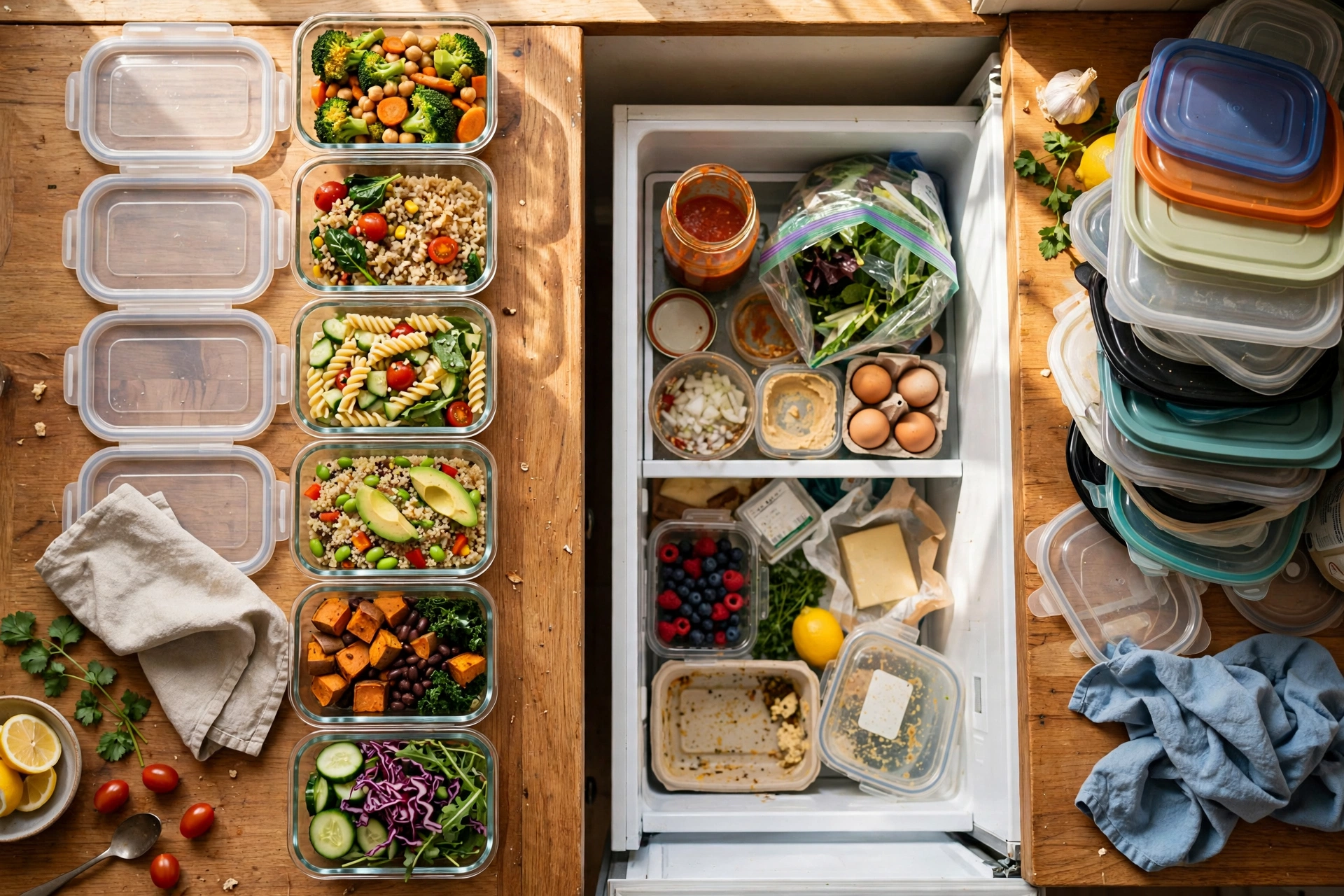
Most meal prep fails in a small kitchen for the same few reasons: too much food for too little fridge, meals that do not survive three days in a container, and a session that leaves the kitchen in chaos.
The good news is that every one of these mistakes has a simple fix. This guide gathers the fifteen most common small kitchen meal prep mistakes — and the fix for each one.
Table of Contents
- Why Small Kitchens Punish Mistakes More
- Small Kitchen Meal Prep Mistakes: Planning Errors
- Cooking Mistakes: Too Much, Too Many, Too Complicated
- Portioning and Labelling Mistakes
- Storage Mistakes: The Fridge and Freezer Fill Up
- Freshness Mistakes: Food That Goes Off Before You Eat It
- Reheating and Eating Mistakes
- The Habit Mistakes That Undo the System
- A Mistake-Proof Prep Session, Step by Step
- How to Rescue a Week That Has Already Gone Wrong
- Your Quick Self-Check Before Every Session
- Frequently Asked Questions
- Conclusion
Why Small Kitchens Punish Mistakes More
In a large kitchen, a mistake is forgiving. In a small kitchen, there is nowhere to hide one — a wrong decision fills the only shelf, blocks the only counter, or uses the only free hob ring, and the food goes off before it is eaten.
Small Kitchen Meal Prep Mistakes: Planning Errors
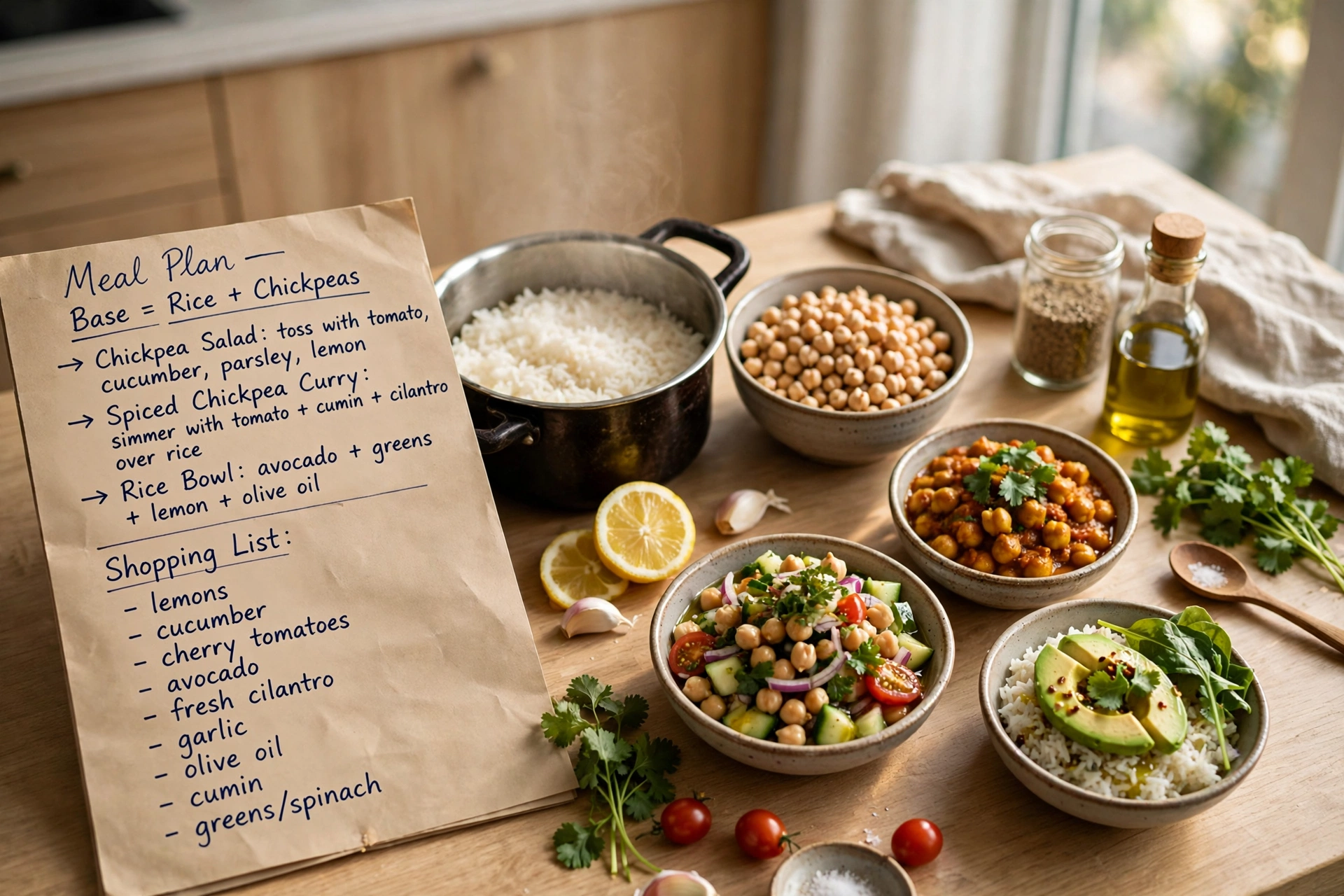
Mistake 1: Planning five different meals — and shopping before you plan
Five different dinners and five different lunches mean five pots, five chopping sessions, and a fridge that cannot hold five sets of leftovers.
The fix is the one-base rule: cook one cheap base and change what goes with it — a pot of rice becomes chickpeas and feta on Monday, tuna and sweetcorn on Tuesday, and a fried egg and soy sauce on Wednesday. Write the list from the plan.
For the planning steps in full, see A Beginner’s Guide to Meal Planning for a Small Household.
Mistake 2: Planning for a household you do not have
Most recipes serve four or six, and a household of one or two that follows them cooks twice the food it can eat.
The fix is to halve recipes as a habit, and to cook for the household plus one: a pot that makes six portions for a household of two gives two dinners, two lunches, and two freezer portions.
Cooking Mistakes: Too Much, Too Many, Too Complicated
Mistake 3: Cooking a whole week at once
Food prepped on Sunday is tired by Thursday. The fix is two short sessions instead of one long one: prep for three or four days, then a twenty-minute top-up midweek.
Mistake 4: Cooking meals that do not reheat well
Crisp fried food goes soft, fresh salads wilt, pasta cooked in advance turns stodgy, and creamy dishes can split when thawed.
The fix is to choose meals that scale and reheat well — soups, stews, curries, cooked grains and pulses, and sauces — adding fresh leaves and dressing at serving time.
For the batch method in full, see Batch Cooking in a Small Kitchen: Tips to Save Time and Space.
Mistake 5: Starting too many pots at once
Starting a second dish before the first is off the heat means two pots competing for one counter and one sink.
The fix is cooking in sequence: one pot, then one tray, then the next batch. Start with the longest, most hands-off job — the pot of soup or the tray of vegetables — and wash up while it simmers.
Portioning and Labelling Mistakes
Mistake 6: Storing everything in one big container
A large container opened four times is food reheated four times, and every reheat dries the food out a little more.
The fix is single portions, sized to one meal for one person — four small containers are four fresh meals. For the container system in full, see How to Store Meal Prep Containers in a Small Kitchen.
Mistake 7: Forgetting to label containers — and eating in the wrong order
Unlabelled food gets opened, sniffed, and put back, then thrown away a week later. In a small fridge, a label is the only way to know what is inside and when it was cooked.
The fix takes ten seconds per container: masking tape and a pen, with the contents and the date. Label the container, not the lid, because lids get swapped.
Then eat first-in, first-out: move the older containers to the front, and eat the most perishable first.
Storage Mistakes: The Fridge and Freezer Fill Up
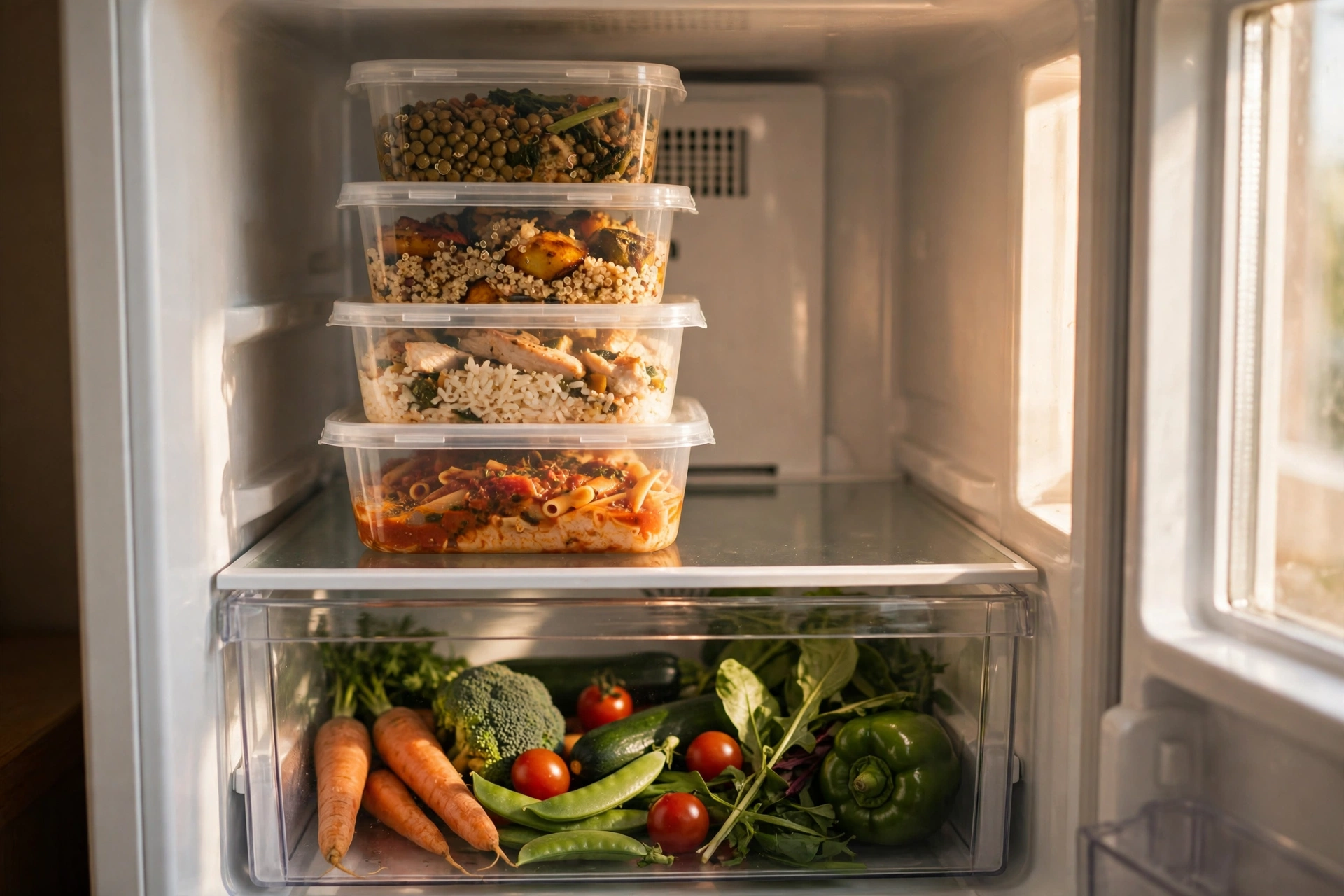
Two container mistakes cause most storage trouble: lids kept away from their containers, and sets bought before measuring. Keep lids in the same home as the bases, filed upright by size.
Mistake 8: Packing the fridge to the edges
A fridge crammed to the edges cannot circulate cold air, so food at the back stays warmer than it should. If you have to move three containers to reach one, you have prepped too much.
The fix is to leave breathing room, with a small gap at the back. If the fridge cannot hold five lunches, prep three and top up midweek.
For the fridge system in full, see Small Fridge Organization for Meal Prep.
Mistake 9: Treating a small freezer like a big one
A small freezer compartment or drawer usually holds two or three single-portion cooked meals, plus a few basics. It is for the overflow of a batch, not a month of cooking.
The fix is a small rolling reserve: cook two freezer meals a week, freeze them flat in single portions, newest at the back, and replace each portion as you use it.
For the packing method in full, see Freezer Meal Prep for Small Kitchens: Planning and Storage Tips.
Freshness Mistakes: Food That Goes Off Before You Eat It
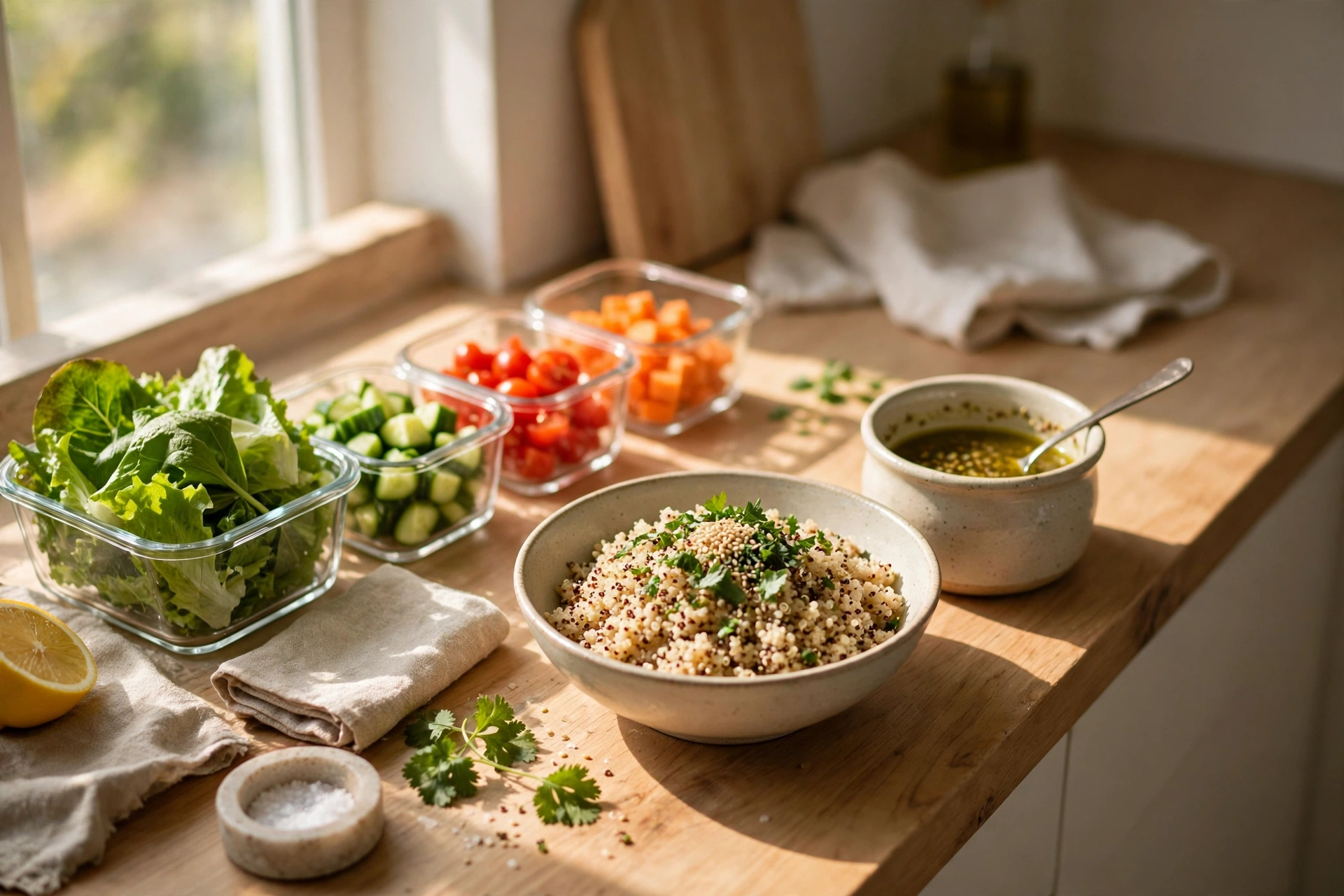
Mistake 10: Dressing and assembling food too early
Dressing is the main cause of soggy prepped food: a salad dressed on Sunday is one you will not want on Wednesday.
The fix is to keep wet and dry parts separate until eating time — dressings in small pots, tomatoes and pickles out of wraps, and a spread of hummus or cream cheese as a barrier between the bread and the wet filling.
Mistake 11: Prepping delicate food for the whole week
Salad leaves, soft herbs, cut tomatoes, avocado, and berries fade fast, so prepping them on Sunday for Friday is planning to throw food away.
The fix is to split the prep: sturdy food early, delicate food late. Cook sturdy food on Sunday, and assemble Thursday and Friday’s wraps in a short Wednesday top-up.
For the ingredient-by-ingredient guide, see How to Keep Meal Prep Ingredients Fresh Throughout the Week.
Mistake 12: Cooling food the wrong way
A large pot cools slowly in the middle, so leaving it on the counter for hours is a risk — and a steaming pot warms everything around it in the fridge.
The fix is to portion first: spoon the batch into shallow, single-portion containers, which cool much faster than one deep pot. Leave the lids off while the food cools, then chill it promptly. Eat fridge portions within a few days.
Reheating and Eating Mistakes
Mistake 13: Reheating the same portion twice
A portion reheated twice is dry, tired, and — if it has spent too long at room temperature between heats — not safe to eat. It usually happens because a container was too big for one meal.
The fix is the single-portion rule: reheat only the portion you will eat, and reheat it once, until it is piping hot throughout — gently, in a pan on a low heat with a splash of water, or in a microwave in short bursts.
The Habit Mistakes That Undo the System
Mistake 14: Skipping the reset
The session is not finished when the food is stored; it is finished when the kitchen is clean. A messy kitchen starts the next session blocked.
The fix is to build the reset into the session: wash the pot, the board, and the knife, wipe the counter and the hob, and put everything back where it lives. Then note what is left — that note starts next week’s plan.
Mistake 15: Treating one bad week as proof it does not work
The most damaging mistake is not a cooking error at all. It is quitting after the first week goes wrong — the food went soggy and the fridge overflowed.
Almost every beginner has a bad first week. The fix is to start smaller than you think you need to — one pot, four to six portions, three lunches — and change one thing each week until it fits your kitchen.
For a timed version of a small first session, see One-Hour Meal Prep Plan for Busy Weekdays.
A Mistake-Proof Prep Session, Step by Step
First, plan for twenty minutes: check what you already have, choose three or four bases, and write the list from the plan.
Second, shop once and put the shopping away the moment you get home — frozen food first, then chilled, then pantry.
Third, clear the counter and set up one workstation. Fourth, cook in sequence, longest and most hands-off first, washing as you go.
Fifth, cool in shallow containers, portion into single servings, and label every container. Sixth, store by the map: meals on the middle shelf, oldest at the front; freezer portions flat, newest at the back.
Seventh, reset: wash up, wipe down, and note what is left.
How to Rescue a Week That Has Already Gone Wrong
If the week is already off track, do not start again — rescue it. Open the fridge and sort everything into three piles: eat today, freeze today, throw away.
Anything that looks or smells off goes in the bin. Turn the “eat today” pile into one use-it-up meal — a soup, stir-fry, omelette, or pasta dish — the same evening.
Freeze anything cooked that will not be eaten soon, in flat, single portions, labelled with the contents and the date.
Your Quick Self-Check Before Every Session
Run through this list before you start.
- Did I check what is already in the fridge, freezer, and pantry?
- Is the plan three or four bases, not five different meals?
- Will it fit the fridge — three or four days of food, not seven?
- Are the meals ones that reheat well?
- Are the containers single portions with lids?
- Is the dressing separate, and are the delicate parts for later in the week?
If the answer to any of these is no, fix that one thing before you start cooking.
Frequently Asked Questions
What is the single biggest meal prep mistake in a small kitchen?
Cooking too much for the space you have. A batch that fills every shelf is food that will be thrown away. Cook for the household plus one, prep for three or four days, and top up midweek.
Can I still meal prep if my fridge is very small?
Yes. Use one matching set of square containers, meals stacked on the middle shelf, oldest at the front, and a midweek top-up instead of a whole week at once. If the fridge is still full, move some portions to the freezer on prep day.
How do I fix prepped food that has gone soggy?
You usually cannot rescue it, but you can stop it happening again: keep dressings in small pots and add them at eating time, and store wet and dry parts separately.
Is it normal for meal prep to go wrong at first?
Yes. Most people have a messy first week — too much food, a soggy salad, or a container with no lid. Start with one pot and three lunches, and change one thing each week until it fits your kitchen.
How many meals should I prep at once in a small kitchen?
Three: three days of lunches or dinners, with a short midweek top-up for the rest of the week. Four to six portions of one batch is the right size for a household of one or two.
Conclusion
Small kitchen meal prep mistakes mean the plan is bigger than the space. The fixes are small and repeatable: plan from what you have, cook one base and change the toppings, prep for three or four days, portion into single containers, label everything, keep wet and dry parts separate, and reset the kitchen.
Start this week with one fix, not all fifteen: pick the mistake you recognised most in this guide and change only that. For the wider system, read Easy Meal Prep Ideas for Small Kitchens, and for the end-to-end workflow that ties it all together, see Small Kitchen Meal Prep Workflow: From Grocery Shopping to Storage.