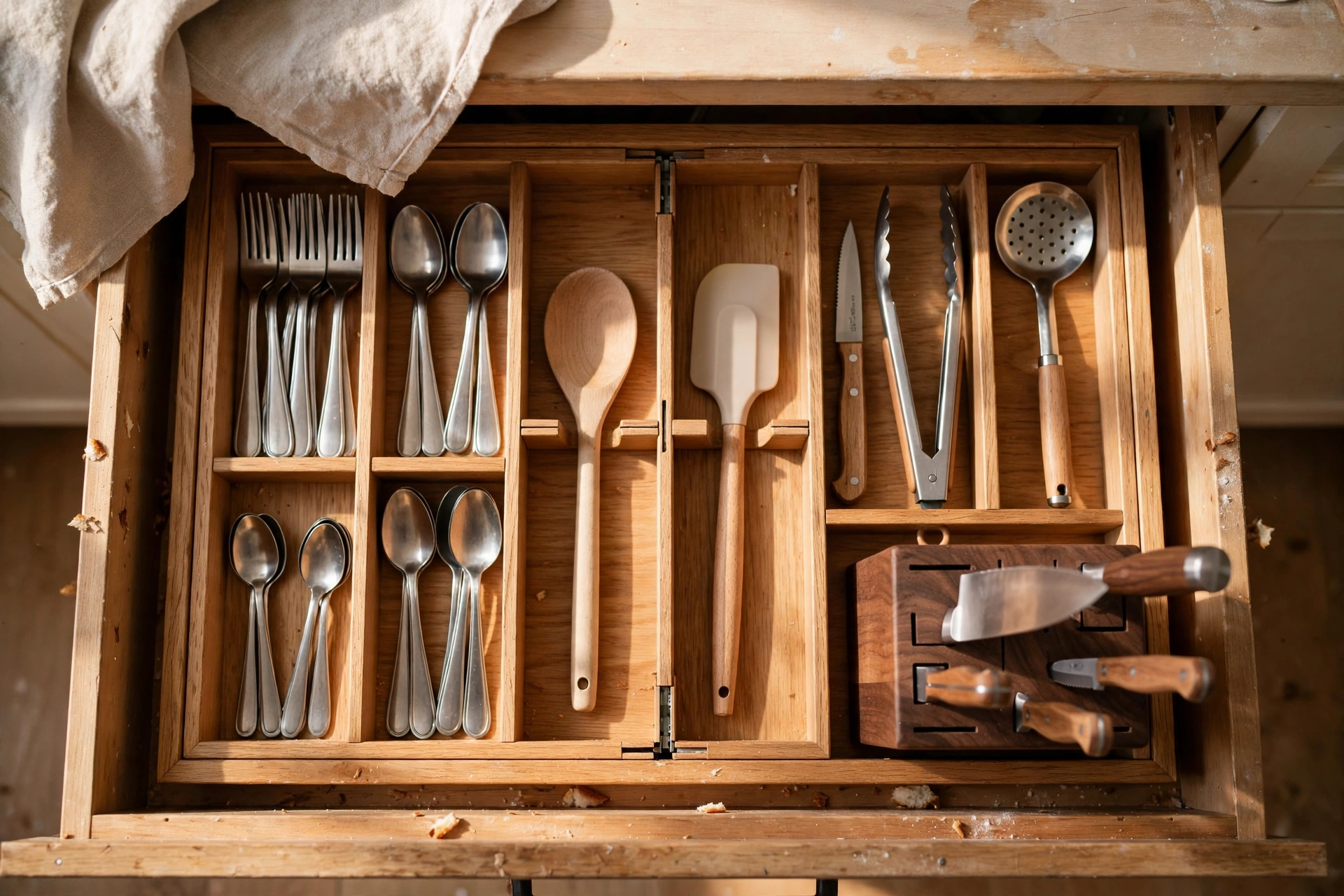
The best kitchen drawer organizers for a small kitchen are the ones that fit the drawer you already have: a tray that fills the cutlery drawer, an expandable organizer that grows to fill a wide drawer, adjustable dividers that split a deep drawer into lanes, and a knife block with a slot for every blade. You do not need a whole system — just a few dividers that match the tools you own.
This guide covers the organizer types worth buying, how to measure a drawer, how to fit each drawer type, and the mistakes that leave a drawer messy again.
Table of Contents
- What Makes a Drawer Organizer Worth Buying?
- Kitchen Drawer Organizers: The Types Worth Considering
- Measuring Your Drawers Before You Buy
- Organizing by Drawer Type
- A Step-by-Step Plan for Fitting Your Drawers
- Keeping Organizers Clean and in Place
- What to Look For Before You Buy
- Common Mistakes to Avoid
- Frequently Asked Questions
- Conclusion
What Makes a Drawer Organizer Worth Buying?
A drawer organizer earns its place only if it makes the drawer easier to use, not just tidier to look at. A tray that slides every time you open the drawer is not an organizer — it is a loose box.
Open the drawer, take the tool you want with one hand, and close it — if anything moved, the organizer is not doing its job.
A good organizer does three things. It gives every tool a fixed home, so nothing slides to the back.
It separates groups that do not belong together — cutlery from cooking tools, sharp blades from everything else. And it leaves a little empty space, because a packed drawer pushes items out of their sections.
The other test is fit: an organizer a centimetre too wide will not sit flat, and one too small leaves a gap where loose items collect.
Kitchen Drawer Organizers: The Types Worth Considering

Most small kitchens need two or three kitchen drawer organizers: a tray for cutlery, an expandable organizer or adjustable dividers for utensils, and a knife block or guard for blades. Each type below suits a different drawer, so start with the drawer you open most.
Fixed Trays and Inserts
A fixed tray is a single piece with moulded sections — the classic cutlery tray — that drops into the drawer and stays put. It suits a drawer that rarely changes.
Five or six sections — forks, knives, spoons, teaspoons, and one spare — cover most households. Look for low walls and a non-slip base so it does not slide.
The trade-off is inflexibility. If your drawer changes, the tray does not.
Expandable Organizers
An expandable organizer is a tray with sides that slide out, so it grows to fill the drawer width. It suits a drawer that changes over time, or one you have not measured exactly, because it adjusts to the space.
The most useful type is a utensil organizer: a tray with long slots for cooking tools that expands from about 30 cm (12 in) to about 45 cm (18 in). Check that the sliding parts lock or sit firmly when expanded — an organizer that creeps back in leaves a gap where spoons collect.
It needs no screws and leaves no marks, so it suits rented kitchens.
Adjustable Dividers
Adjustable dividers are separate pieces — spring-loaded bars, slotted boards, or pegboard-style dividers with pegs — that split a drawer into lanes you can change whenever the contents change. They suit deep drawers and drawers with mixed contents.
Spring-loaded dividers press against the drawer sides without screws. The trade-off is that dividers only split the drawer — they do not hold small items, so pair them with a small box or tray inside one lane for loose pieces.
In-Drawer Knife Blocks
An in-drawer knife block is a slotted block that lies flat in the drawer, with a separate slot for each blade. It is the safest way to store knives in a drawer: every blade has its own slot.
Choose a block with slots that fit your longest knife. If your drawer is too shallow for a block, use blade guards or sheaths instead, handles at the front, or move the knives to a wall-mounted magnetic strip.
Deep-Drawer Organizers
Deep drawers hold heavy, bulky items rather than small tools, so they need a different organizer. The most useful type is a vertical divider that stands trays, boards and lids upright, like files, so you can see each one and lift it out without moving the rest.
A pegboard base is the second useful type: a board with pegs arranged around pots and pans to stop them sliding. Keep the load in a single layer where you can.
Measuring Your Drawers Before You Buy
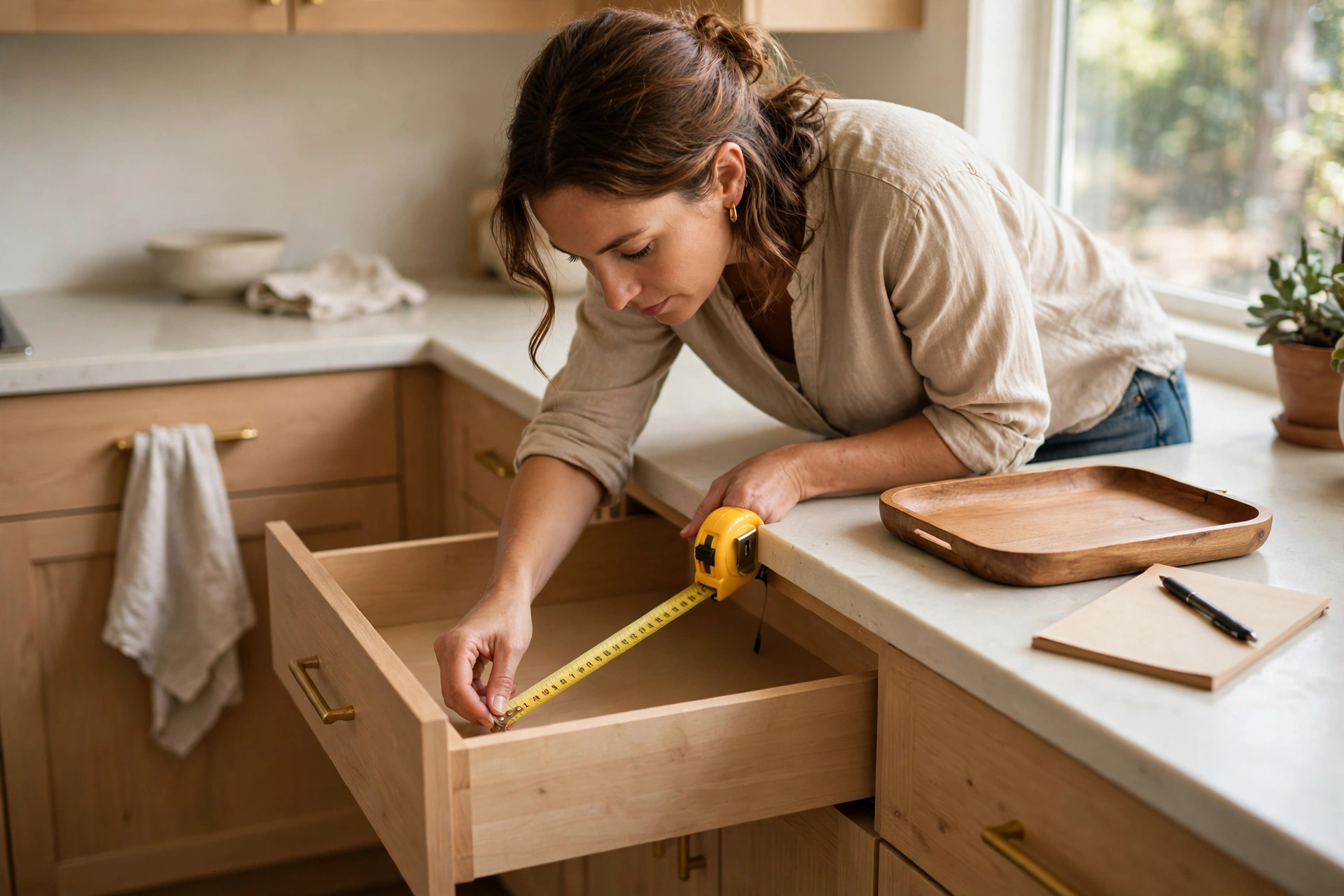
Every organizer purchase starts with three measurements, taken inside the drawer: width, depth, and clear height with the drawer closed. Write the numbers down — guessing in the shop is how the wrong tray comes home.
Width matters most — measure at the front and at the back, because some drawers are slightly wider at the front.
Depth matters for cooking utensils: a long-handled ladle may be longer than the drawer, and no organizer fixes that.
Clear height matters for knife blocks and deep trays: measure from the base of the drawer to the underside of the drawer above, and check that the organizer plus the tallest item still lets the drawer close.
Note anything that reduces the usable space: a handle inside the drawer front, a lip at the front edge, or a screw head that sticks out. For the wider method, see How to Organize Kitchen Drawers in a Small Kitchen.
Organizing by Drawer Type
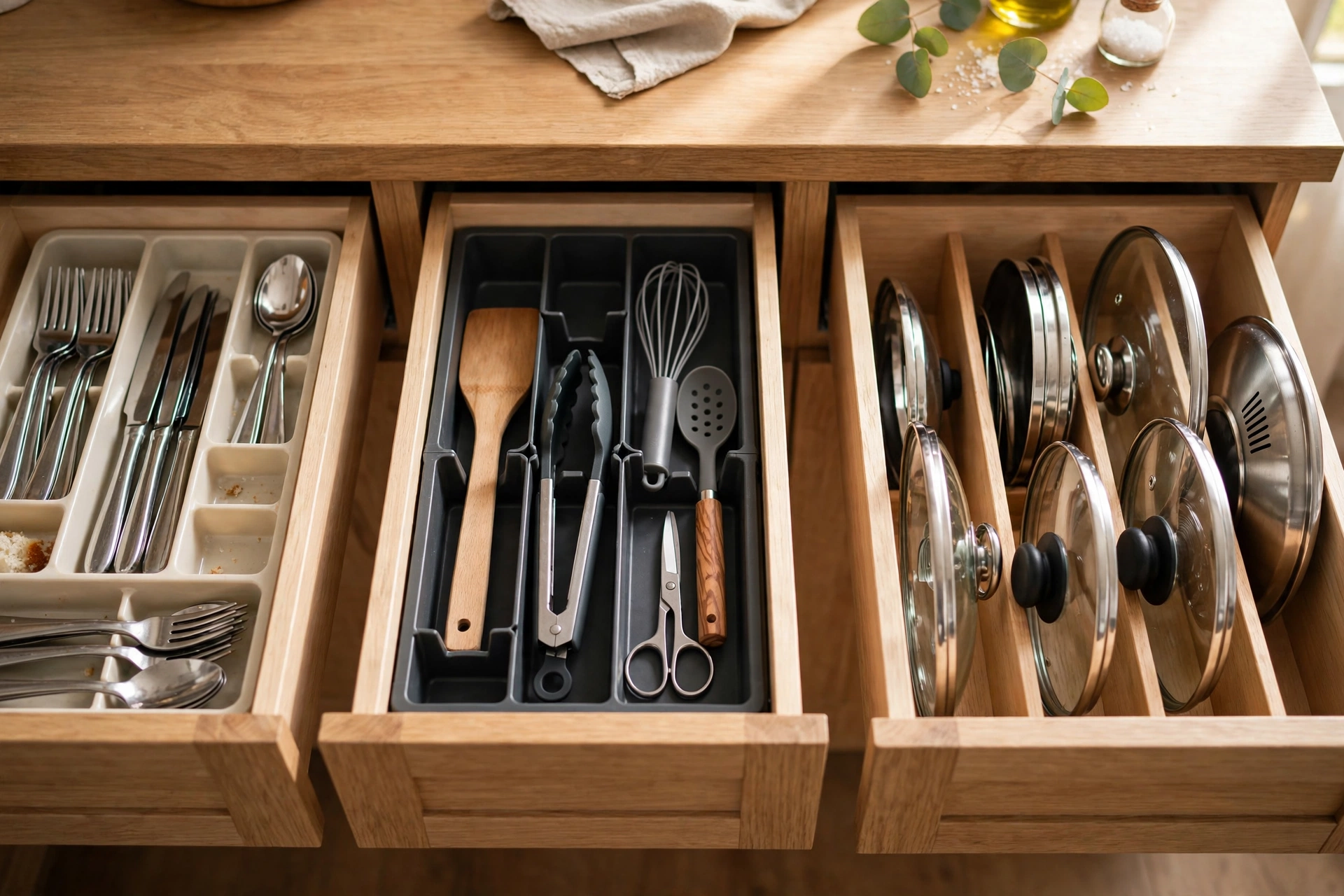
The organizer that works depends on the drawer, so match it to the drawer in front of you.
The Cutlery Drawer
The cutlery drawer is usually the shallowest, near where you serve food. A fixed tray is the right organizer here: five or six sections, forks, table knives and spoons in the front, teaspoons behind.
Store cutlery flat, handles facing the same way, and leave one section empty — a full tray spills when you open it.
The Utensil Drawer
The utensil drawer holds the long tools: spatulas, ladles, tongs, whisks and peelers. An expandable organizer suits it best, because the long slots widen to fit the tools you own.
Lay cooking utensils flat in a single layer, handles together. Keep measuring tools in their own small section, clipped together on a ring — for the set itself, see Best Measuring and Prep Tools for Small Kitchens.
If a utensil is too long for the drawer, move it to a wall rail — see Wall-Mounted Kitchen Tools That Free Up Counter Space.
The Deep Drawer
Deep drawers are the best place for heavy items: pots, pans, mixing bowls, food containers and baking trays. Use vertical dividers to stand trays, boards and lids upright.
Store lids upright in a divider, grouped by size. For the cookware side of this drawer, see How to Organize Pots, Pans, and Lids in a Small Kitchen.
For containers and their lids, see How to Organize Food Storage Containers and Lids.
Narrow and Shallow Drawers
A narrow drawer, a shallow drawer above the fridge, or a thin drawer beside the cooker can still earn its place. A narrow drawer suits a single row of adjustable dividers, or one long, thin tray.
A shallow drawer suits flat items in a single layer: tea towels, placemats, or baking paper. Use small boxes you already own as dividers first, rather than forcing a standard tray into a narrow drawer.
A Step-by-Step Plan for Fitting Your Drawers
Work through these steps one drawer at a time. Do not buy organizers for the whole kitchen at once.
Step 1: Empty the drawer and sort it. Take everything out, wipe the base, and sort into three groups: keep, move, and let go.
Step 2: Measure the inside of the drawer. Measure width at front and back, depth, and clear height with the drawer closed. Take the numbers with you.
Step 3: Choose one organizer type for this drawer: a fixed tray for cutlery, an expandable organizer for utensils, adjustable dividers for a deep drawer.
Step 4: Test the fit before you load it. Put the empty organizer in the drawer and open and close it a few times. It should sit flat, not rock, and not slide — if it slides, add a non-slip mat underneath.
Step 5: Load it light, then fill it. Daily-use items go in first, at the front, then weekly items behind them.
Step 6: Live with it for a week. Use the drawer normally before buying the next organizer. If you keep reaching past it, the layout is wrong — move the divider, not the tool.
Keeping Organizers Clean and in Place
Lift trays and dividers out once a month, wipe the drawer base, and wash the organizer with hot water and washing-up liquid. Bamboo and wood trays should be wiped, not soaked, and dried fully before they go back in.
Stop sliding with a non-slip mat under the organizer, cut to the size of the drawer base. If a tray still moves, it is too small for the drawer.
Check spring-loaded dividers every few months, and replace an organizer when it is cracked or warped — a rocking tray is worse than no tray at all.
What to Look For Before You Buy
Dimensions. Compare the organizer’s size with the drawer you measured — an expandable organizer gives you some room for error, a fixed tray gives you none.
Materials. Bamboo and wood look warm but should not be soaked. Plastic is light and easy to clean, but can warp. Stainless steel is durable but heavy.
Durability. Check the joints, hinges and sliding parts first. A loose joint will only get looser.
Cleaning. Smooth surfaces wash fastest. A tray with narrow slots needs a brush.
Capacity. Count the sections against the tools you own — a tray with four sections for five groups leaves one group loose.
Storage footprint. An organizer should use the drawer it is in, not add clutter elsewhere.
Common Mistakes to Avoid
Buying organizers before decluttering. Remove what you do not use first. For the full method, see How to Declutter a Small Kitchen: A Step-by-Step Guide.
Buying without measuring. A tray a centimetre too wide will not sit flat, and one too small leaves a gap where loose items collect. Measure first.
Filling every section. A packed drawer pushes items out of their sections — leave a little empty space in each one.
Storing knives loose. A loose blade can cut you, and it blunts itself knocking against other tools. Every blade needs a slot, a guard, or a sheath.
Choosing a fixed tray for a drawer that changes. If the contents change often, an expandable organizer or adjustable dividers last longer.
Forgetting the drawer above. A tall organizer or item can stop the drawer closing — check the clear height with the drawer closed, not open.
Frequently Asked Questions
What is the best drawer organizer for a small kitchen?
A fixed tray for the cutlery drawer and an expandable organizer for the utensil drawer. Those two cover the drawers you open most, and neither needs screws.
Are expandable drawer organizers worth it?
Yes, when the drawer is wide or its contents change. They adjust to fill the space, so they suit rented kitchens. Check that the sliding parts lock firmly when expanded.
How do I stop a drawer organizer from sliding?
Put a non-slip mat underneath it. If it still slides, the organizer is probably too small for the drawer.
What should I do with a drawer that is too shallow for a knife block?
Use blade guards or sheaths for each knife, handles at the front, or move the knives out of the drawer onto a wall-mounted magnetic strip.
Can I use kitchen drawer organizers in a rented kitchen?
Yes — trays, expandable organizers and spring-loaded dividers need no screws and leave no marks. Only screw-fixed dividers need the landlord’s permission.
Conclusion
Kitchen drawer organizers work when they fit the drawer you already have: a fixed tray for cutlery, an expandable organizer for utensils, adjustable dividers for a deep drawer, and a knife block with a slot for every blade. Declutter first, measure the drawer, and buy one organizer for one drawer.
Start with the drawer you open most — usually the cutlery drawer — and work through the six-step plan for that drawer. For the wider picture, see Best Space-Saving Kitchen Tools for Small Kitchens — and for the tools that earn their storage space alongside them, read Small Kitchen Essentials: Tools That Earn Their Storage Space. For the buying method behind every purchase in this guide, see How to Choose Space-Saving Kitchen Tools Without Wasting Money.