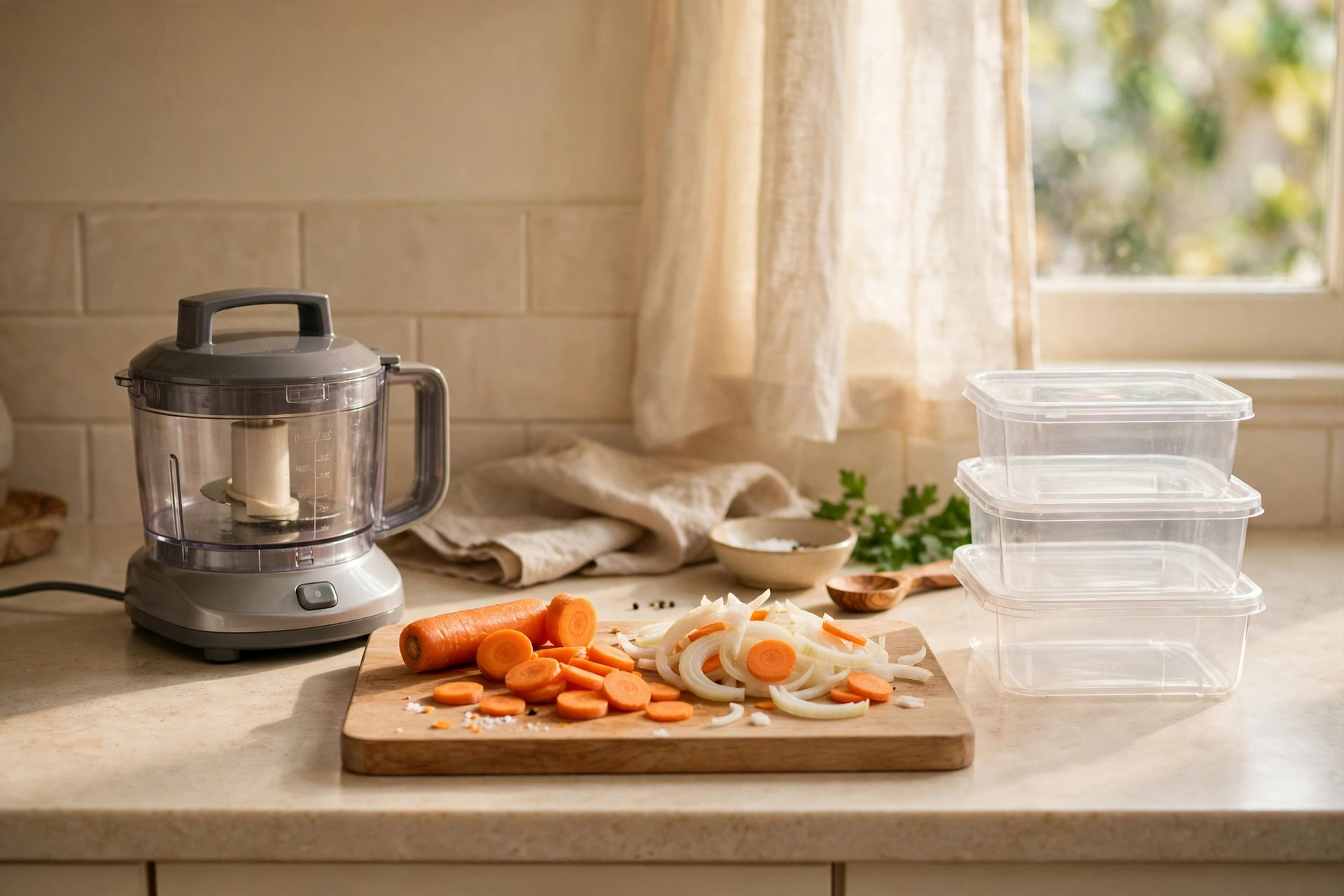
The best small kitchen food processors fit your counter, your cupboard and the way you actually cook. A machine that chops onions in seconds but never leaves its box is no help at all, so size and storage matter as much as power.
This guide covers bowl sizes, types, footprint, power and cleaning for small kitchen food processors, plus storage ideas and a step-by-step way to choose. No brand names, no prices — just what to look for.
Table of Contents
- Small Kitchen Food Processors: What Makes One Work in a Small Kitchen
- The Three Types Worth Knowing
- Bowl Size: Match It to How You Cook
- Footprint, Weight and Where It Will Live
- Power and Functions That Matter
- Cleaning and Looking After It
- Storage Ideas for a Small Kitchen
- A Step-by-Step Way to Choose One
- Common Mistakes to Avoid
- Frequently Asked Questions
- Conclusion
Small Kitchen Food Processors: What Makes One Work in a Small Kitchen
A food processor earns its place when it does jobs your knife does slowly, without demanding a whole shelf. Onions, cheese and carrots take minutes by hand and seconds with the right blade.
Buy for your real cooking, not for a kitchen you might have one day. If you cook for one or two and mostly chop vegetables, a big machine with a dozen discs will sit unused while a smaller one gets used weekly.
If your counter is already crowded, look at the wider picture first. The compact kitchen appliances guide shows how small kitchen food processors fit alongside your other machines.
The Three Types Worth Knowing

Processors fall into three broad groups, and the group matters more than any single feature. Each suits a different kind of cooking, and picking the wrong one is the most common regret.
Mini choppers
A mini chopper holds roughly 1 to 3 cups (about 250 to 750 ml) and handles small jobs: a handful of herbs, a single onion, a small batch of breadcrumbs. It takes up little space and stores easily, which suits a one-person household.
Its limit is capacity. It cannot shred a whole cabbage or slice salad for a family dinner, and running three batches for one recipe gets old fast. If your cooking regularly involves large amounts, a mini chopper will slow you down, not speed you up.
Mid-size processors
A mid-size processor holds roughly 7 to 9 cups (about 1.7 to 2.1 litres) and covers most everyday cooking. It chops a family-size batch of vegetables, shreds cheese for a whole dish and slices salad for several meals.
This size fits most small kitchens well. It is large enough to be useful and small enough to lift with one hand and store in a standard cupboard.
Small kitchen food processors in this middle range are the easiest to live with: big enough for a weeknight dinner, small enough to keep within reach.
Full-size processors
A full-size processor holds 11 cups (about 2.6 litres) or more and suits a cook who preps large batches, often for a family or a week of meals. It handles big loads without stopping, and the wide bowl takes whole vegetables with less trimming.
In a small kitchen, a full-size machine is a commitment. It needs a permanent home on the counter or a deep cupboard, and it is heavier to lift. Buy one only if your cooking needs that capacity several times a week.
Bowl Size: Match It to How You Cook
Bowl size is the first decision when choosing small kitchen food processors, and it is worth getting right. Too small means cooking in batches; too big means small amounts rattle around and chop unevenly.
Start by counting how many people you usually cook for. One or two people need 3 cups or less. Three or four need a 7-cup bowl or larger, and a household that batch-cooks for the week needs 9 cups or more.
Think about your most common job too. A processor used mainly for onions and herbs can be small; one used for grating cheese or shredding cabbage for a crowd needs more.
Judge by your largest regular job, not your average one. The measuring and prep tools guide helps you work out how much you actually prep at once, and that amount decides the bowl size you need.
Footprint, Weight and Where It Will Live
Measure where the processor will live before you buy it. Check the width and depth of the counter or shelf, and the height under your wall cabinets. A machine with a tall feed tube may not fit under them.
Weight matters as much as size. A heavy base stays steady while it runs, but you must lift it in and out of a cupboard. If you will store it up high, a lighter machine is safer to handle.
A processor on the counter gets used far more than one buried at the back of a cupboard. If you have a spare corner, that is the best home for it. If not, keep it at the front of a low cupboard, within easy reach.
Small kitchen food processors work best when their home is decided before they arrive. The small kitchen counter organization guide shows how to clear that corner, and the space-saving cutting boards guide shows boards that fit the same small patch.
Power and Functions That Matter
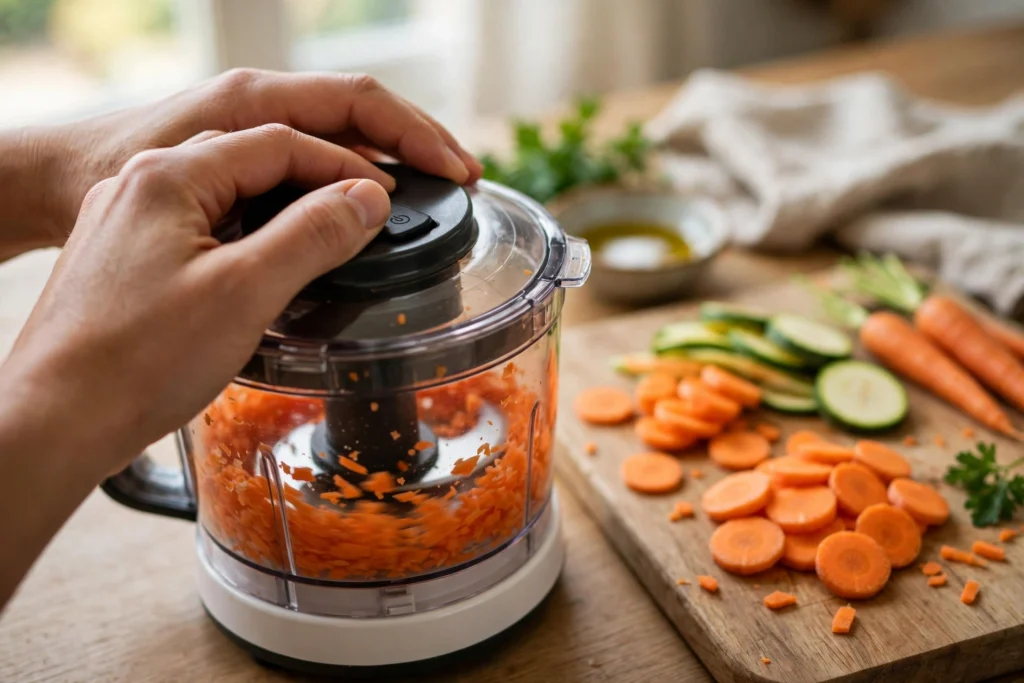
Power is measured in watts, and the number tells you how hard the motor can work without stalling. Soft vegetables and herbs need far less power than firm roots or thick mixtures.
For most small kitchen food processors, a motor in the middle range is enough. Very low power stalls on firm food; very high power often means a bigger, heavier body.
A pulse button is the most useful control on any processor. Short pulses let you stop at a coarse chop instead of ending up with a puree. A machine with only one long on-off switch gives you far less control.
The discs and blades decide what the machine can actually do. A slicing disc and a shredding disc cover most jobs. A dough blade or whisk attachment is useful only if you will use it often; extra discs that never leave the box are just clutter.
Small kitchen food processors with fewer parts are often the better buy. The multi-functional kitchen tools guide explains why one tool doing three jobs well beats three tools doing one badly.
Cleaning and Looking After It
Cleaning is where many small kitchen food processors earn their bad reputation. A machine full of grooves, a fixed blade and a lid full of crevices takes longer to wash than the chopping time it saved you.
Check whether the bowl, lid and blade can go in the dishwasher, and whether the blade lifts out. A removable blade is easier to wash and dry, and drying matters: trapped moisture leads to smells and dull blades.
Wash the parts straight after use. Food left to dry on a blade is much harder to scrub off, and dried food in a lid crevice is a hygiene risk. A quick rinse and warm soapy water is usually enough.
Wipe the motor base with a damp cloth and never put it under the tap. It holds the motor and electrics, so water inside is both a safety risk and a way to ruin the machine.
Storage Ideas for a Small Kitchen
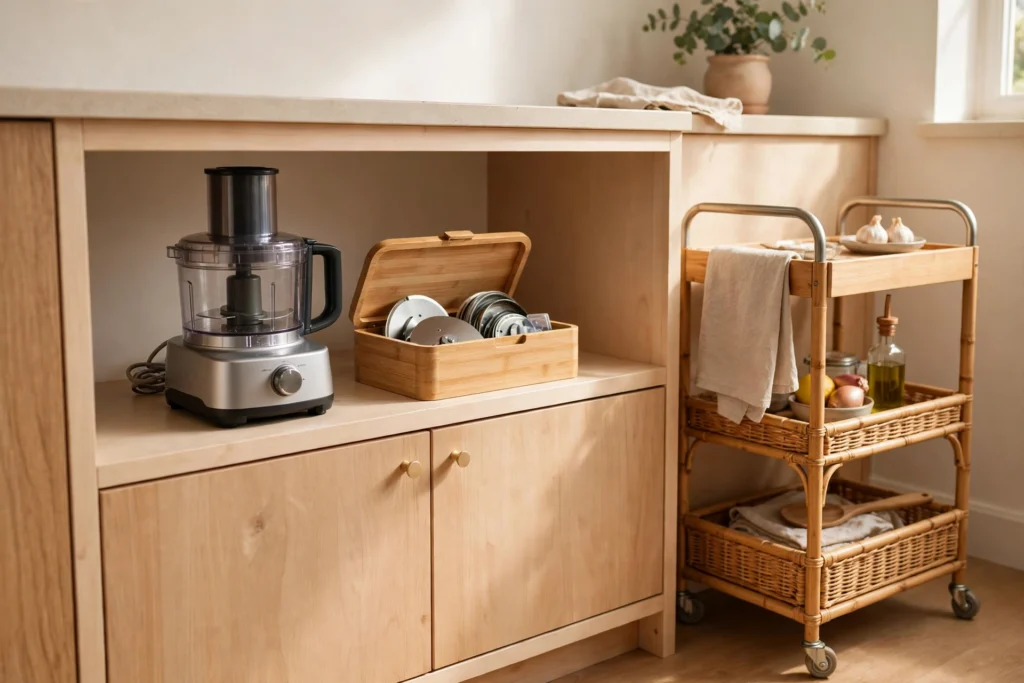
A food processor needs a home within reach but out of the way — one you can reach without moving other things, because a machine that takes five minutes to dig out will stay in the cupboard.
If the bowl and lid fit inside the base or stack on top of it, keep the machine assembled. Taking it apart means reassembling it every time, and that friction puts people off.
Keep the discs and blades in one container, such as a small box or lidded tub, in the same cupboard as the machine. The same logic applies to cookware: the pots, pans and lids guide shows why keeping matching parts together saves time daily.
Once food is chopped or sliced, store it sealed in the fridge and use it soon. The FDA’s advice on storing food safely explains how long prepared food keeps and why cold storage matters.
If you are still deciding which tools deserve your limited space, the small kitchen essentials guide helps you rank them. Small kitchen food processors that earn their shelf are keepers; the rest are better given away.
A Step-by-Step Way to Choose One
Choosing is easier with a clear order. Work through these steps and you will end up with a machine that fits your kitchen and cooking, not a box of regrets.
- Count how many people you cook for most nights, and note your biggest regular job.
- Measure the counter or cupboard space where it will live, including the height.
- Choose the bowl size that fits that cooking — small kitchen food processors come in mini, mid-size and full-size.
- Check the weight and whether you can lift it comfortably with one hand.
- Look at the controls and discs, and keep only the ones you will actually use.
- Check how the parts wash and whether they fit in your dishwasher.
- Compare your shortlist against your measured space, then pick the smallest one that meets your needs.
Before you buy, run the same test you would use for any new tool. The how to choose space-saving kitchen tools guide walks through that check, and the best space-saving kitchen tools guide shows what else competes for the same shelf.
Common Mistakes to Avoid
Buying the biggest machine you can afford. A large processor crowds the counter, and a heavy machine that never leaves the cupboard helps nobody. Buy the size your cooking needs, not the size your budget allows.
Overfilling the bowl. Food packed to the brim cannot move, so the bottom turns to puree while the top stays in chunks. Fill to the marked line and work in batches.
Forcing food down the feed tube. Large pieces jam the tube and strain the motor, and pushing hard with your hand is dangerous. Cut food to fit the tube first, then let the pusher do its job.
Skipping the lid lock. Most processors will not run unless the lid is locked in place; that lock is a safety feature. Forcing the machine to run without it risks a nasty cut and can damage the motor.
Not thinking about noise. A processor is a loud machine, and that matters if you cook early, late, or through thin walls. If quiet matters, check the noise level before you buy and plan your prep for a time that suits the household.
Using the same bowl for raw meat and salad vegetables without washing it in between. Raw meat can leave bacteria on the bowl and blade, and salad vegetables are eaten raw. Wash the bowl, lid and blade with warm soapy water between jobs.
Frequently Asked Questions
Can small kitchen food processors replace a blender?
Partly. A processor handles chopping, slicing and shredding far better than a blender, and it can make sauces and dips. A blender is still better for smooth drinks and thin soups, as its tall jug keeps liquid moving in a vortex. If you make smoothies daily, keep the blender. If not, a processor can cover the rest.
Can I use a food processor to make dough?
Yes, for shortcrust pastry and small amounts of bread dough. Use short pulses and stop as soon as the dough comes together, since overworking it makes pastry tough. A full-size bowl handles a loaf-sized batch; a mini chopper does not have the room. Check your machine’s instructions first — some motors are not built for heavy dough.
Can you put hot food in a food processor?
No, let it cool first. Hot food gives off steam, and that steam can build pressure under the lid and push it loose. Heat can also warp a plastic bowl over time. Let soups and cooked vegetables cool until warm, then process in small batches.
How do I stop fresh herbs turning into a paste?
Use short pulses, not a long run, and check after every two or three. Dry the herbs well first, since wet leaves bruise and clump. Work in small batches so the leaves have room to move, and stop as soon as they look chopped.
Conclusion
Small kitchen food processors work best when chosen for the kitchen you have, not the one you wish you had. Measure your space, match the bowl to the people you cook for, and pick the machine you will actually lift out and use.
Measure your cupboard tonight and note your most common chopping job. That pair of numbers will tell you the bowl size you need, and the rest follows from there.