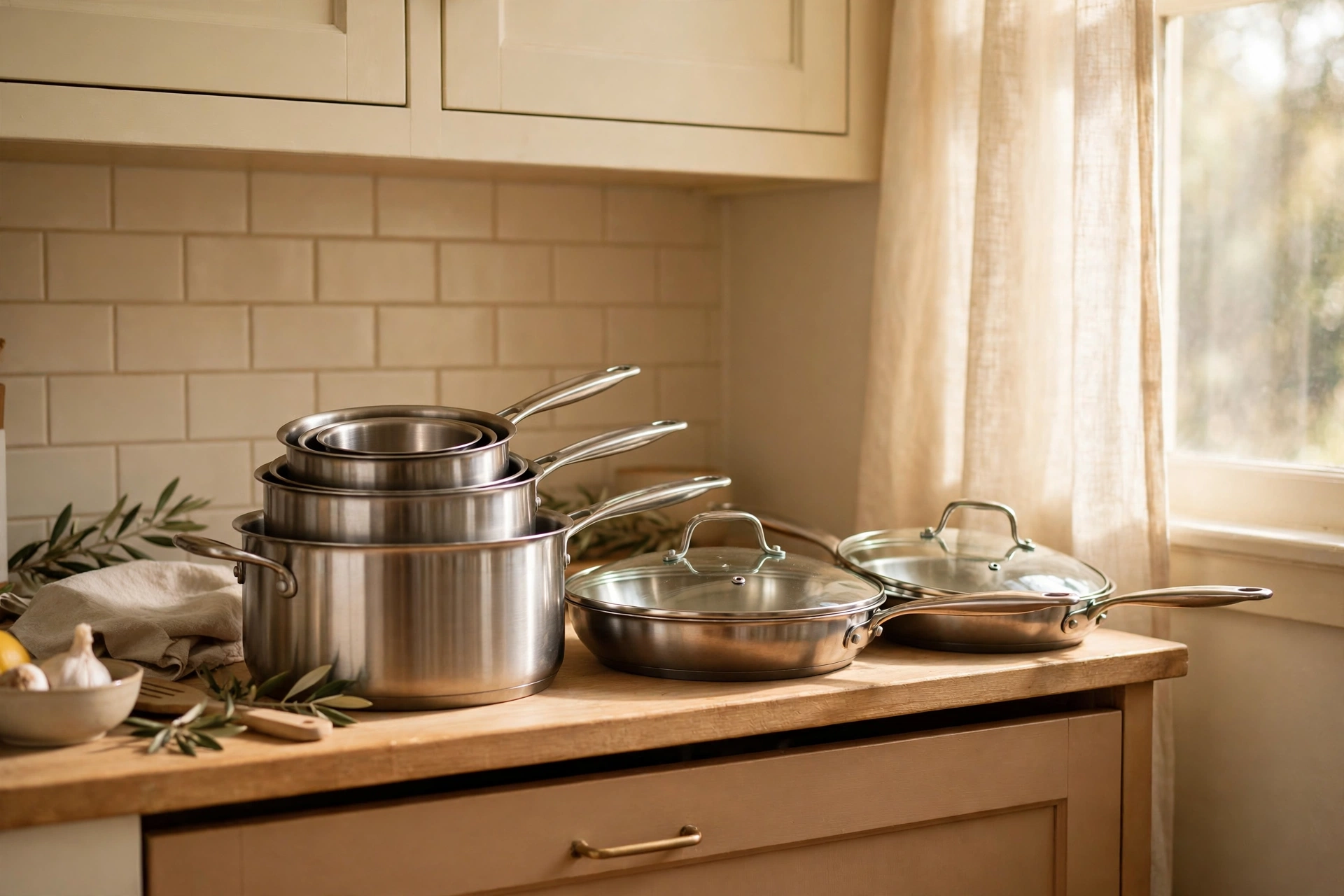
The best space-saving cookware sets fit your cupboard, your hob and the way you cook. A set that stacks neatly and covers your everyday meals beats a bigger one that leaves pans scattered.
This guide explains the types of space-saving cookware sets, how many pieces you need, which materials suit small kitchens, and how to choose a set that stores well — no brand names, no prices, just what to check.
Table of Contents
- What Makes a Cookware Set Space-Saving?
- Space-Saving Cookware Sets: The Main Types
- How Many Pieces Do You Actually Need?
- Materials: What to Weigh Up
- Size, Weight and Hob Compatibility
- Lids and Handles: The Parts That Decide the Footprint
- Cleaning and Looking After the Set
- Storing a Cookware Set in a Small Kitchen
- A Step-by-Step Way to Choose Your Set
- Common Mistakes to Avoid
- Frequently Asked Questions
- Conclusion
What Makes a Cookware Set Space-Saving?
A set saves space when the pieces fit inside each other, share lids or use handles that come off. The real test is the room the whole set takes up when stored, not the size of one pan.
The best space-saving cookware sets also cut the number of pieces you own. Five pans used weekly beat twelve rarely touched, and a set built around your real meals takes less room than a random collection.
Weight and shape matter too: deep, heavy pots need a low, strong shelf, while shallow pans fit in a drawer. The best space-saving kitchen tools guide shows what else competes for the same shelf.
Space-Saving Cookware Sets: The Main Types

Most space-saving cookware sets fall into four groups — the right one depends on your storage and the way you cook.
Nesting sets
Nesting sets are made to stack, each piece a little smaller than the last. A full set can take up little more room than its largest pot, which suits a single low cupboard.
Check the stacked height before you buy: a set that stacks straight lifts out as one unit, while one that wobbles will annoy you daily.
Detachable-handle sets
Detachable-handle sets use one or two handles that clip onto any pan. Without fixed handles, the pans stack tightly and even fit in the oven.
The handle needs a home, usually a drawer, and you add a step each time you cook. Check that the clip feels firm and the handle sits comfortably in your hand when full.
Sets with shared lids
With shared lids, one lid fits two or three pans of the same diameter — three lids instead of six takes up noticeably less room.
Check that each shared lid sits flat on every pan it is meant to fit — a lid that rocks lets steam escape and rattles while food cooks.
Compact sets for one or two people
Compact sets use smaller diameters, often 16 to 20 cm (about 6 to 8 inches), and fewer pieces. They suit small households, small hobs and shallow cupboards.
Their limit is capacity: a small saucepan cannot hold a family-size batch of soup. If you cook for three or more, a compact set will slow you down.
How Many Pieces Do You Actually Need?
When you compare space-saving cookware sets, count the pans alone: a “10-piece set” may include lids and utensils, and only the pan count decides how much room the set needs.
For one or two people, three or four pans cover most meals: a small frying pan, a medium saucepan, a larger pot for pasta or soup, and a lid or two to share — a set that fits one cupboard.
For three or four people, add a larger frying pan and a stockpot, bringing the set to five or six pans. A household that batch-cooks needs the stockpot most — a small pot means cooking the same batch twice.
The small kitchen essentials guide uses the same test for every tool: it earns its space only if you use it often, so check the set list piece by piece.
A deep frying pan that also works as a shallow pot does two jobs in one piece of storage — the multi-functional kitchen tools guide explains why that double duty matters most in a small kitchen.
Materials: What to Weigh Up
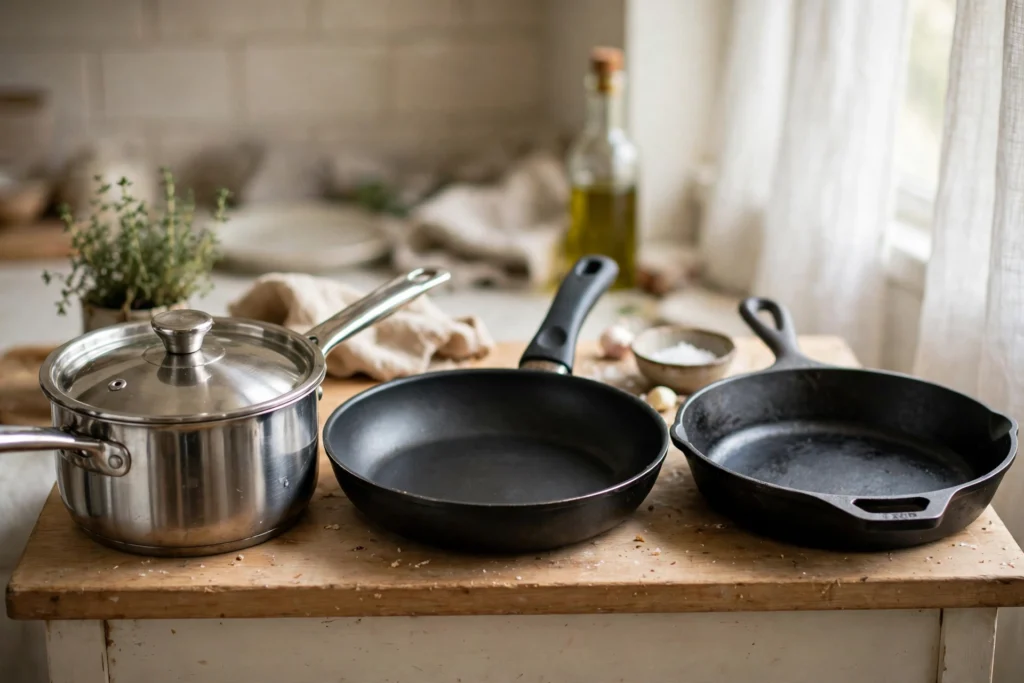
The material of space-saving cookware sets affects weight, care and how the pan cooks. No material wins on every point, so weigh the trade-offs against your own habits.
Stainless steel
Stainless steel is durable, handles high heat well and needs no coating. It suits browning meat and sauces, and lasts for years with basic care.
Food can stick if the pan is cold or dry, so preheat it and add a little oil. A full steel set is heavy, which matters if you lift pans from a high cupboard.
Non-stick
Non-stick pans are easy to cook with and clean — popular for eggs, fish and quick weeknight meals. Food releases without much oil, and washing takes minutes.
They need gentler care than steel: high heat and rough scrubbing wear the coating down, so follow the maker’s instructions.
Cast iron
Cast iron holds heat superbly and goes from hob to oven without a second thought. It suits slow cooking and searing, and a single pan can last a lifetime.
In a small kitchen, the weight is the real cost: a cast iron set is heavy to lift, needs a low sturdy shelf, and must be dried fully after washing.
Hard-anodised aluminium
Hard-anodised aluminium is light, heats evenly and usually carries a non-stick coating — easy cleaning in a pan far lighter than steel or cast iron.
Check the care instructions first: some pieces are not dishwasher-safe, and the coating still needs gentle treatment.
Size, Weight and Hob Compatibility
Space-saving cookware sets work best when they match your hob as well as your cupboard: measure the rings and compare them with the base diameter of the pans, since a pan wider than the burner wastes heat.
Aim for a base that sits neatly on the ring you will use most, and check the largest pan, not just the smallest — a pan that overhangs the hob can be unstable.
Measure your storage too: the depth of your cupboard or drawer, the shelf height, and the longest handle — the small kitchen cabinet organization guide shows how to map a cabinet first.
Test the weight in person when you can: lift a pan with one hand as you would when it is full. Heavy sets belong low, between knee and shoulder height.
Hob type matters too: gas, electric and induction hobs need different bases, and induction needs a magnetic base to heat at all. If your hob is induction, check the base is magnetic and flat first.
Lids and Handles: The Parts That Decide the Footprint
In space-saving cookware sets, lids decide how much room the set takes: a lid for every pan means twice as many flat discs, while shared lids cut that number in half.
Glass lids let you watch food without lifting the lid and losing heat, but they are heavier and can chip if dropped. Metal lids are lighter and stack flat, though they hide the food, so you lift them to check.
Handles decide the footprint too: long fixed handles need deep storage and can stop a drawer closing, while short or detachable handles let pans stack closer. Check handles feel secure, with no wobble where they meet the pan.
Once the set is home, the lids still need their own place — the how to organize pots, pans, and lids guide shows how to give them one.
Cleaning and Looking After the Set
Space-saving cookware sets last longer when the care routine fits your life: check the instructions before you buy, since some sets are dishwasher-safe and others need hand washing.
Wash the pans soon after cooking: food left to dry is much harder to remove, and dried food around a lid rim or handle joint is a hygiene risk. Warm soapy water is usually enough.
Dry each piece fully before you stack it away: trapped moisture between nested pans leads to smells and marks, so stand pans upside down on a rack for a few minutes. Stack the set in the order it was designed for, largest at the bottom, so the pieces sit steady.
Storing a Cookware Set in a Small Kitchen
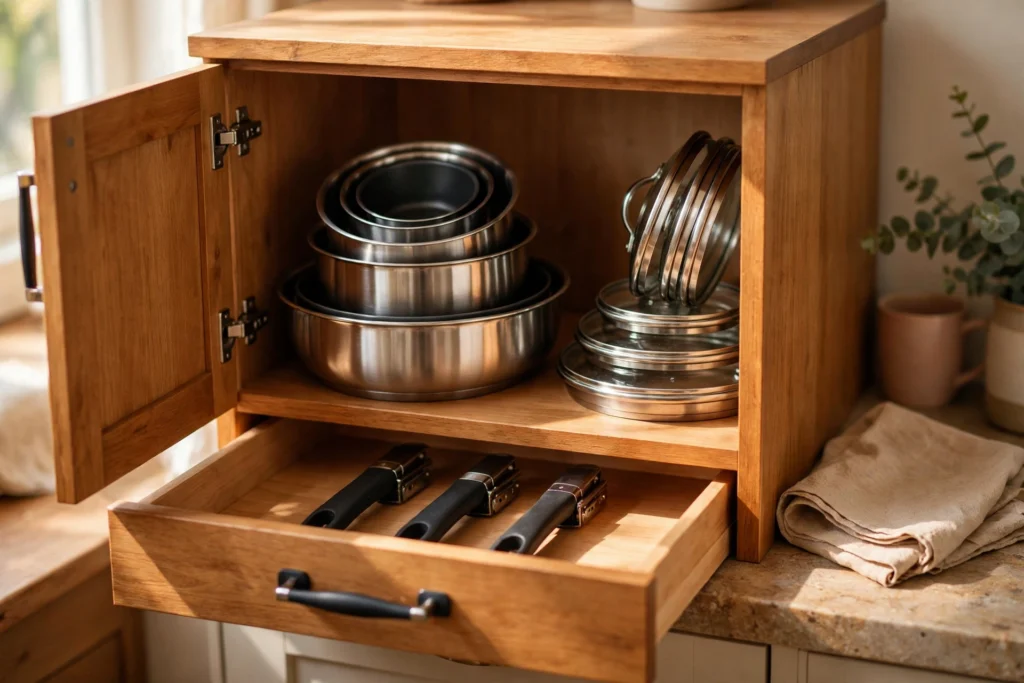
Space-saving cookware sets and food processors are often the two bulkiest things in a small kitchen, so they deserve the easiest cupboard. The best small kitchen food processors guide shows how to store the machine; the set belongs in the low cupboard or drawer nearest the cooker.
Give the set a zone, not just a shelf: the how to organize kitchen cabinets by zone guide shows how to group cooking tools near the hob, so set, lids and handles live within one reach. Keep detachable handles in the same drawer or cupboard as the pans.
Once you have cooked, move leftovers out of the pan into a sealed container — a pan takes up far more fridge room, and the best stackable kitchen storage containers guide shows ones that fit a small fridge.
The FDA’s advice on storing food safely explains how long cooked food keeps in the fridge and why it should cool in a shallow container.
A Step-by-Step Way to Choose Your Set
Choosing space-saving cookware sets is easier with a clear order — work through these steps and you will end up with a set that fits your kitchen and your cooking.
- List the meals you cook most weeks and the pans each one needs.
- Measure your hob rings, your cupboard or drawer, and the shelf height.
- Choose the set type that fits that space: nesting, detachable handles or shared lids.
- Pick the piece count that matches your household, with each piece doing a different job.
- Choose a material you will look after, not just one that looks good.
- Check the lids, handles and weight by lifting a pan as if it were full.
- Compare your shortlist against your measurements, then pick the smallest set that covers your meals.
Before you buy, run the same test you would use for any new tool: the how to choose space-saving kitchen tools guide walks through that check and catches the impulse buys a small kitchen cannot afford.
Common Mistakes to Avoid
Buying the biggest set on offer — a large set crowds the cupboard, and the pieces at the back never get used.
Choosing by looks alone — a good-looking set with a wobbling handle or a lid that rocks is a daily annoyance.
Stacking pans without protection — nesting bare pans scratches non-stick coatings and marks steel. Slip a cloth or paper towel between pieces when you stack them.
Putting a hot pan under cold water — a hot pan plunged into cold water can warp, and a warped base will not sit flat on the hob. Let pans cool before washing them.
Buying a set for a household you do not have — a set built for a family of five is wasted on a household of one.
Letting the set scatter across cupboards — pieces stored in three places get forgotten, and a lid in another cupboard is one you will not fetch.
Frequently Asked Questions
Can I mix pieces from different sets?
Yes — a mixed set can fit a small kitchen better than a boxed one. Measure the diameters so the pans nest, and check that lids fit across the pieces you pair. Try the stack first, since mixed pieces rarely nest as neatly as a designed set.
Should I buy a set or buy pieces one at a time?
A set usually costs less per piece and matches in material and looks, which suits a cook starting from scratch. Buying one piece at a time suits a cook who already owns most of what they need and knows exactly which gaps to fill.
How long should a cookware set last?
Years, with care, depending on the material and how hard it is used. Replace a piece when its handle loosens, its base warps, or its coating peels badly. Replace single pieces as they wear out, not the whole set.
Can I use metal utensils on a non-stick set?
It is best avoided: metal can scratch the coating and shorten the life of the pan. Use wooden or silicone utensils instead, which are gentler on the surface.
Conclusion
Space-saving cookware sets work best when chosen for the kitchen you have, not the one you wish you had. Match the set type to your storage, the piece count to the people you cook for, and the material to the care you will give it.
Measure your cupboard tonight and list the meals you cook most weeks — those two notes will tell you the set size you need, and the rest follows.