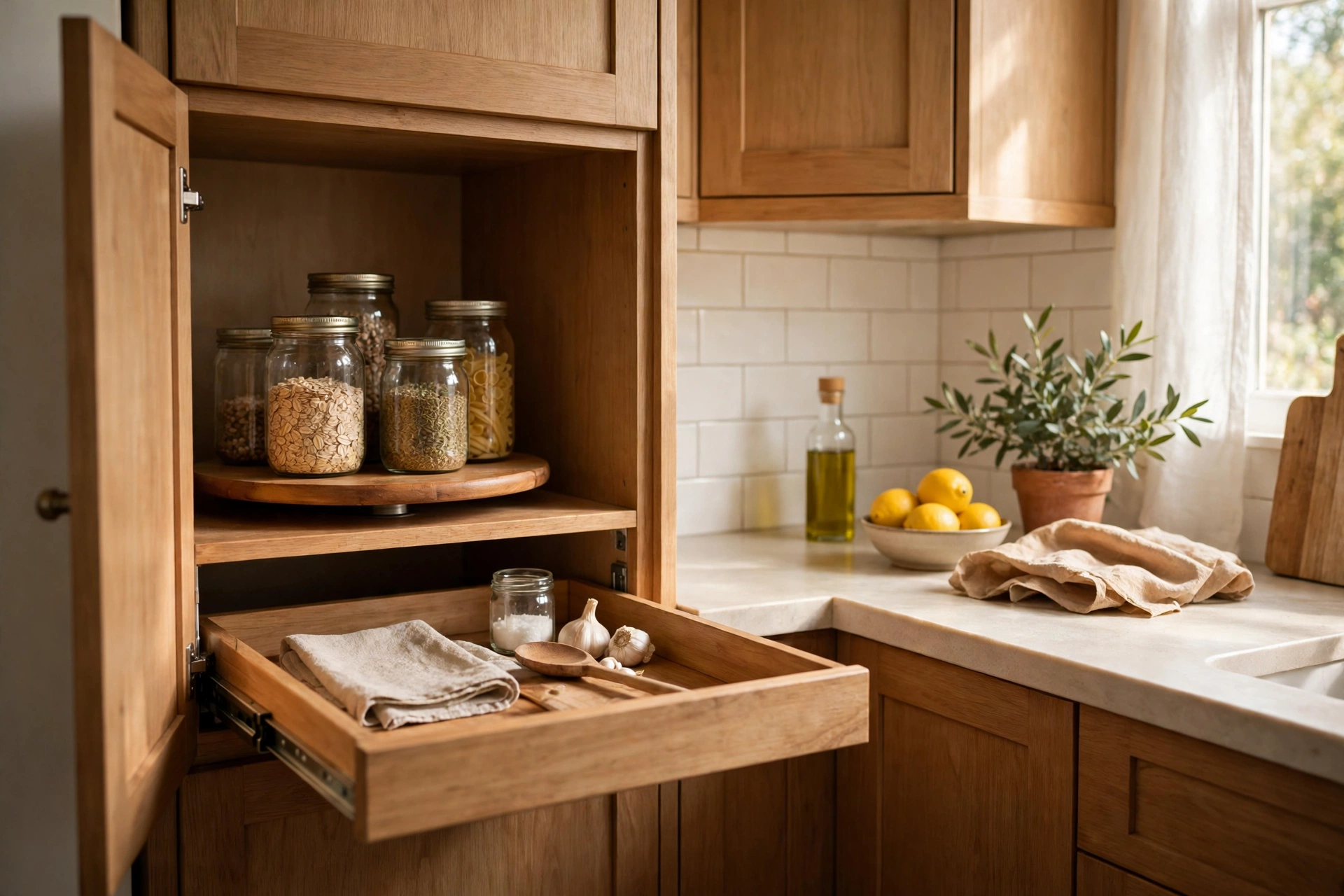
Corner cabinets are the hardest cupboards in a small kitchen to use well. The space at the back is deep and dark, things slide out of reach, and the door opening is often too narrow for the cabinet behind it — which is why corner cabinet organization matters.
The good news is that a corner cabinet can become one of the most useful spots in your kitchen. You do not need to rebuild it — you need to know what kind of corner you have, measure it, and pick a solution that brings the back forward.
Table of Contents
- Why Corner Cabinets Are So Hard to Use
- What Kind of Corner Cabinet Do You Have?
- Step 1: Measure Your Corner Cabinet First
- Step 2: Empty It and Decide What Belongs There
- Step 3: Pick the Right Corner Cabinet Organization Solution
- What to Store in a Corner Cabinet (and What to Keep Out)
- Corner Cabinet Organization for Renters
- Keeping It Organized Week After Week
- Common Mistakes to Avoid
- Frequently Asked Questions
- Conclusion
Why Corner Cabinets Are So Hard to Use
A corner cabinet is not like a normal cupboard. The door sits on one side, but the cabinet stretches away, so the deepest part is the hardest to reach.
You end up kneeling on the floor, reaching past the front row for a pan or a jar you know is in there somewhere. That is why corner cabinet organization starts with the reach problem, not with buying organizers.
The second problem is the shape. A corner cabinet is wider than its opening, so a large roasting tin fits inside but will not pass through the door without tilting it and moving the front row first.
What Kind of Corner Cabinet Do You Have?

Before you choose any solution, work out which type of corner cabinet you have. The three common types need different fixes, and a turntable that suits one may be useless in another.
The blind corner cabinet
A blind corner cabinet is the trickiest kind. It has one door on one run of units, and stretches into the corner where you cannot see it at all.
This is the type where things disappear — a jar of sauce two years past its best is a classic blind-corner find. Blind corners need a solution that pulls the back out to you.
The L-shaped corner cabinet
An L-shaped corner cabinet has doors on both runs, or one wide door that opens onto the L. You can see more than with a blind corner, but the middle of the L is still awkward — a turntable fits well here, as do swing-out shelves.
The diagonal corner cabinet
A diagonal corner cabinet sits across the corner at a 45-degree angle, with a single door facing into the room. It is the easiest type to use, because the door faces you and the space is shallow, though the sides still waste space.
Step 1: Measure Your Corner Cabinet First
Good corner cabinet organization starts with a tape measure, not a shopping trip. A fitting a centimetre too wide will not go in, and one too small will waste the space you are trying to save.
Open the door fully and measure the opening: width, height, and depth from the front edge to the back wall. Write the numbers down, and measure twice.
Next, measure the inside: the width across the back wall, the depth of each side, and anything that eats into the space, such as a hinge or a pipe. Note whether the shelves move, and how much clear height each one has.
Finally, check the door itself. Does it open flat, or stop at 90 degrees? A door that cannot open fully will block a pull-out shelf, so the door swing matters as much as the inside measurements.
Step 2: Empty It and Decide What Belongs There
Now empty the whole cabinet. Take everything out, wipe the shelves, and look at what you actually own — a corner cabinet that has never been emptied is usually holding duplicates, broken lids, and items you stopped using years ago.
Sort what comes out into three piles: use every week, use sometimes, and hardly ever. Be honest with the third pile — if you have not used something in a year, it does not earn a place in the hardest cabinet in your kitchen.
If you need help with the clear-out decisions, How to Declutter a Small Kitchen: A Step-by-Step Guide walks through the same process for the whole kitchen, one cupboard at a time.
Once you know what is staying, count it: the pans, the jars, the tins, and the small appliances. That count tells you how much space the solution needs, and stops you buying a fitting that is too small.
Step 3: Pick the Right Corner Cabinet Organization Solution
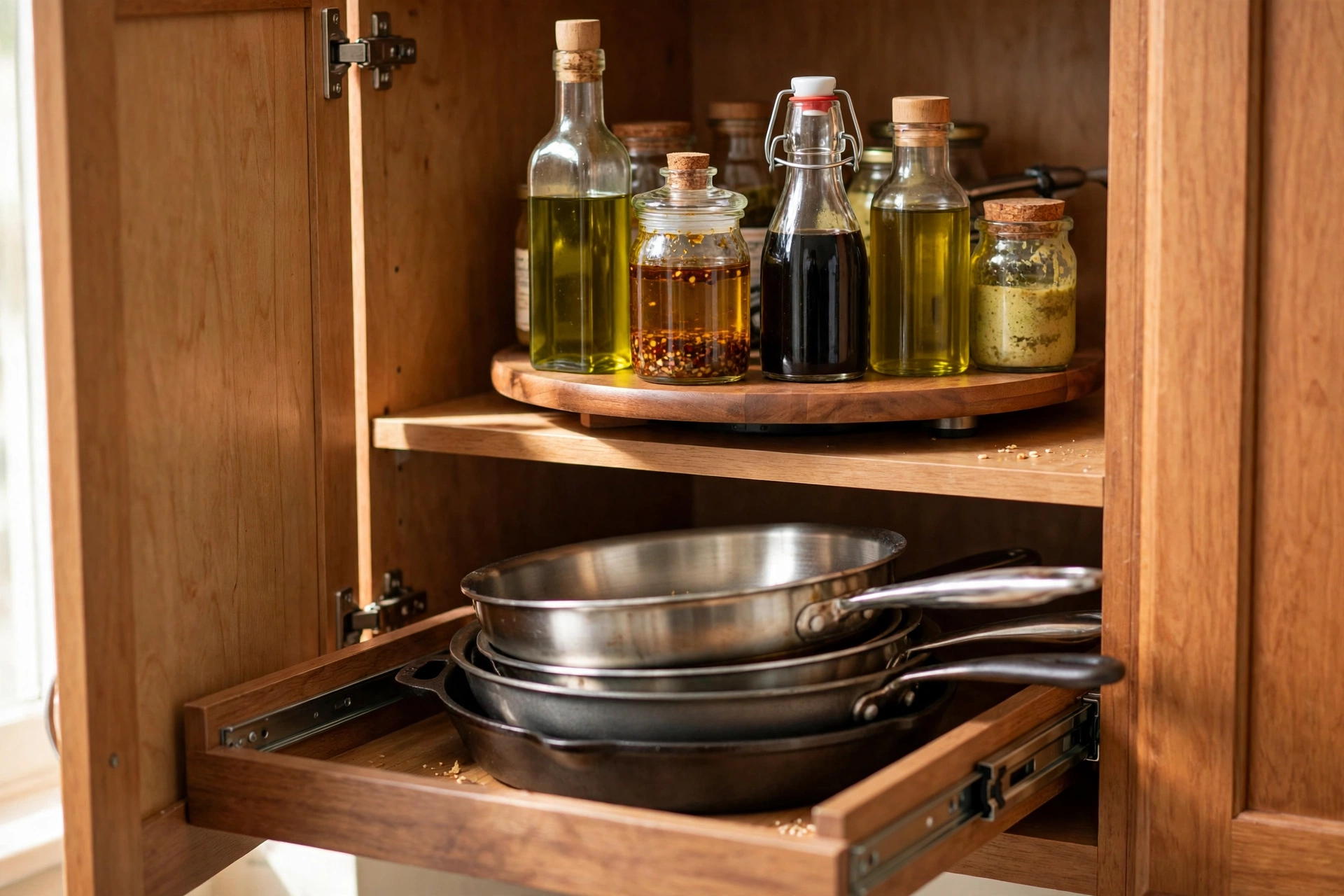
There is no single best fix for a corner cabinet. The right choice depends on your cabinet type, your measurements, and what you plan to store.
The turntable, or lazy Susan
A turntable is the simplest fix for corner cabinet organization, and often the best. You spin it, and the back row comes to the front. It suits jars, oils, sauces, and small tins — anything that stands upright and does not tip over as it turns.
Choose one with a low edge or a rim, so jars do not slide off as it turns. Measure the diameter against the opening, because a turntable that cannot pass through the door is no use.
A full round turntable suits an L-shaped or diagonal corner. For a blind corner, a half-round or D-shaped one fits the cabinet shape better and slides out further.
Pull-out shelves
Pull-out shelves are the best corner cabinet organization fix for a blind corner. They slide out towards you on runners, so you can see everything without reaching into the dark. One or two can turn a blind corner into an ordinary cupboard.
Measure carefully before you order: the shelf must pass through the door opening, clear the hinges, and the runners need a flat surface to fix to. If you are not comfortable fitting runners yourself, ask a joiner or a handyperson.
Keep the shelves shallow enough that they slide out fully — a shelf that only comes halfway out is barely better than a fixed one.
Swing-out shelves
Swing-out shelves are shaped shelves that pivot out of the cabinet when you open the door. Made for blind corners, they bring the contents right out into the room where you can see them. They cost more than a turntable and need more care to fit, so check the weight limit first and keep heavy items low.
Corner drawers
Some kitchens have corner drawers instead of a corner cabinet — drawers shaped to fit the corner, usually in a diagonal or stepped layout. Treat each one like any other drawer: one job, and dividers to stop things sliding. See How to Organize Kitchen Drawers in a Small Kitchen and Drawer Organizers and Dividers for Small Kitchen Tools.
Simple sliding bins
If you do not want to fit anything permanent, sliding bins are the cheapest fix. Put one or two labelled bins inside the cabinet and slide them out like drawers to reach the back.
Choose bins with handles or a lip you can grip, and keep them light enough to lift out with one hand. Clear bins work best, because you can see inside without pulling them all the way out.
For more storage ideas that fit small kitchens, see Small Kitchen Storage Racks and Organizers Worth Considering.
What to Store in a Corner Cabinet (and What to Keep Out)

Give the corner to weekly items, not daily ones. For corner cabinet organization, good choices are large pots, roasting tins, baking trays, weekend appliances, and bulky items such as a food processor.
Keep heavy items on the lowest shelf, where you can lift them out safely. A heavy pot stored up high is hard to lift out and easy to drop, so plan the shelf heights around the heaviest item first.
If you store pans in the corner, keep the lids with them — for the full detail, see How to Organize Pots, Pans, and Lids in a Small Kitchen.
Keep daily items out. Plates, mugs, everyday pans, and the spices you reach for each night belong in a cabinet you can see into easily. For the wider plan, see Small Kitchen Cabinet Organization: Practical Ideas for a Clutter-Free Space.
Corner Cabinet Organization for Renters
Renters can fix a corner cabinet without changing the kitchen itself: use solutions that sit inside the cabinet and come out again when you move.
A turntable, sliding bins, and a small battery light are all renter-friendly, because none of them need screws or drilling. A turntable just sits on the shelf, and bins slide in and out.
Avoid pull-out shelves and swing-out shelves in a rental unless your landlord has agreed in writing, because they need runners screwed into the cabinet — the same goes for moving fixed shelves.
When you move out, take your turntable and bins with you. They will fit the next kitchen’s corner just as well, and you will not have spent money on something you had to leave behind.
For more no-drill ideas across the whole kitchen, see Small Kitchen Organization for Renters: No-Drill Storage Ideas.
Keeping It Organized Week After Week
Corner cabinet organization only lasts when the system is easy to keep up. If putting something back means kneeling down and reaching into the dark, it will not happen, and the cabinet will slide back into a jumble.
Make the right place the easy place. Keep the most-used item in each group at the front of its turntable or bin, and the least-used at the back. Leave a little empty space on every shelf.
Common Mistakes to Avoid
Most corner cabinet organization goes wrong in the same few ways. Avoid these and your system will last much longer.
Storing daily items in the corner. Anything you use every day belongs in a cabinet you can reach easily. Daily items in a corner end up on the counter, and the corner fills with things you never use.
Buying a fitting before measuring. A turntable or pull-out shelf too wide for the door opening is a waste of money. Measure the opening, the inside, and the door swing first.
Filling the cabinet to the front. A corner cabinet with no empty space has nowhere for new things to go. Leave room on each shelf, and the layout will hold.
Stacking pans without a plan. A stack of pans in a corner means lifting the whole pile to reach the one at the bottom. Store pans upright with a divider, or keep only one small stack in the corner.
Forgetting the light. A dark corner hides clutter and makes you avoid the cabinet. A small battery light on the inside roof costs little and makes the whole cabinet easier to use.
Frequently Asked Questions
What is the best way to organize a blind corner cabinet?
Use a corner cabinet organization solution that brings the back to you: pull-out shelves or swing-out shelves work best, because they slide or pivot the contents out where you can see them. A half-round turntable or sliding bins cost less and still help.
Should I put a lazy Susan in my corner cabinet?
A turntable suits most corner cabinets, especially for jars, oils, and sauces. It works best in L-shaped and diagonal corners, and a half-round one suits a blind corner better than a full round one.
What should I store in a corner cabinet?
Store things you use weekly rather than daily: large pots, roasting tins, baking trays, and weekend appliances. Keep heavy items on the lowest shelf, and daily items in a cabinet you can see into easily.
How do I organize a corner cabinet without spending much?
For simple corner cabinet organization, start with sliding bins and a turntable, both of which sit inside the cabinet without any fitting. Empty the cabinet first, keep only what you use, and label the bins.
Conclusion
Corner cabinet organization comes down to four steps: work out what kind of corner you have, measure it, empty it and decide what belongs there, and pick a solution that brings the back to the front.
Start with the cabinet that frustrates you most. Measure the opening, choose one fix — a turntable, a pull-out shelf, or sliding bins — and put everything back with a clear home for each item.
For your next step, read How to Organize a Small Kitchen with Limited Cabinet Space. It covers the rest of your cabinets, and the corner makes more sense once the whole kitchen has a plan. For the wider picture, see 25 Smart Small Kitchen Organization Ideas That Make Every Inch Count.