
Breakfast is the meal most often skipped, because the morning is the busiest part of the day. Breakfast meal prep fixes that by moving the work to a quieter moment: a short session on Sunday evening, or ten minutes the night before, so the morning is just grab, heat, and eat.
In a small kitchen, the best breakfasts to prep need one pot or one tray, fit in a small fridge or freezer, and still taste good three or four days later. This guide shows you which breakfasts to prep, how to store them, and how to fit the whole thing into thirty minutes.
Table of Contents
- What Breakfast Meal Prep Really Is — and What It Is Not
- Why Mornings Are the Hardest Meal to Cook Fresh
- What Makes a Breakfast Prep-Friendly
- A Breakfast Prep Session, Step by Step
- Breakfast Meal Prep Ideas That Work
- What to Prep the Night Before, and What to Prep for the Week
- Storing Breakfasts: Fridge and Freezer
- Grab-and-Go Mornings: Breakfasts That Travel
- Hot Breakfasts Without Cooking in the Morning
- Common Mistakes to Avoid
- Frequently Asked Questions
- Conclusion
What Breakfast Meal Prep Really Is — and What It Is Not
Breakfast meal prep means getting several mornings of breakfast ready in one short session, so each morning takes two minutes instead of twenty. The usual pattern is two or three breakfast types, prepped in small batches, rotated across the week.
That is different from general meal prep, which focuses on lunch and dinner, and from a timed cooking session, where several dishes are cooked at once. Breakfast prep is smaller and simpler: one tray of egg muffins, a few jars of overnight oats, and a pot of fruit compote can cover a whole working week for one or two people.
Why Mornings Are the Hardest Meal to Cook Fresh
Mornings are short, and in a small kitchen they are crowded: breakfast, coffee, a bag to pack, and a door to leave through. Cooking from scratch needs a clean pan, a clear counter, and time to wash up — three things a weekday morning rarely offers.
That is why breakfast benefits most from prep. A breakfast already in a container needs no decisions, no cooking, and almost no washing up.
The morning becomes a two-minute job: take the jar from the fridge, add fruit or nuts, and eat.
What Makes a Breakfast Prep-Friendly
Not every breakfast survives being made ahead. A prep-friendly breakfast has three qualities.
First, it keeps: it still tastes good after three or four days in the fridge, or a few weeks in the freezer.
Second, it travels: it can be eaten at the table, at a desk, or on a train without falling apart.
Third, it is filling: it has protein, grain, or fruit — not just sugar — so it keeps you full until lunch.
Breakfasts that pass these tests are built around oats, eggs, yoghurt, bread, or fruit. Breakfasts that fail them are the ones that depend on being fresh from the pan: a fried egg goes rubbery, toast goes soft, and a smoothie separates in the fridge.
A Breakfast Prep Session, Step by Step
A breakfast prep session is one short session, usually on a Sunday evening, and takes about thirty minutes for three or four days of breakfasts.
First, choose two or three breakfasts for the week — one cold, one hot, and one grab-and-go, so the mornings do not all feel the same. Check what you already have before you shop.
Second, set up one workstation: a board, a knife, a bowl, and your jars and containers. Start with the longest, hands-off job — the tray of egg muffins or baked oats in the oven.
Third, while the tray bakes, build the cold breakfasts: overnight oats into jars, yoghurt and fruit into pots, and smoothie ingredients into freezer bags.
Fourth, cool the tray, portion it into single containers, and label each one. Fifth, put the fridge breakfasts on the middle shelf, the freezer ones in their spot, and wash up.
For a timed version of a one-hour session, see One-Hour Meal Prep Plan for Busy Weekdays.
Breakfast Meal Prep Ideas That Work
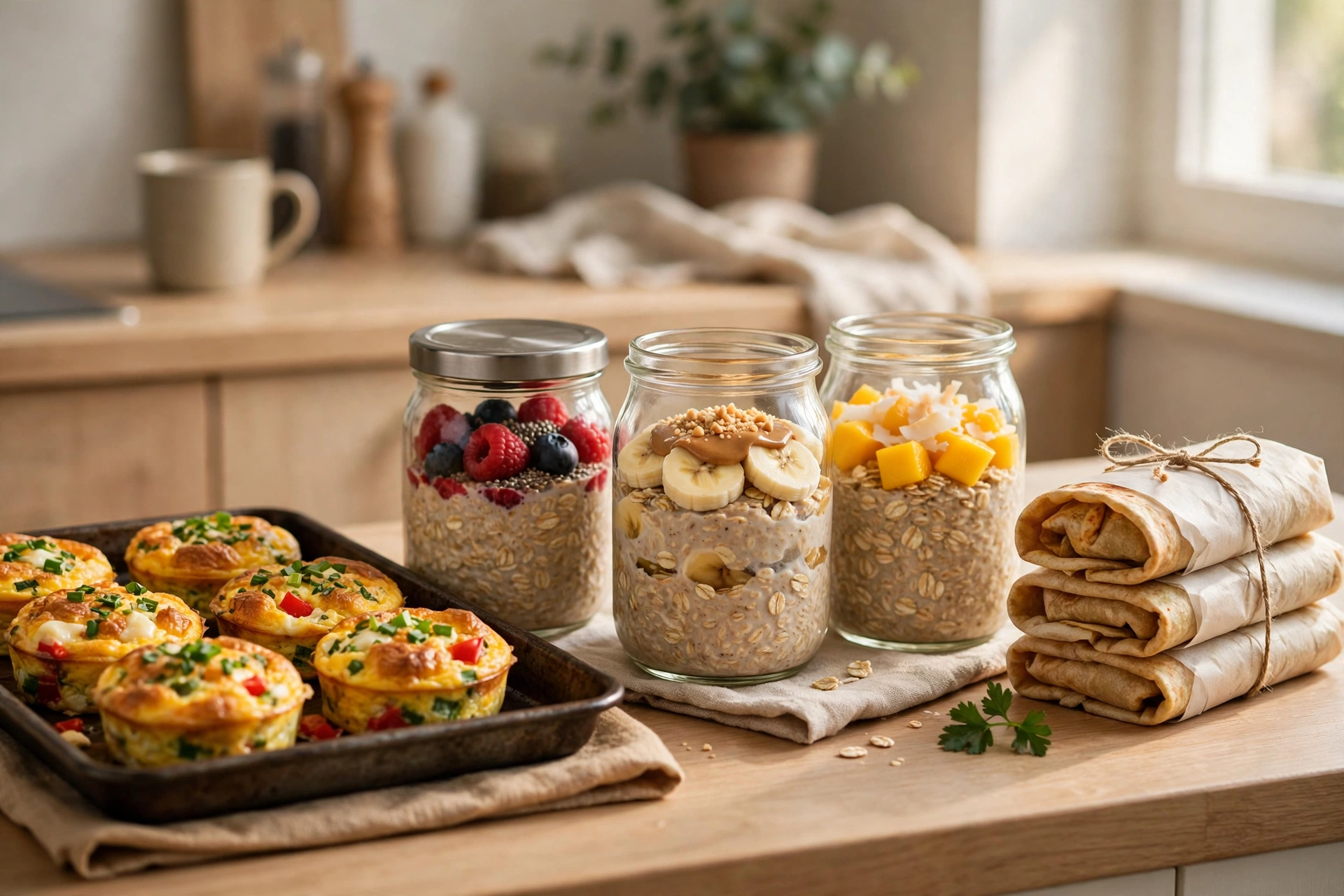
Overnight oats and chia puddings
Overnight oats are the simplest make-ahead breakfast: rolled oats soaked in milk or yoghurt overnight, ready to eat cold in the morning.
The base is always the same — about 40 to 50 g (roughly half a cup) of oats with about 120 ml (half a cup) of milk or yoghurt — and the toppings change: banana and peanut butter, berries and honey, or apple and cinnamon.
Make two or three jars at once, and add crunchy toppings in the morning so they stay crunchy. Chia puddings work the same way: chia seeds stirred into milk, left overnight, and topped with fruit.
Egg muffins and frittata squares
Egg muffins are eggs baked in a muffin tray with vegetables and cheese — a hot breakfast that reheats in a minute.
Whisk six to eight eggs with chopped peppers, spinach, and grated cheese, and bake in a greased muffin tray for fifteen to twenty minutes. A frittata square is the same idea in a baking dish, cut into portions.
Breakfast burritos and wraps
A breakfast burrito is scrambled egg, beans, cheese, and salsa wrapped in a flatbread, eaten with one hand.
Make a batch on Sunday, wrap each one in greaseproof paper, and keep them in the fridge for the first few days or the freezer for later in the week. Reheat in a pan or microwave, and add fresh salsa at eating time so the wrap does not go soggy.
Baked oats and breakfast muffins
Baked oats are oats, milk, egg, and fruit baked in a dish and cut into squares — a warm breakfast that keeps for several days.
Breakfast muffins, made with oats, banana, and nuts, work the same way: bake a batch of six or eight, keep them in a sealed container, and grab one on the way out.
Yoghurt and fruit pots
A yoghurt pot takes two minutes: plain yoghurt, berries or sliced fruit, and oats or granola in a small container.
Prep the dry parts — oats, nuts, and seeds — ahead of time, and add the yoghurt and fruit the night before, so the oats stay crunchy.
Smoothie packs
A smoothie separates in the fridge, so prep it as a pack instead: portion fruit, spinach, and oats into freezer bags, one bag per smoothie.
In the morning, tip one bag into a blender with milk or yoghurt and blend for a minute.
What to Prep the Night Before, and What to Prep for the Week
Split breakfast prep into two timeframes, and the food stays fresh.
Prep for the week: overnight oats, egg muffins, baked oats, breakfast muffins, and smoothie packs. These keep for three or four days in the fridge, or longer in the freezer.
Prep the night before: yoghurt pots, wraps and burritos for tomorrow, cut fruit, and anything with soft fruit. These are best eaten within a day or two, and a ten-minute evening session keeps them fresh.
Prep in the morning, in two minutes: toast, coffee, a boiled egg, and the toppings — nuts, seeds, honey, and fresh fruit. These small fresh jobs are what make a prepped breakfast feel like a real breakfast.
For the ingredient-by-ingredient freshness rules, see How to Keep Meal Prep Ingredients Fresh Throughout the Week.
Storing Breakfasts: Fridge and Freezer
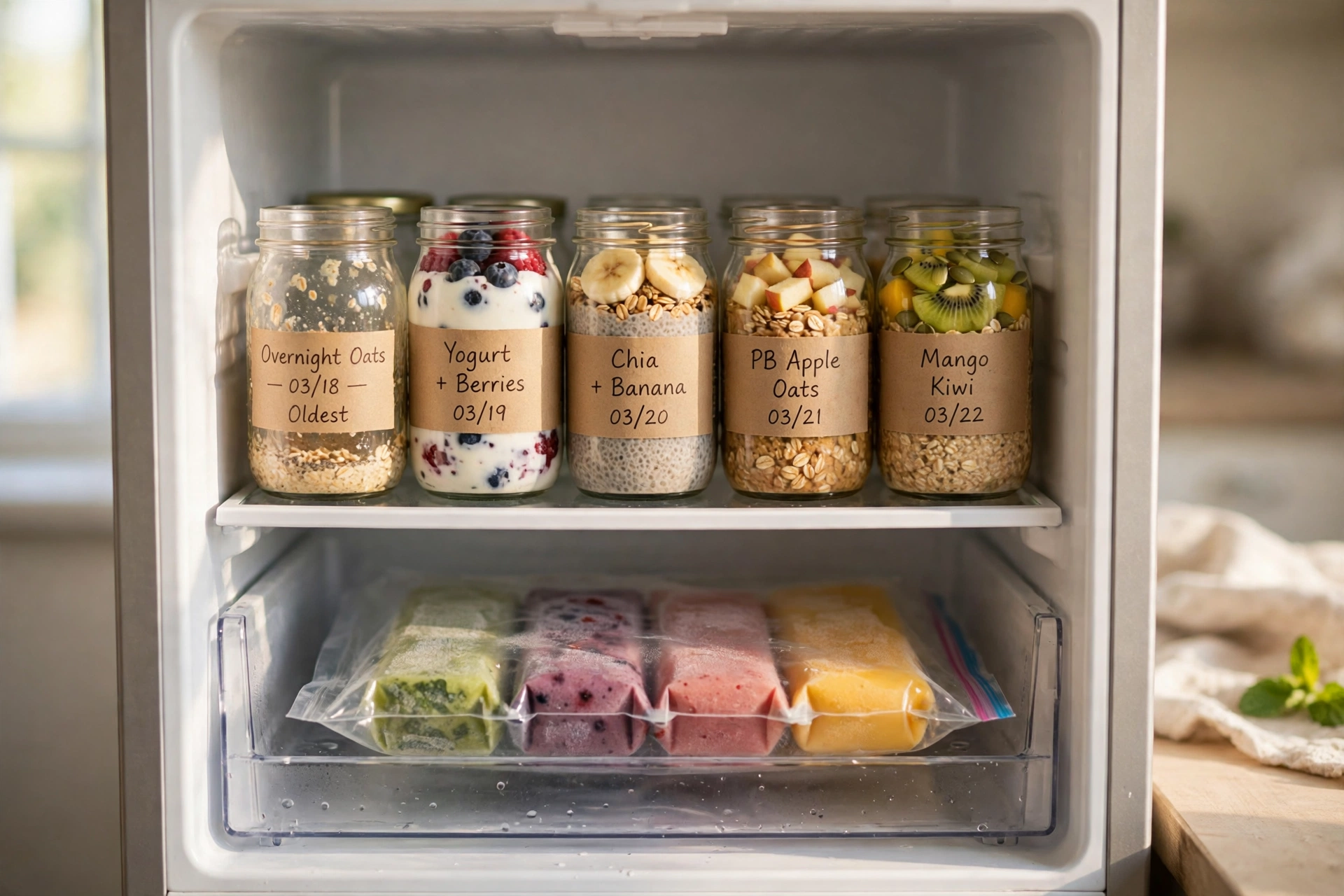
Breakfasts are small, so they fit a small fridge easily — but only if they have a fixed place. Keep the week’s breakfast jars and containers together on one shelf, usually the middle shelf, in a row, oldest at the front.
For the fridge system in full, see Small Fridge Organization for Meal Prep.
In the freezer, breakfasts should be flat and single-portion where possible: burritos wrapped flat, egg muffins in a single layer in a bag, and smoothie packs laid flat until solid.
A small freezer usually holds a few breakfast portions alongside the week’s dinners. Label everything with the contents and the date, and use the oldest first.
For the packing method in full, see Freezer Meal Prep for Small Kitchens: Planning and Storage Tips.
Chill cooked breakfasts promptly once they have cooled, eat fridge portions within a few days, and if food looks or smells off, do not eat it. For the container system, see How to Store Meal Prep Containers in a Small Kitchen.
Grab-and-Go Mornings: Breakfasts That Travel
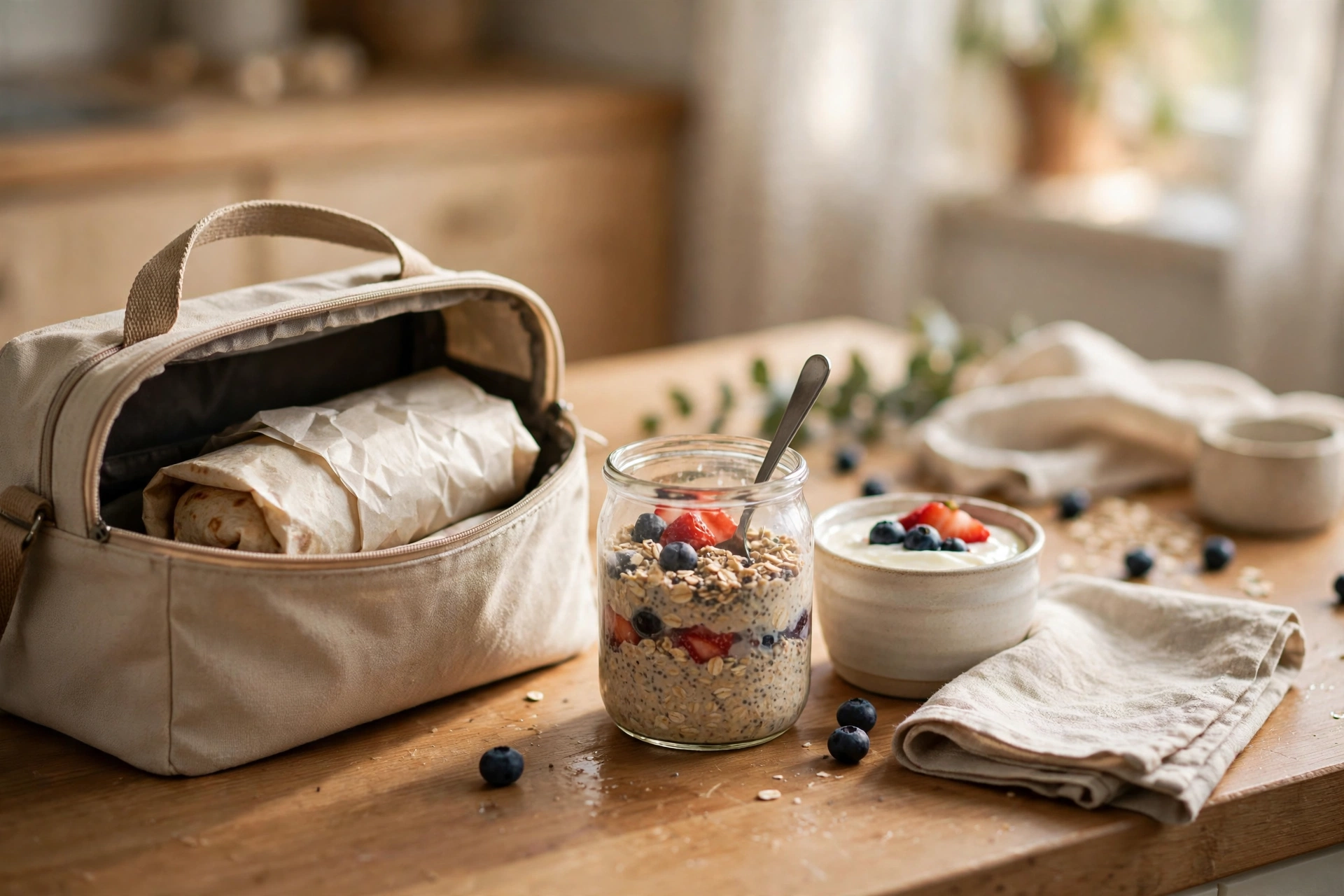
Some mornings do not allow sitting down at all. A grab-and-go breakfast can be eaten with one hand, in a bag, or at a desk, without a plate or a microwave.
The best travellers are breakfast muffins, a wrapped burrito, a jar of overnight oats with a spoon, and a yoghurt pot.
Avoid anything that leaks, needs a bowl, or goes soggy in a bag: a smoothie without a sealed lid, a wrap with wet fillings, or cereal with milk poured in. Pack wet and dry parts separately.
For lunches that travel the same way, see How to Prep a Week of Lunches in a Small Kitchen.
Hot Breakfasts Without Cooking in the Morning
A hot breakfast does not have to mean cooking in the morning. Egg muffins, frittata squares, baked oats, and burritos all reheat in a minute or two — in a microwave in short bursts, or in a small pan on a low heat with a lid on.
Reheat only the portion you will eat, until it is piping hot throughout.
Common Mistakes to Avoid
Prepping a whole week of one breakfast. The same oats five mornings running gets boring by Wednesday. Prep two or three types and rotate them.
Making breakfasts that need to be eaten hot and fresh. A fried egg or toast does not survive the fridge.
Storing crunchy toppings with wet food. Granola, nuts, and seeds go soft in yoghurt overnight. Keep them in a separate small pot and add them in the morning.
Prepping smoothies as finished drinks. A blended smoothie separates in the fridge within hours. Prep smoothie packs in the freezer and blend in the morning.
Forgetting a protein. A breakfast of only fruit or only toast will not keep you full until lunch. Add eggs, yoghurt, nuts, or beans to every breakfast.
Leaving breakfasts unlabelled. A jar without a date gets opened, sniffed, and put back. Label every container with the contents and the day.
Prepping for seven days at once. Most prepped breakfasts are best eaten within a few days. Prep for three or four days, then top up midweek.
For the full list of errors to watch for across all your prep, see Meal Prep Mistakes to Avoid in a Small Kitchen.
Frequently Asked Questions
How many days ahead can I meal prep breakfast?
Most prepped breakfasts — overnight oats, egg muffins, baked oats, and yoghurt pots — are best eaten within three or four days. Burritos and smoothie packs keep longer in the freezer.
What is the easiest breakfast to meal prep?
Overnight oats: oats and milk or yoghurt in a jar, left in the fridge overnight, with toppings added in the morning. It needs no cooking and takes two minutes to make.
Can I meal prep breakfast without a microwave?
Yes. Build the week around breakfasts meant to be eaten cold — overnight oats, yoghurt pots, and muffins — and save the hot ones, like egg muffins, for mornings at home with a pan.
How do I keep overnight oats from going soggy?
Use rolled oats, not instant, and keep the liquid to about half a cup per half cup of oats. Add crunchy toppings in the morning, not the night before.
Is meal prepping breakfast cheaper than buying it?
Usually, yes. A jar of oats, an egg muffin, or a homemade burrito costs far less than the same breakfast bought on the way to work, and the ingredients — oats, eggs, and fruit — are among the cheapest in the shop.
Conclusion
Breakfast meal prep ideas come down to three habits: choose breakfasts that keep and travel well, prep two or three types in one short session, and split the work — sturdy food for the week, fresh parts the night before. Overnight oats, egg muffins, and burritos cover most mornings, and one small fridge shelf holds them all.
Start this week with one short session: three jars of overnight oats and a tray of egg muffins. For the wider system, read Easy Meal Prep Ideas for Small Kitchens, and for breakfasts that need no cooking at all, see Simple No-Cook Meal Prep Ideas for Busy Days.
3 thoughts on “How to Meal Prep Breakfasts Ahead of Time”