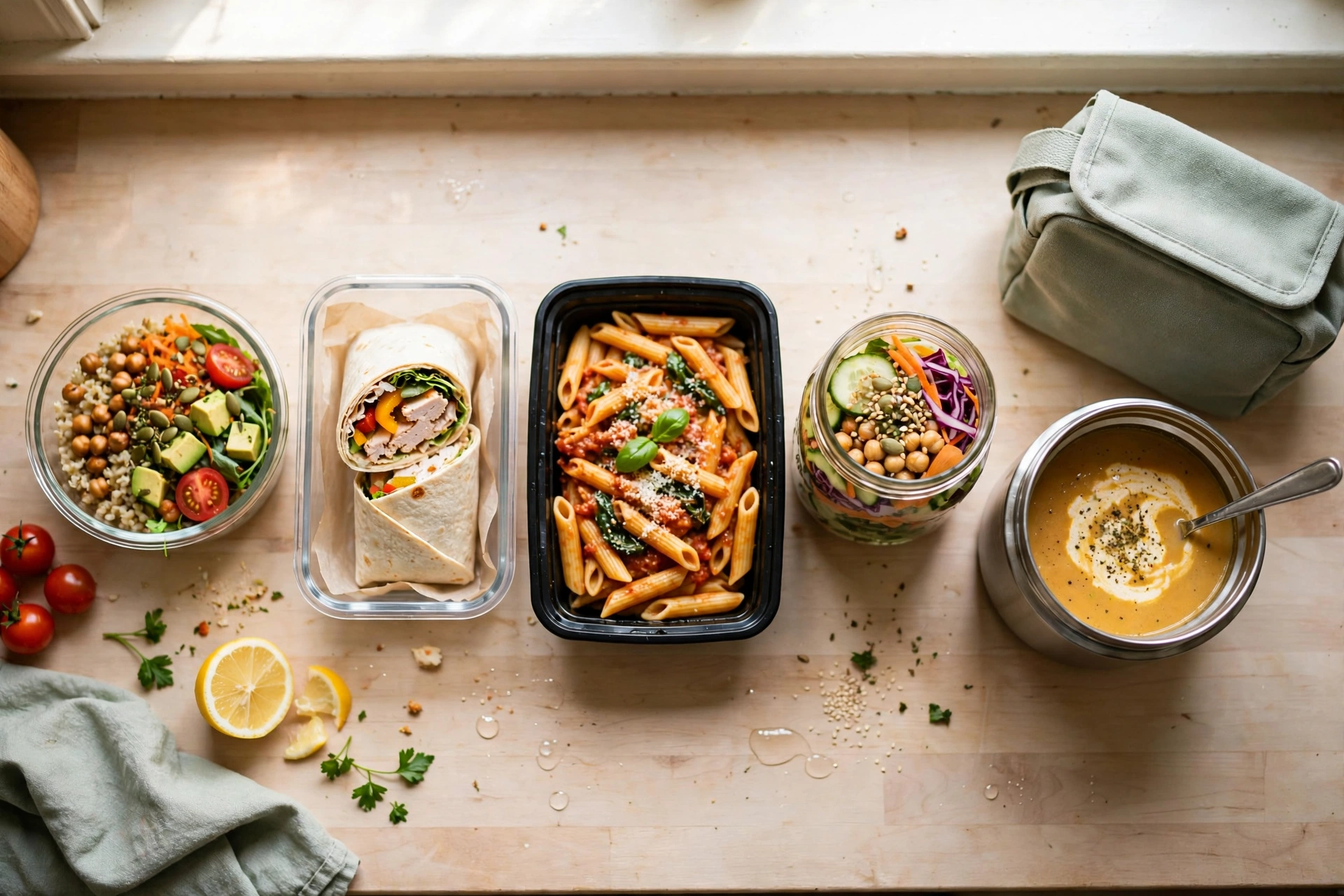
A week of lunches in a small kitchen does not need five different recipes, a big fridge, or a whole Sunday lost to cooking. It needs one base, a few proteins, and a plan for which lunch gets eaten on which day.
Weekly lunch meal prep means deciding the week’s five lunches in advance, cooking the shared parts once, and packing each lunch so it travels well and still tastes good at midday. This guide shows you the formula, a sample week, and the packing and freshness habits that make it work.
Table of Contents
- What a Week of Lunches Actually Looks Like
- The Lunch Formula: One Base, One Protein, One Crunch
- Weekly Lunch Meal Prep: Planning Five Lunches From One Base
- A Sample Week: Monday to Friday
- Lunch Ideas That Travel Well
- Packing Lunches for Work
- Keeping a Week of Lunches Fresh
- The Midweek Top-Up
- Common Mistakes to Avoid
- Frequently Asked Questions
- Conclusion
What a Week of Lunches Actually Looks Like
A realistic week of lunches is five containers, not fifteen. The lunch that works is the one already packed, already labelled, and already in the fridge.
Planning is mostly a scheduling job. Pick five lunches your household likes, check what you already have, and work out which parts can be shared.
The goal is a lunch that is filling, varied enough not to bore you by Wednesday, and small enough to fit a small fridge. Five identical containers of the same stew will do the job, but most people stop eating them by day three.
Variety does not need five recipes. It needs one base with five different toppings — and that is a much smaller job.
The Lunch Formula: One Base, One Protein, One Crunch
Every good packed lunch has three parts: a base, a protein, and something fresh or crunchy. The base is what fills you up — rice, pasta, couscous, quinoa, bread, or a wrap.
The protein keeps you full until dinner — beans, chickpeas, lentils, eggs, cheese, or tinned fish. The crunch makes the lunch pleasant to eat — cucumber, carrot, peppers, salad leaves, pickles, or nuts.
The formula matters because it turns lunch planning into a mix-and-match exercise. Cook one large pot of rice on Sunday, and it becomes five different lunches.
Monday: with chickpeas and feta. Tuesday: with tuna and sweetcorn. Wednesday: fried with an egg and soy sauce. Thursday: with beans and salsa. Friday: with leftover roasted vegetables.
The cooking stays the same; only the toppings change. That is the whole trick.
Weekly Lunch Meal Prep: Planning Five Lunches From One Base

Planning five lunches is not cooking five meals. It is cooking two or three shared parts — a pot of grains, a tray of roasted vegetables, a batch of chickpeas or beans, and a sauce or dressing — then assembling five different combinations in minutes.
Start by choosing the week’s base and two proteins. Then list the five lunches, one per day, and check the overlap: if three lunches use the same rice, you cook rice once.
If none of them share anything, the plan is too complicated. Simplify it until at least three lunches share a base, and the week becomes manageable.
Write the plan down, on paper or on your phone, in the order the lunches will be eaten. The most perishable lunch — the one with cut fruit, soft cheese, or dressed salad — goes first, on Monday.
The sturdiest lunch — a grain bowl, a pasta box, or a soup — goes last, on Friday. For the full planning steps, see A Beginner’s Guide to Meal Planning for a Small Household.
For the cooking session that makes the shared parts in one hour, see One-Hour Meal Prep Plan for Busy Weekdays.
A Sample Week: Monday to Friday
A sample week shows how the formula works in practice. This is one example for one or two people — swap any lunch for another your household likes, keeping the same structure.
Monday: chickpea and feta grain bowl. Cooked quinoa or rice, tinned chickpeas, cucumber, tomatoes, feta, and olives, with a lemon dressing kept in a small pot.
Tuesday: tuna and sweetcorn wrap. Tinned tuna, sweetcorn, spring onion, and salad leaves in a wrap, with hummus spread first as a barrier so the wrap does not go soggy.
Wednesday: egg fried rice. The same rice from Monday, fried with an egg, soy sauce, and spring onions, with grated carrot on the side.
Thursday: bean and salsa pasta box. Cooked pasta with kidney beans, sweetcorn, peppers, and salsa, eaten cold or at room temperature. Pasta holds up well for several days in the fridge.
Friday: soup and bread. A portion of soup from the freezer or the fridge, with bread and cheese — the lunch that needs the least fresh food, for the day the fridge is at its emptiest.
For lunches that need no cooking at all, see Simple No-Cook Meal Prep Ideas for Busy Days.
Lunch Ideas That Travel Well

A lunch that travels well survives a bag, a commute, and a few hours in a cool bag. The best travellers are foods meant to be eaten cold or at room temperature, that do not leak, wilt, or go soggy.
Grain bowls and pasta boxes
Grain bowls and pasta boxes are the most reliable packed lunches: the base is sturdy, the toppings sit on top, and nothing needs reheating.
Pack the dressing separately. Rice, quinoa, couscous, and pasta all work, with beans, cheese, eggs, or tinned fish for protein, and cucumber, carrots, or peppers for crunch.
Wraps and sandwiches
Wraps travel better than sandwiches, because a wrap rolled tightly and wrapped in greaseproof paper holds its shape.
Build them with a barrier — hummus, cream cheese, or butter — between the filling and the bread, and keep wet fillings like tomatoes and pickles out until eating time. A wrap made the evening before is fine; one made on Sunday for Friday is not.
Salads that survive the week
A salad that survives is a salad with its parts kept separate. Pack the leaves, chopped vegetables, and protein in one container, and the dressing in a small pot.
Sturdy vegetables — carrots, cabbage, peppers, and cucumber — last longer than soft leaves, so a coleslaw or a chickpea salad keeps for three or four days, while a leafy salad is best eaten within a day or two.
Soups and stews in a flask or container
Soup is the easiest lunch to prep in bulk, but it needs a leakproof container or a flask, and reheating — so it suits a workplace with a microwave or a kitchen.
A flask keeps soup hot until lunchtime with no reheating at all. For the batch-cooking side of this, see Batch Cooking in a Small Kitchen: Tips to Save Time and Space.
Packing Lunches for Work
Packing is half the job. A lunch that is packed well gets eaten; a lunch that leaks in the bag gets thrown away.
Pack each lunch in one container, with the dressing in a small separate pot and a fork or spoon in the bag. Use a container with a lid that seals properly — one that has leaked once will leak again, so replace it.
Label each container with the day it is for. A container labelled Wednesday gets eaten on Wednesday, not left at the back until Friday.
Keep the bag cool if the day is warm or the commute is long. An ice pack or a frozen bottle of water keeps the lunch cold until midday and doubles as a cold drink once it thaws.
For the container system in full, see How to Store Meal Prep Containers in a Small Kitchen.
Keeping a Week of Lunches Fresh
A week of lunches stays fresh when the parts are kept apart and the eating order is planned. Dressings are the main cause of soggy lunches, so store them separately and add them at eating time.
Salad leaves stay crisp when washed, dried, and stored in a container lined with kitchen paper. Most prepped lunches are best eaten within a few days, so put the most perishable lunches first and the sturdiest last.
Label every container with the contents and the day, keep the oldest at the front, and if food looks or smells off, do not eat it. For the full fridge system, see Small Fridge Organization for Meal Prep.
For the freshness system in full, see How to Keep Meal Prep Ingredients Fresh Throughout the Week.
The Midweek Top-Up
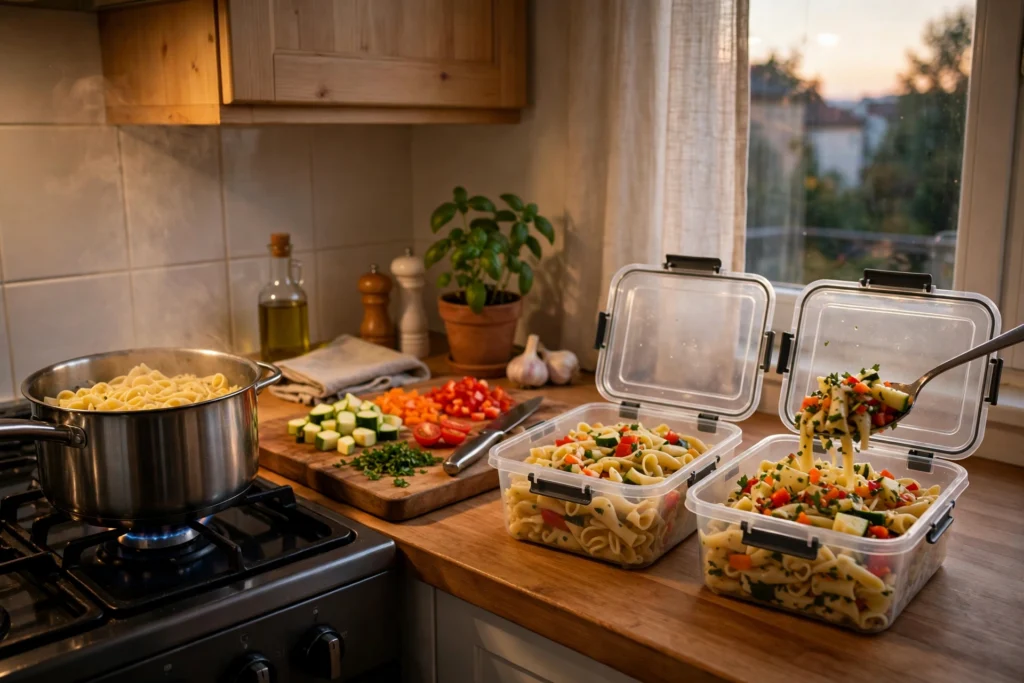
A week of lunches does not have to be prepped in one session. Food prepped on Sunday is at its best on Monday and Tuesday; by Thursday, the salad is tired and the wraps are soft.
A short midweek top-up — twenty minutes on Wednesday evening — keeps the second half of the week as fresh as the first. The top-up is small: cook a fresh pot of grains or pasta, chop fresh vegetables, and assemble Thursday and Friday’s lunches.
The first half of the week is already eaten, so the fridge has space again. Two short sessions beat one long one, in a small kitchen and in a small fridge.
This is also the moment to check the budget. A top-up that uses what is already in the fridge and pantry costs less than a second big shop — see Budget-Friendly Meal Prep for Small Households for the full approach.
Common Mistakes to Avoid
Prepping five identical lunches. The same lunch five days running gets boring by Wednesday, and boring food gets thrown away. Use one base and change the toppings.
Prepping the whole week on Sunday. Food prepped on Sunday is tired by Thursday. Prep for three days, then top up midweek.
Dressing salads and grain bowls when you pack them. Dressing soaks through everything within hours. Keep it in a small pot and add it at lunchtime.
Packing a wrap four days ahead. A wrap made on Sunday for Friday will be soft and soggy. Make wraps the evening before, at most.
Forgetting a protein. A lunch of only salad and cucumber will not keep you full until dinner. Add beans, cheese, eggs, tinned fish, or nuts to every lunch.
Using containers that leak. A leaking container ruins the bag and the lunch. Test a container with water before you trust it with soup or dressing.
Planning lunches that do not match the day. A soup needs reheating, a salad needs a table, and a wrap needs nothing. Match the lunch to where you will eat it.
Frequently Asked Questions
How many lunches should I prep at once in a small kitchen?
Three is a good number for one session: Monday to Wednesday, with a short midweek top-up for Thursday and Friday.
What are the best packable lunches for work?
Grain bowls, pasta boxes, and wraps travel best: they are eaten cold or at room temperature, they do not leak if the container seals, and they need no microwave. Soup works too, in a leakproof container or a flask.
How do I keep packed lunches from going soggy?
Keep wet and dry parts separate until eating time: dressing in a small pot, tomatoes and pickles out of the wrap, and salad leaves packed separately from the base. A spread of hummus or cream cheese acts as a barrier inside a wrap.
Can I prep a week of lunches without a microwave at work?
Yes. Build the week around lunches meant to be eaten cold: wraps, grain bowls, pasta boxes, and salads. Soup and stews are the only lunches that really need reheating, so save those for home days.
How long do prepped lunches last in the fridge?
Most are best eaten within a few days, with the most perishable first. Grain bowls, pasta boxes, and soups usually keep well for three or four days. If food looks or smells off, do not eat it.
Conclusion
Weekly lunch meal prep in a small kitchen comes down to three things: one base that becomes five different lunches, a plan that puts the most perishable lunch first and the sturdiest last, and a midweek top-up so Thursday and Friday are as fresh as Monday.
Start this week with three lunches and a Wednesday top-up: a grain bowl, a wrap, and a pasta box. For the wider system, read Easy Meal Prep Ideas for Small Kitchens, which covers the whole small-kitchen meal prep approach in one place.
2 thoughts on “How to Prep a Week of Lunches in a Small Kitchen”