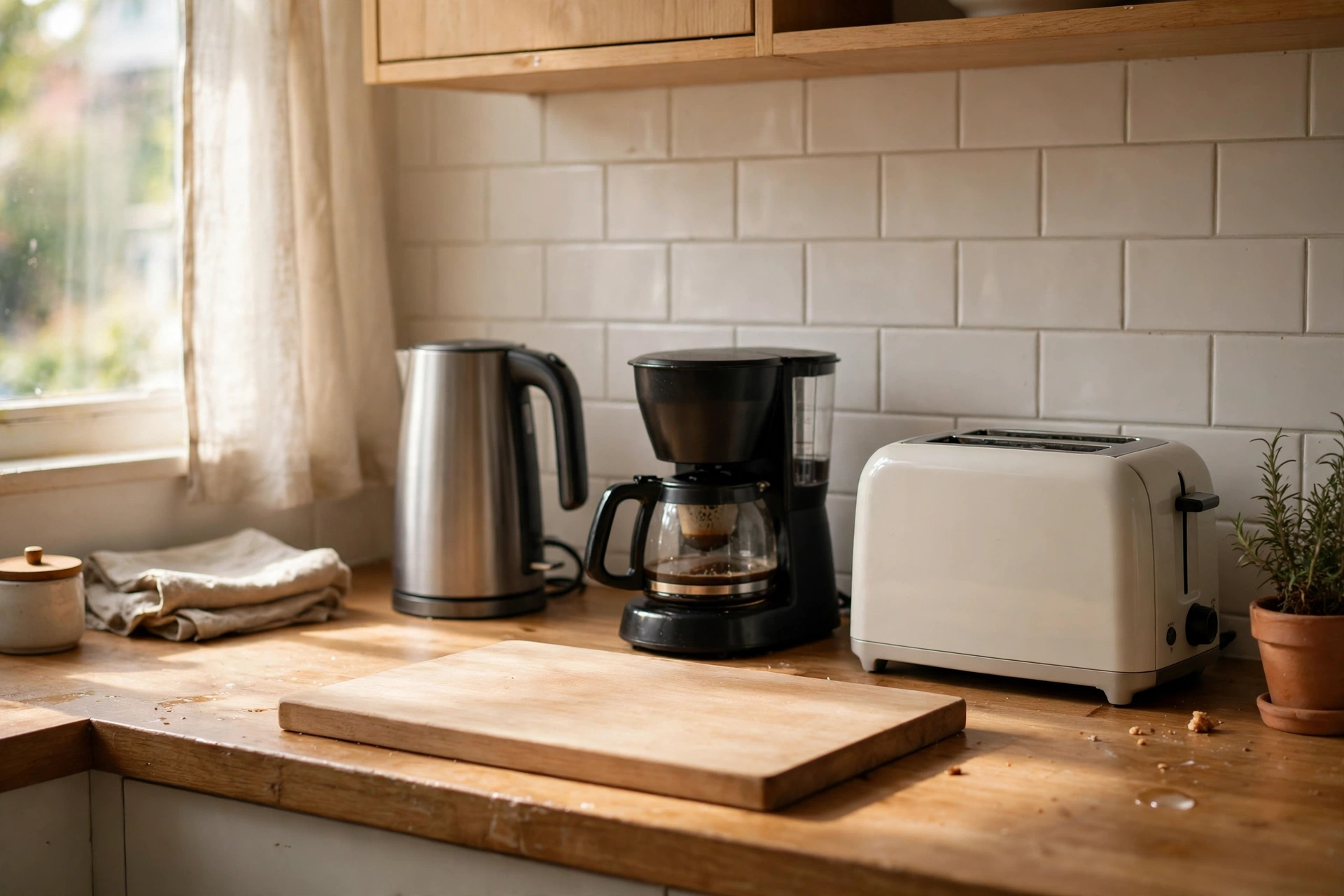
The best compact kitchen appliances for small counters are the ones you use every day and that fit the space you have: a slim kettle, a small coffee maker, and a compact toaster earn their place in most small kitchens, while a multi-cooker or air fryer earns it only if you cook with it often.
Everything else — the bread maker, the juicer, the big slow cooker — belongs in a cupboard, or not in the kitchen at all. This guide covers each appliance type, the keep, store or rotate framework, and how to choose by footprint, capacity, and cleaning.
Table of Contents
- What “Compact” Really Means for an Appliance
- Compact Kitchen Appliances: The Ones That Usually Earn Counter Space
- Compact Kitchen Appliances That Earn Space for Some Households
- Appliances That Rarely Earn Counter Space
- Keep, Store or Rotate: A Simple Decision Framework
- How to Choose a Compact Appliance, Step by Step
- What to Check Before You Buy
- Where to Store the Appliances You Use Less Often
- Safety Basics for Small Kitchens
- Mistakes to Avoid
- Frequently Asked Questions
- Conclusion
What “Compact” Really Means for an Appliance
“Compact” on a box means smaller than standard, but it does not tell you whether the appliance fits your kitchen. It earns the word only when three things are true: footprint fits the counter, height fits under the wall cupboards, and capacity fits the meals you cook.
Footprint is the square it stands on — measure the counter run, then the appliance’s base, including the handle and the space the lid or door needs to open. Height matters too: an appliance too tall to open under a cupboard gets dragged out every time.
Capacity is the measure people forget: a one-litre kettle means boiling water twice for a family, and an air fryer too small for your household means cooking in batches. Compact should mean “right-sized for your kitchen and your household,” not “the smallest one in the shop.”
Compact Kitchen Appliances: The Ones That Usually Earn Counter Space
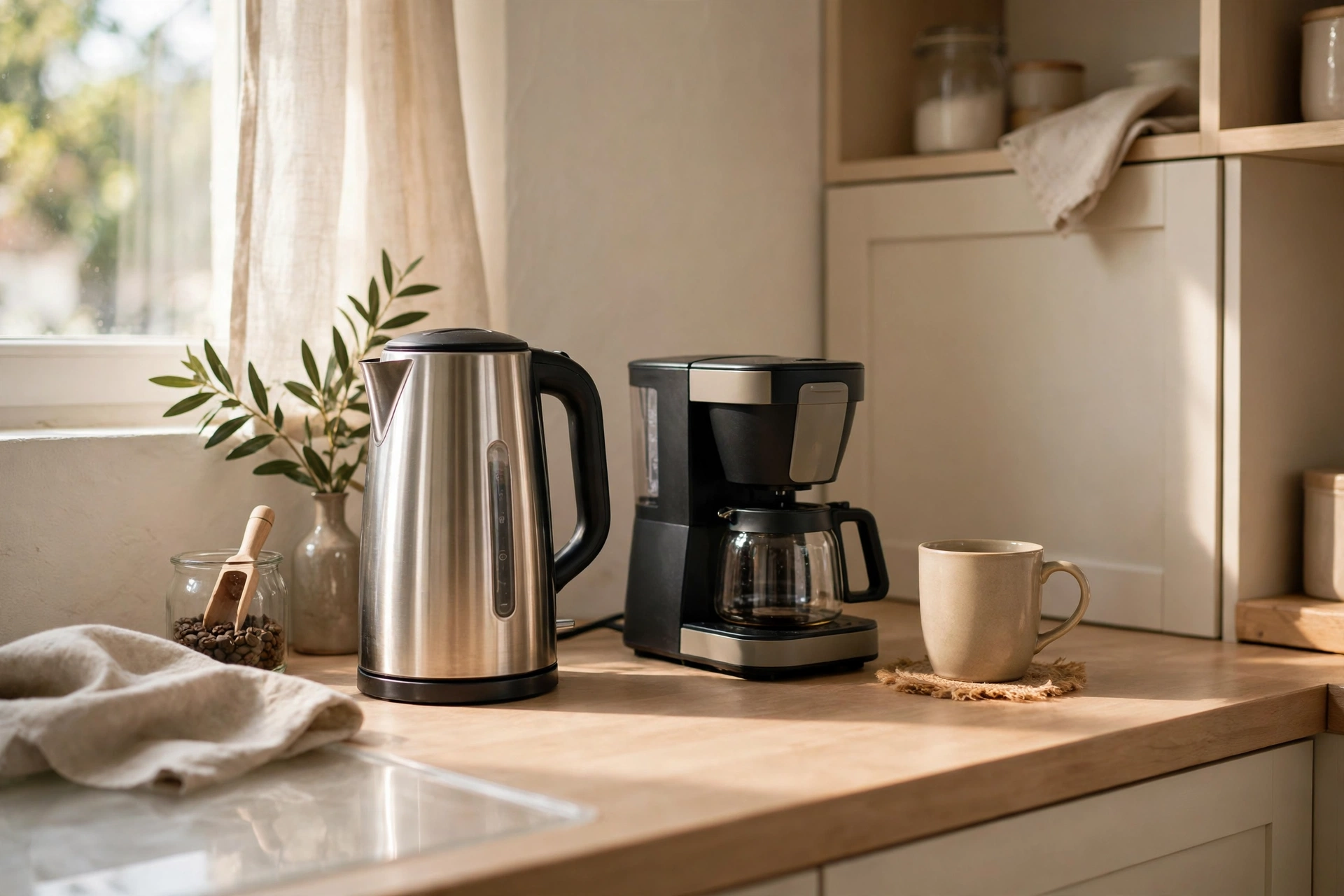
These four are used daily and do a job that is hard to replace with a pan or a knife. Each still has to pass the test: do you use it most days, and does it fit without crowding the prep area?
A slim kettle
A kettle earns counter space because it is used daily — boiling water in a pan is slower and ties up a hob ring. Choose a slim one that fits your counter run and holds enough for your household in one boil, and keep it beside the coffee maker.
A small coffee maker
If you drink coffee every morning, a coffee maker earns its spot. A small drip machine suits a household that drinks several cups; a single-serve machine suits one person; a pour-over set-up needs no counter space at all. Keep it beside the kettle — see Small Kitchen Counter Organization: Keep Your Counters Clear and Useful.
A compact toaster
A toaster does one job, but it is a job most households do every day, and it is small enough to earn its place. A two-slice toaster suits one or two people; a four-slice version suits a family but takes roughly twice the space. It needs clearance above it for heat to escape, so keep it clear of low shelves and walls.
A compact microwave
A microwave is the largest everyday appliance, and the one most worth moving off the counter. If it stays, choose the smallest size that fits the plates you actually reheat, and leave room to open the door fully and set down a hot dish beside it. A sturdy shelf or stand frees more counter space than any other single change. For reheating routines, see How to Meal Prep with Limited Counter Space.
Compact Kitchen Appliances That Earn Space for Some Households
These can be the most useful thing in a small kitchen — or the most wasted space. The difference is how often you use them.
An air fryer
An air fryer cooks quickly and crisps food without heating the oven. It earns counter space if you use it three or more times a week — not if you use it once a fortnight. Size is the trap: too small means cooking in batches, too large takes a quarter of your counter. Measure the footprint with the basket pulled out.
A multi-cooker
A multi-cooker — pressure cooking, slow cooking, steaming, and sautéing in one pot — earns its space if it replaces two or three other things. If it replaces a slow cooker, a rice cooker, and a steamer, one appliance doing three jobs is a genuine space saving; if it sits beside the appliances it was meant to replace, it is not. Multi-cookers are heavy and tall, so they need a low, strong shelf if stored. For batch cooking, see Batch Cooking in a Small Kitchen: Tips to Save Time and Space.
A blender or personal blender
A full-size blender earns counter space in a household that blends daily — smoothies, soups, sauces. A personal blender earns it more easily: smaller, lighter, and the cup doubles as the blending jar. The trade-off is capacity — one or two portions, not a jug of soup for four. If you blend once a week or less, either version belongs in a cupboard.
Appliances That Rarely Earn Counter Space
A bread maker is the classic example: large, heavy, used a few times a year at most. A sandwich press and a juicer are the same story — one job, used occasionally, taking a permanent square of counter. A large slow cooker falls into this group too.
The honest test is two questions: when did you last use it, and what would you cook instead? If the answer is “last month” and “the same meal, in a pan,” it is decoration, not equipment. Move it to a high shelf, and if six months pass without it, let it go.
Keep, Store or Rotate: A Simple Decision Framework
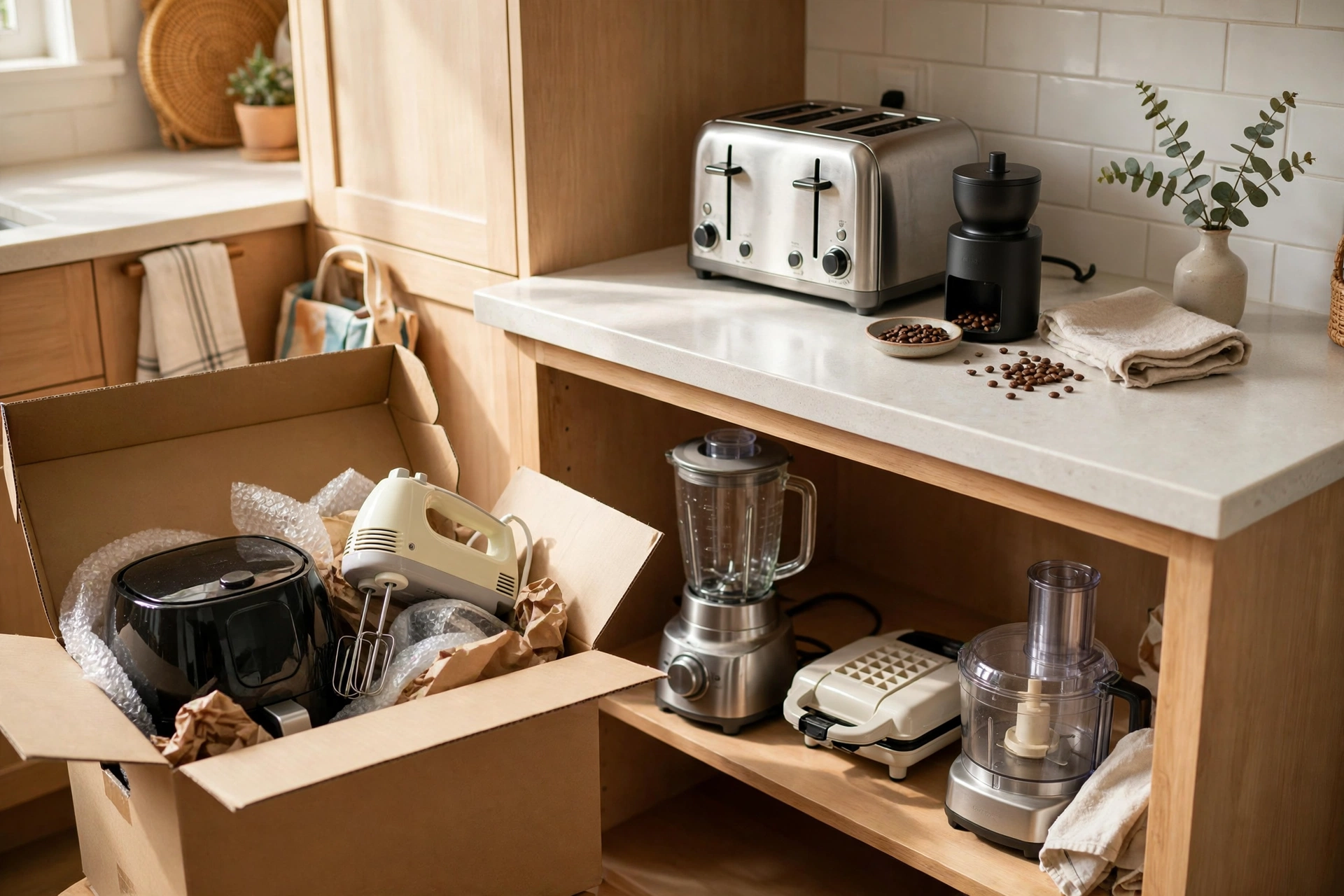
Ask four questions about each appliance. How often do I use it? Daily use earns counter space; weekly use earns a cupboard spot; monthly use or less earns a high shelf or a new home. How much counter does it take? Measure the footprint, including the handle and the space the lid or door needs.
Does it replace something else? One appliance that replaces two or three tools earns more space than a single-job one. How hard is it to get out and put away? A light appliance fetched in ten seconds will be used; a heavy one on a high shelf will not.
Sort each appliance into one of three groups. Keep on the counter: used daily, fits without crowding the prep area. Store in a cupboard: used weekly, light enough to lift, easy to reach. Rotate or remove: used monthly or less, or a duplicate — rotate means bringing it out for a specific job and putting it away the same day. For the decluttering method, see How to Organize a Small Kitchen with Limited Cabinet Space.
How to Choose a Compact Appliance, Step by Step
Work through these steps before you buy.
Step 1: Measure your counter and your clearance. Measure the run where it will live — width, depth, and height under the wall cupboards — and note where the sockets are.
Step 2: List the meals you actually cook. Write down the ten meals you cook most often and which appliances each needs — if none needs a juicer, you do not need one. See One-Hour Meal Prep Plan for Busy Weekdays for a realistic meal plan.
Step 3: Check the capacity for your household. A compact appliance should fit the amount you cook in one go — a kettle that needs two boils creates extra work instead of saving it.
Step 4: Check how it cleans. Parts that lift out and wash easily beat fixed parts and awkward corners.
Step 5: Plan where it will live when it is not in use. Decide its home before you buy it: which cupboard, which shelf, and whether you can lift it there safely. Heavy appliances live low, or on the counter.
Step 6: Replace, don’t add. Let a new appliance replace the old version, or two single-job appliances with one multi-use one. For tools that do several jobs, see Multi-Functional Kitchen Tools That Save Space.
What to Check Before You Buy
Check dimensions with the lid open, the door open, and the jug lifted off — open measurements cause trouble under wall cupboards. Check capacity: big enough for a normal meal, small enough for your counter.
Check materials: stainless steel is durable but heavy, plastic is light but can stain, glass is heavier and more fragile. Check durability in the moving parts — lids, hinges, handles, baskets — because those fail first.
Check cleaning: parts that lift out, surfaces that wipe clean, no gaps where food collects. And check the storage footprint: how much room it takes when put away, and how heavy it is.
Where to Store the Appliances You Use Less Often
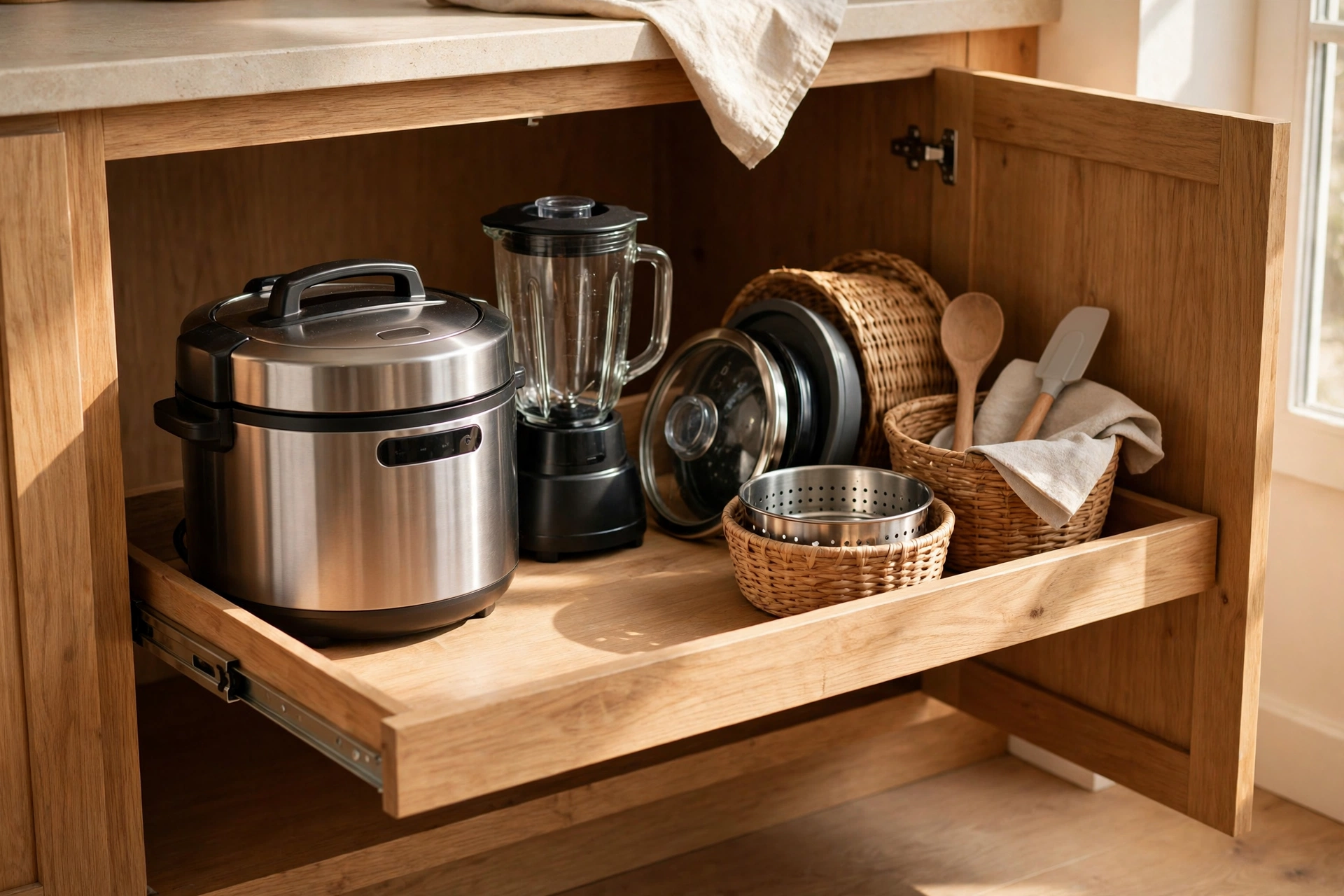
Appliances you use weekly still need an easy-to-reach home, or they drift back onto the counter. The best homes are low, strong, and close to where they are used. A cupboard with a sliding tray or pull-out shelf is ideal; without one, use a low shelf.
Keep each appliance’s parts with it, so you are not hunting through cupboards for a lid or a basket. For appliances used monthly or less, a high shelf or another room is fine. If an appliance has not been used in six months, consider whether it should stay — see Best Space-Saving Kitchen Tools for Small Kitchens. In a rental, check your lease before drilling, as explained in Small Kitchen Organization for Renters: No-Drill Storage Ideas.
Safety Basics for Small Kitchens
Leave space around anything that gets hot. Keep cords away from water and the hob, and do not let one trail across a walkway or hang over the edge. Do not overload sockets, or run two heat-producing appliances from one socket.
If an appliance is damaged — a frayed cord, a cracked jug, a loose plug — stop using it. Always follow the manufacturer’s instructions, and keep the manual somewhere you can find it.
Mistakes to Avoid
Filling the counter before measuring it. Buying three appliances and discovering they fill the whole counter is the commonest mistake.
Choosing the smallest version of everything. The smallest air fryer, blender, and kettle look tidy in the shop and frustrate you at home.
Keeping a single-job appliance “just in case.” A juicer used twice a year is a square of counter you cannot chop on.
Buying an appliance to fix a storage problem. A new multi-cooker does not help if your cupboards are full of appliances you never use — declutter first; see How to Declutter a Small Kitchen: A Step-by-Step Guide.
Forgetting the open measurements. An appliance that fits closed but not open will be dragged around every time.
Storing heavy appliances up high. A stand mixer or multi-cooker on a high shelf is an appliance you will stop using — and one you risk dropping.
Frequently Asked Questions
How many appliances should live on a small kitchen counter?
Most small kitchens have room for two or three. The test is the prep area: if a chopping board and a bowl cannot fit on the counter at once, something has to move.
Is a multi-cooker worth it in a small kitchen?
Yes, if it replaces two or three other appliances and you use it several times a week — not if it sits beside the appliances it was meant to replace, or you use it once a month.
What is the best way to store a stand mixer in a small kitchen?
If you bake weekly, a strong, low cupboard or pull-out shelf works. Otherwise a hand mixer in a drawer does the same jobs.
Can I put a microwave on a shelf instead of the counter?
Yes, if the shelf is strong enough, the microwave fits with space around it for heat and steam, and you can reach it.
Are compact appliances less powerful than full-size ones?
Not necessarily — what changes is capacity. A compact appliance usually holds less, so check it fits the amount you cook in one go.
Conclusion
Compact kitchen appliances match your cooking, your household, and your measurements — not the cleverest features or the smallest boxes. Start with the daily trio of kettle, coffee maker, and toaster, then add one multi-use appliance only if you use it several times a week.
Work through the framework: measure your counter, list the meals you cook, sort every appliance into keep, store or rotate, and replace rather than add. For the wider picture on tools, see Best Space-Saving Kitchen Tools for Small Kitchens.