
The best multi-functional kitchen tools replace two or three single-purpose tools you already own: a good chef’s knife that chops, slices, and dices; a sheet pan that roasts, bakes, and reheats; a large bowl that mixes, serves, and stores — one tool doing three real jobs means two fewer tools in the drawer.
Multi-functional kitchen tools save space by cutting the count, not the size. This guide covers what the label honestly means, the tools that earn it, the ones that only pretend to, and how to judge one before you buy it.
Table of Contents
- What “Multi-Functional” Really Means
- Multi-Functional Kitchen Tools: The Ones That Earn Their Space
- The “Multi-Use” Tools That Usually Disappoint
- How to Judge Any Multi-Use Tool Before You Buy
- A Step-by-Step Plan to Swap Single-Use Tools for Multi-Use Ones
- Using Multi-Use Tools Well
- What to Check Before You Buy
- Mistakes to Avoid
- Frequently Asked Questions
- Conclusion
What “Multi-Functional” Really Means
A tool is only truly multi-functional if it does two or more jobs you actually do, well enough to replace the single-purpose one. A garlic press that also slices is not multi-functional if you only ever press garlic with it — a chef’s knife is, because it chops, slices, dices, and minces every day.
It earns the label in three ways: it replaces several tools, like a sheet pan; it works at several stages, like a bowl used for mixing and serving; or it adapts, like tongs. If it does none of these in your kitchen, it is a single-use tool with extra features.
The test is your cooking, not the packaging: count its jobs in a normal week — if the answer is one, the list on the box does not matter. A tool that does three jobs you never do saves nothing.
Multi-Functional Kitchen Tools: The Ones That Earn Their Space
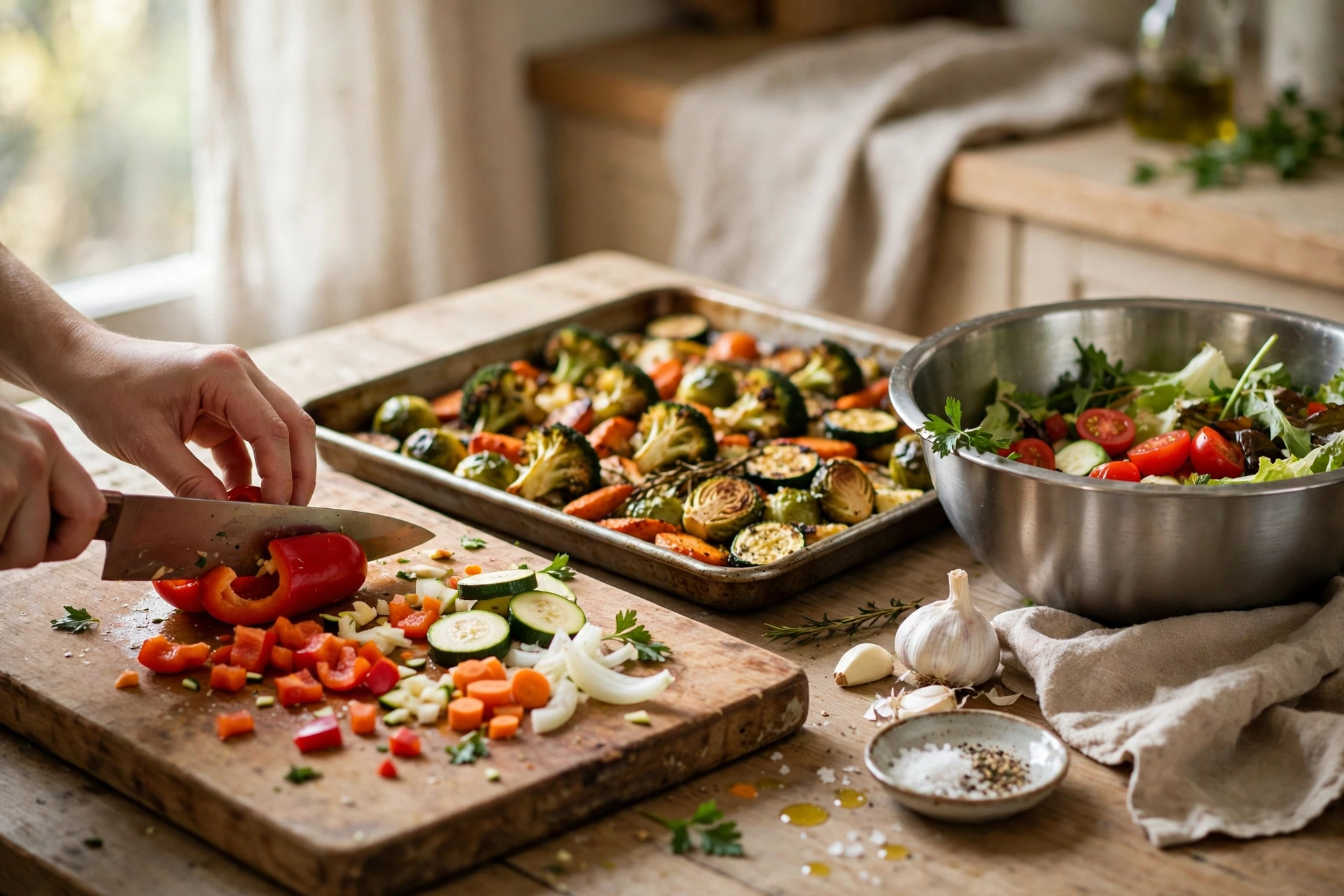
Four or five tools cover most everyday cooking — start with these, and add one only when you can name its jobs.
A good chef’s knife
One 20 cm (8 in) chef’s knife chops, slices, dices, minces, and crushes, replacing a drawer of specialist knives. Choose one that feels balanced, keep it sharp, and store it on a magnetic strip or in a knife block — a blunt knife is slower and less safe, so sharpening is part of owning one.
A sheet pan
A sheet pan is a metal tray with low sides, far more versatile than its name suggests: it roasts vegetables and chicken, bakes biscuits and flatbreads, and reheats leftovers — one pan replacing a roasting tin and a baking tray. Line it with baking paper for sticky jobs, and clean it while it is still warm.
A large mixing bowl
A large bowl mixes batter, tosses salads, marinates meat, and serves food at the table. Buy one large bowl rather than a set of five: one around 28 cm (11 in) across handles most jobs.
A heavy pot or Dutch oven
A heavy, lidded pot cooks soups, stews, curries, rice, and pasta, and goes from hob to oven to table. The trade-off is weight — it needs a low, strong shelf. For batch cooking with one pot, see Batch Cooking in a Small Kitchen: Tips to Save Time and Space.
Tongs
Tongs turn meat, toss salad, lift pasta from boiling water, and serve food — four jobs from one slim tool that takes up almost no drawer space. Keep them near the chopping board, where the work happens.
A silicone spatula
A heatproof silicone spatula stirs sauces, scrapes bowls clean, folds batter, and flips pancakes — one spatula replacing a wooden spoon and a rubber scraper. Choose one heatproof to the temperatures you cook at, and check the head is firmly fixed to the handle.
A box grater
A box grater grates cheese, shreds carrots and cabbage, and zests citrus, all from one upright tool. Store it sharp sides in, or inside a container, so it does not catch on other tools, and dry it straight away, or it will rust.
The “Multi-Use” Tools That Usually Disappoint
Not every tool that claims several jobs delivers them — the second and third jobs are usually ones nobody does, or ones the tool does badly.
A garlic press that also slices is still a single-use tool: the extras are fiddly, and a knife is faster. A spiralizer makes vegetable noodles — one job, however many blades it comes with. An egg slicer slices eggs and nothing else.
The other failure is the gadget that does several jobs badly instead of one job well — a combination peeler-slicer-grater that is awkward to hold, hard to clean, and worse at each job than the simple version.
How to Judge Any Multi-Use Tool Before You Buy
Ask these five questions before any multi-use tool comes home — pass all five and it is worth buying; fail two or more and leave it in the shop.
Which jobs will I use it for, this week? Name two or three real jobs from meals you cook — “it could chop, slice, and peel” is not an answer.
Which tools will it replace? A multi-use tool only saves space if the tools it replaces leave the kitchen — if the old ones stay “just in case,” nothing has been saved.
Does it do each job well enough? A tool that grates cheese beautifully and zests badly is a grater, not a multi-use tool — each job has to be good enough that you would not reach for the single-purpose version instead.
Is it easy to clean? A tool with joints and hidden corners takes longer to wash than the tools it replaces. If cleaning it feels like a chore, you will stop using it.
Where will it live? Picture its home before you buy it: a tool in a drawer you can reach in ten seconds will be used; one on a high shelf will not.
A Step-by-Step Plan to Swap Single-Use Tools for Multi-Use Ones

Swap one group at a time, not the whole kitchen at once — a slow swap sticks; a big clear-out usually ends with the old tools coming back.
Step 1: Empty one drawer and sort it. Take everything out and sort it into three groups: used weekly, used monthly, and not used in six months. For the full method, see How to Declutter a Small Kitchen: A Step-by-Step Guide.
Step 2: Find the duplicates. Look for tools that do the same job: two peelers, three graters, a slicer and a mandoline. Keep the one you reach for first.
Step 3: List the jobs that are left. Write down the jobs the remaining tools do, and look for one tool that covers two or three of them.
Step 4: Buy one replacement, not five. Replace the biggest group first, usually the chopping and slicing tools, and live with the replacement for a few weeks before buying the next one.
Step 5: Remove the old tools. Put the replaced tools in a box out of the kitchen for a month. If you do not open it, let them go; if you reach for one, it was earning its space.
Step 6: Give each multi-use tool a fixed home. A chef’s knife on a magnetic strip, tongs on a hook, a sheet pan stacked flat in a cupboard — if a tool has no home, you still have too many tools. See How to Organize Kitchen Drawers in a Small Kitchen for drawer layouts.
Using Multi-Use Tools Well
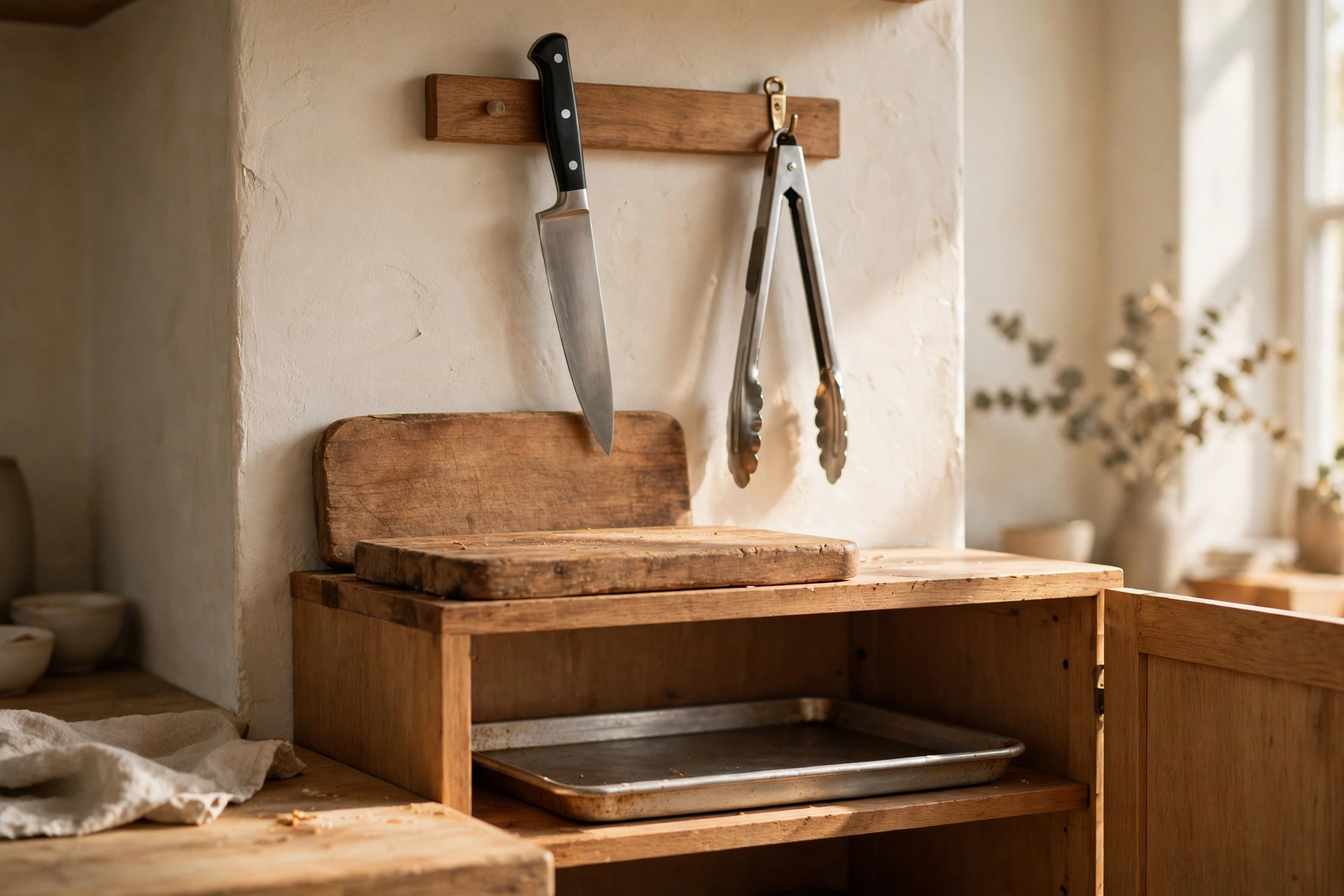
A multi-use tool earns its space only if it stays in good condition, because one worn-out tool means losing three jobs at once. Keep knives sharp — a blunt chef’s knife is slower and less safe — and wash and dry it straight after use. Clean a sheet pan while it is still warm.
Dry a box grater straight away, and check joints and handles: a loose hinge or wobbly head means replacing the tool before it fails mid-meal.
Store multi-use tools where you use them: the knife and tongs near the chopping board, the sheet pan near the oven, the bowl near the prep area. For storing what you cook with them, see How to Store Meal Prep Containers in a Small Kitchen. For keeping the counter clear around them, see Small Kitchen Counter Organization: Keep Your Counters Clear and Useful.
What to Check Before You Buy
Dimensions. A multi-use tool should fit where it will live and the meals you cook: a sheet pan that does not fit your oven is useless, and a bowl too small for a family salad creates extra work.
Materials. Stainless steel is durable but heavy; silicone is flexible and heatproof but must be thick enough to hold its shape; wood should not be soaked.
Durability. Check the joints, hinges, and handles first: a multi-use tool is used more than a single-purpose one, so its weak points wear faster. A wobbling head or tongs that do not spring back will only get worse.
Cleaning. Parts that come apart or open fully are easier to wash; a tool with hidden corners where food collects will be left in the sink. Dishwasher-safe saves time, but check the heat will not warp it.
Capacity. A tool too small creates extra work — a small bowl means mixing batter in two batches. Choose the size that fits your household, not the smallest on the shelf.
Storage footprint. How much room does it take when put away, and does it replace tools that took up more? A box grater takes the space of one upright tool and replaces three.
Mistakes to Avoid
Buying a multi-use tool for jobs you never do. A slicer-dicer is wasted on a household that only chops onions — match the tool to your cooking, not to the list on the box.
Keeping the old tools as well. The new knife arrives, the old ones stay in the drawer “just in case,” and nothing has been saved.
Choosing a gadget over a skill. A chopper looks faster than a knife, but a sharp knife and a little practice do the same job with one tool.
Ignoring the cleaning cost. A tool with five attachments takes five times as long to wash as a knife.
Buying the cheapest version. A multi-use tool is used for several jobs every week, so a flimsy one fails sooner.
Collecting multi-use tools instead of using them. Five versatile tools that each do three jobs is still clutter if you only cook three meals a week.
Frequently Asked Questions
How many multi-functional tools do I actually need?
Four or five: a chef’s knife, a sheet pan, a large mixing bowl, tongs, and a spatula cover most everyday cooking. Add a heavy pot and a box grater if you cook one-pot meals.
Are multi-functional tools as good as single-purpose ones?
For everyday cooking, yes — a chef’s knife chops as well as a specialist knife, and a sheet pan roasts as well as a roasting tin. A single-purpose tool wins only for a job you do very often or very precisely, such as paper-thin slices. If you do that job once a month, the multi-use tool wins.
What is the best first multi-use tool to buy?
A good chef’s knife: it is used in almost every meal, replaces the most tools, and takes up the least space. A sheet pan is the second-best buy, because it roasts, bakes, and reheats.
Can multi-use tools really replace appliances?
Some can: a chef’s knife and a box grater replace a food processor for most small households, and a heavy pot replaces a slow cooker. But a kettle, a toaster, and a microwave each do a job no hand tool can. For which appliances earn counter space, see Best Compact Kitchen Appliances for Small Counters.
Do multi-use tools work in a rental kitchen?
Yes — they change what is inside the drawers, not the kitchen itself, so no drilling or permission is needed. Store them in drawers and cupboards to keep the counter clear, as in Small Kitchen Counter Organization: Keep Your Counters Clear and Useful.
Conclusion
Multi-functional kitchen tools save space only when they do two or three jobs you actually do every week, and the tools they replace leave the kitchen. A chef’s knife, a sheet pan, a large bowl, tongs, and a spatula cover most everyday cooking.
Start with the five-question test — which jobs, which tools it replaces, how well it does each job, how easy it is to clean, and where it will live — then swap one group at a time. For the wider picture, see Best Space-Saving Kitchen Tools for Small Kitchens, for the containers that hold what these tools help you cook, read Best Stackable Kitchen Storage Containers for Small Spaces, and for the tools that earn their storage space, see Small Kitchen Essentials: Tools That Earn Their Storage Space.
3 thoughts on “Multi-Functional Kitchen Tools That Save Space”