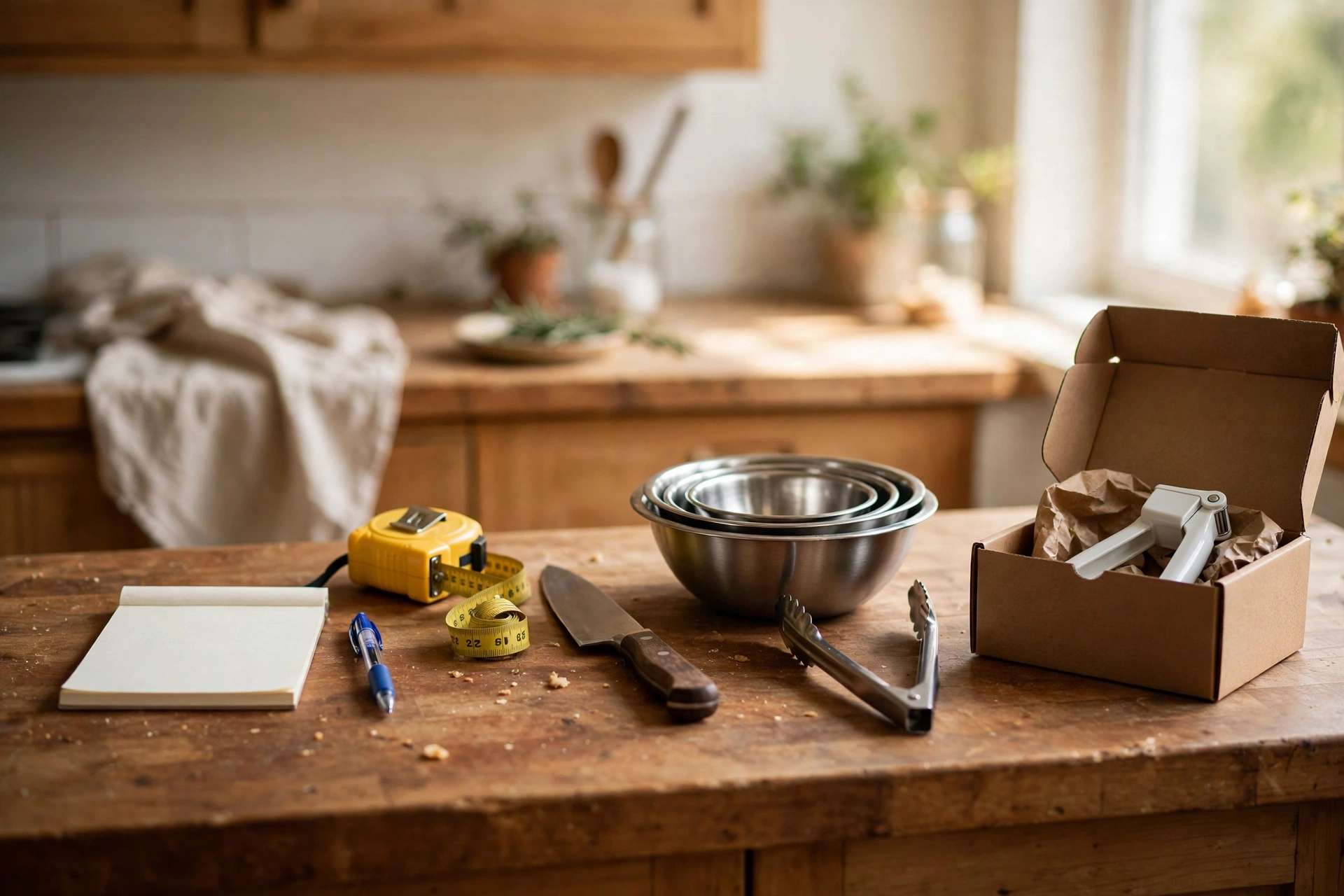
The best way to learn how to choose space-saving kitchen tools without wasting money is to start with a need, not a product: name the job the tool will do every week, measure the space it will live in, and check that it does more than one job or folds away when it is done. A tool that passes those three tests is worth buying; one that fails any of them is a drawer filler.
This small kitchen buying guide covers the checklist to run before you spend, how to judge usefulness and quality, how to avoid unnecessary kitchen gadgets, and the compact kitchen essentials actually worth owning.
Table of Contents
- Why Most Kitchen Tools End Up Wasted
- How to Choose Space-Saving Kitchen Tools: The Need-First Checklist
- Measure Before You Buy
- Multi-Use vs Single-Use: Judging Usefulness
- Quality vs Cheap: What “Good Value” Really Means
- Try Before You Buy
- A Step-by-Step Plan for Buying Without Waste
- The Essentials Worth Owning
- What to Look For Before You Buy
- Common Mistakes to Avoid
- Frequently Asked Questions
- Conclusion
Why Most Kitchen Tools End Up Wasted
Most wasted kitchen tools are not bad tools — they are tools bought for a kitchen that does not exist. A spiralizer suits someone who makes vegetable noodles every week; in a household that cooks three simple meals a week, it is a drawer filler.
Three habits cause most of the waste. Buying on impulse, before anyone has asked what job the tool will do.
Buying a set, where unused pieces still take up room, even nested. And keeping the old tool as well as the new one — the new bowls arrive, the old ones move to the back of the cupboard.
A small kitchen makes every mistake more expensive, because there is nowhere to hide a bad buy. Choose well, and a handful of practical kitchen tools covers almost every meal. For the wider picture, see Best Space-Saving Kitchen Tools for Small Kitchens.
How to Choose Space-Saving Kitchen Tools: The Need-First Checklist
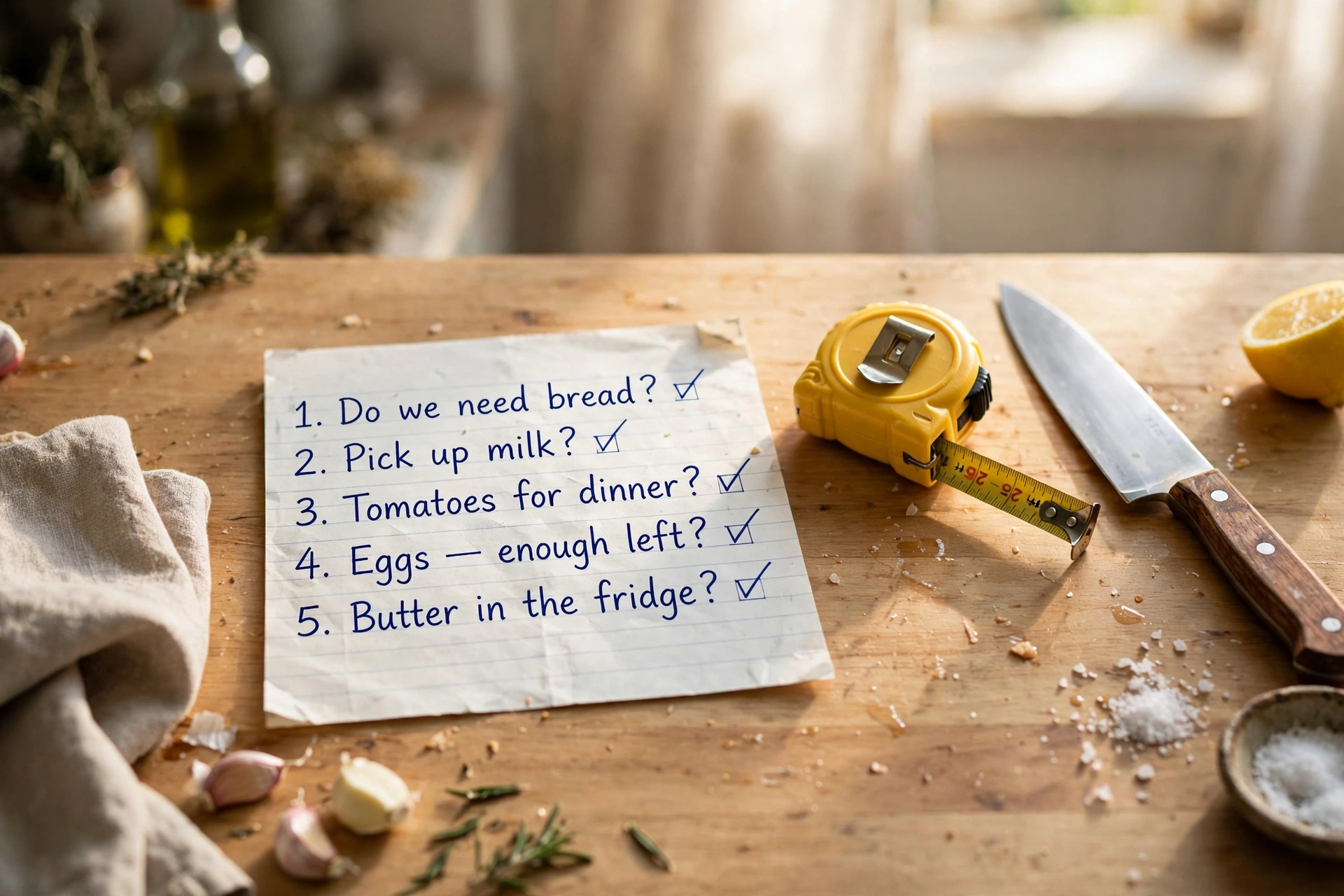
Before you look at a single product, run the need-first checklist — five minutes that saves more money than any sale. Run all five questions on every purchase: a cheap gadget that fails the checklist still costs a drawer slot, and a drawer slot in a small kitchen is worth more than the gadget.
Question 1: What exact job will this tool do?
Name the job in a sentence about a meal you actually cook: “It will drain pasta on Tuesday” is a job; “it could be useful” is not.
If you cannot name the job, you do not need the tool yet.
Question 2: How often will I use it?
A tool used every week earns a drawer slot; one used twice a year does not. If the job came up once or never last month, the tool can wait.
Question 3: What do I use now, and why is it not enough?
Most buying starts with a frustration: the colander is too small, the bowl slides, the peeler is blunt. Name it first.
Question 4: Which tool will it replace?
A space-saving tool only saves space if something leaves — name the tool that will go.
If nothing leaves, you are adding storage, not saving it.
Question 5: Where will it live?
Picture its home first: which drawer, hook or shelf. A tool with no home lives on the counter, taking up worktop.
Measure Before You Buy
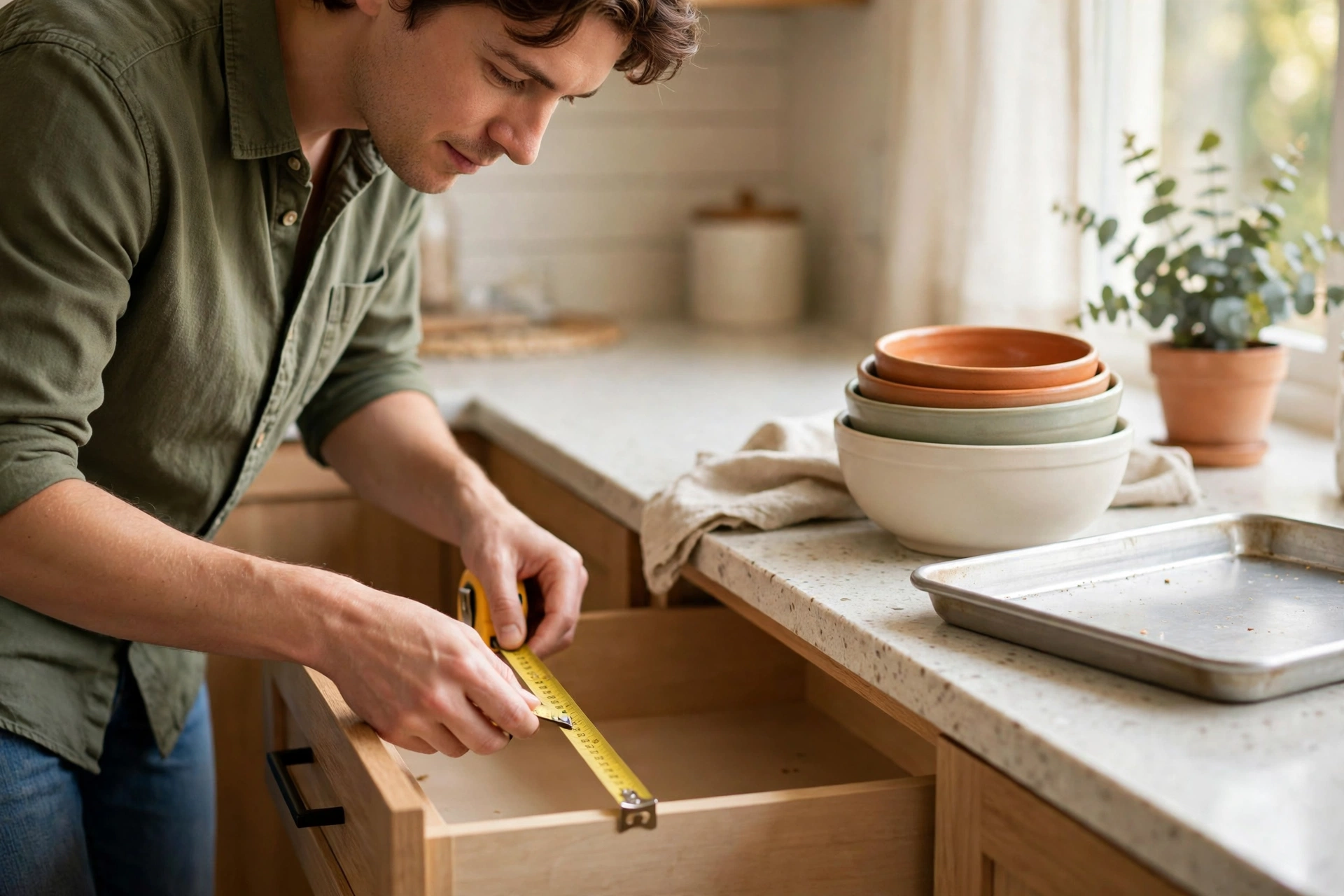
Measuring is the cheapest step in this guide, and the one most often skipped — a tool that does not fit its home is wasted money.
Measure three things inside the space where the tool will live: width, depth, and clear height with the drawer or cupboard closed. Write the numbers down.
Measure the tool too, in the state you will store it — folded height, nested size, flat size — not just the size you use it at.
Measure the job as well: the pan the tool must fit, the oven the tray must slide into, the sink the rack must span. For the wider method, see How to Declutter a Small Kitchen: A Step-by-Step Guide.
Multi-Use vs Single-Use: Judging Usefulness
The most useful question is the simplest: how many real jobs will this tool do in a normal week?
A multi-use tool does two or three jobs you actually do, well enough to replace the single-purpose tools: a chef’s knife chops, slices and dices; a sheet pan roasts, bakes and reheats; a large bowl mixes, serves and stores. See Multi-Functional Kitchen Tools That Save Space for the full list.
A single-use tool does one job only, which is fine if it does it every day — a peeler earns its drawer slot. Used weekly, it earns its space; used twice a year, it does not.
Judge usefulness with three checks. Count the jobs in a normal week. Ask whether it does each job well enough.
Check the cleaning cost too — a tool with five attachments takes far longer to wash than the simple one it replaces.
Watch for two traps: the gadget that claims several jobs nobody does, and the gadget that solves a problem you do not have, like an egg separator in a household that cracks two eggs a week.
Quality vs Cheap: What “Good Value” Really Means
Cheap and good value are not the same thing. A tool you use every week wears out faster than one you use once a month.
What matters is the cost per use: a tool used two hundred times a year is cheap at almost any price, and one used twice is expensive even when it costs very little. A simple peeler can last for years; a cheap knife used daily fails sooner.
Check the joints, hinges and handles first: a folding tool lives or dies by its hinge, and a loose joint will only get looser. Pick the tool up — one that feels flimsy in the shop will not get sturdier at home.
Materials are a useful guide. Stainless steel is durable but heavy. Silicone must be thick enough to hold its shape.
Wood should not be soaked. Plastic can warp and stain. For the same spend-less thinking applied to food, see Budget-Friendly Meal Prep for Small Households.
The opposite trap is paying more for a feature you will never use.
Try Before You Buy
Borrow it: ask a friend or family member if you can borrow the tool for a week — a week of real cooking tells you more than any review.
Improvise it: try the job with what you already own — a knife instead of a chopper, a bowl instead of a salad spinner.
Wait thirty days. Put the tool on a list and wait a month.
If you still want it and can name its job, buy it. If you have forgotten it, it was the impulse.
A Step-by-Step Plan for Buying Without Waste
Work through these steps in order, one purchase at a time.
Step 1: Audit what you already own. Empty one drawer or cupboard at a time and sort tools into three groups: used weekly, used monthly, and not used in six months.
Step 2: List the frustrations, not the products. Write down the jobs that are hard or slow — a product earns a place only if it fixes one.
Step 3: Run the need-first checklist. For each frustration, run the five questions: the job, the frequency, what you use now, what it replaces, and where it will live. Fail one, cross it off.
Step 4: Measure the space and the job. Measure the drawer, shelf, sink and pan before you shop.
Step 5: Try it first. Borrow the tool, improvise the job, or wait thirty days. Buy only what survives the trial.
Step 6: Buy one tool and use it for a few weeks. If it solves the frustration, let the old tool go — one in, one out.
The Essentials Worth Owning

Most small kitchens end up with a short list of compact kitchen essentials — the useful kitchen gadgets most households actually use.
A good chef’s knife, around 20 cm (8 in). One large chopping board and one small one. A large mixing bowl that mixes, serves and stores.
A sheet pan that roasts, bakes and reheats. A heavy, lidded pot for soups, stews, rice and pasta. Tongs and a heatproof spatula.
Nesting measuring cups and spoons, and a slim kitchen scale for baking. A peeler and a small grater.
Stackable containers with lids that fit. For the measuring set in detail, see Best Measuring and Prep Tools for Small Kitchens.
That is the whole list for most households — about a dozen tools. If your cooking needs more, add one tool at a time. For the essentials in detail, see Small Kitchen Essentials: Tools That Earn Their Storage Space.
What to Look For Before You Buy
Dimensions. Compare the tool’s stored size — folded, nested or flat — with the space you measured.
Materials. Stainless steel is durable but heavy; silicone must be thick enough to hold its shape; wood should not be soaked; plastic can warp and stain.
Durability. Check the joints, hinges and handles first — a tool used every week wears out fastest at its weak points.
Cleaning. Smooth surfaces and parts that come apart wash fastest; a tool with hidden corners where food collects will be left in the sink.
Capacity. A tool that is too small creates extra work — choose the size that fits the meals you cook.
Storage footprint. How much room does the tool take when put away, and does it replace tools that took up more?
Common Mistakes to Avoid
Buying gadgets before fixing storage. A new folding tool does not help if your cupboards are already full of tools you never use — declutter first, then buy.
Buying a whole set at once. A ten-piece set looks like good value, but pieces you never use still take up room, even nested. Buy one tool at a time.
Choosing the smallest version of everything. Size tools for the meals you cook, not for the shop shelf.
Collecting single-use gadgets. Five single-use gadgets fill a drawer that could hold the tools you use every day.
Keeping the old tool as well as the new one. The new tool arrives, the old one stays “just in case,” and nothing has been saved. If the new tool works, let the old one go.
Forgetting the counter beside the tool. A tool needs a clear counter to work with. For the counter around it, see Small Kitchen Counter Organization: Keep Your Counters Clear and Useful.
Frequently Asked Questions
How do I know if a kitchen gadget is worth buying?
Run the need-first checklist: name the job, count how often it came up last month, name what you use now and why it is not enough, name the tool it will replace, and picture where it will live. Pass all five and buy it; fail two and leave it.
What is the best first space-saving tool to buy?
The one that fixes your biggest frustration — usually a nesting bowl set, a folding colander, or stackable containers. Buy one, live with it for a few weeks, then buy the next.
Are cheap kitchen tools a false economy?
Sometimes. A cheap peeler can last for years; a cheap knife fails sooner, because it is used every week.
How many kitchen tools does a small kitchen actually need?
About a dozen: a chef’s knife, two boards, a large bowl, a sheet pan, a heavy pot, tongs, a spatula, nesting cups and spoons, a slim scale, a peeler, a small grater and stackable containers.
Should I buy kitchen tools as a set or one at a time?
One at a time. A set fills a drawer with pieces you never use.
Buy the tool that fixes your biggest frustration first. For containers that stack beside them, see Best Stackable Kitchen Storage Containers for Small Spaces.
Conclusion
Learning how to choose space-saving kitchen tools without wasting money comes down to a short habit: name the job, count how often it comes up, measure the space it will live in, and buy one tool at a time — then let the old tool go. A tool that passes the checklist and survives the thirty-day wait is worth owning.
Start with the audit: empty one drawer, sort by use, and list the frustrations before you list the products. For the wider picture, see Best Space-Saving Kitchen Tools for Small Kitchens — and in the next article, Small Kitchen Essentials: Tools That Earn Their Storage Space, we look at the essentials in detail. For keeping the tools you do buy tidy, see Drawer Organizers and Dividers for Small Kitchen Tools.
1 thought on “How to Choose Space-Saving Kitchen Tools Without Wasting Money”