
The best compact dish drying rack for a small kitchen fits your sink, holds a normal wash, and disappears when you are done. A roll-up rack that drains into the basin, a foldable rack that flattens into a drawer, or a small over-sink frame that leaves the counter clear — each one dries the dishes without taking the worktop hostage.
This guide covers the rack types, how to choose by sink size and household, drainage and hygiene, and storage.
Table of Contents
- What Makes a Dish Drying Rack “Compact”?
- Compact Dish Drying Rack: The Types Worth Considering
- How to Choose by Sink Size and Household
- Drainage: Where the Water Goes
- Keeping a Drying Rack Clean and Fresh
- A Step-by-Step Plan for Choosing Your Rack
- How to Store a Drying Rack When Not in Use
- What to Look For Before You Buy
- Common Mistakes to Avoid
- Frequently Asked Questions
- Conclusion
What Makes a Dish Drying Rack “Compact”?
A drying rack is only truly compact if it dries a full load in less space than the ordinary one.
A rack saves space in three honest ways. It uses the sink itself, so no counter is involved at all.
It folds or rolls away, so it only exists while the dishes are drying. Or it is sized to the load, so it holds a normal wash without a spare corner of empty frame.
Compact Dish Drying Rack: The Types Worth Considering
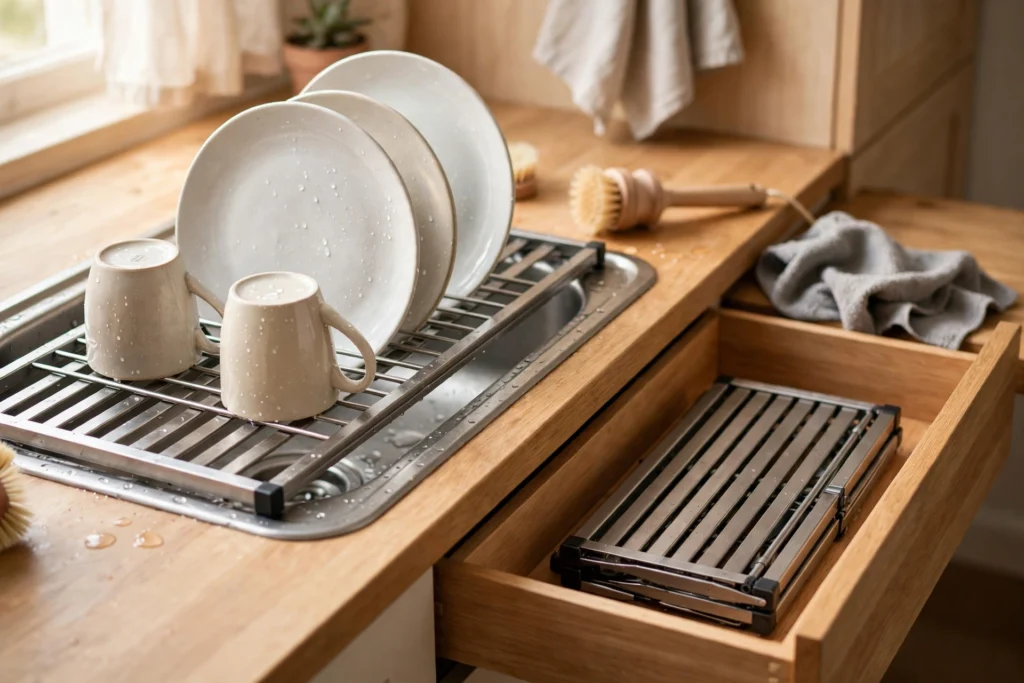
You do not need every type below. One rack, matched to your sink and your washing habits, is enough for most small kitchens.
Over-Sink Fixed Frame Racks
An over-sink fixed frame is a rigid frame that sits across the basin, with slots for plates, a cup for cutlery and a base that drains into the sink. It saves the most counter space of any rack type, because it uses no worktop at all.
The trade-off is fit. It must match the sink’s width, or it overhangs and slips. Look for adjustable feet or a frame that grips the rim.
For more on accessories that sit across the sink, see Over-the-Sink Accessories That Create More Prep Space.
Roll-Up Racks
A roll-up rack is a row of slim rods, usually stainless steel with silicone ends, that unrolls across the sink and rolls up into a drawer when you are done. It is the most space-saving type of all.
In use it is a drying surface, in storage it is a rolled mat the size of a tea towel. It holds a few items at a time — plates, mugs, a colander — so it suits a household that washes as it goes.
The trade-off is capacity: it will not hold a full load after a big dinner.
Foldable Racks
A foldable rack opens into a normal drying rack and folds flat when the dishes are dry. It suits a household that wants a proper rack — plate slots, a cutlery cup, a drain board — but not one that lives on the counter all day.
Look for a firm hinge and a flat folded shape that slides into a drawer or a narrow gap.
For folding tools in general, see Best Collapsible Kitchen Tools for Compact Homes.
Compact Countertop Racks
A compact countertop rack is a small, rigid rack that sits beside the sink — the ordinary type, just sized for a small kitchen. Choose the smallest size that holds a normal load.
Look for a drain board or a spout that directs water back into the sink, because a rack that drips onto the counter leaves a puddle you have to wipe up.
Dish Drying Mats
A dish drying mat is a flat, absorbent pad that sits on the counter beside the sink. It is not a rack at all, which is its strength.
It rolls or folds away when dry and takes up no height.
The trade-off is capacity and airflow. Dishes lie flat, so they dry more slowly than on a rack, and the mat itself needs to dry out fully between uses or it will smell. A mat works best paired with a small rack.
How to Choose by Sink Size and Household
The sink decides the rack more than the rack decides the sink. Measure the width across the rim and the bowl depth, and note whether the sink is single or double.
An over-sink or roll-up rack a centimetre too wide will not sit flat, and one a centimetre too narrow will slip into the basin.
Then match the rack to the household. A household of one or two that washes as it goes needs a roll-up rack or a small mat.
A household of three or four that washes once a day needs a compact countertop rack or a fixed over-sink frame that holds a full load.
If most of your load is plates and bowls, plate slots matter.
If it is glasses and mugs, a flat area or a mat matters more. Count a normal wash before you shop — six plates, four bowls, four mugs and a pan is typical for a household of two.
For the cabinet under the sink, and the storage that pairs with a drying rack, see Under-Sink Organization Ideas for Small Kitchens.
Drainage: Where the Water Goes
A rack that drains badly leaves puddles on the counter and water marks on the dishes, however well it holds them. Over-sink and roll-up racks drain best, because the water drips straight into the basin.
A countertop rack needs a drain board or a spout that angles back toward the sink. Check that the board slopes the right way and that the spout reaches the basin, not the edge of the counter.
A rack with no drain board at all is a tray of standing water — and standing water is what makes a rack smell.
Two habits matter as much as the design: shake dishes before you put them on the rack, and empty the drain board once the dishes are put away — a rack sitting in its own puddle will smell by evening.
Keeping a Drying Rack Clean and Fresh
A drying rack lives in the wettest corner of the kitchen, so it needs cleaning more often than most tools. Rinse it after every wash-up and let it dry fully before you fold it away.
Once a week, wash it properly with hot water and washing-up liquid.
Use a brush on the slots, joints and corners where food and soap collect.
If a rack starts to smell, dry it fully and leave it open to the air.
If the smell stays after a good wash, replace it. A scratched or cracked surface holds smells that washing cannot remove.
A Step-by-Step Plan for Choosing Your Rack

Work through these steps before you buy, and buy one rack only.
Step 1: Measure the sink and the counter. Measure the sink’s width and bowl depth, and the counter beside it. A rack that does not fit its home will live in the middle of the worktop.
Step 2: Count a normal wash. Count what you dry in a normal wash — that count is the capacity you need.
Step 3: Choose the type. Over-sink or roll-up if the counter is the problem, foldable if you want a rack that disappears, a mat if you wash a few things at a time.
Step 4: Check the drainage. Does the water go into the sink? A drain board that slopes the wrong way or a spout that misses the basin is a puddle waiting to happen.
Step 5: Test the fold or the roll. Open and close the rack a few times. It should fold or roll in one smooth movement, and sit flat without wobbling when open.
Step 6: Give it a fixed home. A roll-up rack in a drawer, a foldable rack upright in a narrow gap, a countertop rack beside the sink. For the counter around the sink, see Small Kitchen Counter Organization: Keep Your Counters Clear and Useful.
How to Store a Drying Rack When Not in Use

A drying rack only saves space if it is put away. A roll-up rack rolls into a drawer.
A foldable rack flattens into a drawer or slides upright into a narrow gap, and a mat rolls up or hangs over a tap.
A fixed over-sink frame leans upright in a narrow gap. Dry the rack before you store it — a rack put away damp will smell.
For pans and lids that also need a home after drying, see How to Organize Pots, Pans, and Lids in a Small Kitchen.
What to Look For Before You Buy
Dimensions. Compare the rack’s size with the sink and the counter you measured. A rack that is too wide will not sit flat, and one that is too narrow will slip.
Materials. Stainless steel is durable and easy to clean but heavy. Plastic is light and cheap but can warp and stain.
Durability. Check the joints, hinges and feet first. A rack lives or dies by its weakest joint, and a hinge that feels slack on day one will only get looser.
Cleaning. Smooth surfaces and parts that lift out wash fastest. A rack with narrow slots or a grooved drain board needs a brush.
Capacity. Choose the size that fits the wash you counted in Step 2. A rack that holds half a wash leaves the other half on the counter.
Storage footprint. How much room does it take when put away? A roll-up rack takes a drawer slot, and a foldable rack takes a slice of a gap.
Common Mistakes to Avoid
Buying a rack before measuring the sink. A rack a centimetre too wide will not sit flat, and one too narrow will slip. Measure first, buy second.
Choosing the smallest rack in the shop. The smallest rack looks tidy and leaves half your dishes on the counter. Size the rack for the wash you actually do.
Ignoring drainage. A rack with no drain board or a spout that misses the sink leaves a puddle on the counter every time you wash up.
Never cleaning the rack. A rack that is never washed will smell. Rinse it after every wash-up and wash it properly once a week.
Buying a rack with nowhere to store it. A foldable rack that lives open on the counter is not saving any space. If it has no home, it will live on the worktop and take back the space it saved.
Drying everything on the rack. A rack is for the daily wash, not for every pan and tray you own. For the wider method of working on a small counter, see How to Meal Prep with Limited Counter Space.
Frequently Asked Questions
What is the best dish drying rack for a very small kitchen?
A roll-up rack: it drains into the sink, takes up no counter, and rolls into a drawer. If you wash a full load once a day, a foldable rack or a small over-sink frame is better.
Do over-sink drying racks fit all sinks?
No — they must match the sink’s width, and they need a flat rim to rest on. Measure the width and bowl depth before you buy.
How do I stop my dish drying rack from smelling?
Rinse it after every wash-up, empty the drain board, and let it dry fully before you fold it away. Wash it properly once a week, and dry a mat fully between uses.
If the smell stays after a good wash, replace the rack.
Are foldable dish drying racks durable?
It depends on the hinge and the material. A rack with a firm hinge and thick frame usually holds up well, while a thin rack with a loose hinge will only get looser.
Can I use a dish drying mat instead of a rack?
Yes, for a few dishes at a time — glasses, mugs and cutlery dry well on a mat. For a full load, a rack dries faster because air moves around the dishes.
Conclusion
The best compact dish drying rack fits your sink, holds a normal wash, drains into the basin, and disappears when the dishes are dry. A roll-up rack suits a household that washes as it goes, and an over-sink frame suits one that wants the counter clear.
Start with the six-step plan: measure, count, choose, check the drainage, test the fold, and give the rack a home. Then keep it clean and dry it before you store it.
For the wider picture, see Best Space-Saving Kitchen Tools for Small Kitchens — and for the tools that earn their storage space alongside it, read Small Kitchen Essentials: Tools That Earn Their Storage Space. In the next article, Wall-Mounted Kitchen Tools That Free Up Counter Space, we look at the tools that move storage off the counter and onto the wall.