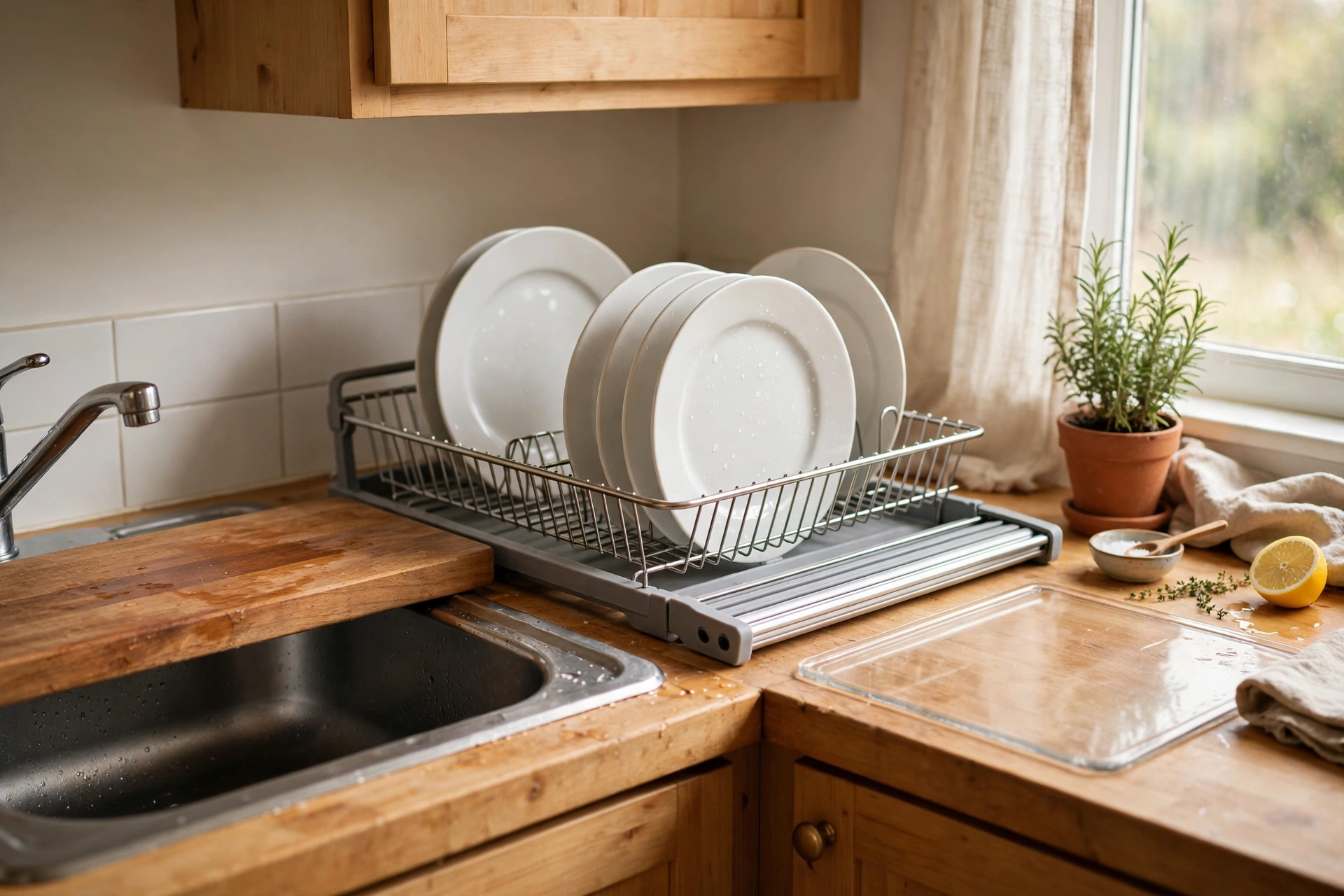
The best over the sink kitchen accessories turn the sink into extra worktop: a board that rests across the rim for chopping, a roll-up rack that drains dishes over the bowl, and a sink cover that gives you a flat surface where the basin used to be. Together they can add a whole chopping area to a small kitchen, without a remodel.
This guide covers the accessory types worth considering, how the sink becomes a second worktop, how to use the sink area safely, how to choose by sink type, and the mistakes to avoid.
Table of Contents
- What Makes an Over-the-Sink Accessory Worth Buying?
- Over the Sink Kitchen Accessories: The Types Worth Considering
- How the Sink Becomes a Second Worktop
- Hygiene Basics: Using the Sink Area Safely
- Choosing by Sink Type
- A Step-by-Step Plan for Choosing Over-the-Sink Accessories
- What to Look For Before You Buy
- Common Mistakes to Avoid
- Frequently Asked Questions
- Conclusion
What Makes an Over-the-Sink Accessory Worth Buying?
An over-the-sink accessory earns its place only if it turns dead space into a working surface, or into a drying space that frees the counter. That is the whole test.
It does one of three honest jobs. It covers the basin, like a board or a sink cover, so you can chop or stack on top of it. It drains over the basin, like a roll-up rack, so washed dishes drip into the sink. Or it strains over the basin, like a colander, so you can rinse without holding anything over the worktop.
The test is simple: does it give you more room to work, and does it lift off in seconds when you need the tap? If it blocks the sink or wobbles, skip it.
Over the Sink Kitchen Accessories: The Types Worth Considering
You do not need every type below — one or two solve most problems. Start with the job you do most, and buy for that job first.
Over-Sink Cutting Boards
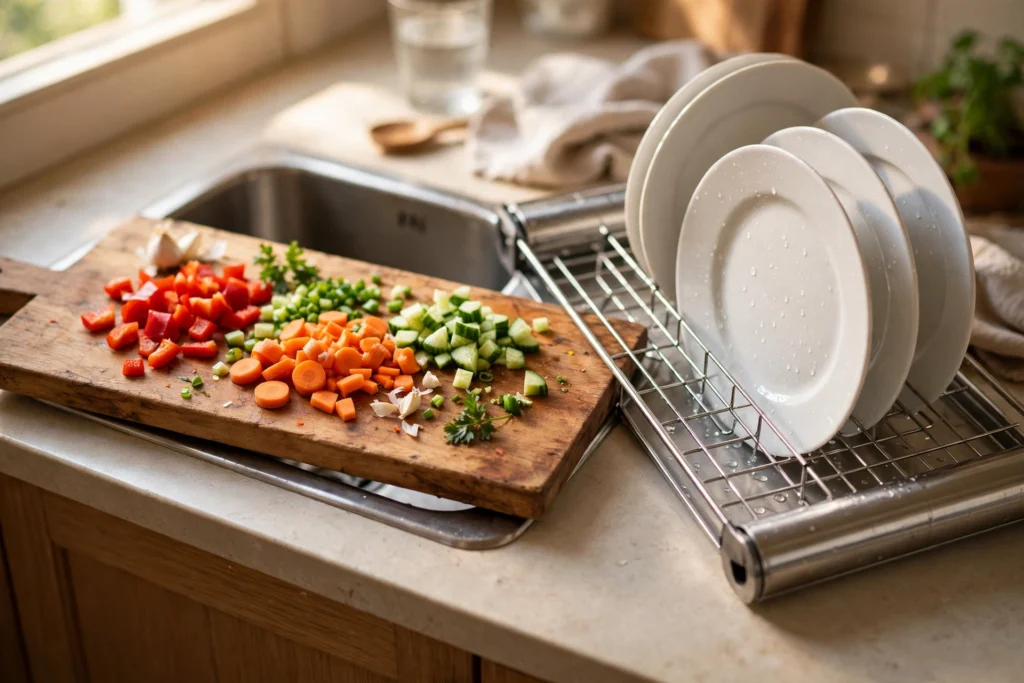
An over-sink cutting board rests on the rim of the sink and turns it into a second chopping surface. Choose one with a lip, rails or rubber feet that grip the edges, and measure the sink first: it must sit flat without wobbling and lift off in seconds when you need water.
For board materials, sizes and the prep tools that pair with them, see Space-Saving Cutting Boards and Prep Tools for Small Kitchens.
Roll-Up Dish Racks
A roll-up rack is a row of slim rods, usually stainless steel with silicone ends, that unrolls across the sink. Unroll it to drain washed plates and vegetables, then roll it up into a drawer.
The trade-off is capacity — it holds a few items, not a full load — so it suits a small household’s daily washing up rather than a big family dinner.
Over-Sink Drying Racks
An over-sink drying rack is a fixed frame that sits across the sink, holding plates, bowls and cutlery while they drip into the basin. It saves more counter space than a freestanding rack, because the drips go into the sink instead of onto the worktop.
Look for one that fits your sink exactly — too wide and it overhangs, too narrow and it slips — and that lifts off easily for cleaning, because food and soap collect under the frame.
Sink Covers
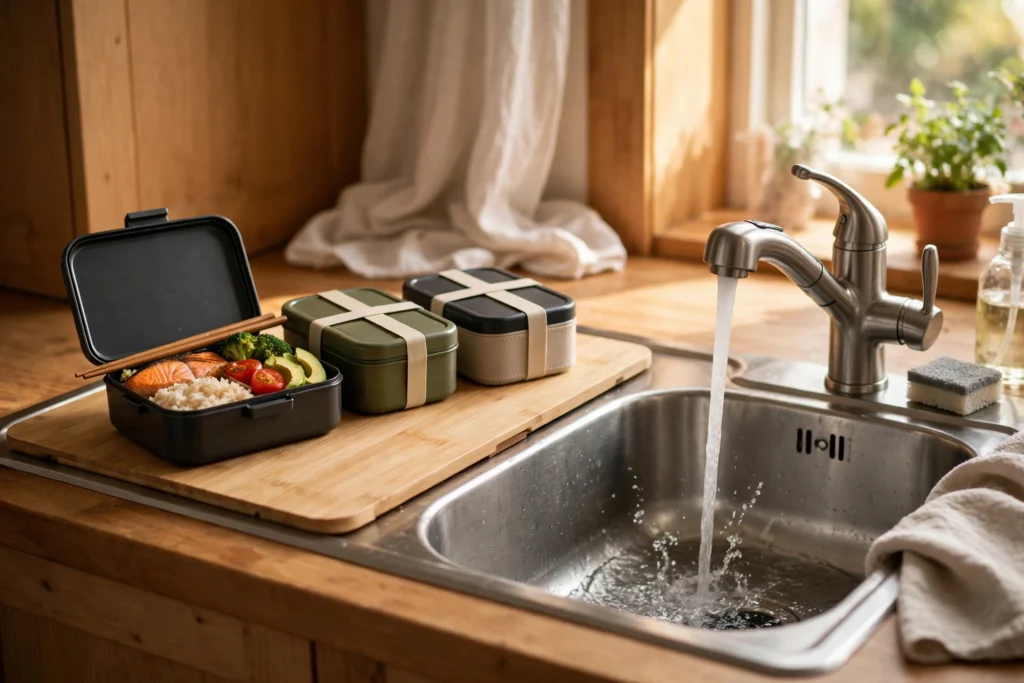
A sink cover is a flat panel — wood, plastic or stainless steel — that sits over the basin and gives you a plain, level surface: a whole extra stretch of worktop for stacking, serving or packing lunches.
The trade-off is that the sink is out of action while the cover is on, so it works best once the washing up is done, or over one bowl of a double sink.
Over-Sink Colanders and Strainers
A colander that sits across the sink — on extending arms, a rim, or a frame — lets you rinse vegetables and drain pasta without holding anything over the counter. The trade-off is storage: a rigid over-sink colander is bulky, so a folding version earns its space more easily.
For folding options, see Best Collapsible Kitchen Tools for Compact Homes.
How the Sink Becomes a Second Worktop
The sink is not a worktop by itself — it becomes one when the accessories work as a set. Think of it in three zones: the board for chopping, the rack for draining, and the cover for stacking. You only need one zone active at a time.
Start by clearing the counter beside the sink, so there is somewhere to set the accessory down. Then choose the job: for chopping, rest the board across the basin with a small bowl beside it — chopped food goes into the bowl, peelings into a scrap bowl, and the board lifts off when you need the tap.
For draining, unroll the rack and let washed items drip into the basin. For stacking, cover one bowl of a double sink as a landing pad for packed lunches.
For the wider method of working on a small counter, see How to Meal Prep with Limited Counter Space.
Hygiene Basics: Using the Sink Area Safely
The sink is where raw meat is rinsed and dirty dishes are washed — so anything that touches food over the sink needs more care than a board on the counter.
Clean the sink before you prep over it. Rinse the basin, wipe the rim, and clear dirty dishes away first. A board over a dirty sink is a board over dirty water.
Keep raw meat and ready-to-eat food separate. Use a different board — or a different colour — for raw meat and fish, and wash the board and sink after raw meat.
Choosing by Sink Type
Not every accessory fits every sink, and the wrong match is the most common reason these tools end up unused. Measure the sink before you buy anything.
A double-bowl sink is the best case: cover one bowl and keep the other free for water, so you can chop over one side and rinse in the other. Measure each bowl separately, because the two are often different sizes.
A shallow or small sink — common in flats and older kitchens — limits what fits across it. A board that is too wide will overhang and tip, and a heavy rack will strain a shallow basin.
For the cabinet under the sink — the storage that pairs with these accessories — see Under-Sink Organization Ideas for Small Kitchens.
A Step-by-Step Plan for Choosing Over-the-Sink Accessories

Work through these steps before you buy.
Step 1: Measure the sink. Measure the width across the rim, the depth front to back, and the bowl depth. Note whether it is single or double, and whether the rim is flat or curved. An accessory a centimetre too wide will not sit flat.
Step 2: Name the job. Chopping space, drying space, or somewhere to stack? One job, one accessory — a board for chopping, a roll-up rack for drying, a cover for stacking.
Step 3: Check what you already own. You may already have a board that fits across the sink, or a colander that sits over it — try what you own first.
Step 4: Buy one accessory first. Start with the one that solves the biggest frustration — usually the board or the roll-up rack — and live with it for a few weeks before adding the next.
Step 5: Give each accessory a fixed home. A roll-up rack in a drawer, a board upright in a narrow gap, a cover on a hook. If it has no home, it will live on the counter and take back the space it saved. For the counter around the sink, see Small Kitchen Counter Organization: Keep Your Counters Clear and Useful.
Step 6: Build the habit. Use it for one job a day for a week.
What to Look For Before You Buy
Dimensions. Compare the accessory’s size with the sink you measured — width, depth, and tap clearance. The stored size matters too: a cover with nowhere to live will end up on the counter.
Materials. Stainless steel is durable and easy to clean, but heavy. Wood is kind to knives but should not be soaked. Silicone grips well but can stain and is too soft for heavy chopping. Plastic is light and cheap but can warp and scar.
Durability. Check the edges, rails and joints first: an accessory lives or dies by its grip. A warped board rocks, and a loose joint sags.
Cleaning. Smooth surfaces wash fastest; narrow slats or a grooved board need a brush. Anything that cannot be cleaned properly after raw meat is not safe to keep.
Capacity. A board that is too small leaves you chopping in batches, and a rack that holds two plates does not solve a drying problem. Choose the size that fits your meals and your dishes.
Storage footprint. How much room does the accessory take when it is put away?
Common Mistakes to Avoid
Buying an accessory before measuring the sink. A board a centimetre too wide will not sit flat, and a rack that overhangs will slip. Measure first, buy second.
Covering the sink and then needing the tap. A sink cover is useless if you need water every few minutes — use it for stacking, not while you are cooking.
Leaving the accessory over the sink all day. A board left across the basin is a sink you cannot use, and a rack left over it collects dirty dishes.
Forgetting about weight. A heavy board or a rack full of wet plates can strain a shallow sink or slip on a curved rim — check the grip first.
Buying a set of accessories at once. A board, a rack, a cover and a colander all at once is a drawer full of tools you have not learned to use. Buy one, then add the next only when you can name its job.
Prepping over a dirty sink. The sink must be clean before food goes near it. Wash the basin and the rim first, every time.
Frequently Asked Questions
Are over-the-sink accessories worth it in a very small kitchen?
Yes — the sink is often the biggest unused surface in a small kitchen, and one accessory can add a whole chopping area. Start with a board or a roll-up rack, whichever solves your biggest frustration.
Can I use a cutting board over the sink safely?
Yes, if the sink is clean first, the board sits flat without wobbling, and you use a separate board — or a different colour — for raw meat. Wash the board and sink after raw meat, and dry the board before storing it.
What is the best over-the-sink accessory to buy first?
A roll-up dish rack, for most households: it unrolls in seconds, drains into the sink, rolls up into a drawer, and doubles as a cooling rack. If chopping space matters more, buy a board first.
Do over-the-sink accessories work with a double sink?
Yes — a double sink is the best case: cover one bowl and keep the other free for water. Measure each bowl separately, because the two are often different sizes.
How do I store over-the-sink accessories in a small kitchen?
A roll-up rack goes in a drawer, a board stands upright in a narrow gap or against the wall, and a cover hangs on a hook or slides behind a cupboard door. For containers that stack beside them, see Best Stackable Kitchen Storage Containers for Small Spaces.
Conclusion
Over the sink kitchen accessories earn their space by turning the basin into a working surface: a board that adds a chopping area, a roll-up rack that drains dishes into the sink, and a cover that gives you a flat surface for stacking. One or two well-chosen accessories can add a whole prep area to a small kitchen, without a remodel.
Start with the six-step plan: measure the sink, name the job, check what you already own, buy one accessory, give it a home, and build the habit — then keep the sink clean, keep raw meat separate, and put the accessory away when the job is done.
For the wider picture, see Best Space-Saving Kitchen Tools for Small Kitchens — and for the tools that earn their storage space alongside them, read Small Kitchen Essentials: Tools That Earn Their Storage Space. In the next article, Best Slim Kitchen Carts for Extra Storage and Workspace, we look at the carts that bring extra storage and worktop to wherever you need it.
2 thoughts on “Over-the-Sink Accessories That Create More Prep Space”