
The best slim kitchen carts give a small kitchen two things it is short of: a place to store things and a surface to work on. A narrow trolley that slides into the gap beside the fridge, a rolling cart that wheels to the cooker when you need it, or a small island cart that adds a chopping surface — each one brings storage and worktop to wherever you need it, without changing the room.
A slim kitchen cart works because it fits a gap that was doing nothing. If a cart has no gap to go back to, it becomes a permanent obstacle. Before you buy one, name its two jobs — “it will hold the oils and baking trays, and it will be the surface I chop on” is a real plan; “it will hold things” is not.
This guide covers the cart types, how to measure for one, wheels and stability, what to store on each shelf, using a cart as extra worktop, and the mistakes to avoid.
Table of Contents
- What Makes a Slim Kitchen Cart Worth Buying?
- Slim Kitchen Cart Types Worth Considering
- How to Measure for a Slim Cart
- Wheels, Brakes and Stability
- What to Store on a Slim Cart
- Using a Cart as Extra Worktop
- A Step-by-Step Plan for Choosing a Slim Cart
- What to Look For Before You Buy
- Slim Carts in Rented Kitchens
- Common Mistakes to Avoid
- Frequently Asked Questions
- Conclusion
What Makes a Slim Kitchen Cart Worth Buying?
A slim kitchen cart earns its place only if it does two jobs at once: it stores things that have no home, and it gives you a surface to work on. The good ones do both — oils and spices below, a clear top for chopping above.
The other test is where it lives when you are not using it. A slim cart works because it fits a gap that was doing nothing. If a cart has no gap to go back to, it becomes a permanent obstacle in the only walkway.
For the wider picture of adding storage without changing the room, see How to Create More Storage in a Small Kitchen Without Remodeling.
Slim Kitchen Cart Types Worth Considering

You only need one cart — the type that fits your gap and your cooking. The three types below cover almost every small kitchen.
Narrow Gap Trolleys
A narrow gap trolley is a slim, tall cart — often only 10 to 15 cm (4 to 6 inches) wide — that slides into the gap between the fridge and the counter or between the cooker and a cabinet. It usually has three or four shallow shelves for oils, spices, and tins.
Rolling Kitchen Carts
A rolling cart is the most versatile type: two or three shelves, sometimes a drawer, on four wheels, with a flat top. It wheels to the cooker while you cook and back into its gap when you are done.
Small Island Carts
A small island cart is a heavier, wider cart with a solid top that acts as a mini island in the middle of the kitchen or at the end of a run of units. It adds the most work surface of any cart type, and the shelves underneath hold pots, pans, or dry food.
The trade-off is that it takes up floor space permanently, so it only works where there is room to walk around it.
How to Measure for a Slim Cart
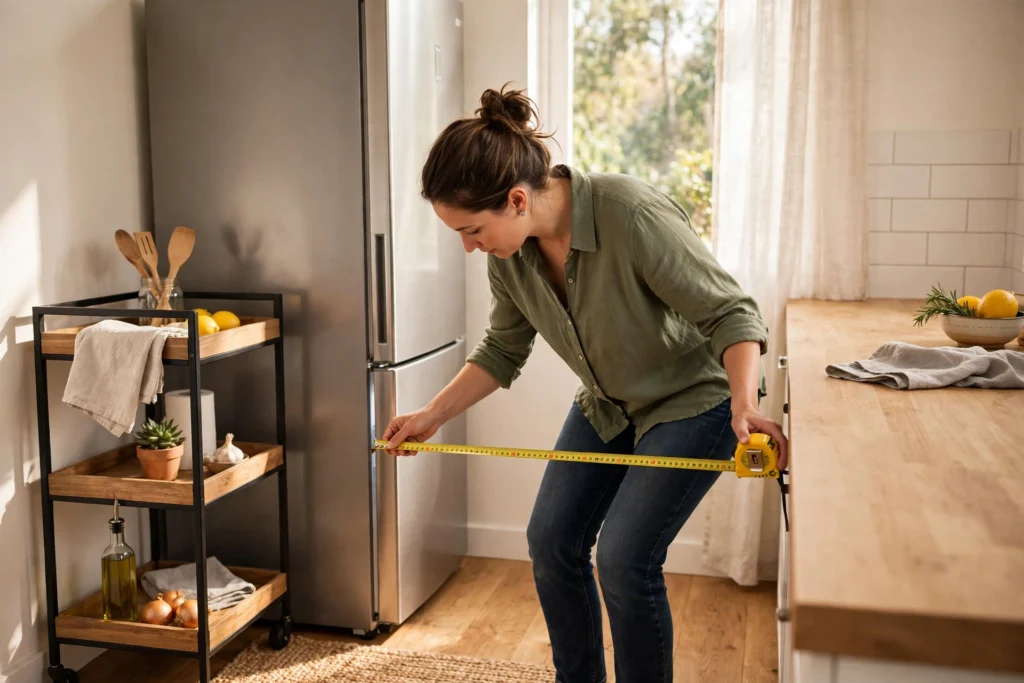
Measure before you shop — a cart a centimetre too wide for its gap is a cart that lives in the middle of the room. Start with the gap where the cart will park: measure the width between the two things it will sit between, the depth from the wall to the front of the cabinets, and the height under any overhang.
Subtract at least 2 cm (about an inch) from the width so the cart slides in and out without scraping. A cart that scrapes the fridge every time you move it will damage both, and you will stop moving it.
Wheels, Brakes and Stability
Wheels are what make a cart a cart, and they are also what make it a problem if they are wrong. A cart with four free-rolling wheels will drift across the floor.
At least two wheels should lock — with a brake you press with your foot — so the cart stays put while you chop on it. Lock the wheels whenever you use the top as a work surface. If the wheels do not lock, the cart is a table that moves, and that is not safe to chop on.
Stability matters as much as the brakes. A tall, narrow cart is easy to tip, especially when the top shelf is loaded and the bottom is empty. Put heavy things low and light things high — pots and tins on the bottom shelf, spices and tea towels on the top.
What to Store on a Slim Cart
A cart works best when each shelf has one clear job. The top shelf is for the things you reach for while cooking: oils, salt, pepper, and everyday spices. The middle shelves are for tins, jars, dry food, and baking trays. The bottom shelf is for heavy things — pots, pans, and the slow cooker — where their weight keeps the cart steady.
For containers that stack neatly on a cart shelf, see Best Stackable Kitchen Storage Containers for Small Spaces.
Using a Cart as Extra Worktop

A cart earns its space when its top becomes a real work surface, not just a lid on a shelf. Wheel it to where you are working, lock the wheels, clear the top, and work on it the way you would work on a counter.
A cart top is at its best for jobs that need a small, clear surface — chopping vegetables, mixing a salad, packing lunch boxes — and it pairs well with a board over the sink, as in Over-the-Sink Accessories That Create More Prep Space.
The habit that makes it work is putting the cart back when the job is done — a cart left in the middle of the floor blocks the only walkway. When you finish, wipe the top and roll it back into its gap. For the counter the cart works beside, see Small Kitchen Counter Organization: Keep Your Counters Clear and Useful.
For the wider method of working on a small counter, see How to Meal Prep with Limited Counter Space.
A Step-by-Step Plan for Choosing a Slim Cart
Work through these steps before you buy.
Step 1: Find the gap. Look for the unused gap in your kitchen — beside the fridge, beside the cooker, or at the end of a run of units. If there is no gap, a wall rack or shelf riser may suit better — see Small Kitchen Storage Racks and Organizers Worth Considering.
Step 2: Measure the gap, the route, and the doorway. Measure the gap, subtract at least 2 cm from the width, and measure the route and the doorways. Write the numbers on a card.
Step 3: Name the cart’s two jobs. Write down what it will store and what you will do on its top. “It will hold the oils and baking trays, and it will be the surface I chop on” is a real plan.
Step 4: Choose the type. A narrow gap trolley for a thin gap; a rolling cart for a wider gap and both jobs; a small island cart for open floor.
Step 5: Check the wheels and the weight. Make sure at least two wheels lock, the cart feels stable, and the shelves will hold what you plan to put on them. Press a corner of the top and push the cart sideways before you buy.
Step 6: Live with it for a few weeks.
What to Look For Before You Buy
Dimensions. Compare the cart’s width, depth, and height with the gap you measured — including the wheels and handles.
Materials. Metal carts are strong and easy to wipe clean, but can be heavy and can rust near the sink if the coating chips. Wood is warm and sturdy but should not be soaked. Plastic is light but can flex under weight.
Durability. Check the joints, the welds, and the wheels first: a cart lives or dies by its frame and its castors.
Cleaning. A cart top that wipes clean in seconds gets wiped properly.
Capacity. Choose shelves with a weight limit that fits what you plan to store — a cart that cannot hold a full pot or a stack of plates is not worth the floor space.
Storage footprint. How much room does the cart take when parked, and does it fit the gap with room to roll?
Slim Carts in Rented Kitchens
Slim carts are one of the best buys for a rented kitchen, because they change nothing about the room: no drilling, no fixing, no holes to fill when you leave. A cart moves with you to the next home.
For more renter-specific ideas, see Small Kitchen Organization for Renters: No-Drill Storage Ideas.
One caution for renters: a heavy cart can mark a soft floor, especially vinyl or laminate, if it sits in one spot for months. Put small felt pads under the wheels, or move the cart a little each week, so the weight does not leave dents.
Common Mistakes to Avoid
Buying a cart before measuring the gap. A cart a centimetre too wide will not fit its gap, and a cart too deep will stick out past the cabinets.
Choosing a cart with no locking wheels. A cart that rolls while you chop is not safe. At least two wheels must lock.
Loading the top shelf and leaving the bottom empty. A top-heavy cart tips easily. Heavy things low, light things high.
Letting the cart top become a dumping ground. Post, keys, and chargers turn a work surface into a shelf. Keep the top clear.
Buying a cart to hold things you should have decluttered. A new cart does not help if it is filled with things you never use. Declutter first — see Best Space-Saving Kitchen Tools for Small Kitchens.
Blocking a walkway, a drawer, or a door. A cart parked across a drawer or in front of the fridge door is an obstacle. Check every door and drawer after you park it, and roll the cart out again if anything catches.
Forgetting the counter beside the cart. The cart needs a clear counter to work with — a place to set things down while you load and unload it.
Frequently Asked Questions
How wide should a slim kitchen cart be?
As wide as the gap it will live in, minus at least 2 cm so it slides in and out without scraping. Measure the gap first, then choose the cart — never the other way round.
Can a kitchen cart really replace extra counter space?
For most small kitchens, yes — for jobs that need a small, clear surface, such as chopping, mixing, and packing lunches. It works best wheeled to where you are working and put back afterwards.
Are slim kitchen carts good for renters?
Yes — they need no drilling or fixing and they move with you. Just check for floor marks if the cart sits in one spot for a long time, and leave a small gap between the cart and the wall.
Do I need a cart with locking wheels?
Yes. At least two wheels should lock, so the cart stays put while you work on its top. A cart without locking wheels is not safe to chop on.
Conclusion
The best slim kitchen carts earn their space by doing two jobs at once: they store the things that have no home, and they give you a surface to work on — then they roll back into a gap that was doing nothing. A slim kitchen cart can add a whole prep area to a small kitchen, without a remodel.
Start with the six-step plan: find the gap, measure it, name the cart’s two jobs, choose the type, check the wheels, and live with it for a few weeks. Then keep the top clear and the wheels locked while you work.
For the wider picture, see Best Space-Saving Kitchen Tools for Small Kitchens — and for the tools that earn their storage space alongside them, read Small Kitchen Essentials: Tools That Earn Their Storage Space. In the next article, Compact Dish Drying Racks for Small Kitchen Sinks, we look at the racks that dry dishes over the sink.