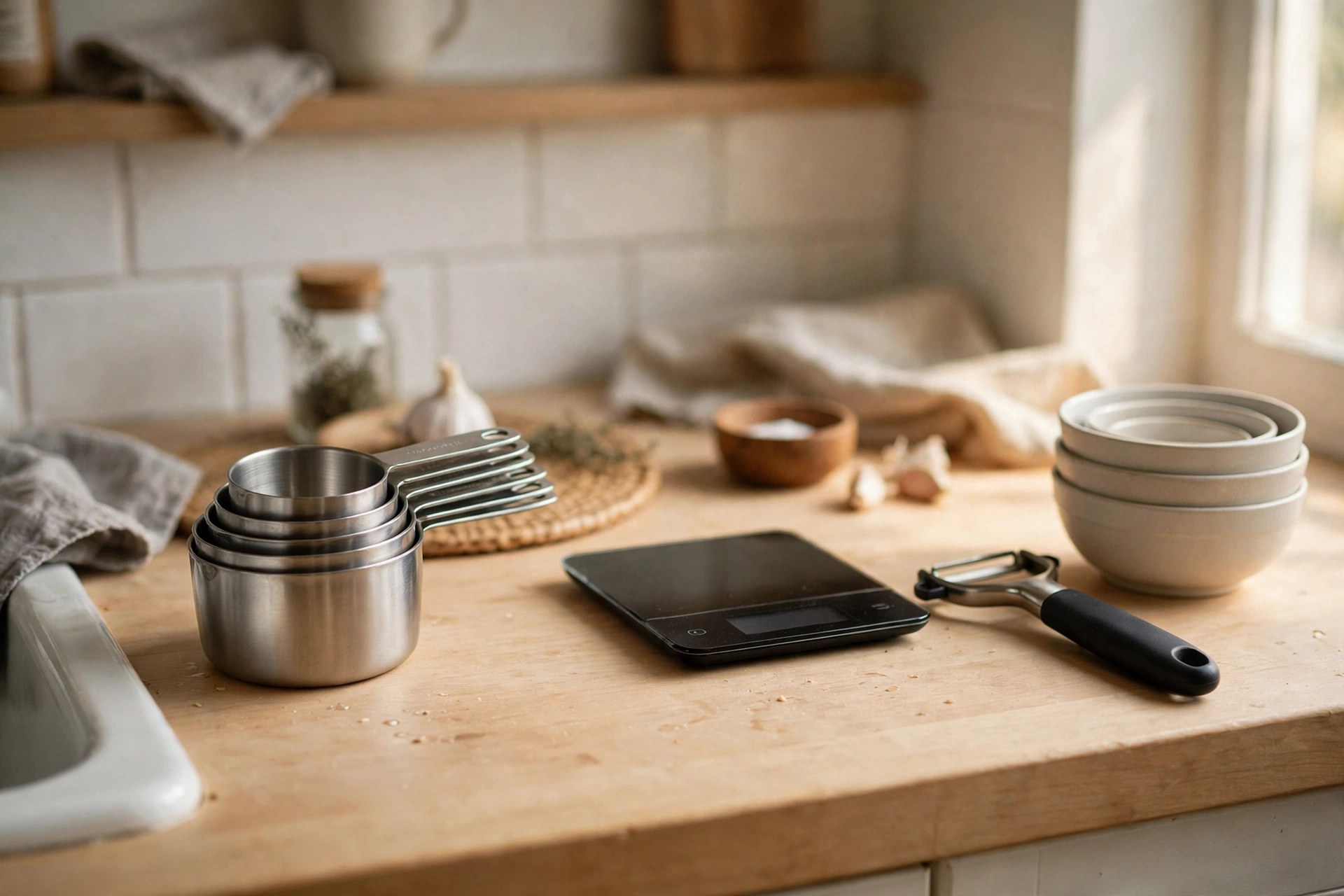
The best kitchen prep tools for small kitchens stack, nest or fold into a single drawer: nesting measuring cups and spoons, a slim kitchen scale, a peeler, a small grater and two or three nesting mixing bowls. That set covers almost every everyday meal.
This guide covers the small kitchen utensils worth owning, how to choose them, and how to store them.
Table of Contents
- What Makes a Measuring or Prep Tool “Space-Saving”?
- Kitchen Prep Tools for Small Kitchens: The Set Worth Owning
- How Much Measuring and Prep Gear Does a Small Kitchen Need?
- Measuring Accurately in a Small Kitchen
- A Step-by-Step Plan for Building Your Set
- How to Store Measuring and Prep Tools
- What to Look For Before You Buy
- Common Mistakes to Avoid
- Frequently Asked Questions
- Conclusion
What Makes a Measuring or Prep Tool “Space-Saving”?
A measuring or prep tool saves space only if it does its job without adding clutter. Most measuring tools fail that test: cups that do not nest take up a whole shelf, and a scale that does not fit in a drawer lives on the counter.
A tool saves space in three ways. It nests, like measuring cups that fit inside each other.
It is slim enough for a drawer, like a flat scale. Or it does two jobs, like a jug that also mixes batter.
The other test is use: a tool you reach for every day earns a drawer slot.
Kitchen Prep Tools for Small Kitchens: The Set Worth Owning
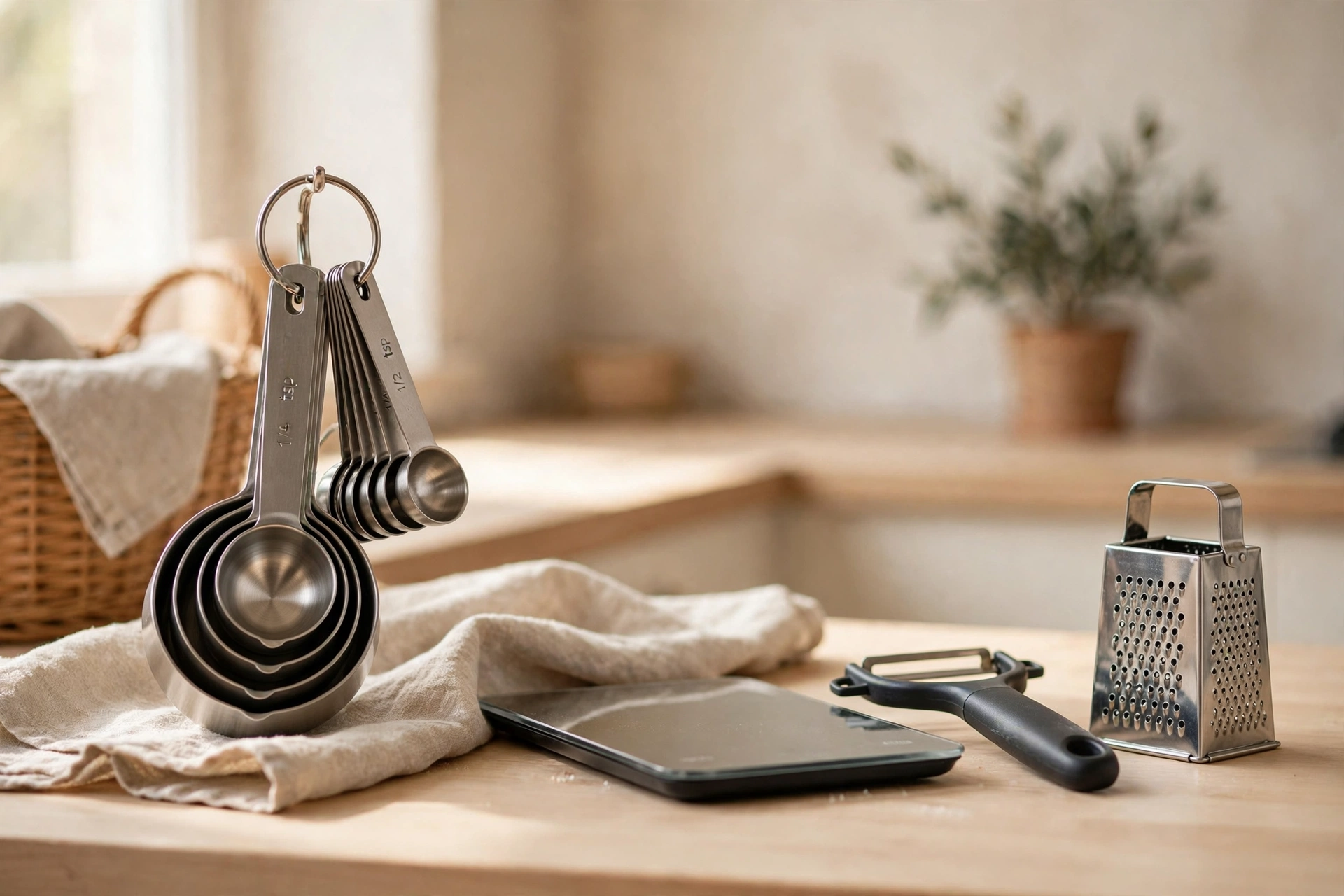
You do not need every tool below — the core set is small, and each tool below earns its place for a different reason.
Nesting Measuring Cups
Nesting measuring cups are the foundation of the set. A set of four or five cups nests into a stack the size of a single cup, held together by a ring or clip so they do not scatter in the drawer.
Choose cups with clear markings you can read at a glance. Cups suit dry ingredients best: spoon flour in and level it off.
Nesting Measuring Spoons
Nesting measuring spoons work the same way: a set of four or five spoons nests into a stack the size of one spoon and clips together on a ring. They are the tool for the small amounts that decide whether a dish works: salt, baking powder, spices and oil.
Look for a narrow shape that fits into a spice jar, and markings that will not rub off. A set that clips together stays together in the drawer.
A Compact Kitchen Scale
A kitchen scale is the most accurate measuring tool in a small kitchen, and the most space-saving, because it replaces the cups for many jobs. A slim, flat scale slides into a drawer and weighs ingredients straight into the bowl, so there is less washing up.
It is the tool for baking, where a few extra grams of flour change the result. Look for a clear display you can read with a bowl on top, and a tare button that resets the weight to zero.
Peelers, Graters and Small Cutting Tools
A peeler is slim, cheap and faster than a knife at peeling, and it fits in a drawer slot. Kitchen scissors are the second small tool: they cut herbs, open packets and trim meat for small jobs, and they hang from a hook or sit in a drawer.
For the board these tools work with, see Space-Saving Cutting Boards and Prep Tools for Small Kitchens.
A small box grater grates cheese, shreds carrots and zests citrus from one upright tool that takes up the space of a mug, while a flat grater is slimmer still and slides into a drawer. Store a grater sharp-side in, so it does not catch on your hand.
Nesting Mixing and Prep Bowls
Nesting mixing and prep bowls are the containers that hold everything together. A set of three bowls that nest into one stack takes up the space of a single bowl: one large bowl — around 28 cm (11 in) across — for batter and salads, one medium for vegetables, and one small for eggs and sauces.
A set of four or five tiny prep bowls lets you measure and chop everything before you start cooking. They nest too, and a stack of them fits in a drawer.
For tools that do several jobs at once, see Multi-Functional Kitchen Tools That Save Space.
How Much Measuring and Prep Gear Does a Small Kitchen Need?
For a household of one or two, the core set is small: nesting measuring cups and spoons, one slim scale, one peeler, one small grater and three nesting bowls. That is the whole set, and it fits in one drawer and one shelf.
For a household of three or four, add one more bowl, and a second peeler only if two people prep at once. More than that, and you are storing duplicates: two sets of cups do not measure twice as well.
Cook a normal week with what you have, then count what you actually reached for.
Measuring Accurately in a Small Kitchen
Good measuring matters most for baking, where a small error changes the result. The scale is the most accurate tool: weigh flour, sugar and butter rather than scooping them, because a scooped cup of flour can weigh very differently.
If you do use cups, spoon dry ingredients in lightly and level the top with the back of a knife — never pack them down. Wet and dry ingredients need different tools.
A jug with a spout suits liquids — pour at eye level and read the marking at the bottom of the curve — while a dry cup suits flour and sugar. Measuring spoons suit both, as long as you level them off.
Measure everything before you start cooking, into small prep bowls.
Also, weigh straight into the bowl, using the tare button between ingredients, so there is one bowl to wash. For the wider method of working on a small counter, see How to Meal Prep with Limited Counter Space.
A Step-by-Step Plan for Building Your Set

Work through these steps before you buy, and buy one tool at a time.
Step 1: Empty the drawer and count what you own. Take every measuring and prep tool out of the drawer and cupboard, and count them. Most small kitchens have two sets of cups and a drawer of gadgets they never use.
Step 2: Sort by use. Sort the tools into three groups: used weekly, used monthly, and unused for six months. The weekly group is your core set, and the unused group leaves the kitchen.
Step 3: Find the gaps. Compare what is left with the core set in this guide: nesting cups and spoons, a slim scale, a peeler, a small grater and three nesting bowls. The gaps are what you need to buy — usually one or two tools, not a whole set.
Step 4: Buy one tool at a time. Buy the tool that solves the biggest frustration first — usually the scale or the nesting bowls — and use it for a few weeks before buying the next one.
Step 5: Give each tool a fixed home. A drawer slot for the cups and spoons, a flat spot for the scale, a hook for the scissors. If a tool has no home, it will live on the counter.
Step 6: Measure a week of meals with the new set. Cook a normal week using only the core set.
How to Store Measuring and Prep Tools
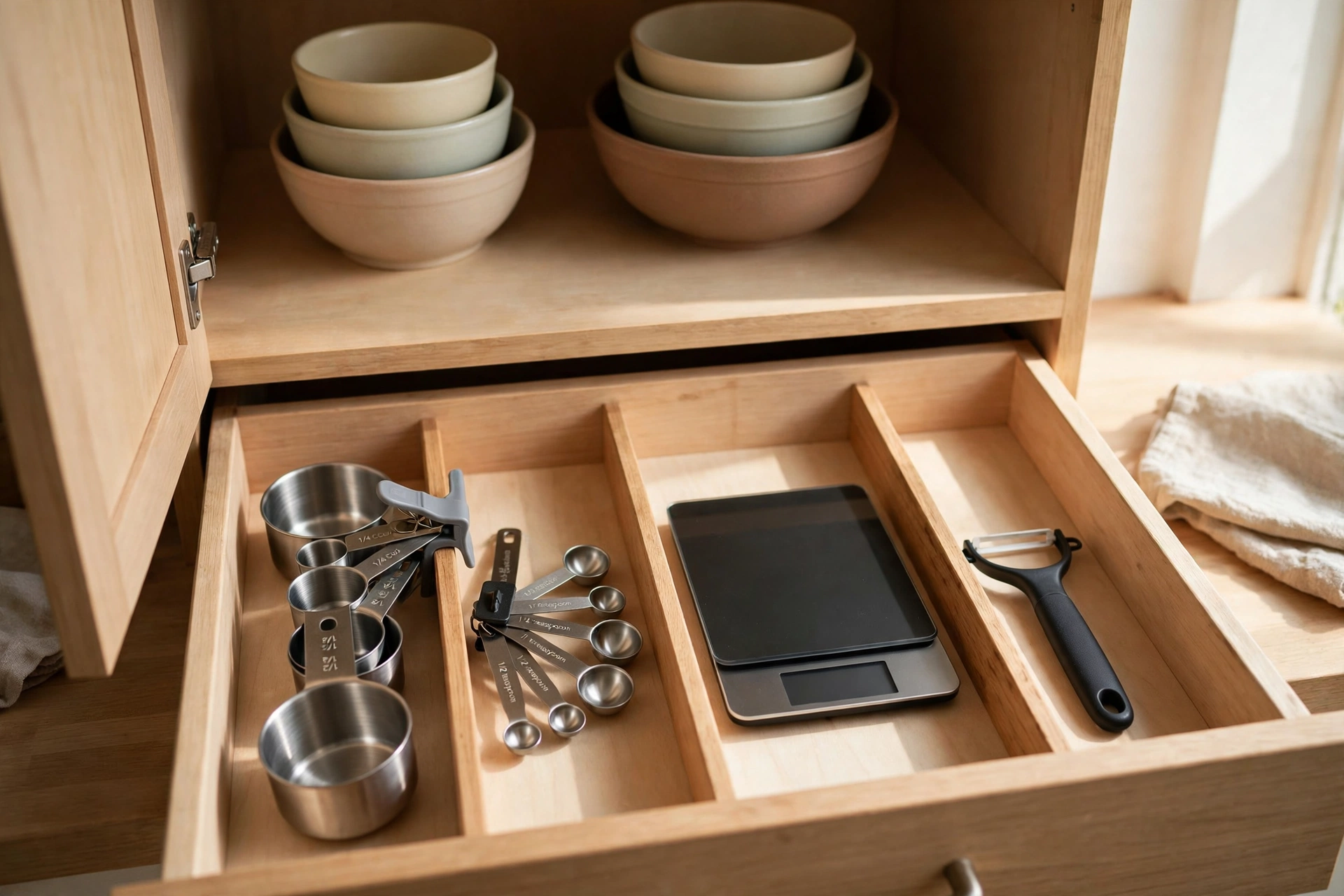
A small drawer is the best home for these tools, because they are small, flat and used at the counter. Keep the cups and spoons clipped together in one corner, the scale flat at the back, and the peeler and grater in a slot beside them.
For drawer layouts, see How to Organize Kitchen Drawers in a Small Kitchen. For the dividers that keep the set tidy, see Drawer Organizers and Dividers for Small Kitchen Tools.
A wall hook is the second home, and it suits the tools with a hole or a loop: measuring spoons on a ring, scissors and a flat grater all hang from a rail beside the prep area. Hanging them leaves the drawer for the scale, the bowls and the cups.
For rails and hooks, see Wall-Mounted Kitchen Tools That Free Up Counter Space.
Nesting bowls live stacked in a cupboard, largest at the bottom. Keep the stack short — three bowls is plenty — and dry bowls before you stack them, or the stack will smell.
For containers that stack beside the bowls, see Best Stackable Kitchen Storage Containers for Small Spaces.
What to Look For Before You Buy
Dimensions. Compare the tool’s size with the drawer or hook where it will live. A scale that does not fit the drawer will live on the counter.
Materials. Stainless steel cups and spoons are durable and easy to clean. Plastic is light and cheap but can warp and hold smells.
Durability. Check the joints, handles and markings first. A measuring cup with markings that rub off is useless, and a peeler with a loose blade will only get looser.
Cleaning. Smooth surfaces and parts that come apart wash fastest. A grater with narrow slots needs a brush, and a scale must be wiped clean and kept dry.
Capacity. A bowl that is too small means mixing in two batches. Choose the size that fits the meals you cook.
Storage footprint. How much room does the tool take when put away? A nesting set takes the space of one tool, and a scale takes a flat drawer slot.
Common Mistakes to Avoid
Buying a whole set before you know what you need. A twenty-piece set fills a drawer with tools you never use. Buy the core set first, then add one tool at a time.
Choosing the smallest tools in the shop. The smallest jug and the smallest bowl look tidy and frustrate you at home. Size the tool for the meals you cook.
Keeping duplicates “just in case.” Two sets of cups do not measure better than one. Keep the best of each and let the rest go.
Scooping flour from the bag. Scooping packs the flour down, so the measurement is wrong. Spoon it in lightly and level it off, or weigh it.
Using a dry cup for liquids. A dry cup has no spout, so liquids spill and the measurement is wrong. Use a jug for liquids and a cup for dry ingredients.
Leaving the scale on the counter. A scale on the counter takes up worktop and gets wet. Store it flat in a drawer, and wipe it clean before you put it away.
Frequently Asked Questions
Do I need both measuring cups and a kitchen scale?
For everyday cooking, cups and spoons are enough. For baking, a scale is worth having: it is more accurate and weighs straight into the bowl.
What is the best measuring tool for a very small kitchen?
A slim kitchen scale: it replaces the cups for many jobs and slides into a drawer. If you bake rarely, nesting cups and spoons are the better first buy.
Are nesting measuring cups accurate?
Yes, as long as you use them properly: spoon dry ingredients in lightly and level the top with the back of a knife, rather than scooping straight from the bag. A scale is more accurate still, but cups are accurate enough for most everyday cooking.
How many mixing bowls does a small kitchen need?
Three: one large bowl for mixing and tossing, one medium bowl for vegetables and marinades, and one small bowl for eggs and sauces. Add small prep bowls if you like to measure everything before you start cooking.
Can I store measuring tools on the wall?
Yes — measuring spoons on a ring, scissors and a flat grater all hang well from a rail or a hook. Keep the scale and bowls in a drawer or cupboard.
Conclusion
The best kitchen prep tools for small kitchens nest, stack or slide into a drawer: nesting cups and spoons, a slim scale, a peeler, a small grater and three nesting bowls. That set covers almost every everyday meal.
Start with the six-step plan: empty the drawer, sort by use, find the gaps, buy one tool at a time, and give each tool a home. Then cook a normal week with the new set, and add only what you reached for more than twice.
For the wider picture, see Best Space-Saving Kitchen Tools for Small Kitchens — and for the tools that earn their storage space alongside it, read Small Kitchen Essentials: Tools That Earn Their Storage Space. In the next article, Drawer Organizers and Dividers for Small Kitchen Tools, we look at the dividers that keep this set tidy in the drawer.
2 thoughts on “Best Measuring and Prep Tools for Small Kitchens”