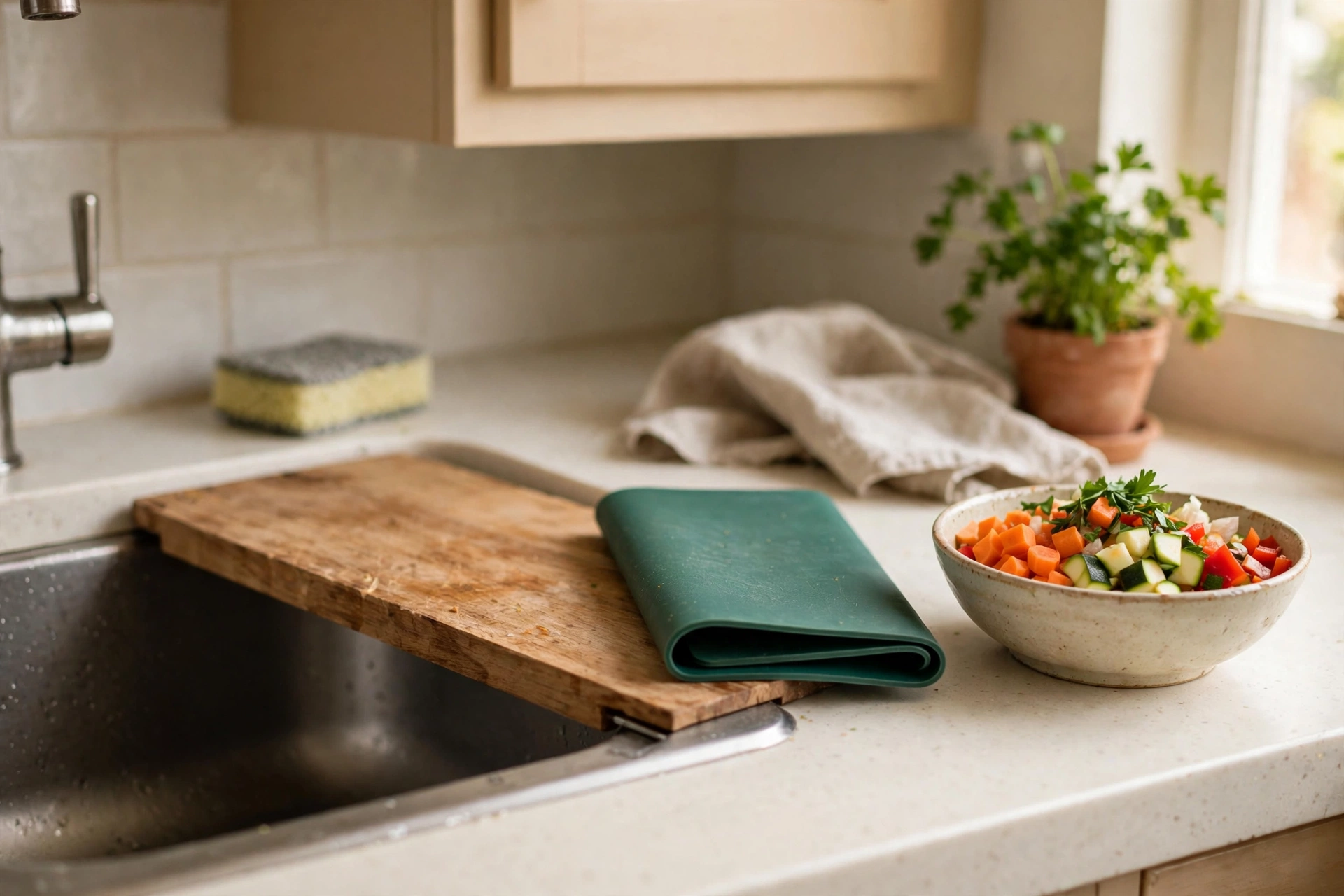
The best space-saving cutting boards do not take up a whole counter and do not need a whole cupboard. An over-sink board turns the sink into extra worktop, a foldable board doubles as a funnel for chopped food, and a slim board slides into the gap beside the fridge. One good board, a sharp knife, and a small bowl are enough to prep a full meal.
This guide covers the board types, materials, sizes, storage, and the prep tools that pair with them.
Table of Contents
- What Makes a Cutting Board Space-Saving?
- Space-Saving Cutting Boards: The Types That Save the Most Room
- Materials Compared: Wood, Plastic, Bamboo and Silicone
- What Size Board Does a Small Kitchen Need?
- A Step-by-Step Plan for Choosing Your Boards
- How to Store Cutting Boards in a Small Kitchen
- The Small Prep Tools That Pair with a Good Board
- What to Check Before You Buy
- Mistakes That Waste the Space You Saved
- Frequently Asked Questions
- Conclusion
What Makes a Cutting Board Space-Saving?
A board can save space in four honest ways. It uses a surface you already have, like the sink. It folds or rolls away, like a flexible mat.
It stores flat, like a slim board that slides into a narrow gap. Or it does two jobs, like a board with a built-in container.
So test every board the same way: does it give you enough room to work, and where will it live when you are done? If the answer to either question is weak, the board is not space-saving for your kitchen.
Space-Saving Cutting Boards: The Types That Save the Most Room
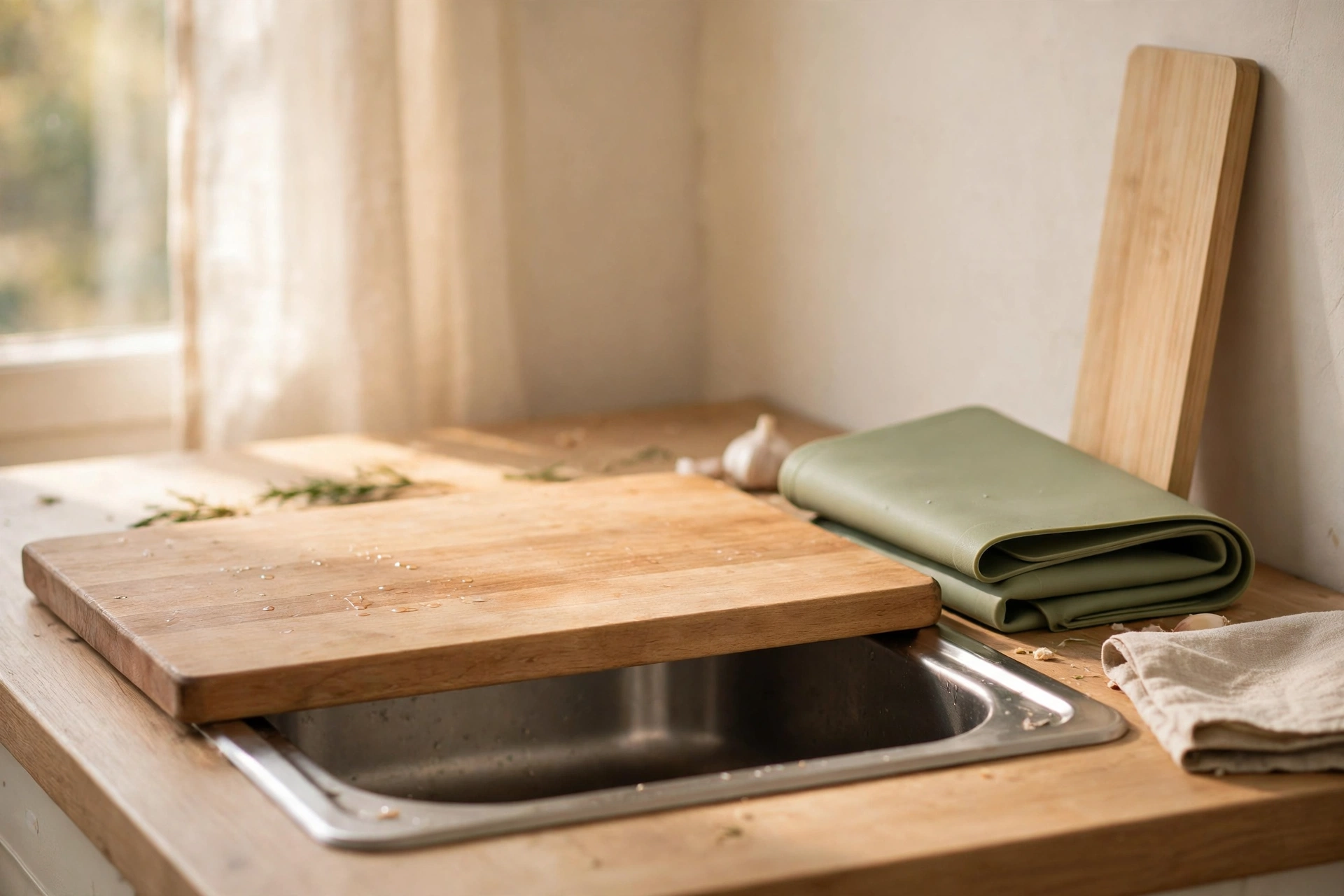
One main board and one spare is enough for most small kitchens. The right second board depends on what your kitchen lacks most — counter space or storage space.
Over-Sink Boards
An over-sink board rests on the rim of the sink, turning dead space into a second worktop — the single biggest space gain a board can give a small kitchen. Choose one with a lip or rails that grip the sink edges, and measure the sink first: it must sit flat without wobbling and lift off in seconds when you need water.
The sink is covered while the board is in use, so it works best as a second board, not your only one. For more on using the sink as extra worktop, see How to Meal Prep with Limited Counter Space.
Foldable and Flexible Boards
A foldable board is a thin, flexible mat that lies flat for chopping and folds into a funnel to tip chopped food into a pan or bowl. It stores almost anywhere: rolled up in a drawer, slipped behind a cupboard door, or hung from a hook.
Flexible mats are usually sold in colour sets, which helps with food safety: one colour for raw meat and fish, another for vegetables and bread. The trade-off is stability — a thin mat can slide, so put a damp cloth underneath.
Slim and Stackable Boards
Slim boards save space by being thin. A board 1 cm thick slides into the gap beside the fridge or into a narrow drawer, where a chunky butcher’s block never will.
Boards with Built-In Containers
A board with a built-in container — a tray that slides out from the side, or a well at one end — catches chopped food as you work, so you do not need a separate bowl on the counter. The trade-off is cleaning: check that the container lifts out and washes easily, and that it holds a normal pile of chopped vegetables.
Materials Compared: Wood, Plastic, Bamboo and Silicone
Wood is kind to knife edges and lasts for years if it is looked after. It should not be soaked or put in the dishwasher — wash it by hand and let it dry standing up.
Plastic is light, cheap, and easy to wash, which is why most colour-coded sets are plastic. Its limits are wear: a plastic board scars over time, and deep cuts can hold food and smells, so replace it when the surface is heavily scored.
Bamboo is hard, light, and dries quickly, which suits a small kitchen with limited drying space. It is harder on knife edges than wood.
Silicone is the material of flexible mats: it folds, rolls, and washes easily. It is light and nearly unbreakable, but too soft for heavy chopping and it can stain.
What Size Board Does a Small Kitchen Need?
The right board is the smallest one that still lets you work comfortably. Too small means chopping in batches with food falling off the edges; too big means it lives on the counter because there is nowhere to store it.
For most small kitchens, a main board of about 30 by 45 cm (12 by 18 inches) is the sweet spot: big enough for a pile of chopped vegetables, small enough to fit in a cupboard or slide into a gap. Measure your storage before you buy — a board that overhangs the counter edge will tip.
A second board can be smaller — about 20 by 30 cm (8 by 12 inches) — for quick jobs or raw meat. Keeping raw meat and ready-to-eat food separate is the simplest food-safety habit in a small kitchen.
A Step-by-Step Plan for Choosing Your Boards
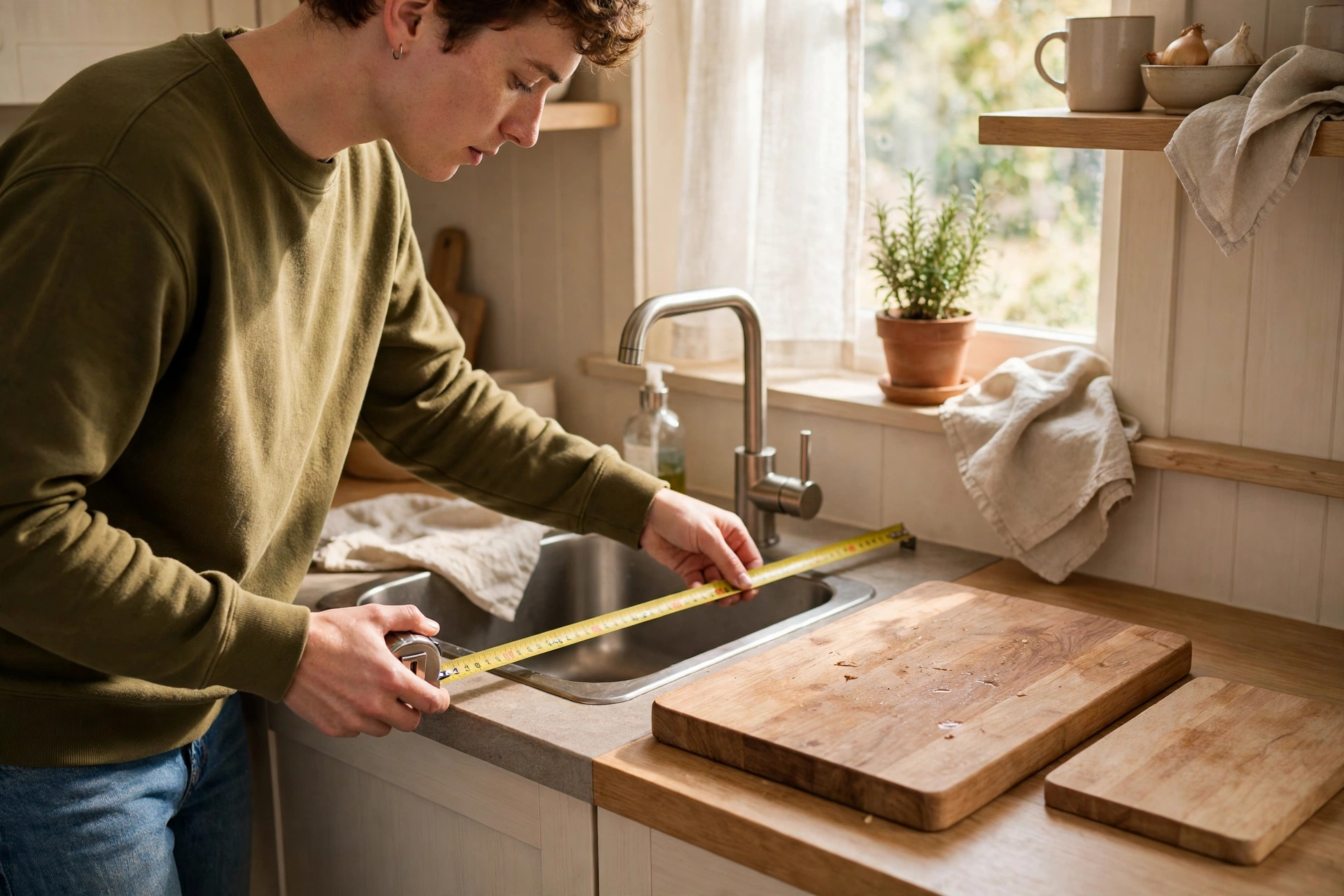
Work through these steps before you buy, and you will end up with two boards instead of five.
Step 1: Measure your counter and your storage. Measure the clearest counter run, the sink, and the gap where boards will live. A board that does not fit its home will live on the counter.
Step 2: Count how many boards you already own. Empty the cupboard and the drawer and count them — most small kitchens have three or four, and use one. Keep the best two.
Step 3: Choose your main board first. Pick the board you will reach for every day: rigid, about 30 by 45 cm, in a material you are happy to wash by hand.
Step 4: Add one space-saving second board. Choose the type that solves your biggest frustration: an over-sink board for counter space, a foldable mat for storage, or a board with a container if the counter is too small for a bowl.
Step 5: Give each board a fixed home. Decide where each board lives — which gap, hook, or shelf — and put it back there every time. See Small Kitchen Counter Organization: Keep Your Counters Clear and Useful for what earns a permanent spot on the counter.
Step 6: Match the board to the job. Use the main board for heavy chopping, the flexible mat for quick jobs, and the over-sink board when you need a second surface.
How to Store Cutting Boards in a Small Kitchen

Store boards upright, like books on a shelf: they take up less room, and you can pull out the one you want without moving the rest. A gap beside the fridge, a file organizer in a cupboard, or a rack on a cupboard door all work.
Hang boards that have a hole or handle from a hook — see Best Space-Saving Kitchen Tools for Small Kitchens for more ideas on using wall space. Foldable mats roll up and fit in a drawer.
Dry boards before you store them — a board put away damp will smell. Stand it upright to dry, then put it in its home.
The Small Prep Tools That Pair with a Good Board
A good knife is the first: one sharp chef’s knife does most of the chopping, slicing, and dicing a small kitchen needs, and takes up a strip of wall or a slot in a drawer. Keep it sharp — a blunt knife is slower and less safe. For more on tools that do several jobs, see Multi-Functional Kitchen Tools That Save Space.
A peeler is the second: slim, cheap, and faster than a knife at peeling. A Y-shaped peeler suits most hands and fits in a drawer slot.
A scrap bowl is the third: a small bowl beside the board for peelings keeps the worktop clear.
Kitchen scissors are the fourth: they cut herbs, open packets, and trim meat for small jobs. For drawer layouts that keep these tools easy to reach, see How to Organize Kitchen Drawers in a Small Kitchen.
What to Check Before You Buy
Dimensions. Compare the board’s size with the counter run, the sink, and the gap where it will live — the stored size matters most.
Materials. Wood is kind to knives but needs hand-washing; plastic is light but scars; bamboo is hard but tough on edges; silicone folds but is too soft for heavy work.
Durability. Check the edges and the surface: a board that warps, cracks, or scores deeply will not last, and a warped board rocks while you chop.
Cleaning. A board that washes quickly gets washed properly. Smooth surfaces and parts that lift out wash fastest, and a board that cannot be cleaned properly after raw meat is not safe to keep.
Capacity. A board that is too small creates extra work. Choose the size that fits the meals you cook, not the smallest one on the shelf.
Storage footprint. How much room does the board take when put away? A slim board takes a slice of a gap; a foldable mat takes a drawer slot.
Mistakes That Waste the Space You Saved
Buying a board before measuring the sink and the gap. A board a centimetre too wide for the sink will not sit flat. Measure first, buy second.
Choosing the smallest board in the shop. The smallest board looks tidy and frustrates you at home. Size the board for the meals you cook.
Using one board for everything. Raw meat and ready-to-eat food on the same board is the most common food-safety mistake in a small kitchen. Keep a second board for raw meat.
Leaving the board on the counter. A board that lives on the counter is taking up worktop. Only a board you use every day earns a permanent spot.
Buying a board with a container that is too small. A tiny tray fills up after one onion. Check the container holds a normal pile of chopped vegetables before you buy.
Frequently Asked Questions
How many cutting boards does a small kitchen need?
Two: one main board of about 30 by 45 cm for everyday chopping, and one smaller board for raw meat or quick jobs. A foldable mat makes a useful third, because it stores almost anywhere.
Are over-sink cutting boards worth it?
Yes, if your sink is a standard size and the board sits flat without wobbling — it adds a whole second worktop for free. It is less useful if you need the sink constantly, or if the board is too small to chop on. Measure the sink before you buy.
Are foldable cutting boards durable?
It depends on the material and how thick it is. A thick, flexible mat usually holds up well; a very thin one can slide, curl at the edges, and is too soft for heavy jobs.
What is the best cutting board material for a small kitchen?
Most small kitchens do well with one wooden board as the main board and one plastic board as the second. Wood is kind to knives; plastic is light and cheap to replace when heavily scored.
Conclusion
Space-saving cutting boards give you more work surface or less storage to worry about: an over-sink board adds a second worktop, a foldable board stores almost anywhere, and a slim board slides into a gap you already have. Two good boards and a sharp knife are enough to prep a full meal on a small counter.
Start with the six-step plan: measure, count your boards, choose your main board, add one space-saving second board, give each board a home, and match the board to the job. For the system that keeps chopped food moving from board to storage, see Best Stackable Kitchen Storage Containers for Small Spaces and How to Organize Food Storage Containers and Lids — and for the tools that fold flat when the cooking is done, read Best Collapsible Kitchen Tools for Compact Homes. For the tools that earn their storage space alongside your boards, see Small Kitchen Essentials: Tools That Earn Their Storage Space.
3 thoughts on “Space-Saving Cutting Boards and Prep Tools for Small Kitchens”