A Beginner’s Guide to Meal Planning for a Small Household
Meal planning for a small household means deciding, once a week, what you will eat for the next few days — then shopping once for exactly that. For one or two people in a small kitchen, the plan does not need to be detailed or rigid: pick three or four dinners, note what you already have, write a short shopping list, and leave two evenings open for leftovers or a simple meal.
That is the whole system. The rest of this guide shows how to make it a habit that takes twenty minutes a week and survives a busy one.
Table of Contents
- What Meal Planning Really Is — and What It Is Not
- Why Planning Matters More in a Small Household
- Before You Plan: Know Your Week
- Step 1: Take Stock of What You Already Have
- Step 2: Pick Your Meals With a Theme-Night Template
- Step 3: Build Your Weekly Template
- Step 4: Write the Shopping List From the Plan
- Portions for One or Two: How Much to Plan
- Leftovers: Plan Them In, Do Not Discover Them
- Reducing Food Waste With a Plan
- Meal Planning for a Small Household: A Twenty-Minute Weekly Routine
- Common Mistakes to Avoid
- Frequently Asked Questions
- Conclusion
What Meal Planning Really Is — and What It Is Not
Meal planning is often shown as a colour-coded spreadsheet covering every meal for a month. For a household of one or two, that version fails within a week, because small households are unpredictable: a late meeting, a friend dropping by, or simply not fancying what was planned on Tuesday.
A useful plan for a small household is much lighter. It answers three questions: which dinners will we cook this week, what do we need to buy for them, and what happens to the leftovers?
Breakfasts and lunches can stay simple and repeatable, while dinners carry the variety.
Why Planning Matters More in a Small Household
Planning matters more when the household is small, not less. A family of five can absorb a mistake — a bag of spinach bought for one recipe gets used in another. In a household of one or two, one wrong buy fills the fridge: herbs go limp, half a cabbage sits untouched, and a pack bought on offer becomes a race against its date.
A small kitchen makes the same point: no spare shelf for food bought “just in case”, and a small fridge holds a few days of ingredients, not a fortnight’s worth.
That is also why planning and prep belong together. Once the plan exists, cooking it is the easy part — see Easy Meal Prep Ideas for Small Kitchens.
Before You Plan: Know Your Week
Start with the week, not with the food. Before choosing a single meal, look at the next seven days: which evenings you will be home and cooking, which are late or busy, and which days have a lunch away from home.
Two or three busy evenings change the plan completely. A late night is not a night for a new recipe with ten ingredients; it is a night for leftovers or a quick assembly meal. Mark one or two “no-cook” evenings in the plan from the start.
Step 1: Take Stock of What You Already Have
Every plan starts in the kitchen, not in a recipe book. Open the fridge, the freezer, and the pantry, and look at what is actually there.
In a small kitchen this takes five minutes, because there is not much to look through. For pantry layout, see Small Pantry Organization Ideas for Tight Spaces.
Write down three things: food that needs using up soon, food you have plenty of, and the basics you are out of. A half-used bag of rice, a tin of tomatoes, and herbs that will not last the week are the raw material for the plan — use the “needs using up” list first.
Step 2: Pick Your Meals With a Theme-Night Template

The hardest part of meal planning is choosing what to eat. A theme-night template removes the choosing: each night has a loose theme, and you only pick a meal inside it.
A simple template looks like this: Monday is a grain bowl or a soup, Tuesday is pasta or noodles, Wednesday is a one-pot meal, Thursday is leftovers or a quick assembly meal, and Friday is a traybake, a curry, or a meal out. Saturday and Sunday stay flexible.
Themes work because they limit the choice without removing it: “Tuesday is pasta” still leaves plenty of meals to pick from, but it stops the blank-page problem of “what shall we eat this week?”
Step 3: Build Your Weekly Template
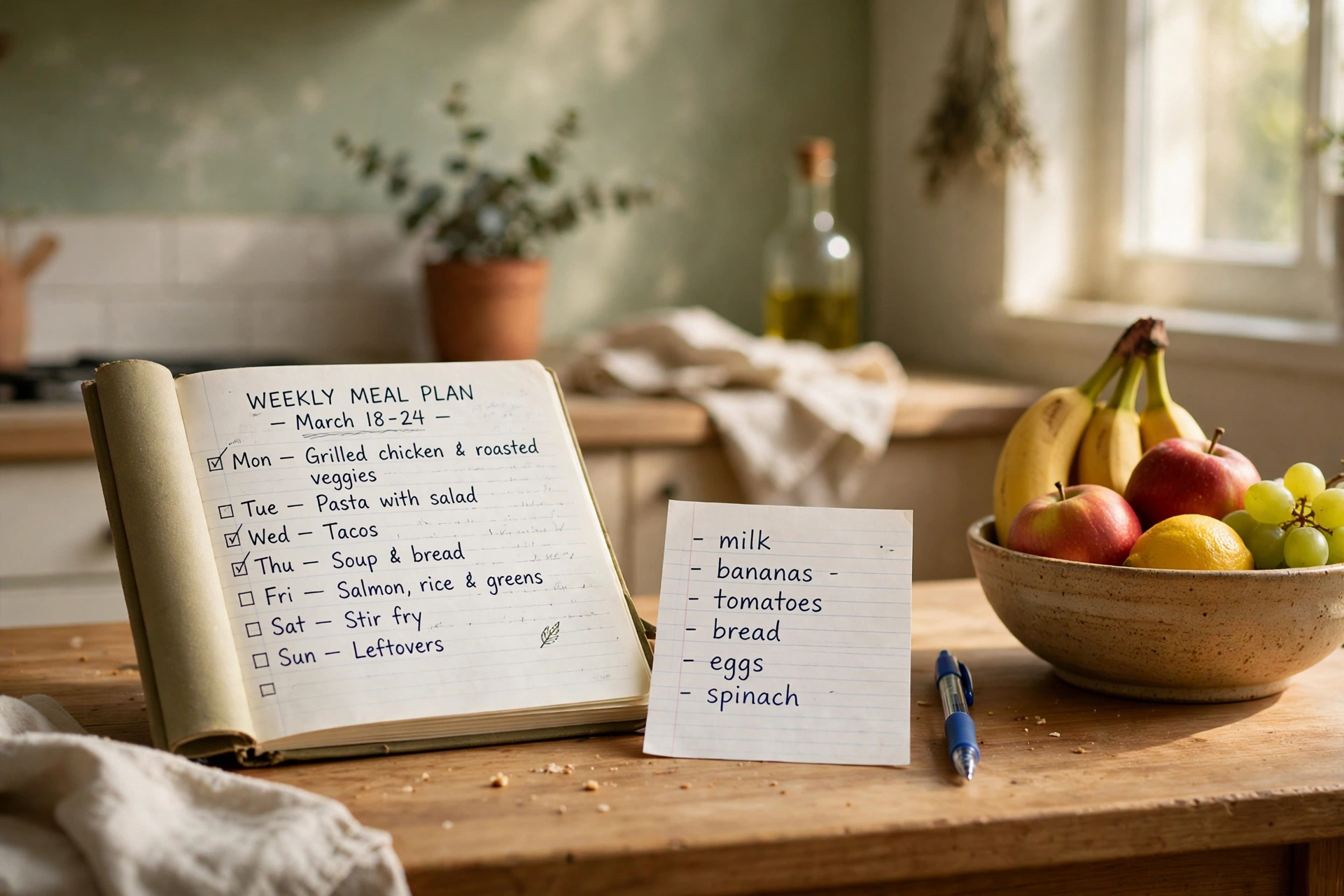
Once the themes are set, fill in the week. Write the plan where you will see it: a page in a notebook, a note on the fridge, or a list on your phone. Keep it to the dinners, plus a note for lunch if lunch needs cooking.
A sample week for two people: Monday, lentil soup with bread. Tuesday, pasta with tomato sauce from the tinned tomatoes already in the cupboard. Wednesday, a tray of roasted vegetables with rice.
Thursday, Wednesday’s leftovers, reheated. Friday, a simple curry with rice.
Saturday, a stir-fry using the vegetables that need using up. Sunday, a slow meal — or a day off.
Notice what the sample does: five cooked dinners, not seven, with rice and vegetables reused across two meals.
Step 4: Write the Shopping List From the Plan
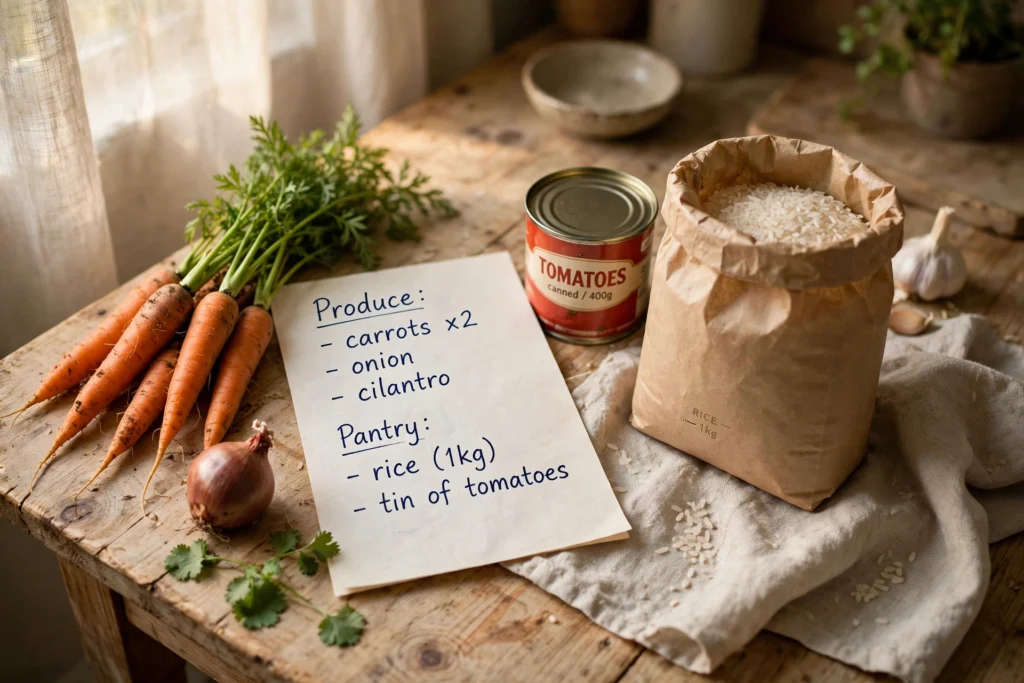
The shopping list comes from the plan, not the other way round. Go through each planned meal and write down only the ingredients you do not already have, checking the stock-take list as you go.
If the plan needs half an onion, do not buy a whole bag unless the other half has a job in another meal — and check whether a smaller pack would do.
Group the list by where things are in the shop — vegetables, protein, grains and tins, dairy, and everything else — so the shop is quick.
For a household of one or two, a weekly shop for five dinners usually fits on half a page. Buy the smallest pack that fits the plan.
Portions for One or Two: How Much to Plan
Portion sizes are where small-household planning most often goes wrong, because most recipes are written for four. Cooking a recipe for four and eating it twice is a good plan — cooking it for four and eating half is waste. Plan for the household, plus one portion.
A simple rule: plan each dinner for the household, plus one extra portion for lunch or the next evening. A pot of soup for two becomes two dinners and a lunch; a tray of roasted vegetables becomes a dinner and a wrap filling.
For ingredients, think in handfuls rather than packets: a pot of rice for two needs about one mug of dry rice. After a few weeks you will know by eye what your household eats.
Leftovers: Plan Them In, Do Not Discover Them
Leftovers are not a failure of planning — they are the plan working. The difference is whether they were meant to happen: a planned leftover becomes Thursday’s dinner, while an accidental one becomes a container at the back of the fridge that nobody wants.
Plan leftovers into the week. If Monday’s soup makes four portions, Tuesday’s lunch is already decided; if Wednesday’s roast vegetables fill a tray, Thursday’s wrap filling is already made.
Store leftovers so they are actually eaten: cool them promptly, label them with the contents and the date, and put them at the front of the fridge. For container and lid advice, see How to Organize Food Storage Containers and Lids.
To keep planned ingredients fresh until their day comes, see How to Keep Meal Prep Ingredients Fresh Throughout the Week.
Reducing Food Waste With a Plan
A plan cuts food waste in three ways: you buy only what the plan needs, so less food arrives; the stock-take uses up what is already in the kitchen; and leftovers have a job in the plan, so they get eaten instead of thrown away.
The waste that remains usually comes from the same few places: fresh herbs bought for one recipe, salad leaves bought in a large bag, and bread bought in a loaf too big for two people. The plan can fix each one: share the same herbs across two recipes, buy the smallest bag of salad, or freeze half the loaf on the day you buy it.
Planning to a budget and planning to cut waste go together — see Budget-Friendly Meal Prep for Small Households.
A small counter helps here too — there is nowhere for a forgotten bag to hide. Keep the counter clear so the plan stays visible: see Small Kitchen Counter Organization: Keep Your Counters Clear and Useful.
Meal Planning for a Small Household: A Twenty-Minute Weekly Routine

The whole routine takes about twenty minutes, once a week, at the same time — Saturday morning, or Sunday evening.
First, five minutes: look at the week and mark the busy evenings.
Second, five minutes: take stock of the fridge, freezer, and pantry, and note what needs using up.
Third, five minutes: pick the meals from your theme template and favourites, and fill in the week.
Fourth, five minutes: write the shopping list from the plan, grouped by shop section, and check it against what you already have.
That is the routine. Keep the plan, the list, and your favourites in the same place every week. After a month, it takes ten minutes.
Keep two or three standby meals — a tin of soup, eggs, bread, a jar of sauce — so a changed evening is covered.
For the full journey from plan to packed containers, see Small Kitchen Meal Prep Workflow: From Grocery Shopping to Storage. And when the week is short on time, a single timed session covers it — see One-Hour Meal Prep Plan for Busy Weekdays.
Common Mistakes to Avoid
Planning every meal for seven days. A full week of detailed meals is too rigid. Plan five dinners and leave two evenings open.
Planning meals you do not actually like. A plan full of meals nobody enjoys gets abandoned by Wednesday. Plan the meals your household eats happily, and add one new idea at a time.
Shopping before planning. A shop without a plan fills the fridge with ingredients that never become a meal.
Buying the family pack for two people. A large pack is only a saving if it all gets used.
Forgetting the leftovers. A plan that ignores leftovers wastes them.
Making the plan too complicated. A spreadsheet that takes an hour to maintain will be dropped within a month. Keep the plan to one page and twenty minutes.
Giving up when the plan changes. A changed evening is not a failed plan. Move the meal, use a standby, and carry on.
Frequently Asked Questions
How do I start meal planning as a beginner?
Pick a theme for each night, choose five dinners you already know, check what you already have, and write a short shopping list. Start with one week, not a month.
How many meals should I plan for a small household each week?
Plan about five dinners, with two evenings left open for leftovers or a night off. Keep breakfasts and lunches to two or three repeating options.
How do I meal plan for two people without wasting food?
Plan each dinner plus one extra portion, reuse ingredients across two meals, buy the smallest pack that fits the plan, and write leftovers into the week as meals.
What if I do not like eating the same meal twice?
You do not have to. Plan ingredients, not finished meals: one pot of rice becomes a grain bowl one night and a wrap filling the next.
How long does meal planning take each week?
About twenty minutes once a week: five minutes each on the week ahead, the stock-take, choosing meals, and the list. It gets quicker with practice.
Conclusion
Meal planning for a small household works when it is small, simple, and built on your real week. Look at the days ahead, take stock of what you already have, pick five dinners from a theme template and your favourites, and write a shopping list for only what the plan needs. Plan leftovers in as meals and buy the size that fits one or two people.
Start this week with twenty minutes and one page: five dinners, a short list, and two evenings left open. For your next step, see How to Meal Prep with Limited Counter Space if counter space is tight when you cook the plan.
8 thoughts on “A Beginner’s Guide to Meal Planning for a Small Household”