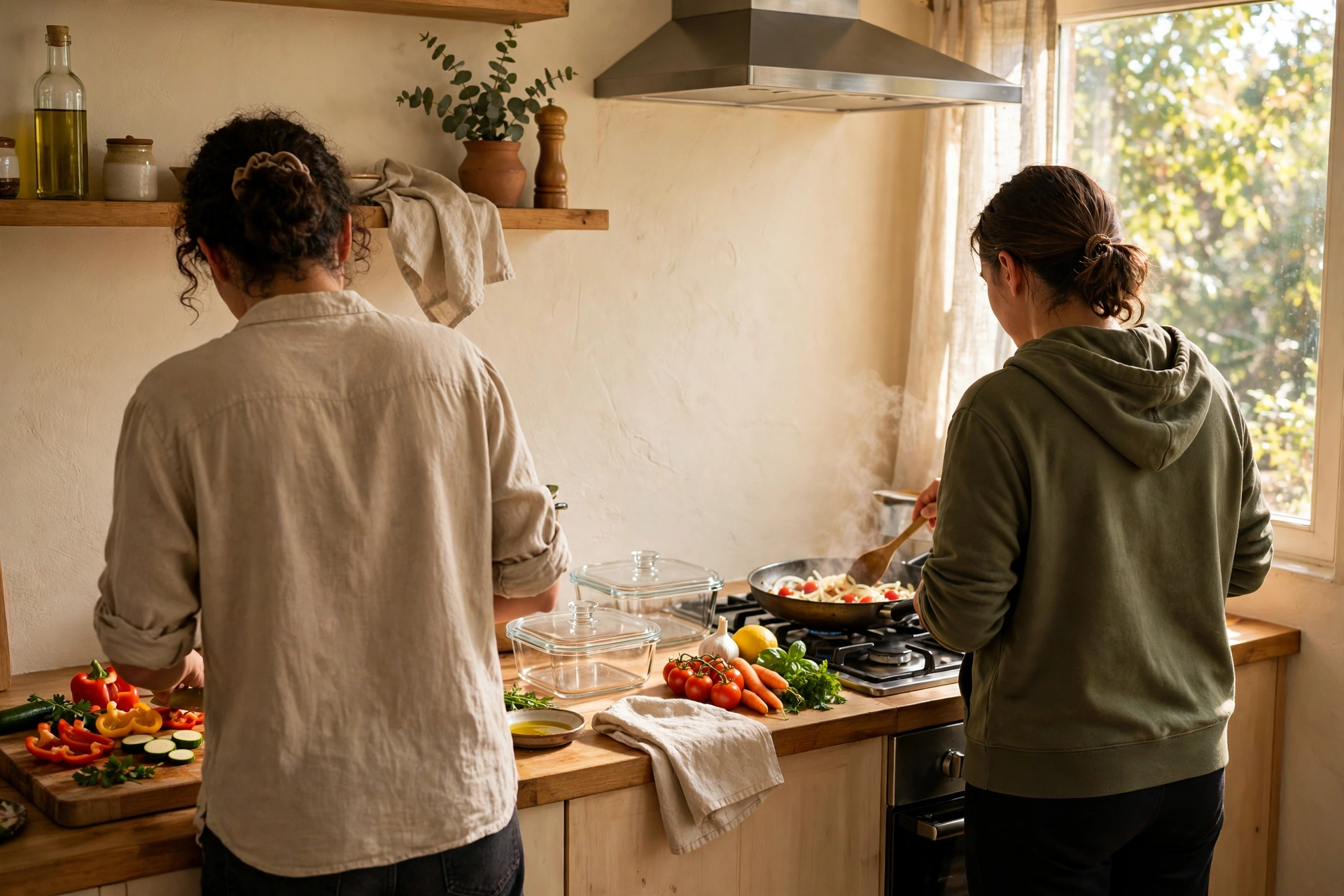
Meal prep for couples works best when you treat it as a shared plan, not a solo chore. In a small kitchen, two people cooking for the week ahead can either save hours or get in each other’s way — and the difference is usually a ten-minute conversation before anyone picks up a knife.
The goal is simple: agree on a few meals you both like, cook them together in one short session, and store them so weekday dinners take minutes, not decisions.
Table of Contents
- What Meal Prep for Couples Looks Like in a Small Kitchen
- Start With a Ten-Minute Weekly Check-In
- Build a Two-Person Menu That Works for Both of You
- Portions for Two: How Much to Cook
- A 90-Minute Meal Prep for Couples Session
- Cooking Together Without Tripping Over Each Other
- Storing Two People’s Meals in a Small Fridge
- Weekday Lunches When Your Schedules Don’t Match
- Common Mistakes Couples Make With Meal Prep
- Frequently Asked Questions
- Start This Weekend With One Shared Session
What Meal Prep for Couples Looks Like in a Small Kitchen
For two people, meal prep does not mean a fridge full of identical boxes. It usually means three or four shared dinners, a couple of lunches, and a few building blocks — cooked grains, a tray of roasted vegetables, a pot of something saucy — that you can mix and match through the week.
The shared part is the plan and the cooking session. The individual part is the finishing: how much each of you takes, how spicy it is, and what goes on the side. Keeping those two parts separate is what makes meal prep for couples work.
Why Two-Person Prep Is Different From Cooking for One
Cooking for two is not just cooking for one, doubled. A pot of rice or pasta scales easily, but a single frying pan does not — two chicken breasts fit where four crowd, steam, and cook unevenly. That is why couples do better with tray bakes, one-pot meals, and big pots than with pan-fried food.
Two people also means two sets of preferences to satisfy in one session. One of you may love heat and the other may not, or one of you may be hungry at six and the other at eight. A good plan handles those differences with flexible finishes, not two separate menus.
Start With a Ten-Minute Weekly Check-In
Sit down together for ten minutes before you plan anything, and do it away from the kitchen — at the table or on the sofa, wherever you actually talk. Each of you names three things: what your week looks like, one meal you would like, and one meal you are tired of.
Check the calendar first, because the plan has to fit real life. Late meetings, gym nights, and a dinner with friends all change what you need. A week with three late evenings needs quick reheat meals.
Then pick three or four dinners and two or three lunches, and leave one or two evenings deliberately open. Those open evenings are for leftovers, a simple meal, or eating out — leaving them blank is part of the plan.
Write the plan down where you will both see it, even if it is just a note on the fridge. A plan that lives in one person’s head is not a shared plan. For a fuller grounding, see A Beginner’s Guide to Meal Planning for a Small Household.
Finally, agree on who does what before the session starts. One of you might shop while the other cooks, or you might split the session by task. Decide it during the check-in, not halfway through the cooking.
Build a Two-Person Menu That Works for Both of You
A two-person menu is built around overlap: meals you both enjoy, made so each of you can adjust your own plate. Start with the dishes you already cook well together and add one new idea at a time.
One Shared Base, Two Finishes
The most useful trick in meal prep for couples is the shared base. Cook one big pot of rice, grains, or pasta, one tray of roasted vegetables, and one protein — then finish each portion differently.
Build-your-own meals work the same way. Tacos, grain bowls, and wraps all start from the same cooked ingredients, and each person assembles their own plate — you cook once and eat two slightly different meals. For starting points, browse Easy Meal Prep Ideas for Small Kitchens.
When Appetites Don’t Match
It is normal for two people to be hungry in different amounts, and the fix is portioning, not separate cooking. Serve the hungrier person a bigger scoop of grains or an extra side, and keep the protein portions roughly equal.
Watch this over a couple of weeks and you will learn your household’s pattern: who eats more at dinner and who wants a bigger lunch. Once you know it, portioning becomes automatic.
Portions for Two: How Much to Cook
The easiest way to think about portions in meal prep for couples is in servings, not in weight. A dinner for two is two servings, and a pot that makes four servings gives you dinner tonight plus dinner or lunch tomorrow. Most couples find that cooking four servings of a main dish is the sweet spot.
Grains are forgiving: a cup of dry rice or pasta usually stretches to two generous servings once cooked, so two cups covers a dinner and a lunch each. Vegetables shrink in the pan, so roast a full tray even when it looks like too much.
Protein is where people most often undercook. Two portions that look right raw can look small once cooked, so cook enough for the meal plus one extra serving and let the leftovers become tomorrow’s lunch.
Think in pairs when you pack, too. Two matching containers, filled at the same time, stop the nightly question of whose portion is whose. For the money side, Budget-Friendly Meal Prep for Small Households shows how a shared shop keeps the weekly spend down.
A 90-Minute Meal Prep for Couples Session
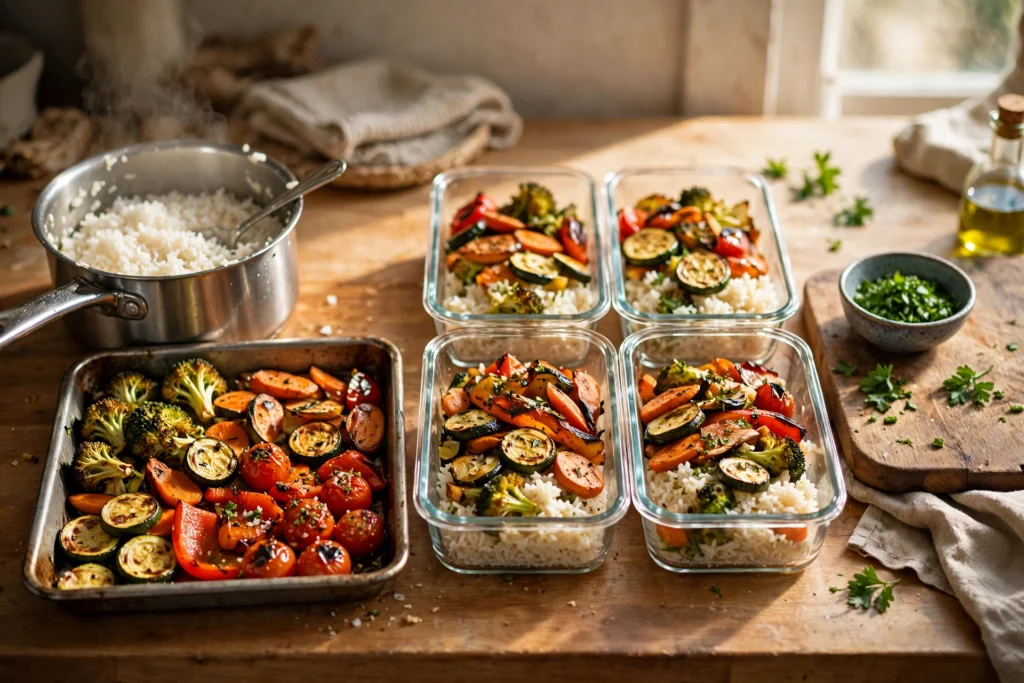
A 90-minute session sounds long until you break it into jobs. Start by reading the plan together, then get the slow things going first: grains on the hob, a tray in the oven, a pot simmering.
While those cook, split the hands-on work. One of you chops vegetables while the other seasons and starts the protein, then swap roles for the next dish.
When the food is ready, assemble the containers together at the cleared counter. Fill two containers per meal, grains first and the saucy part on top, and keep dressings and crunchy toppings in small separate pots. A One-Hour Meal Prep Plan for Busy Weekdays shows how to squeeze the same session shorter.
Use the last ten minutes for the reset, and do it together. Wash the pans, wipe the counter, and put the containers in the fridge. A session that ends with a clean kitchen feels finished.
If you enjoy cooking in bigger batches, Batch Cooking in a Small Kitchen: Tips to Save Time and Space explains how to scale this session up without needing more equipment or counter space.
Cooking Together Without Tripping Over Each Other
A small kitchen fits two cooks if you give each person a zone. One of you takes the stove and the other takes the counter, and you pass things across rather than crossing in front of each other. It sounds formal, but after one session it feels natural.
Choose meals that suit one pan or one pot where you can. A tray bake or a stew needs one person at the oven and one at the chopping board, while four pans on the hob need two people in the same square metre.
Keep the counter clear as you go, because a small kitchen has no spare surface to absorb mess. Wash a board as soon as you finish with it. If counter space is your main struggle, How to Meal Prep with Limited Counter Space has practical ways to create room.
Storing Two People’s Meals in a Small Fridge

Meal prep for couples needs a storage system, or the fridge fills up by Tuesday. Give prepped meals one shelf and keep it for that purpose only, so you always know where dinner is. Stackable containers with matching lids earn their space here.
Label every container with the day and the contents, using masking tape and a pen. It takes seconds and ends the guessing game of opening four boxes to find the right one.
Eat the fridge meals within a few days and freeze anything that will wait longer, following the general guidance on storing food safely from the FDA. Keep dressings and crunchy toppings separate until serving time.
For the full picture on fridge layout and containers, read Small Fridge Organization for Meal Prep and How to Store Meal Prep Containers in a Small Kitchen.
Weekday Lunches When Your Schedules Don’t Match

Lunches are where couples’ schedules usually split, so meal prep for couples needs a lunch plan of its own: one of you leaves at seven, the other works from home, and a shared lunch hour is rare. Pack lunches the night before, straight after dinner, while the containers are already out and the food is in front of you.
Give each person their own lunch box, even when the contents started as the same dish. One of you might take the grain bowl cold and the other might reheat it at work, so packing separately lets each lunch suit its owner.
For more lunch ideas that pack well, see How to Prep a Week of Lunches in a Small Kitchen.
Common Mistakes Couples Make With Meal Prep
The most common mistake is planning a full week of identical meals. By Wednesday, neither of you wants the same box again, and the rest of the week goes to waste. Three or four different dinners stay appetising far longer.
Another mistake is letting one person carry the whole job. When one partner plans, shops, cooks, and cleans, the other one drifts away from the system. Splitting the work — and swapping the jobs regularly — keeps it fair.
A third mistake is cooking two separate menus to please two different tastes. It doubles the cooking time and the washing up, and turns a shared session into two solo ones. One shared base with different finishes gives each of you what you want for half the work.
The last mistake is planning every single night with no room for life. A dinner invitation or a late meeting will break a rigid plan, and a broken plan feels like a failure. Leave one or two evenings open every week and the plan bends instead of breaking.
Frequently Asked Questions
What if one of us is vegetarian and the other eats meat?
Cook the shared parts together and add the protein separately. Roast one tray of vegetables and cook one pot of grains, then cook a vegetarian protein and a meat protein side by side. Each of you builds a plate from the shared base plus your own protein.
What if one partner travels during the week?
Halve the batch for the nights one of you is away, and freeze the extra portions instead of cooking a full week for one person. The partner at home eats from the fridge for two or three nights, and the frozen portions wait until you are both home again.
How do we keep meal prep from feeling like a chore?
Give the session a fixed time and a small ritual around it. Cook at the same time each week, put on music you both like, and finish with a shared meal from what you just cooked. With a meal together at the end, it feels like part of the weekend rather than a task before it.
What if one of us doesn’t cook at all?
That partner can still own half the system without touching the stove. Shopping, chopping, washing up, and packing lunches are all real jobs, and a non-cook who handles two or three of them is carrying their share. Each person does the jobs they are comfortable with, and the session still takes half the time.
Start This Weekend With One Shared Session
Pick one evening this week, sit down for the ten-minute check-in, and cook two dinners together in a single session. Keep it small: one shared base, two finishes, two containers each, and a clean kitchen at the end.
If that one session makes your weekdays easier, repeat it next week and add a third dinner. Meal prep for couples grows from a single shared evening, not from a perfect system.