
Meal prep small freezer cooking works when you plan around the space you actually have, not the space you wish you had. A freezer the size of a single drawer can still hold a week of dinners if every meal lies flat, every bag is labelled, and nothing goes in without a plan.
Most people fail with a small freezer because they cook first and find space later. They fill two big tubs, wedge them in sideways, and spend the next month digging past them. Flip the order round: measure the freezer, choose meals that fit it, then cook.
Table of Contents
- Meal Prep Small Freezer Basics: What Fits and What Does Not
- Measure Your Freezer Before You Plan a Single Meal
- The Flat-Freeze Method, Step by Step
- Bags and Containers That Waste the Least Space
- What Freezes Well in a Small Freezer
- A Small-Freezer Weekly Plan That Actually Works
- Rotation: Eating the Oldest Meal First
- Defrosting Without Wasting a Meal
- Common Mistakes to Avoid
- Frequently Asked Questions
- Conclusion
Meal Prep Small Freezer Basics: What Fits and What Does Not
A small freezer usually means the box above a fridge, a single drawer, or a compact chest under 5 cubic feet (about 140 litres). The usable space is smaller still once the ice tray and the half-used bag of frozen peas take their share.
A small freezer rewards a short list of meals, not a month of cooking. Seven to ten portions is a realistic full load, and that is plenty when the fridge covers the first two days of the week.
The meals that suit it best are flat, dense and portioned: soups, stews, curries, pasta sauces and cooked grains. Bulky boxes, whole roasts and half-empty tubs waste the space you need most.
Meal prep small freezer planning is a different skill from general freezer cooking. The freezer meal prep guide covers the wider planning side; this article is about the fitting-in part: measuring, flattening, stacking and rotating.
Measure Your Freezer Before You Plan a Single Meal
Measure the inside of your freezer, not the outside label, and note the width, depth and height of each shelf or drawer. A bag one inch too wide will not lie flat, and a stack one inch too tall will stop the drawer closing.
Count the usable space in portions, not litres. One flat quart bag (about 1 litre) of soup is one dinner for two. Lay a bag flat on the shelf and count how many fit side by side; that number is your real capacity.
Note the cold spots before you load anything. The back of a top freezer stays coldest, while the door shelves warm up each time you open it. Keep everyday items near the front and long-storage meals at the back.
A meal prep small freezer plan built on real measurements beats a hopeful one every time. If only six flat bags fit, then six portions is your batch size, and the seventh meal comes from the fridge instead.
The Flat-Freeze Method, Step by Step
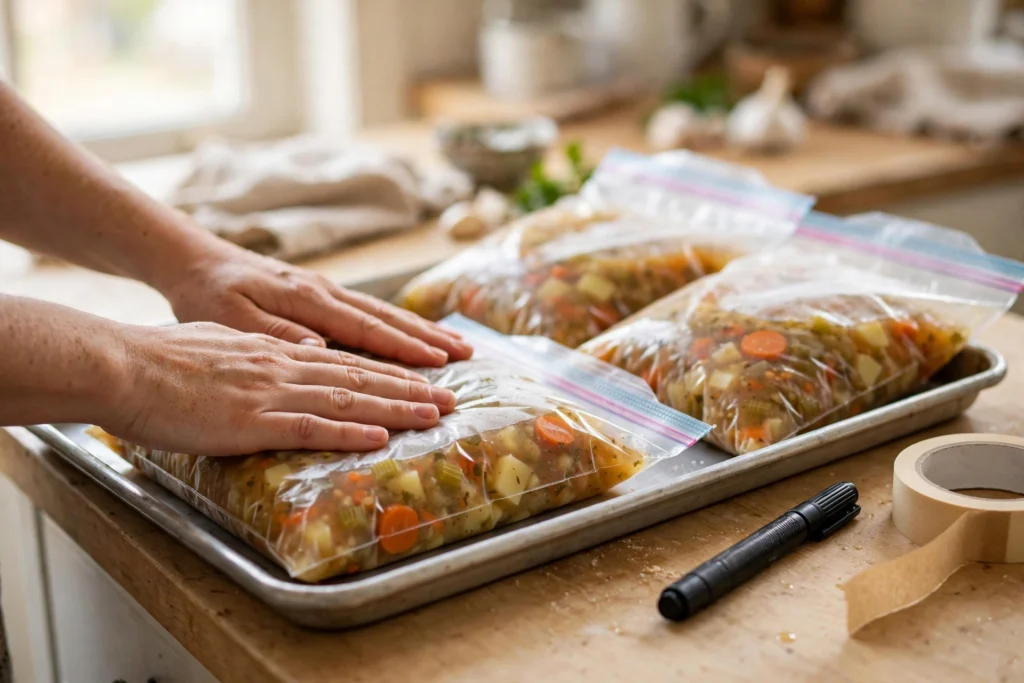
Flat freezing turns soup into a slim slab that files away like a book. It is the single best technique for a meal prep small freezer, and it works with nothing fancier than freezer bags and a baking tray.
- Cool the food completely before it goes near a bag. Warm food steams inside the bag, and that steam becomes frost.
- Portion into single-meal amounts before freezing, not after. A bag that feeds two is easy to thaw and use; a bag that feeds six has to be thawed whole.
- Fill each bag only two-thirds full, then press out the air from the bottom up. A bag with air in it puffs up and lets frost form.
- Seal the bag, lay it flat on a baking tray, and smooth the food into an even layer about half an inch thick.
- Slide the tray into the freezer and leave the bags alone until they are solid. Once frozen flat, stand the slabs upright like files.
- Label every bag with the dish name and the date. A frozen slab of chilli looks exactly like a frozen slab of curry.
Cooling and storage times matter for safety as well as space, so follow the FDA’s advice on storing food safely when you are unsure how long a dish keeps. Cooked meals generally hold their quality for two to three months in a freezer, so date every bag.
When you have no counter space to lay out bags and trays, work in small batches. The limited counter space guide shows how to prep one dish at a time on a single clear patch.
Bags and Containers That Waste the Least Space

Freezer bags beat rigid tubs in a meal prep small freezer for most foods. A bag moulds itself into gaps and lies flat. A tub holds its shape no matter what, and that shape includes a lot of trapped air.
Use bags for anything that pours or spreads: soups, stews, sauces, cooked beans, cooked grains and marinated meat. Save tubs for foods that must hold their shape, like meatballs in sauce or portions of rice you want to tip straight onto a plate.
Square tubs stack far better than round ones, and tubs of one single size stack better than a mixed collection. If you buy new containers, pick one size and stick to it; a matched set behaves like a filing system.
The stackable kitchen storage containers guide explains what to look for in a set, and the meal prep container storage guide covers keeping lids and bases together.
What Freezes Well in a Small Freezer
Some foods come out of a small freezer tasting almost as good as the day they went in, and some never recover. Choosing the first group is half the battle in meal prep small freezer cooking.
Soups, stews, chilli, curries and pasta sauces are the safest bets. They freeze flat, thaw evenly, and reheat in one pan. Cooked beans, lentils and rice freeze well too, and they turn into a meal with a fried egg or a handful of fresh vegetables.
Marinated chicken pieces, meatballs and cooked mince freeze in thin, flat layers and thaw fast. Portion them by the meal, so you only thaw what tonight’s dinner needs.
Creamy sauces can split when they thaw, so freeze the base and add cream or yoghurt after reheating. Fried foods go soft, salads go limp, and cooked potatoes turn grainy, so leave those out entirely.
A Small-Freezer Weekly Plan That Actually Works
A week of meal prep small freezer cooking needs only three dishes and one session. Cook three recipes on Sunday, portion each into two or three bags, and you have six to nine frozen meals.
Start with one soup or stew, one curry or chilli, and one sauce-based dish like a pasta sauce or a bean stew. These three cover different flavours, freeze flat and reheat in minutes.
Eat two portions fresh on Sunday and Monday, straight from the fridge. Freeze the rest in flat bags the same day, while the food is cool. The batch cooking guide walks through the same one-session rhythm for a small kitchen.
For one person, three dishes at two portions each is a full freezer and a full week. The meal prep for one person guide shows how to scale portions down without cooking a separate meal every night.
Vegetarian dishes suit this plan well, because beans and lentils freeze flat and cost little. The vegetarian meal prep guide has seven meat-free ideas that work as flat-frozen bags.
Rotation: Eating the Oldest Meal First

In a meal prep small freezer, rotation is not optional. A small freezer has no room for forgotten food, so the rule is simple: the meal that went in first comes out first, every time.
Stand your flat slabs upright with the oldest at the front and the newest at the back. A fresh batch goes behind the older ones, never on top, so the order stays visible at a glance.
Keep a list on the fridge door. Write each meal down as it goes in, cross it off as it comes out, and you will always know what is inside without opening the door.
Prepped food in the fridge needs the same attention. The keep meal prep ingredients fresh guide covers how long it lasts once it is out of the freezer.
Defrosting Without Wasting a Meal
The safest way to defrost a meal prep small freezer meal is also the simplest: move it from the freezer to the fridge the night before. A flat bag thaws in a fridge overnight, and the meal is ready to heat the next evening.
For same-day defrosting, put the sealed bag in a bowl of cold water and change the water every half hour. The meal thaws in an hour or two, and the cold water keeps bacteria from growing quickly.
A microwave defrost setting works when you are short on time, but cook the meal straight after, since partly thawed food has warm spots.
Never leave a frozen meal on the counter all day to thaw. The outside reaches room temperature hours before the middle thaws. Plan the move the night before instead.
Thawing takes fridge space too, so leave a shelf clear for tomorrow’s dinner. The small fridge organization guide shows how to keep one free.
Common Mistakes to Avoid
Filling the freezer in one big shop. A freezer packed tight in a single trip has no room for cold air to move, and the new food takes longer to freeze. Add meals a few bags at a time and let each batch freeze solid first.
Freezing food in the pot you cooked it in. A full pot takes the space of six flat bags and you lose your best pan for a week. Portion first, freeze second.
Keeping a “maybe” pile. Every freezer has a corner of meals nobody really wants: the failed experiment, the double batch everyone got bored of. If nobody has chosen it in three weeks, it is not a meal, it is clutter.
Opening the door to browse for dinner. Every open door lets warm, damp air in, and that air becomes frost on your food and on the freezer walls. Decide from the list on the fridge door, then open the freezer once and take it out.
Cooking one giant batch of a single dish for a meal prep small freezer. Ten portions of the same stew sound efficient until Thursday, when nobody wants stew again. Three small batches of different meals take the same time and space, and the week stays interesting.
Frequently Asked Questions
Can I freeze meals in glass jars in a small freezer?
Yes, if the jar has straight sides and a wide mouth, and you leave at least an inch of space at the top for the food to expand. Glass is rigid, though, so a jar wastes more space than a flat bag and can crack if filled too full.
How do I meal prep for two with a freezer under 3 cubic feet?
Cook three dishes in two-person portions, eat one portion of each fresh in the first two days, and freeze the rest. That gives four frozen dinners for two. A freezer that small cannot hold two full weeks, so plan one week at a time.
Is it safe to refreeze a meal I thawed but did not eat?
Only if it thawed in the fridge and stayed cold the whole time, and even then the texture and flavour will be poorer. A meal thawed in cold water or in the microwave should be cooked and eaten, not frozen again. When in doubt, throw it out rather than risk it.
My freezer has no drawers, just one open box. How do I keep meals findable?
Stand the flat slabs upright in rows and use a small basket, a sturdy tote bag or a cardboard box as a divider to hold each row in place. Keep one row for soups and one for mains, newest bags at the back. A list on the lid tells you what is inside without digging.
How often should I clear out a small freezer?
Do a quick check once a month: pull everything out, read the labels, and toss anything unlabeled or forgotten. Clear it out fully when frost builds up thick on the walls, since frost steals space and makes the freezer work harder.
Conclusion
Meal prep small freezer cooking comes down to three habits: measure the space, freeze everything flat, and eat the oldest meal first. A small freezer will never hold a month of food, and it does not need to. It needs to hold one good week.
Measure your freezer tonight, pick three dishes you like, and freeze your first batch this weekend. Once the first row of slabs is standing upright and labelled, the system runs itself.