
The best space-saving baking tools let you bake proper cakes, loaves and trays of biscuits in a kitchen with almost no spare storage. One rimmed sheet pan, a loaf pan, a round cake pan, a whisk and a cooling rack cover most home baking — and they stack or file into a single shelf.
Baking takes more gear than most everyday cooking, which is why it overflows a small kitchen so fast. Pans are wide and flat, bowls are big, and every recipe seems to ask for one more tin.
The answer is not a smaller version of everything — it is a short list of tools that nest, stack, or file upright, chosen for the bakes you actually make. This guide to space-saving baking tools covers that list.
Table of Contents
- What Makes a Baking Tool Space-Saving?
- Space-Saving Baking Tools: The Kit Worth Owning
- Baking with One Oven and a Small Counter
- A Step-by-Step Plan for Building Your Baking Kit
- How to Store Space-Saving Baking Tools in a Small Kitchen
- What to Look For Before You Buy
- Common Mistakes to Avoid
- Frequently Asked Questions
- Conclusion
What Makes a Baking Tool Space-Saving?
A baking tool saves space when it takes up less room than the ordinary version. A cooling rack that folds flat saves space; a second rack in a different size does not. That is the test for space-saving baking tools: the shape they take when they are put away, not the size they are when you use them.
Baking tools save room in three ways. Flat pans file upright like books, bowls and measuring cups nest inside one another, and slim tools — a whisk, a spatula, a bench scraper — slide into a single drawer slot.
A tool that does none of those things needs a very good reason to stay. For the general rules, see Best Space-Saving Kitchen Tools for Small Kitchens.
Space-Saving Baking Tools: The Kit Worth Owning

You do not need every tool below — the right mix depends on what you bake. A bread baker needs a loaf pan and a bench scraper; a cake baker needs round pans and a whisk. The best space-saving baking tools are the ones you reach for every week.
A rimmed sheet pan
A rimmed half-sheet pan, about 18 by 13 inches (46 by 33 cm), is the hardest-working piece of bakeware in a small kitchen. It bakes biscuits and scones, roasts vegetables, and catches drips under a pie.
Choose a heavy-gauge pan with a rim about an inch high, so it holds its shape and keeps juices in. Thin pans warp in a hot oven. For tools that earn their keep by doing more than one job, see Multi-Functional Kitchen Tools That Save Space.
A loaf pan and a round cake pan
A loaf pan and one round cake pan, 8 or 9 inches (20 or 23 cm) across, cover most home baking between them. The loaf pan bakes bread and pound cake; the round pan bakes layer cakes and sponge.
Buy pans that match your oven and your shelf, not the largest size on the shelf. A round pan too wide for your oven is useless. The buying checks in How to Choose Space-Saving Kitchen Tools Without Wasting Money cover the method.
A muffin tin
A 12-cup muffin tin bakes muffins, cupcakes and individual portions of savoury bakes. It is flat and rigid, so it files upright beside the sheet pan. If you bake muffins less than once a month, skip it.
A whisk, a spatula and a bench scraper
Three slim hand tools cover most of the mixing, folding and scraping in baking, and all three fit in one drawer slot. A balloon whisk beats eggs and cream, a flexible spatula folds batter, and a bench scraper cuts dough and cleans the worktop.
A rolling pin without handles
A French-style rolling pin — a plain tapered cylinder with no handles — rolls pastry and dough just as well as a handled pin, and it stores in a drawer instead of needing a cupboard shelf. Handles add length and make a pin awkward to store.
A cooling rack that folds flat
A cooling rack lifts cakes and biscuits off the tray so air can reach the base, which stops soggy bottoms and helps bakes cool evenly. A rack that folds flat takes up almost no room when stored.
Piping bags and tips in one pouch
A small set of piping tips and a few reusable piping bags turns plain cakes and cupcakes into finished bakes, and the whole set fits in a pouch the size of a pencil case. Keep the tips together in the pouch, not loose in a drawer.
Start with three tips: a round tip for writing and dots, a star tip for borders and swirls, and a flat tip for ribbons. That covers most home decorating. For folding tools that pack away the same way, see Best Collapsible Kitchen Tools for Compact Homes.
An oven thermometer
An oven thermometer is the smallest tool on this list and the only one that costs no storage at all: it hangs from a rack or sits on a shelf inside the oven. Ovens often run hotter or cooler than the dial says, and a thermometer tells you the truth before a cake goes in.
Baking with One Oven and a Small Counter
Baking in a small kitchen is a timing problem as much as a storage problem: one oven, one small counter, and a recipe that wants both at once. The fix is to work in order — measure everything first, mix in one bowl, and bake in batches. A clear counter before you start matters more than any tool.
Use the sheet pan as your cooling station: set the cooling rack across it and let bakes cool there instead of spreading trays across the counter. One-bowl cakes and tray bakes suit small kitchens best.
That is how space-saving baking tools earn their keep twice over: they save storage space and they save counter space while you work. For more ways to keep a small worktop clear while you cook, see Small Kitchen Counter Organization: Keep Your Counters Clear and Useful.
Measuring is where baking differs from everyday cooking: a few extra grams of flour change the result. Weighing ingredients straight into the bowl works best, and the method is covered in full in Best Measuring and Prep Tools for Small Kitchens.
A Step-by-Step Plan for Building Your Baking Kit

Work through these steps before you buy any space-saving baking tools, and buy one tool at a time.
Step 1: List the bakes you make most often. Write down the five or six things you bake regularly — bread, a tray of biscuits, a birthday cake — then list the tools each one needs.
Step 2: Audit what you already own. Empty the shelf where your baking tools live and sort them into three groups: used in the last month, used in the last six months, and not used at all.
Step 3: Measure the shelf where the kit will live. Measure width, depth and height. Flat pans filed upright need height, and a shelf 25 cm deep will not hold a pan 33 cm deep, however well it stacks.
Step 4: Buy the sheet pan first. It is the tool you will use most, so add the next tool only after using it for a few weeks.
Step 5: Give every tool a fixed home. Give the pans a shelf slot, the hand tools a drawer slot, and the piping tips a pouch. If a tool has no home, it will live on the counter.
Step 6: Bake a normal month with the new kit. Then add only the tool you missed more than twice. A kit that grows from real baking stays small; a kit that grows from shopping does not. For the wider test of what earns its storage, see Small Kitchen Essentials: Tools That Earn Their Storage Space.
How to Store Space-Saving Baking Tools in a Small Kitchen
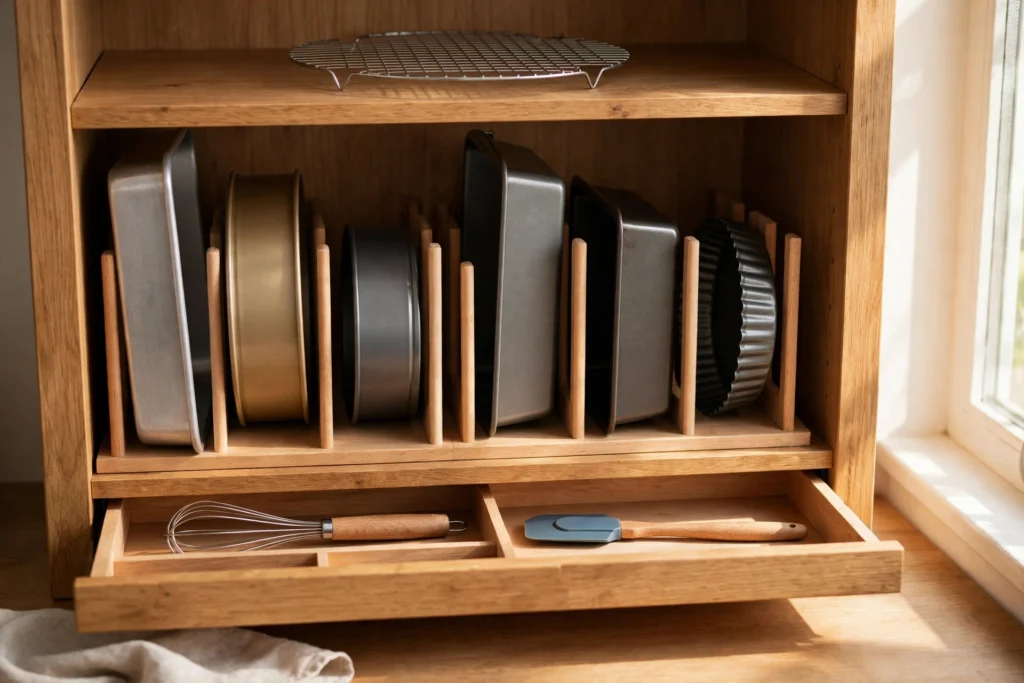
File flat pans upright, like books on a shelf, with a divider or a file holder keeping them in place.
Vertical filing beats stacking for pans, because you can pull out the sheet pan without lifting the loaf pan off it.
For the full method of storing pans and lids, see How to Organize Pots, Pans, and Lids in a Small Kitchen.
Keep the small tools together in one drawer slot, with a divider holding the whisk, spatula and bench scraper apart. For drawer layouts, see Drawer Organizers and Dividers for Small Kitchen Tools.
Store the cooling rack flat on top of the pan stack, or hang it from a hook inside a cupboard door. The oven thermometer stays inside the oven. Keep the sheet pan near the oven, since it is the pan you reach for first.
What to Look For Before You Buy
Baking tools come in every price range, and price alone tells you very little. These checks are the ones that matter most for space-saving baking tools.
Pan gauge. Heavy-gauge metal holds its shape in a hot oven; thin metal warps, and a warped pan bakes unevenly and wobbles on the shelf. Pick the pan up: a good one feels solid, not flimsy, and its rim stays straight.
Nonstick or plain. Nonstick pans release cakes cleanly but need gentle cleaning and soft utensils, or the coating wears. Plain metal pans last longer, but they need greasing or a baking mat. Choose the finish you will actually look after.
Cleaning. Baking tools collect grease and burnt sugar, so smooth surfaces and rounded corners wash fastest. A pan with a rolled rim traps crumbs underneath it, and a piping tip with a narrow bore needs a small brush.
Fit. Read the pan’s stated size and compare it with your oven and your shelf before you buy. A muffin tin that does not fit your oven is useless, and a cooling rack wider than your sheet pan will not store as one unit with it.
Common Mistakes to Avoid
Buying a full set of space-saving baking tools before you know what you bake. A ten-piece set looks like good value, but the pans you never use still take up room. Start with the sheet pan, then add one pan at a time.
Choosing the smallest pans in the shop. The smallest loaf pan looks tidy and overflows when a bread recipe rises, and the smallest sheet pan means baking biscuits in two batches. Size the pan for the recipes you cook.
Keeping a warped or rusty pan “just in case.” A warped pan bakes unevenly, and a rusty one stains food and hands. If a pan has warped or rusted, it has finished its working life — let it go.
Storing pans in the oven and forgetting they are there. Pans left in the oven get in the way of preheating, and a forgotten pan can scorch. If you store pans in the oven, take them out before you switch it on — every time.
Frequently Asked Questions
What size sheet pan fits a small oven?
A half-sheet pan, about 18 by 13 inches (46 by 33 cm), fits most standard ovens. Measure your oven’s interior width and depth before you buy, and leave a gap of an inch or two around the pan so hot air can circulate.
How do I stop my baking pans warping?
Avoid sudden temperature changes: do not run a hot pan under cold water, and let it cool on a rack before washing. Thin pans warp more easily than heavy-gauge ones, so choose space-saving baking tools in heavy-gauge metal.
Do I need a stand mixer in a small kitchen?
No — a whisk and a wooden spoon handle most home baking, and a hand mixer is far smaller if you want power. A stand mixer is heavy and earns its space only if you bake bread or large batches every week.
How should I store baked goods once they are cool?
Let bakes cool fully on a rack first, then store them in airtight containers at room temperature. Most cakes and biscuits keep for a few days this way. The FDA’s guidance on storing food safely is a useful check for food kept out in the open.
Conclusion
Baking in a small kitchen is less about owning less and more about owning on purpose. Every tool on your shelf should have a bake it serves and a home it returns to. That is the whole idea behind space-saving baking tools.
Your next step is the audit in the plan above: empty the pan shelf, sort what you own, and measure the space before you buy anything. Then build your kit around the one bake you make most often.