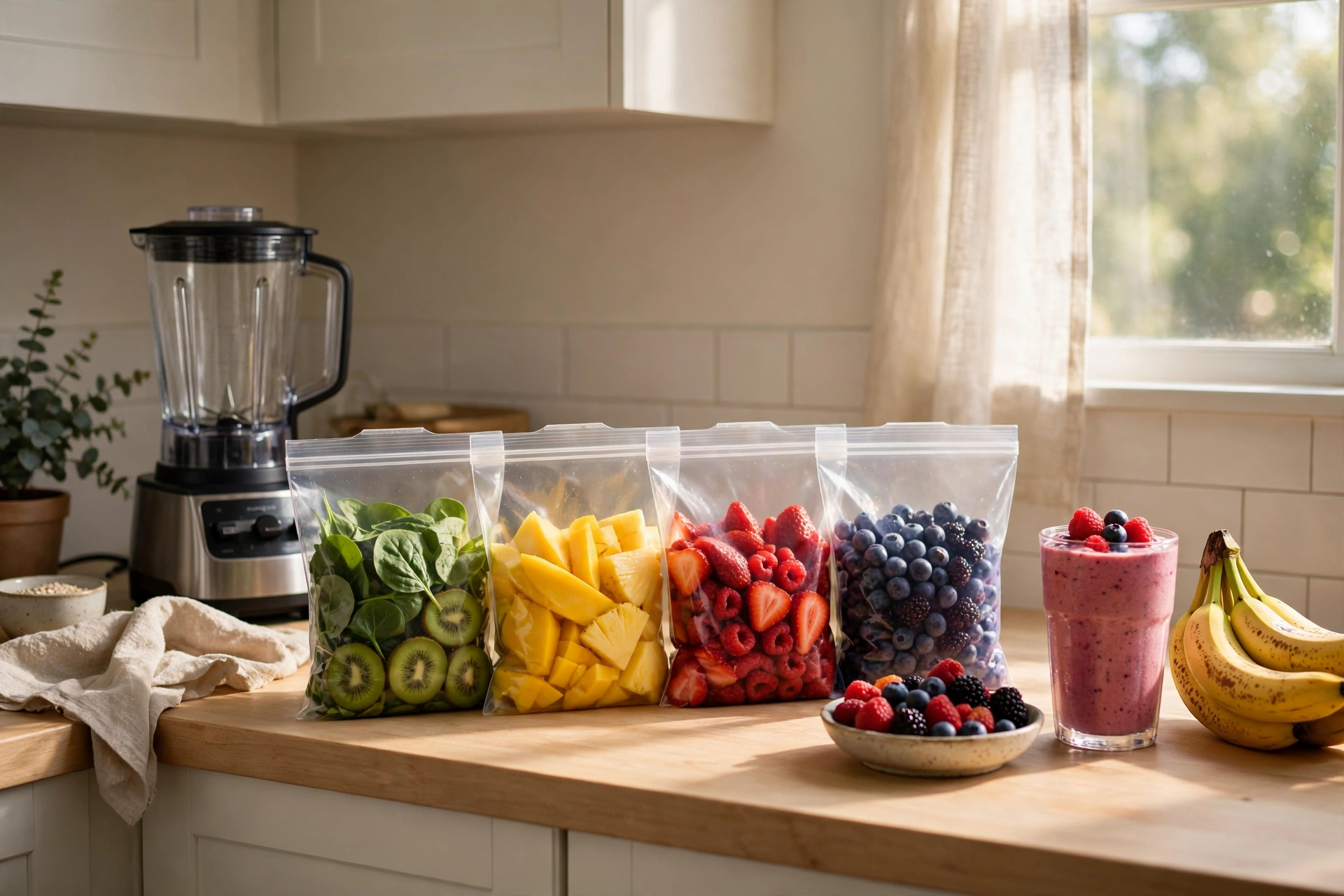
Smoothie meal prep turns a rushed morning into a two-minute job. Instead of washing fruit and peeling bananas before coffee, you open the freezer, tip one pack into the blender, and pour. This guide shows you how to set that up in a small kitchen.
You will learn three ways to prep smoothies, a simple formula, and five combinations that hold up well. You will also learn a twenty-minute weekly session and how to store packs in a tiny freezer.
Table of Contents
- What Smoothie Meal Prep Actually Means
- Why Smoothies Are the Easiest Meal to Prep Ahead
- Smoothie Meal Prep: Three Methods That Work
- Build Your Own Smoothie: A Simple Formula
- Five Smoothie Combinations That Hold Up Well
- The 20-Minute Weekly Smoothie Prep Session, Step by Step
- Storing Smoothie Packs and Blended Smoothies
- Fitting Smoothie Prep Into a Small Kitchen
- Common Mistakes to Avoid
- Frequently Asked Questions
- Start With Five Packs This Weekend
What Smoothie Meal Prep Actually Means
Smoothie meal prep means doing the chopping, measuring, and packing once, so blending takes two minutes in the morning. You prepare single-serving packs of fruit, greens, and dry extras and freeze them flat. Each pack is one smoothie, ready to blend.
It is not the same as blending a whole week of smoothies on Sunday. A blended smoothie separates and loses its fresh taste after a day or two. Prepping the ingredients, not the finished drink, is what makes this work.
The idea suits small kitchens because it needs almost nothing: a blender, a few reusable bags, and a flat patch of freezer space. No cooking, no extra pans, and no big weekly shop.
Why Smoothies Are the Easiest Meal to Prep Ahead
Smoothies skip the two things that make meal prep hard in a small kitchen: cooking and washing up. There is no stove time and no pile of pans.
They also fit a small fridge. A blended smoothie lives in a jar, and a week’s packs lie flat in a freezer drawer. You do not need a second fridge, which is why smoothie meal prep suits rented flats and shared houses.
Mornings are where the payoff shows. A smoothie is breakfast, a snack, or a light lunch, and it is ready while the kettle boils. For more make-ahead breakfast ideas, see Easy Meal Prep Ideas for Small Kitchens.
Smoothie Meal Prep: Three Methods That Work

There are three ways to do smoothie meal prep. Freezer packs are the most flexible, chilled smoothies suit the next day, and frozen cubes are best for small freezers.
Freezer packs
A freezer pack is one smoothie, portioned and frozen. Fill a small bag or container with the fruit, greens, and dry extras for one serving, press out the air, and lay it flat. In the morning, empty it into the blender, add liquid, and blend.
Flat packs stack like files, so a week’s worth takes up less room than a loaf of bread. Label each one with the flavour and the date. For the flat-freezing method in full, see Freezer Meal Prep for Small Kitchens: Planning and Storage Tips.
Blended and chilled
If you want breakfast ready to grab, blend the night before instead. Blend one or two smoothies, pour them into jars, and chill them overnight. They are best within a day, so this method suits tonight and tomorrow morning. For the night-before routine in full, see How to Meal Prep Breakfasts Ahead of Time.
A wide-mouth jar is easier to wash than a narrow bottle. Give it a good shake before drinking.
Frozen smoothie cubes
Cubes are the smallest option. Blend a big batch of smoothie base — fruit, greens, and liquid — pour it into ice cube trays, and freeze. Pop the cubes into a bag, then blend a handful with fresh liquid when you want a smoothie.
This method shines in a nearly full freezer, because cubes fill the gaps between other food. It also lets you mix flavours. The trade-off is an extra blending step, since the cubes need liquid.
Build Your Own Smoothie: A Simple Formula
A good smoothie needs five parts, and once you know them you can build one from what is in the kitchen. Use the amounts below for one serving, then adjust to taste.
Fruit, about 1 cup (150 g): this is the flavour and the sweetness. Frozen berries, mango, peaches, and banana all work. Use one fruit or mix two, and keep the total to about a cup.
Greens, a large handful: spinach is the easiest choice because it blends smooth and tastes mild. Kale works too, but remove the stems first. If you are new to green smoothies, start small and build up.
Protein or healthy fat, 1 to 2 tablespoons: this is what keeps you full until lunch. Yoghurt, peanut butter, oats, and seeds all count. Pick one per smoothie.
Liquid, about 1 cup (240 ml): milk and water are the usual choices, or yoghurt thinned with water. Add the liquid first when you blend, so the blades can move freely. Add a splash more if the smoothie is too thick.
Extras, a teaspoon or two: cocoa powder, cinnamon, vanilla extract, and honey are the common ones. Extras are optional, so skip them if the fruit is sweet enough on its own. A pinch of cinnamon can lift a plain banana smoothie.
Five Smoothie Combinations That Hold Up Well
These five combinations freeze well as packs and blend smoothly, so they are a safe place to start. Each one makes a single serving and follows the formula above.
Berry and banana: frozen mixed berries, half a banana, a handful of spinach, a spoonful of oats, and milk. This is the classic starter — sweet, pink, and hard to get wrong.
Mango and pineapple: frozen mango chunks, a few pineapple pieces, yoghurt, and water or coconut water. It tastes like a holiday breakfast and blends completely smooth.
Green apple and spinach: half a chopped apple, a large handful of spinach, yoghurt, and water. It is lighter than the fruit-heavy options and works as a mid-morning drink.
Chocolate peanut banana: a spoonful of cocoa powder, a spoonful of peanut butter, half a banana, oats, and milk. It tastes like a treat but follows the same five-part formula.
Peach and oat: frozen peach slices, a spoonful of oats, yoghurt, milk, and a pinch of cinnamon. The oats make it filling, and the cinnamon gives it a baked flavour.
The 20-Minute Weekly Smoothie Prep Session, Step by Step
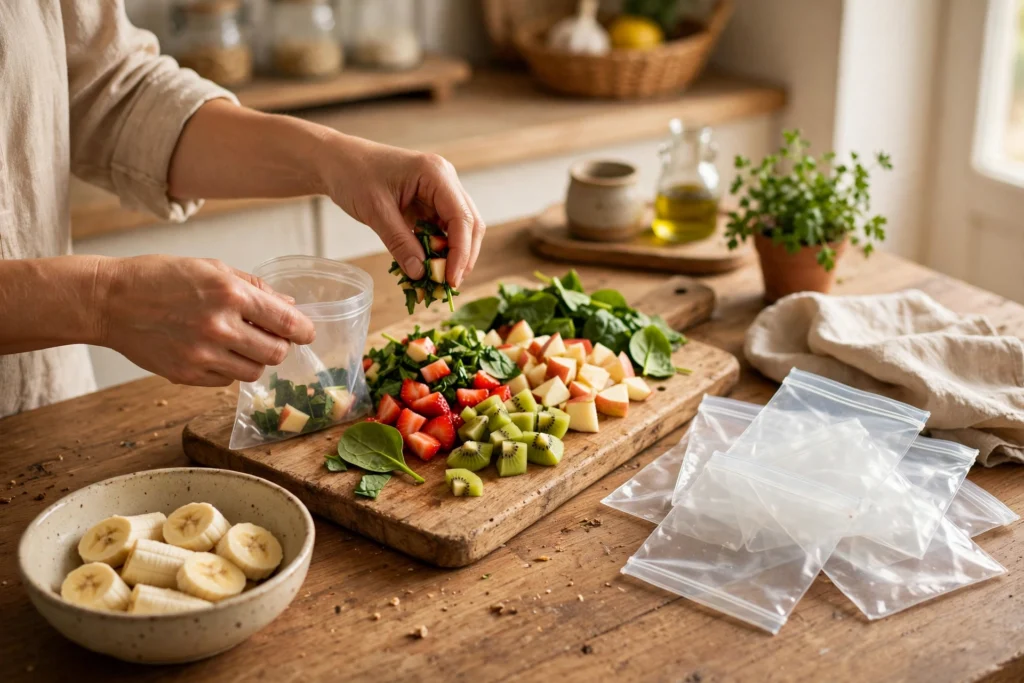
Set aside twenty minutes once a week, and the whole week’s smoothies are packed. This session is the heart of smoothie meal prep for most households.
- Decide the week’s flavours. Pick two or three combinations, usually five packs for five mornings.
- Wash the fresh fruit and greens, and chop what needs it. Peel the bananas and break them in half, and chop apples small so they blend easily.
- Portion the fruit and greens into bags or containers, one pack per smoothie. Keep each pack to a single serving so you never guess amounts in the morning.
- Add the dry extras to each pack: oats, seeds, cocoa powder, or cinnamon. Leave liquids and yoghurt out, because they belong in the blender at serving time.
- Press the air out of each bag, seal it, and write the flavour and the date on it. Lay the packs flat in the freezer.
- Wash the board, knife, and bowls straight away, and wipe the counter. A clean counter makes you want to do it again next week.
- Put the blender back in its usual spot, and check you have enough liquid for the week. For a wider weekly routine, see One-Hour Meal Prep Plan for Busy Weekdays.
Storing Smoothie Packs and Blended Smoothies
Storing is where smoothie meal prep either works or falls apart. Frozen packs keep for two to three months, but use them within a month for the best flavour. Keep them flat and stacked, oldest at the front.
A blended smoothie belongs in the fridge, in a sealed jar, and it is best within a day. Keep it cold from the moment you blend it. The same fridge rules apply as to any fresh food, and the FDA’s guide to storing food safely explains them in detail.
Greens and soft fruit go off fastest, so check them before packing. Wilted spinach and brown bananas still blend fine, but slimy leaves and mouldy fruit belong in the bin. For the full freshness rules, see How to Keep Meal Prep Ingredients Fresh Throughout the Week.
Give packs and jars one fixed spot, so nothing gets buried at the back. For the fridge system in full, see Small Fridge Organization for Meal Prep.
Fitting Smoothie Prep Into a Small Kitchen

Smoothie prep asks very little of a small kitchen: a patch of counter, a shelf in the freezer, and a home for the blender. That is the whole point of smoothie meal prep in a small space — it fits the kitchen you already have.
Store the blender where you can reach it without moving three other things. A personal blender that blends in its own cup takes up less room. Keep the packs in one freezer drawer or one stackable box, so they never spread across the freezer.
Prep on the same patch of counter every week, and clear it first. A board, a knife, and a bowl are the only tools on the surface. For counter strategies, see How to Meal Prep with Limited Counter Space.
Bags and containers need a home too. Nest the empty bags inside one container and keep the stack with the other meal prep containers. For the storage system, see How to Store Meal Prep Containers in a Small Kitchen.
Common Mistakes to Avoid
Most smoothie meal prep problems come from small habits, not bad recipes. Avoid these five and the routine stays easy. For the wider list of weekly prep mistakes, see Meal Prep Mistakes to Avoid in a Small Kitchen.
Blending a whole week of smoothies at once. Five jars made on Sunday means the last few breakfasts are already stale by midweek. Prep the packs instead, and blend fresh each morning.
Adding liquid to a freezer pack. Liquid expands as it freezes, so a bag of milk or yoghurt can split or leak. Keep liquids out of the pack and add them in the blender, where they belong.
Skipping the label. Unlabelled packs all look the same once frozen, and you will end up blending mango when you wanted berry. Five seconds with a marker saves the guesswork.
Overfilling the blender. A jar packed tight with frozen fruit cannot move, so the blades spin in one spot and the smoothie stays lumpy. Fill the jar no more than two-thirds full, and blend in two batches.
Leaving the blender unwashed. Smoothie residue dries hard within an hour, and a dried-on blender is the chore that puts people off prepping. Rinse the jar and blades straight after pouring.
Frequently Asked Questions
What if my blender struggles with frozen fruit?
Let the pack sit on the counter for five minutes, so the edges soften. Add the liquid first, then the pack, and blend in short bursts. If it still struggles, use smaller pieces of fruit.
How do I stop a smoothie turning brown before lunch?
Fill the jar to the top so little air touches the surface, and keep it cold. A squeeze of lemon juice in the blend also slows browning. Even then, a smoothie is best the same day.
Can I use the same packs for smoothie bowls?
Yes, and the only change is the liquid. Use about half the usual liquid so the blend stays thick enough to eat with a spoon. Add toppings after pouring, because toppings packed in the bag would go soggy in the freezer.
How do I share freezer space for smoothie packs in a shared kitchen?
Agree on one drawer, shelf, or stackable box that is yours, and keep every pack inside it. Label each pack with your name and the flavour, and use the oldest first. A small, bounded space is easier to respect than packs scattered across the freezer.
Start With Five Packs This Weekend
Smoothie meal prep works because it asks for twenty minutes once a week and gives back five calm mornings. Pick one combination from this guide, pack five bags, and try it for a week.
Once the routine is running, add a second flavour for variety. Your next step is simple: clear a patch of freezer space and pack your first five.